
Flâneries in Paris: Mansions of the Marais District

- SUBSCRIBE
- ALREADY SUBSCRIBED?
BECOME A BONJOUR PARIS MEMBER
Gain full access to our collection of over 5,000 articles and bring the City of Light into your life. Just 80 USD per year.
Find out why you should become a member here.
Sign in
Fill in your credentials below.
This is the 52nd in a series of walking tours highlighting the sites and stories of diverse districts of the Paris region
Incroyable! My flânerie series has passed its 50th episode and yet I still haven’t explored the gothic gems and 17th-century hôtels particuliers of the Marais district. To put that right I took the metro to Pont Marie on Line 1 and set off up a road whose name took me straight back to the medieval era, a time when Benedictine nuns from Yerres, just a few miles southeast of Paris, bought a property here in the 12th century.
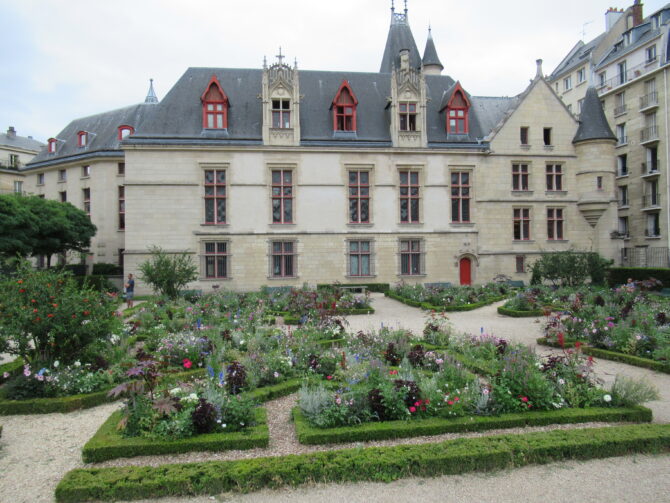
Hotel de Sens. Photo: Marian Jones
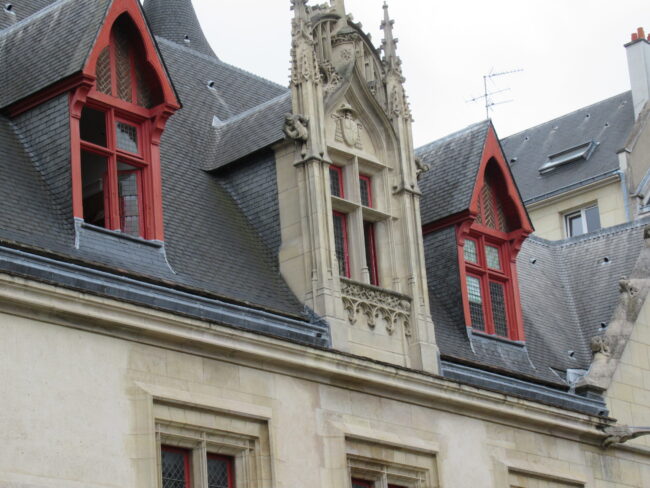
Peel back a linguistic layer or two and the road name – Rue des Nonnains d’Hyères – combines an old word for nuns with a corruption of Yerres. You could pass along it without knowing this, but you couldn’t miss the flamboyant Hôtel de Sens, a lattice-windowed beauty set in exquisite gardens. Its cream walls and slate grey roof, its turrets and gables all hint at a fairytale castle whose watch-towers offer security should a witch or an evil queen come prowling. A side gate allows access to the gardens, allowing me to wander the geometrical beds and clipped hedges, pondering the site’s colorful past.
This beautiful building was ordered in the early 16th century by the Archbishop of Sens who was eager to extend his influence to Paris and the royal court. It has a much racier history too, as the place where Marguerite de Valois partied away the 50,000 francs annual settlement she received on the annulment of her marriage to Henri IV. Plays, feasts and what French sources call soirees de débauche followed, as did a scandalous execution after one of her lovers murdered another in a jealous rage. Queen Margot watched from the window as the unfortunate Comte de Vermont was beheaded in the street below.
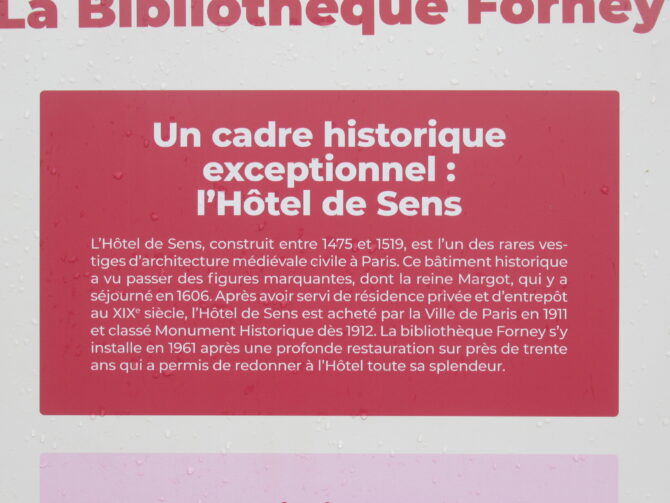


I went round to the back of the building, knowing it houses a library and wondering whether I could get inside. My curiosity was rewarded by a stunning courtyard, but disappointment followed: the library was not open to visitors, a website address “for the curious” led nowhere and the galérie des expositions was “fermé aujourd’hui.” I wasn’t going to see any of the many thousands of the books and display items relating to the decorative arts after all. If I wanted to peruse their antique wallpaper collection, 18th-century fabric samples and Art Nouveau posters, I would have to try again another day. As I was enticed by the mullioned windows looking out over the courtyard and the glimpses of stone staircases winding up inside, I will surely return.
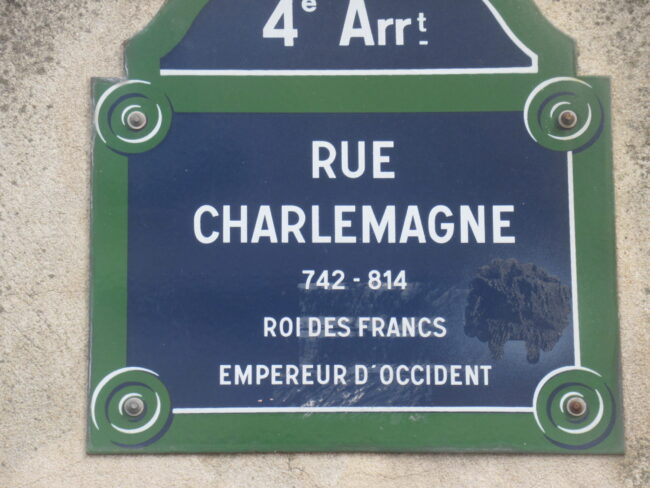
Rue Charlemagne street sign. Photo: Marian Jones
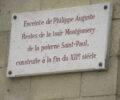
The street sign for Rue Charlemagne reminded me that this towering figure, who died in 814, was both “King of the Franks” and “Emperor of the West,” the man whose coronation by the pope meant the start of the Holy Roman Empire, which lasted for a thousand years. The 12th century king Philippe Auguste has left his mark here too, for jammed in next to a school sat the remains of the Tour Montgomery, part of the wall he built to protect Paris while he went off on a crusade to the Holy Land. Today, young women in hijabs chatted amicably next to the ancient remains, just underneath the sign explaining that this was once a gateway into the newly walled city.
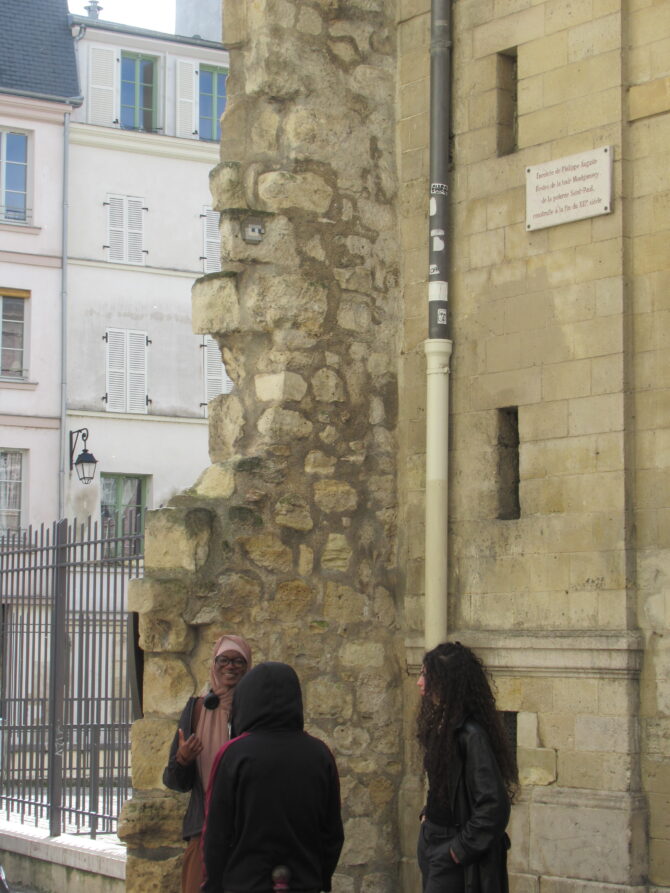
More juxtapositions followed, for this little corner of Paris combines the ancient with the trendy. In Rue Neuve which, like the Pont Neuf, is many centuries older than its name suggests, I passed a restaurant called La Cerise sur la Pizza (The Cherry on the Pizza), just on the corner where the medieval Saint Paul-des-Champs church had been destroyed in the revolution. Crossing the Rue Saint-Antoine, whose origins go back to Roman times, I passed a little shop crammed with Breton sweaters. Round the corner at the Comptoir des Mers fish restaurant, the chalked blackboard offered St Jacques scallops from Trouville and “large snails from Burgundy.”
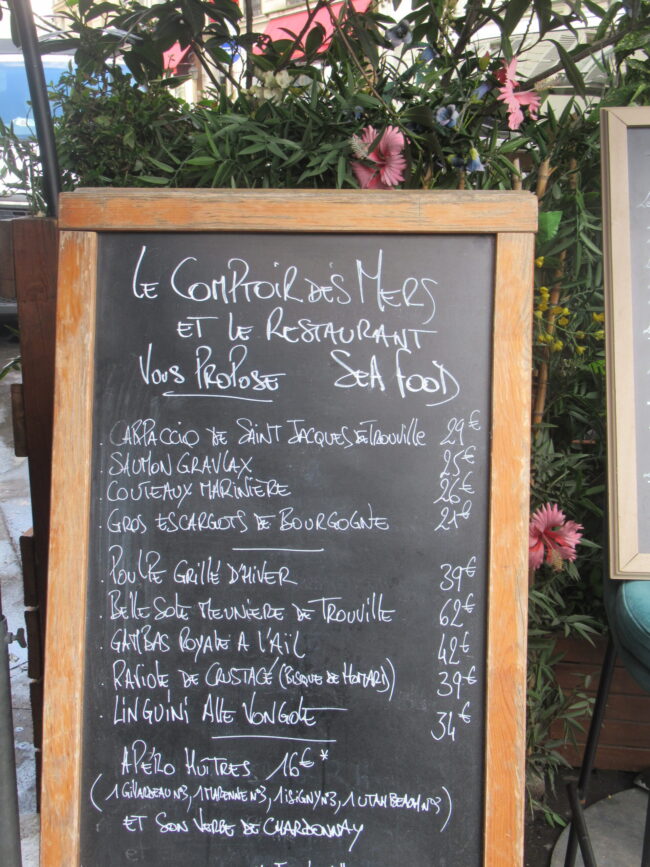
The chalkboard menu at Comptoir des Mers. Photo: Marian Jones
The long Rue des Francs Bourgeois teems with history. Its name dates back to its charitable origins in the 15th century when it housed those too poor to pay any taxes, but the hotels particuliers set along it like jewels in a necklace date from a couple of centuries later when aristocrats flocked there. Their grand mansions are often mysterious, their carriage entrances leading off the street into hidden courtyards and secluded gardens. There’s also a third layer to the street, the bustling commercial activity of today’s boutiques and galleries where the quirky and the sophisticated mingle. It’s still, as Madame de Sévigné described it in the 17th century, un beau quartier.
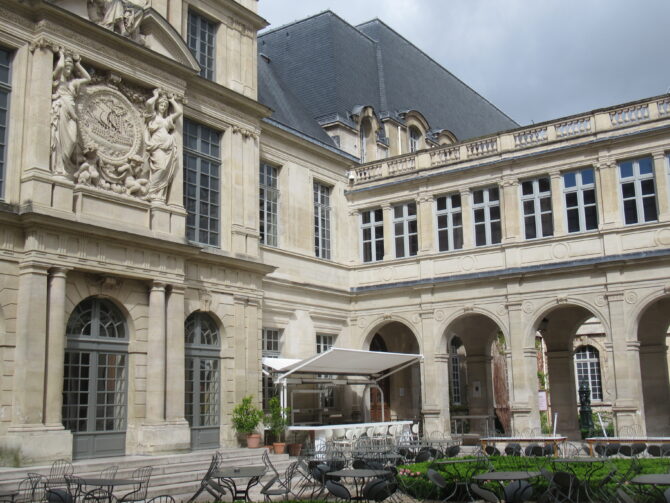

Her former lodgings are in one of the grandest buildings on the street and open to the public because they house the Musée Carnavalet. Its back entrance, behind elaborate black and gold entrance gates, reveals a restaurant – Joli – where you can sit outside to admire the manicured lawns and the arched walkways leading through to the inner courtyard. Just opposite is the Hôtel Lamoignan whose gardens are open to the public so you can get a closer look at the residence begun in the 1590s and once home to the writer Alphones Daudet. The main entrance, round the corner in Rue Pavée, would take you into the Bibliotheque Historique de la Ville de Paris, also open to all.
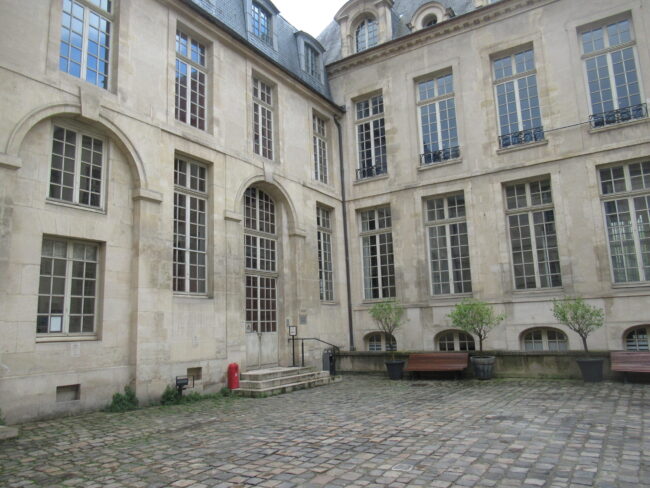
Hotel d’Albret. Photo: Marian Jones
The nearby Hôtel d’Albret is not open to the public, but a delivery was in progress as I passed, meaning I did manage to glimpse inside its elegant courtyard. The information board outside hinted at past scandals, explaining it was once a “hub for aristocratic social life” in Paris where Mesdames Montespan and Maintenon, described as “both favorites of Louis XIV,” are said to have “crossed paths.” I was picturing jealous spats, which there may well have been, but research also revealed a pious side to both women, one eventually becoming mother superior in a convent and the other founding a school for poor girls.
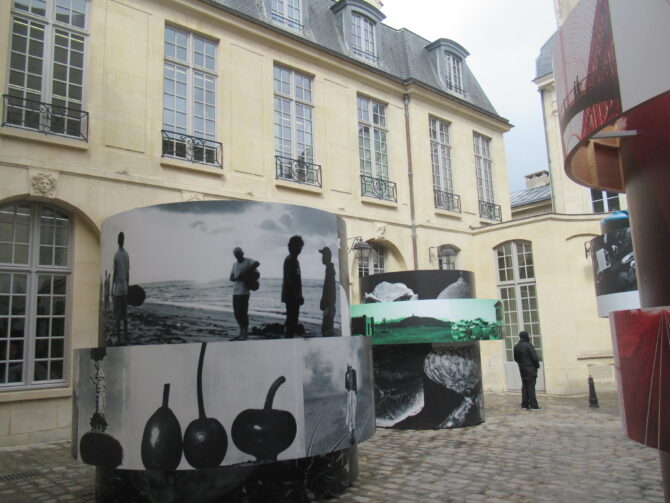
Another courtyard on the left was open, giving access to Comme des Garçons who had installed an exhibition of arty photos to attract the curious towards its entrance: silhouettes on a beach, collections of mystery objects, a single color picture of a landscape. Just across the road I was pulled straight back to the Middle Ages by a brown oar sign demystifying the strangely named dead-end called the Impasse des Arbalétriers. Here, I discovered with the help of a dictionary, crossbowmen used to train. It was also the scene of a grisly assassination when Jean-Sans-Peur had his cousin murdered by spadassins, wonderfully translated by Google as “swashbucklers.”
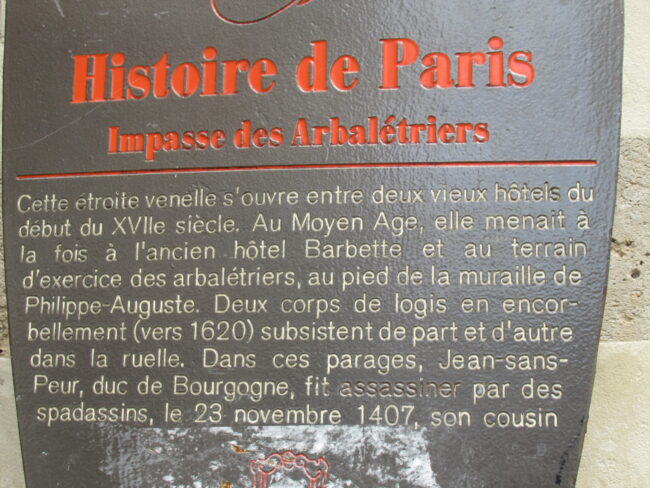
Impasse des Arbalétriers. Photo: Marian Jones
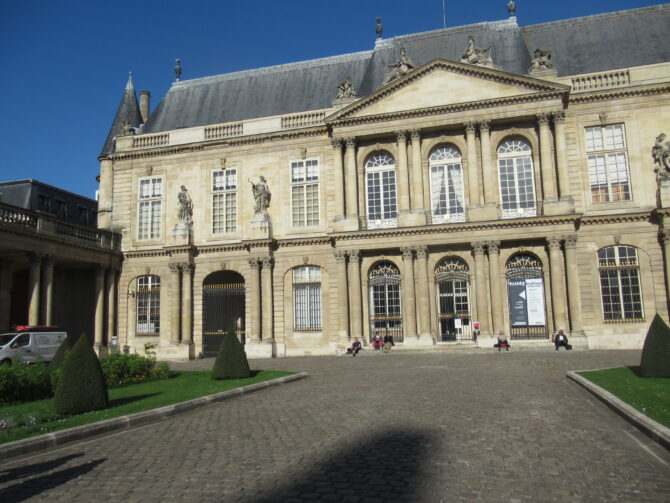
The Archives Nationales, also open to the public, is on the site of two former hotels particuliers, grand houses which once belonged to the Rohan and Soubise families. I’d been inside recently to see the exhibition on Napoleon’s will, so this time I rounded the corner into Rue des Archives to admire the magnificent turreted towers built by an earlier wealthy family, the Clissons. When I looked them up, I found gore and glory. Olivier de Clisson, says a national archives document, was “brave and cruel,” known by his enemies as “the butcher.” It rather took the edge off the romantic towers where I’d been imagining medieval banquets and evenings devoted to courtly romance.


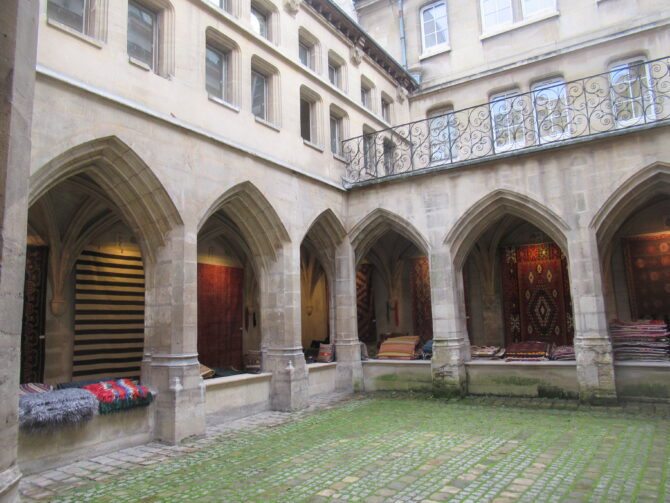
I had one last goal. Rue des Archives is also home to the Clôitre des Billettes, said to be the only remaining medieval cloister in Paris. It’s usually closed, but I can’t resist a cloister, so I resolved to make do with a glimpse of the outside. To my delight, it was unexpectedly open, the venue for a temporary sale of kilims. So, I was able to wander the stone courtyard, built by monks who ran a hospital there from the 13th century. I could imagine them among the sturdy pillars and arched openings of each walkway, hurrying to vespers perhaps or tending to the sick. Did they keep silence, I wondered, or would I perhaps have heard chants or the singing of psalms?

My route to the nearby Rambuteau metro station took me along more roads with resonant names, conjuring up images from the distant past. Rue de la Sainte Croix de Bretonnerie mixes the religious and the Breton, while white-robed monks must surely have scurried up and down the Rue des Blancs Manteaux. Rue du Renard, I discovered, used to be called, “The road of the preaching fox” after a sign which hung there in medieval times. Many streets and much history has disappeared from the Marais, but how amazing it is that so much is still there to be noticed if you just stay curious!
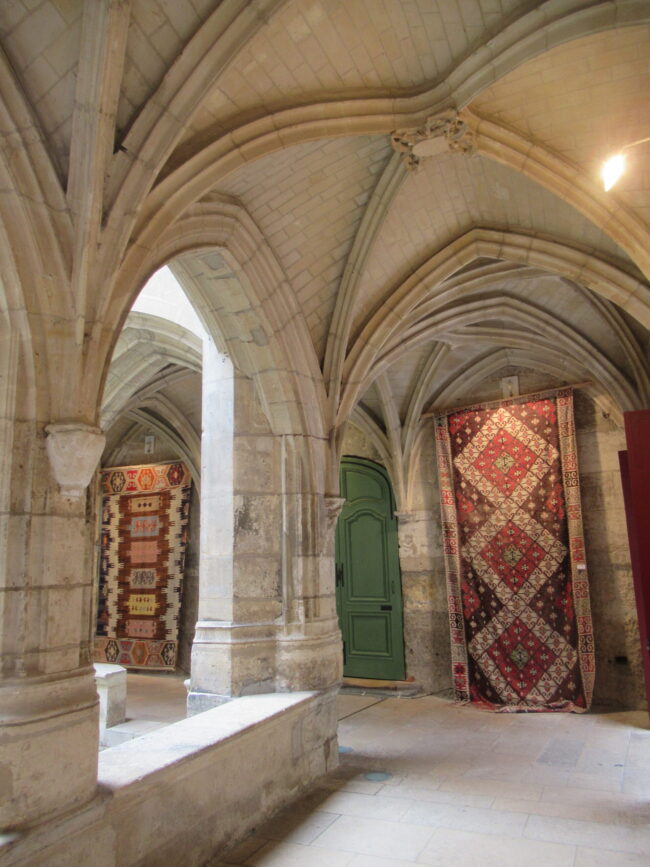
Clôitre des Billettes. Photo: Marian Jones
Lead photo credit : Hotel de Sens. Photo: Marian Jones
More in Carnavalet, Flâneries in Paris, hôtels particuliers, Marais
Related Articles

By Marian Jones