
Why You Shouldn’t Miss the National Archives in the Marais

- SUBSCRIBE
- ALREADY SUBSCRIBED?
BECOME A BONJOUR PARIS MEMBER
Gain full access to our collection of over 5,000 articles and bring the City of Light into your life. Just 80 USD per year.
Find out why you should become a member here.
Sign in
Fill in your credentials below.
Perhaps you’re feeling a little foot-sore while exploring the Marais district and would like to sit quietly in a beautiful garden for a moment? Maybe you’d grab the chance of free entry to one of the baroque hôtels particuliers which line the Rue des Francs Bourgeois? Or, if you are a history buff, wouldn’t you seize the chance to peruse some of France’s most precious historical documents in a site sometimes referred to as “France’s memory”? Amazingly, you can fulfill all these wishes at the National Archives. It’s just a short walk from such popular sites as the Picasso Museum and, being close to where the 3rd and 4th arrondissements meet, it makes the classiest of pit stops for anyone exploring the area’s shops and cafes.
In the early 1700s, two grand buildings, the Hôtel de Soubise and the Hôtel de Rohan, were built in Rue des Francs Bourgeois, and in 1808 Napoleon chose this site to house the growing collection of important national documents. Today the building is a showcase for the National Archives, overseen by the Ministry of Culture, and while much of its ever-expanding collection is stored elsewhere, there are always examples of its treasures on public display here. Given the wealth of material they look after, much of it dating back many centuries, there are always fascinating things to look at and, even better, entry is free.
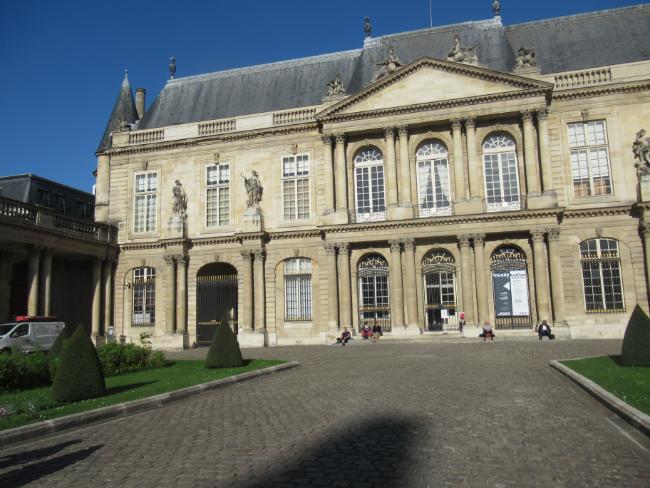
National Archives in the Marais district. Photo: Marian Jones
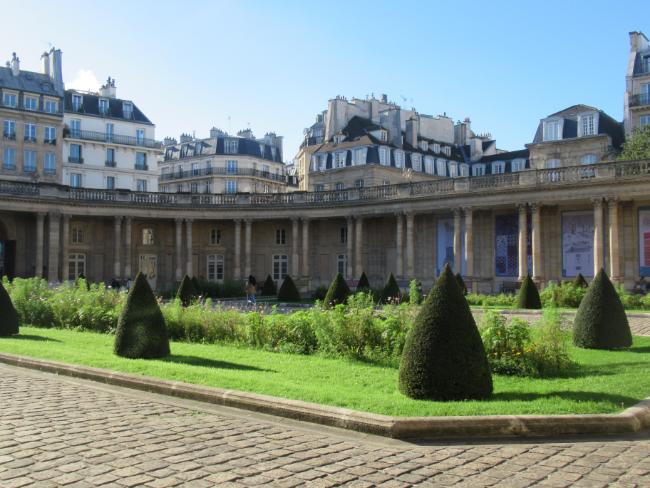
The building and grounds are worth exploring. Maybe you’ll opt to just sit for a while in the stunning garden in front of the house. You can admire the geometric patchwork of neat lawns and perfect topiary from benched seating which lines both sides under the shade of a stone canopy. Perfect on a hot day or indeed during an unexpected shower! You will surely take a picture or two of the main building’s stately façade and then inside you can wander a number of high-ceilinged rooms, such as the Prince de Soubise’s antechamber, still decorated in rococo style. Look around to admire gilt and crystal, look up so as not to miss the ceiling frescos, some by the 18th-century artist François Boucher.
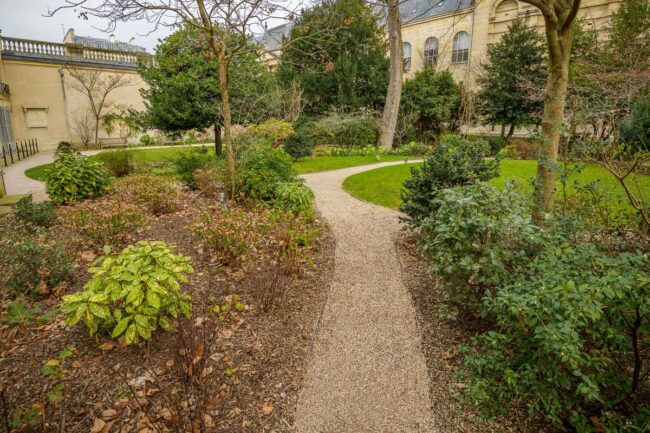
Jardin des Archives Nationales. Photo: Frédéric Combeau/ Ville de Paris
Items from the permanent collection, rotated every few months, are always on display. The first thing I saw as I entered the main display room was the Constitution of the Fifth Republic, the document laying out exactly how today’s France is governed. The archives stretch far back into the past, so you might see testaments to such key moments in history as the founding of the Sainte Chapelle or the events of the French Revolution. Perhaps you’ll be able to read the thoughts of long dead major figures: a journal kept by Louis XV, correspondence between Louis IX and King Henry III of England, or the last letter ever written by Marie-Antoinette the night before her execution.
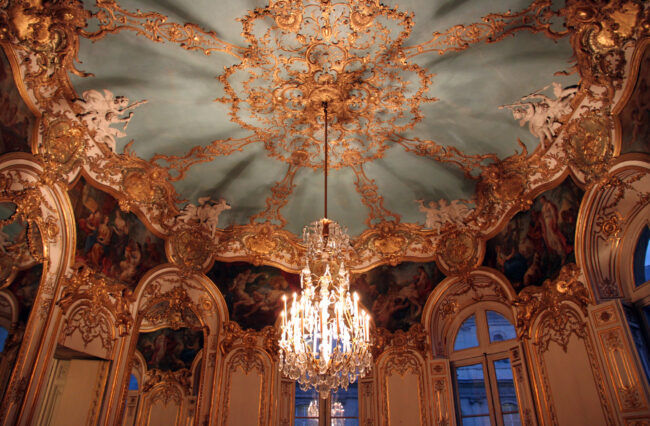
Salon ovale de la princesse in the Hôtel de Soubise. Photo: NonOmnisMoriar / Wikimedia commons
There is often also a temporary exhibition, drawing on material held in the archives. Since 2023, a series known as Remarquables has been running, covering topics voted for by the public. Last year’s Jeanne d’Arc, le premier portrait, centered around the only contemporary drawing of Joan of Arc in existence. During the Paris Olympics the emphasis was on items telling the story of the two previous Olympics held in the city in 1900 and 1924 and other themes have included Victor Hugo’s will and the speech to rally his beleaguered nation given by Général De Gaulle on June 18th, 1940. Each time, the context and significance of the key documents is explained through text, realia, sound and film.
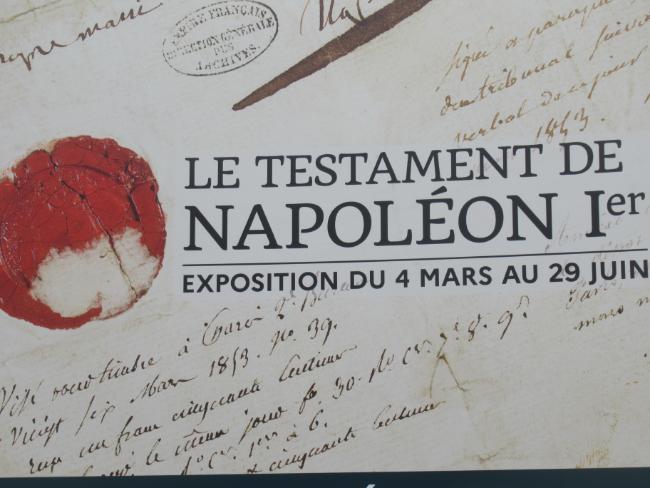
Napoleon’s last testament exhibit at the National Archives. Photo: Marian Jones
Currently, a temporary exhibition covers the fascinating subject of Napoleon’s last will and testament. Until June 29th you can see selected pages from the historic document he wrote in the last weeks of his life while in exile on St Helena. It’s explained that it was only in the spring of 1821 that news of his sister Eliza’s death and his own failing health made him face reality and formalize his final wishes. To read the decisions he made at this late stage is to understand a little more the mind of a man who had wielded such power. But to examine his shaky signature is to realize he was now weak and fading away.
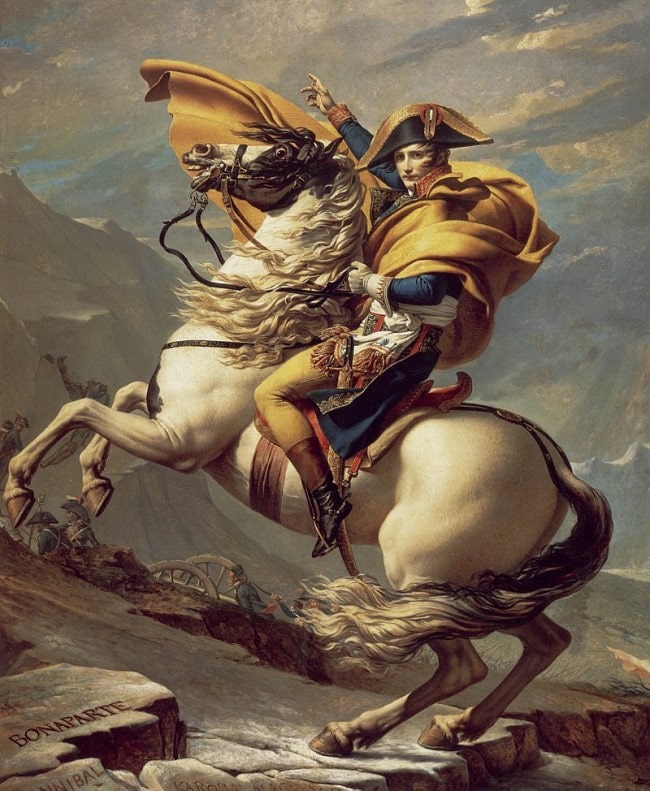
Portrait of Napoleon Bonaparte crossing the Alps, by Jacques-Louis David. Louvre.
Information at the exhibition explains that after Napoleon died on May 5th that year, his will was taken to England and it only arrived in France a generation later. Napoleon’s nephew, Napoleon III, decided it should be added to the national archives and it has been conserved ever since in the armoire de fer (iron chest) reserved for the nation’s most important documents. A selection of original pages from the will is displayed in glass cases and the accompanying explanatory material includes significant quotations, pictures and a short film.
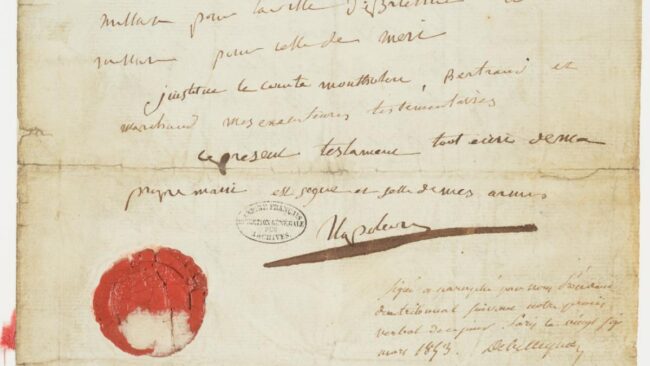
Napoleon’s will, 5th page, 15 April 1821. credit: Archives Nationales
The opening words on the first page will surely send a shiver down your spine: “On this, the 15th day of April, 1821, at Longwood on the Island of St Helena, here is my will and the expression of my last wishes …” Napoleon goes on to confirm that he is dying in the catholic faith (la religion apostolique et romaine) and then writes the memorable words which are inscribed over the entrance to the crypt containing his tomb at the Invalides: “I wish my ashes to be buried on the banks of the Seine, among the French people whom I have so loved.” It’s stirring stuff, is it not?
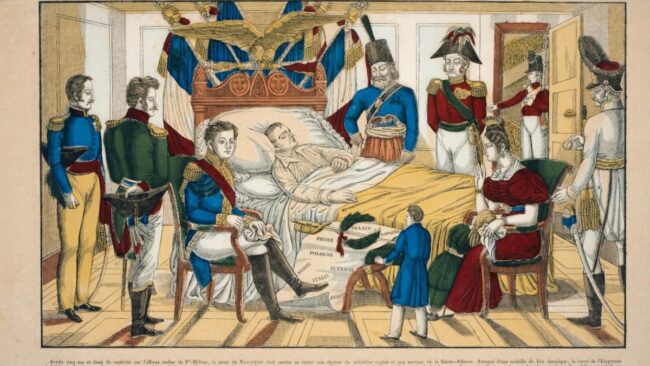
Mort de Napoleon le Grand, gravure par Georgin. Credit: Archives Nationales
Later pages convey his thoughts on the past and his hopes for the future. He thanks his mother and all his brothers and sisters, name by name, pausing to forgive his brother Louis for libeling him in a document “full of false assertions.” He leaves money to those who have served him well (les fidèles serviteurs). He writes of his hopes for his only legitimate son, Napoleon François Joseph Charles Bonaparte, born 10 years earlier, and bequeaths him his sword from the battle of Austerlitz. He hopes that his son will one day regain the French throne and rule according to his father’s motto, “tout pour le peuple français” (“everything for the French people”). Napoleon would never know that his son would die at the age of only 32.
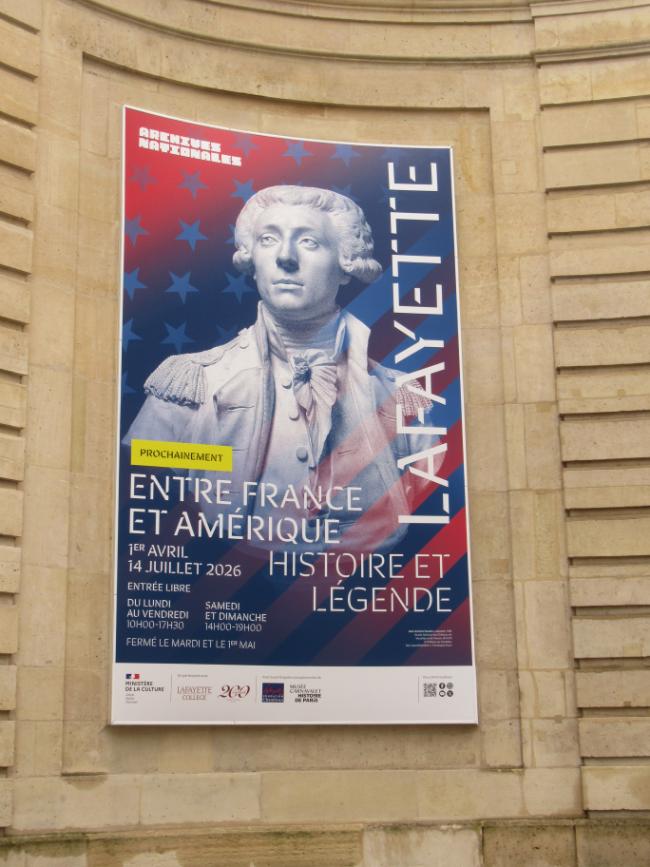
Lafayette exhibit at the National Archives. Photo: Marian Jones
A second exhibition, running until July 14th, will mark the 250th anniversary of the Declaration of American Independence. Lafayette between France and America is jointly organized by the National Archives and the Lafayette College in Pennsylvania, and is dedicated to the man who “formed a bridge” between France and the United States. It highlights the life of the man who was un héros in both countries through more than a hundred items, including portraits, prints and documents, for example letters between Lafayette and George Washington and an early draft of the Declaration of the Rights of Man.
The twin aims of the National Archives are to safeguard the huge and ever-growing collection of nationally important documents and to make them freely available to the public. They do the latter through regular changes in the permanent display and by offering a range of temporary exhibitions, some linked to topics the public have requested, such as Napoleon’s will and others, like the Lafayette event, which unveil key documents from the past at a moment when they have particular significance.
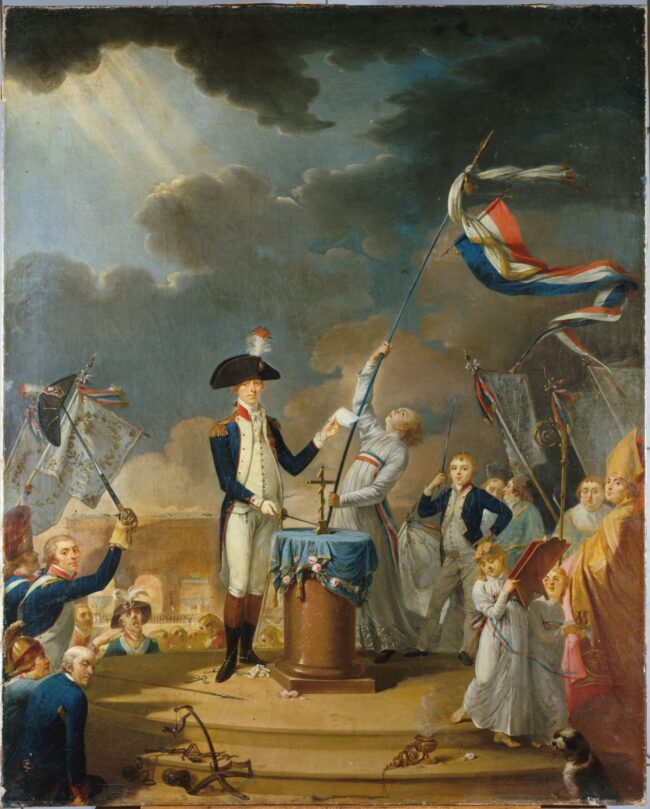
L. David, Le Serment de Lafayette a la fete de la Federation, 1791. Musee Carnavalet
The Archives are a must-visit for history fans, who should pop in every so often to discover what’s newly on display since their last visit. But really, it should be on everyone’s to-do list when visiting the Marais because it’s an excellent way to go behind the scenes in one of the area’s hôtels particuliers, most of which are not open to the public. Also, you never know when you might be in need of a beautiful garden to relax in while you take a breather from all the other pleasures this popular area of Paris has to offer!
DETAILS
Archives Nationales
60, Rue des Francs-Bourgeois, 3rd
Entry is free
Open Monday, Wednesday, Thursday, Friday 10 am – 5:30 pm
Saturday, Sunday 2 pm – 5:30 pm
Nearest Metro stops: Hôtel de Ville (Line 1), Rambuteau (Line 11), Arts et Métiers (Line 3).
For more information on the exhibition on Napoleon’s will click here.
It ends on June 29th, 2026.
For more information on the exhibition on Lafayette click here.
It ends on July 14th, 2026.
Lead photo credit : National Archives in the Marais district. Photo: Marian Jones
More in hotel particulier, Lafayette, Marais, Napoleon
Related Articles


By Marian Jones