
The Essential Guide to the 3rd Arrondissement
- SUBSCRIBE
- ALREADY SUBSCRIBED?
BECOME A BONJOUR PARIS MEMBER
Gain full access to our collection of over 5,000 articles and bring the City of Light into your life. Just 80 USD per year.
Find out why you should become a member here.
Sign in
Fill in your credentials below.
Paris’s second-smallest arrondissement, the Haut Marais is a perfect fusion of the chichi Marais proper, found immediately south, and the more edgily-cool 11th, sprawling east from Place de la République. And although well stocked with trendy cocktail bars, classy galleries and oh-so-bobo boutiques, le troisième nonetheless remains unpretentious and easy-going. There’s ample culture to investigate too, along a tempting tangle of historic streets — half-timbered houses here; ex-factories there — conspicuously lacking in Haussmann façades.
Things to See and Do
The quartier has two headline museums. Housed in a saintly, 17th-century mansion, Musée National Picasso-Paris is compact yet crammed with wonder; galleries expertly document the Spanish maverick’s artistic evolution alongside a temporary exhibit or two. Fifteen minutes’ walk away, the steampunkier Musée des Arts et Métiers tracks scientific and technological innovations through time. Among its wacky highlights are Foucault’s original pendulum, artifacts from the Statue of Liberty’s creation, and an array of early planes.
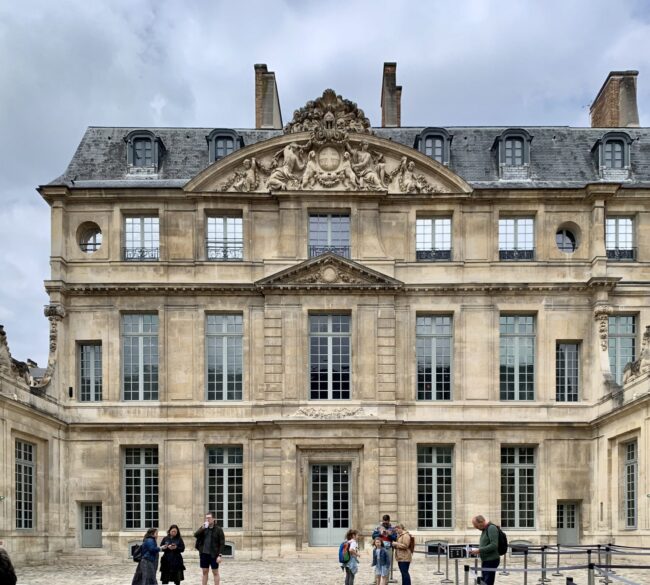
Picasso Museum, Paris, main entrance. Photo: Neoclassicism Enthusiast / Wikimedia commons
Now for an impressive undercard. The free-to-enter Musée Carnavalet recounts Paris’ history from its Roman origins to World War II via a slipper supposedly belonging to Marie-Antoinette while the Musée de la Chasse et de Nature majors in taxidermy, the Foundation Henri Cartier-Bresson hosts photography shows, and the Museum of Jewish Art & History does what it says on the tin.
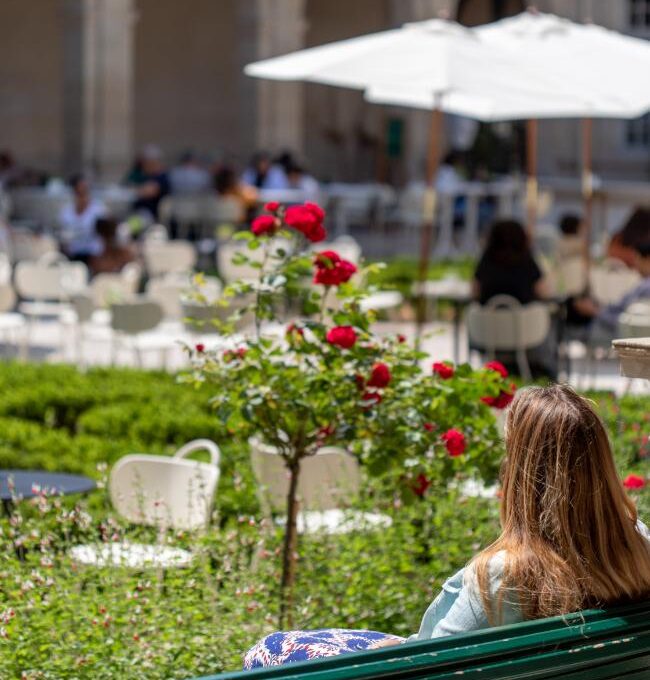
Jardins du Musée Carnavalet – Histoire de Paris. Photo: Sophie Robichon
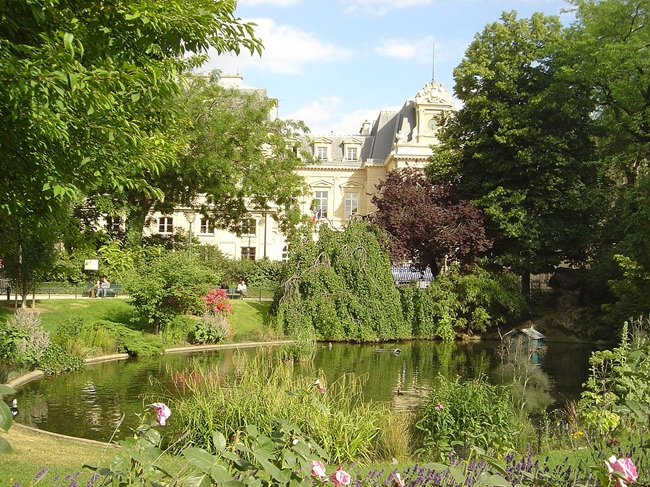
You might also find a pop-up exhibition at the Carreau du Temple, a covered market turned iron-and-glass event space which hosts everything from food trucks to Hermès expositions. The Square du Temple’s botanical plants and duck pond are steps away, yet seclusion is likelier at the more hidden Jardin Anne Frank. Hemmed in by buildings, this small community garden features a memorial to its namesake alongside an orchard.
Art fans will find galleries galore, especially along Rue de Turenne, often in former shops. On Thursday evenings, glass-clinking vernissages seem to be occurring on every street. If romanticism is your bag, aim also to enter the church of Saint-Denys-du-Saint-Sacrement; awaiting in its chapel is Eugène Delacroix’s large, impassioned La Pietà mural.
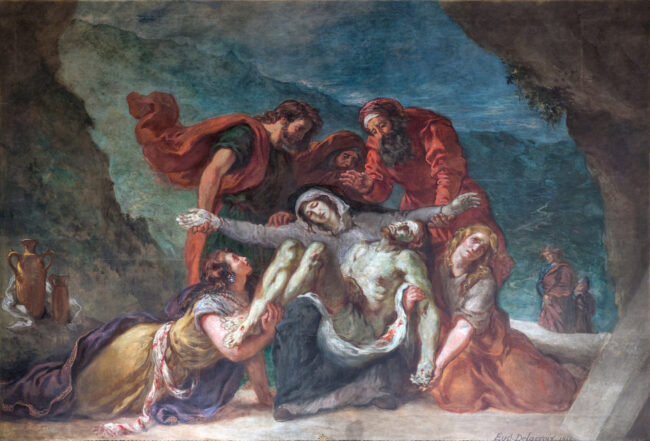
La Pietà, 1842-1844, Eugène Delacroix. Photo: Romainbehar / Wikimedia commons
Places to Eat
Let’s start, as most days ought to, with coffee. Some of Paris’s premier third-wave coffee shops are found in these parts; our votes go to Boot Café, on a quiet street behind its vintage, Insta-ripe “Cordonnerie” shop sign; Fringe, for its rotating photo exhibits and godly cinnamon buns; and laptop-friendly Éclat, because of a stellar chai lattes.
What about the best restaurants? Representing the old school are Bouillon République, a bargain-priced, two-floor temple to 19th-century Paris where onion soup, bœuf bourguignon and profiteroles rule the roost; the bistro Robert et Louise, whose archetypal French fare is salubriously served amid red gingham curtains, hanging copper pans and general, time-trapped clutter; and the divisive Chez l’Ami Louis, loved by the Beckhams but eviscerated by AA Gill.
Taking a more modern approach is Parcelles, an elegant neo-bistro applying French methods to Italian cuisine, plus the Michelin-starred Datil, in which Manon Fleury’s mostly-female team let greens take center stage amid such funky mash-ups as rice porridge with rainbow radishes and strawberries; and, unexpectedly, Auberge Nicolas Flamel. Here, inside a house built in 1407, meticulous tasting menus from the feted chef Alan Geaam champion contemporary French cooking.
The Carreau du Temple’s traders might be long gone, but Marché des Enfants Rouges has been reborn. Named after the red-clad orphans who once lived here, Paris’s oldest covered market hosts stalls specializing in the cuisines of Japan, Lebanon, Morocco and more. Its biggest draw is Les Enfants du Marché, a no-reservations counter-only spot known for ambitious seafood dishes and dependable charcuterie.
Keener on some comfort food? You’ll be needing the same market’s Butcher of Paris for a quality croque monsieur, or BigLove should brunch, pancakes or pizzas be needed.

Vegetables at the Marché des Enfants Rouges. Photo: Mx. Granger/ Wikimedia commons
Shopping
From the eco-friendly, big-in-Japan stationers Papier Tigre — their premises marked out by a giant blue pencil — and Empreintes’ four storeys of fine tableware, ornaments or furniture to Pierre Hermé’s futuristic pastry shop, Poilâne’s sourdough breads, and the shop-cum-salon of top chocolatier Jacques Genin (his hot chocs are a winter must), the Haut Marais hardly lacks for destination shops.
It has two true specialities, however. The first, anchored on Rue de Turenne, is fashion. Independent boutiques abound, led by Carel — the ultimate It Girl brand whose 60s-inspired boots and loafers have long gone global — and its bold new flagship shoeshop. Vintage is another staple, epitomized by the ‘90s-living Nuovo, with its famously dapper staff and disciples such as Lily-Rose Depp and Rosalía. Equally modish is La Boutique de Cara, a consignment store that sells goods by Chanel, Celine, Chloé and more.
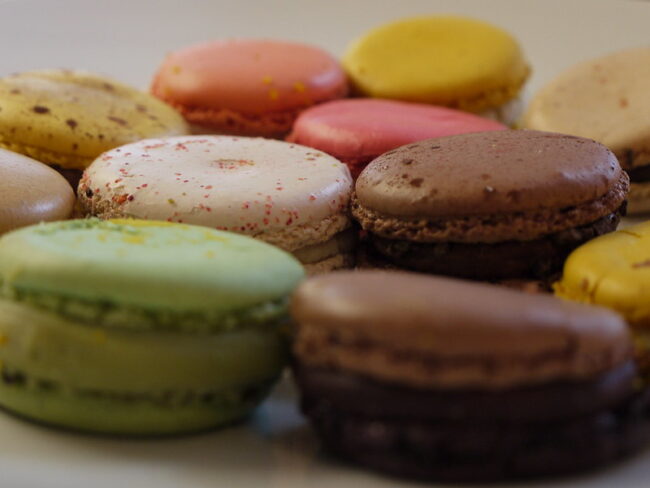
Pierre Hermé macarons. Photo credit: Tristan Ferne / Flickr
Artisanal jewelry is big here, too. Jonas Bowman is based on Rue Charlot while Fanny Boucher sells her unique, high-demand and reliably cheeky — the Boob Ring is especially popular — creations at Bangla Begum, a boutique cheerfully decked out in flea market finds.
But the troisième’s first love — or rather, its first love following a mid-2000s metamorphosis — is concept stores. Run by four fashion-loving friends, Kis (aka Keep It Secret) is the latest, combining coffee with Americana-influenced vintagewear. A similar formula, but also assimilating a bookstore, characterizes The Broken Arm, which pushes up-and-coming designers alongside Rick Owens sunglasses. But there’s no doubting the daddy. This area only really became ascendant when Merci transformed an old wallpaper factory in 2009. Across a trio of loft-sized floors, this is an emporium hawking homeware, art, clothing, candles, Assouline travel books and on and on.
Bars & Nightlife
Although the Haut Marais scores well for wine — particularly Le Barav, a popular bar and wine shop next to the steak-tastic L’Aller Retour restaurant — and beer (Kilomètre Zéro is a combined microbrewery and bar), this is cocktail country at heart.
There’s no end of highly-respected options. The relocated, two-level Bar Nouveau plays on classic concoctions amid decor recalling the 1700s. Half-restaurant and half-DJ-soundtracked bar, moody Mesures advocates Asian flavors. There’s no menu at all at the baby-pink Bisou; instead, you give its bartenders a vague prompt like “I like fruity drinks” and they’ll wizard up something near-unique.
Don’t discount hotel bars, either. Inside Les Bains, a Belle Époque bathhouse turned legendary ’80s club turned luxury hotel, the burgundy-toned Le Roxo is a buzzy den accompanied by two leafy patios, while anyone sat at the Hôtel National des Arts et Métiers’ sexy Herbarium is advised to ignore its extensive whisky selection and order a sumptuous Sud Sud Sud — cognac, mandarin and pear-and-bergamot marmalade.
Close by is possibly the planet’s least-secret speakeasy. At the rear of its namesake Mexican joint, through a supposed kitchen door (ahem), low-lit Candelaria zeroes in on agave-anchored potions. Comfy banquettes are available, as are tacos to line stomachs. Another supposedly hidden bar in the 3rd range is diminutive Bar Sotto, tucked below and behind the well-regarded Italian restaurant Carboni’s, and rightly famed for its martinis. Then there’s the New York-vibed Little Red Door, an unmarked den whose long queues are explained by its now being run by Hugo and Hyacinthe from the nearby Cambridge Public House — which, despite doing an excellent English pub impression via its beers, cozy wood paneling, sausage rolls and stuffed animal heads, also serves impeccable cocktails.
Lead photo credit : The Square du Temple, in front of the 3rd arrondissement city hall in Paris. Photo: David Monniaux/ Wikimedia Commons
More in Haut Marais
Related Articles

REPLY