
Fine Dining in Paris at the Auberge Nicolas Flamel
Nicolas Flamel is quite an enigma. I don’t mean the man himself, although the puzzle surrounding him goes back centuries and may never be solved. I mean the restaurant. The only word I can find to describe the contrast between the building’s medieval exterior and the ultra-modern culinary innovations served inside is discombobulating. I’d go so far as to say that my visit to this restaurant was one of the most fascinating experiences I’ve ever enjoyed. Let me explain.
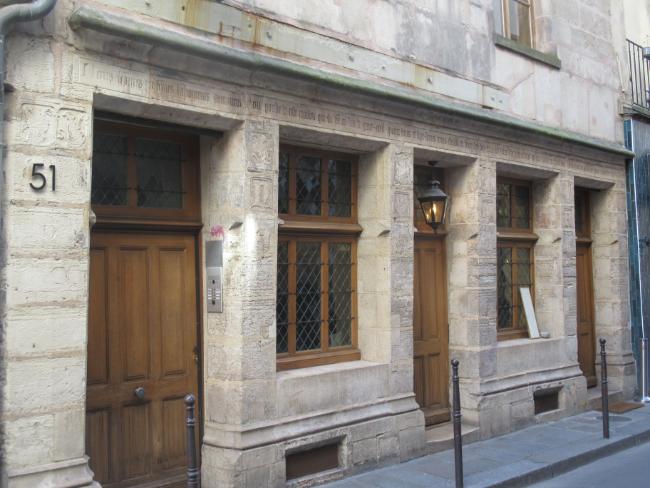
It all began near the Pompidou Centre, when I decided to do a little wandering and came upon Rue de Montmorency, whose name rang a bell. Ah yes, I’d read that the oldest house in Paris was in that street. Sure enough, there it was at number 51, a sturdy stone building with three hefty wooden doors, decorated by little carvings and, running along between the ground and upper floors, a long sentence chiseled out in gothic script. I picked out the quaint phrasing explaining that the house was built in l’an de grâce mil quatre cens et sept, that is “the year of our Lord 1407.” How interesting it would be, I mused, to be able to go inside.
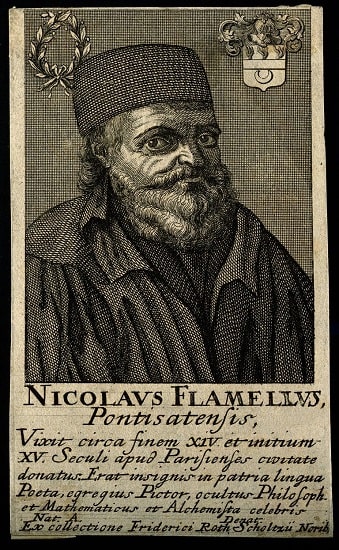
Engraving of Nicolas Flamel. Public Domain
The menu in one of the windows reminded me it’s a restaurant, so I could indeed go in. The food it listed was a surprise to me. Not the hunks of roasted meat, perhaps served with mead, I might have expected, but dishes as far adrift from that as it was possible to be. Langoustines with kiwi fruit and caviar, vegetables I had to google, even in English, selected cheeses, ripened by a Meilleur Ouvrier de France. A seven-course menu would cost 168 euros. “Each?” squeaked my husband. Or we could have the menu déjeuner for 58 Euros. Its three courses would surely be ample. We are not impulsive types, so we went away to think about it.
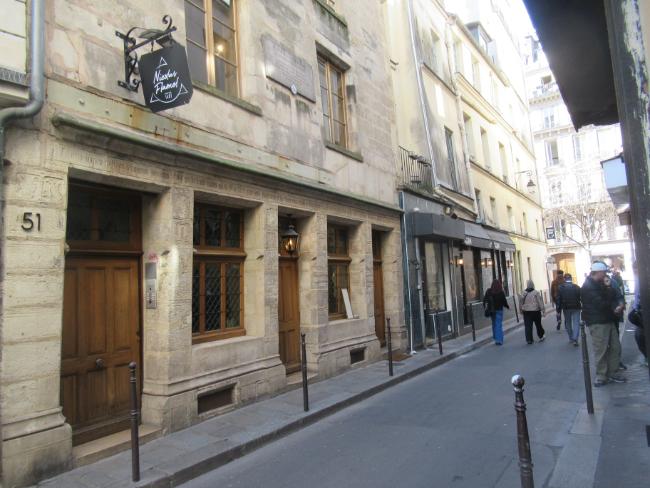
Rue de Montmorency, with the Auberge Nicolas Flamel. Photo: Marian Jones
I was intrigued by Nicolas Flamel’s story and began to research him. Born in the 14th century, he ran a profitable business, selling books and copying manuscripts and grew richer still when he married an affluent widow. Being extremely pious he spent much of his wealth on good works, refurbishing churches and building homes to house the poor, including this one in Rue de Montmorency. That much is accepted fact, but there’s much more because the rumor began that he may have been an alchemist, gifted with the power of turning base metals into gold, a fascinating story linked to the mysterious Philosopher’s Stone, told here by Sue Aran. So, as restaurants with an interesting history are high on my searchlist, I decided to go ahead and book.
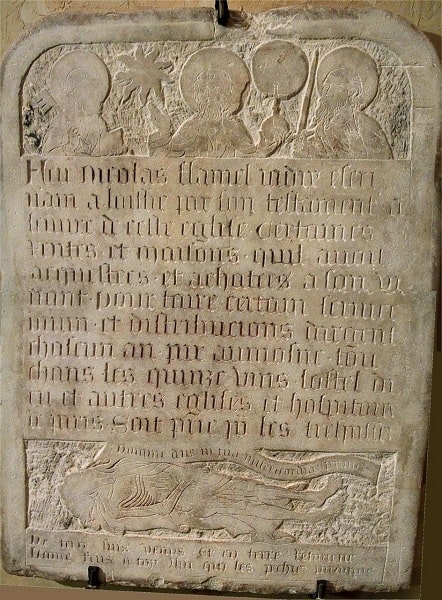
Flamel’s tombstone at Musée Cluny. Public Domain
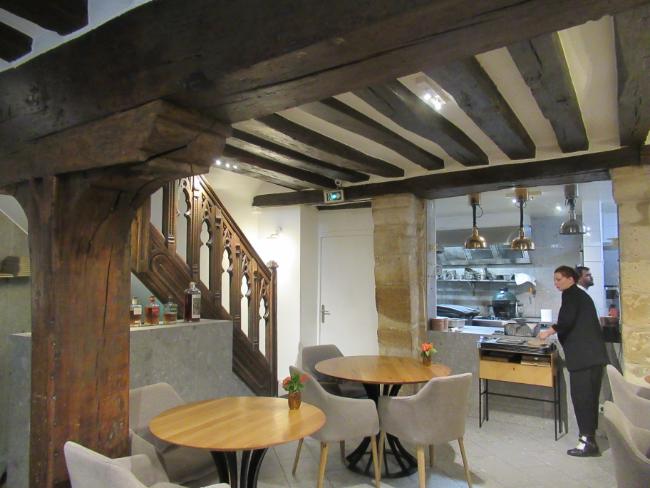
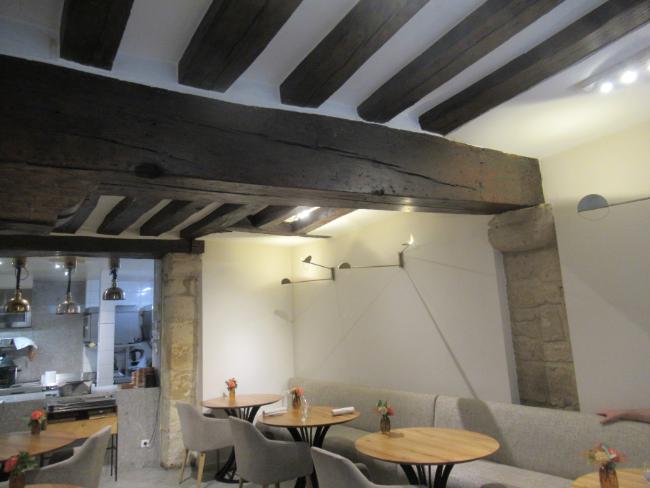
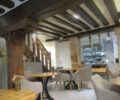
Stepping over the threshhold I found a restaurant with a lighter, airier feel than I’d imagined, with pale wooden tables set against cream stone walls. This contrasted with the enormous beams exposed in the low ceiling above us and the beautiful carved staircase leading to the upper floor. I asked the receptionist if these features were original. The beams, maybe yes, she said, but not the staircase – that was added later. Reviews I’d read revealed mixed opinions, some admiring the “refined, modern décor,” others slating the idea of creating a “bland beige box” in such a historic setting, but I liked the contrast and was intrigued to note that you could see right into the kitchen at the back.
We opted for the menu déjeuner, advertised as three courses, but were soon to discover that a selection of little surprises kept arriving, making keeping track a challenge. I was immediately a bit baffled. The tiny amount of goat’s cheese, presented on a spoon and decorated with olive paste and a tiny bright green leaf, was a tasty mouthful, but surely not the starter? Nor, I think, was the minuscule quantity of soup, explained to me as containing cucumber, fomented cucumber and mint. Our waitress, possibly sensing we were novices, helpfully suggested we taste a tiny amount of soup, then mop up the rest with the little savory croissant provided. A croissant, she added, in case we needed a definition, is “dough, prepared with a lot of love.”
I think the actual starter was the carefully crafted delicacy which followed. Thin slivers of shallot and melon, flavored with port, had been wound together in the shape of a rose and presented inside a pastry layer. It was, we were told, “une tarte revisitée,” a new variation on a tart. Indeed, for it must have taken quite an investment of time to fashion it so beautifully. I ate it slowly, hoping that paid homage to the pains the chef had taken. It was served with a basket of bread, all quite normal I thought, until I noted that the butter was covered in a layer of what looked like actual gold. Surely not, but I didn’t have the courage to ask.
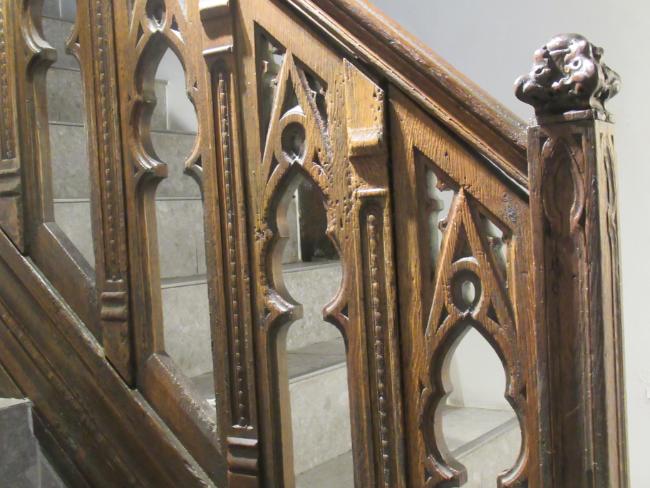
Detail inside the Auberge Nicolas Flamel. Photo: Marian Jones
Before the next course, a little ritual played out. We were shown a box of some 20 different knives, all with handles in different woods. Would we each like to select the one we deemed most suitable? Unsure of the criteria, I chose mine pretty much at random. It had a carved oak handle and I felt its heavy weight in my hand, admiring the sharp, serrated cutting edge before, prompted by the waitress, laying it to rest on the silver block – un repose-couteau, Madame – which had appeared at my side.
Before we could savor the luxury steak which forms the centerpiece of the menu déjeuner there was more to discuss. How to have it cooked? My husband asked for à point (medium rare), earning an incredulous look which I think translated roughly as “You would like the succulence practically cooked out of it?” I sensed an expectation to ask for saignaint, but knowing that means “bleeding” just put me right off. So I mumbled “Bien cuit, s’il vous plait.” I could sense the waitress wrestling with the notion that Madame must know what she wanted. “Vous êtes sûre?” I’m glad I held fast because when it came it was delicious. It was a tasting menu sized portion, artfully garnished with grilled artichoke (two slivers), salted ricotta (again, just a dot), and a truly delicious jus de boeuf, which, as a die-hard Brit, I’d call gravy.
View this post on Instagram
Dessert was truly a sight to behold. The chunky little rectangle displayed on the all-white plate was about the size of a key fob and was built up in layers: an ice cream base, then meringue, followed by a green gel, explained as “a verbena fusion” and to top it off, an exquisite translucent oblong which tasted strongly of lemon and had bright yellow pollen grains and dainty purple flowers set in to it. It was truly a work of art and must surely have been assembled using tweezers. Although it looked too good to spoil, I resisted the temptation to stow it in my handbag as a souvenir. Common sense told me it would melt away.
Coffee was extra, but by this time we were intrigued and ordered it to see what would arrive. And yes, along came more treats we hadn’t anticipated, a delicate mini round of shortbread and what in England would be a giant, over sugared jelly sweet, but at Nicolas Flamel was a blackcurrant flavor bomb, fruity and cleansing and just a perfect way to finish a meal. This was, apparently a mignardise, which, when I looked it up turned out to be “a delicate, bite-sized sweet or savory, served at the end of a meal, acting as a final flourish from the chef.”
View this post on Instagram
I am not really the Auberge Nicolas Flamel’s target audience, being more of a refueler than a fine diner. And yet I loved this experience. I always enjoy a historic setting, we found the service discreet but welcoming, and while I enjoyed some flavors more than others, I appreciated the chance to branch out into the world of French high-end dining. Did I relish the perfect presentation, the debonaire delivery and every little moment of drama, from the sophisticated start to the final flourish? You bet.
DETAILS
Auberge Nicolas Flamel
51, Rue de Montmorency, 3rd arrondissement
Nearest metro stations: Rambuteau (Line 11) or Arts et Métiers (Lines 3 and 11)
Closed Sunday and Monday.
Lunch menu around 58€, dinner menus starting from 78€ (three-course vegetarian). The five-course Alchimiste Menu is 138€.
Lead photo credit : Inside the Auberge Nicolas Flamel. Photo: Marian Jones
Related Articles

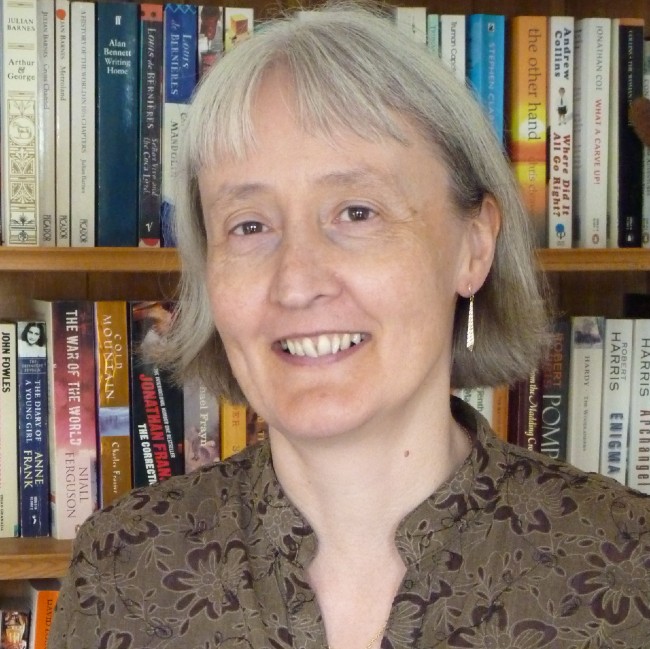
By Marian Jones