The Original Gardeners at Claude Monet’s Giverny
- SUBSCRIBE
- ALREADY SUBSCRIBED?
BECOME A BONJOUR PARIS MEMBER
Gain full access to our collection of over 5,000 articles and bring the City of Light into your life. Just 80 USD per year.
Find out why you should become a member here.
Sign in
Fill in your credentials below.
As France marks the 100th anniversary of Claude Monet’s death in 2026 with multiple exhibits and events, we take a look at the genesis of the artist’s garden at Giverny
Claude Monet created some of the most recognizable art in the world. The artist’s paintings grace the walls of the Musée d’Orsay, the Musée Marmottan-Monet and L’Orangerie where his waterlily series has been mesmerizing people for 100 years. Monet’s own garden in the village of Giverny was often his inspiration.
When Claude Monet first designed his garden at Giverny, he got muddy — planting, weeding, and tilling the earth. However, in 1890 when he eventually purchased the estate 40 miles northwest of Paris, Monet was reputably a crotchety, middle-aged man of 50. Monet had an overarching plan for his property, but the Impressionist didn’t wave a magic paintbrush to produce his floral masterpiece. Monet had a coterie of friends to help him and a team of gardeners who came and went. Though information on those he hired has mostly been forgotten, here’s a little history about the purchase of the house, the development of the gardens and the people that helped Monet create this two-acre Eden.
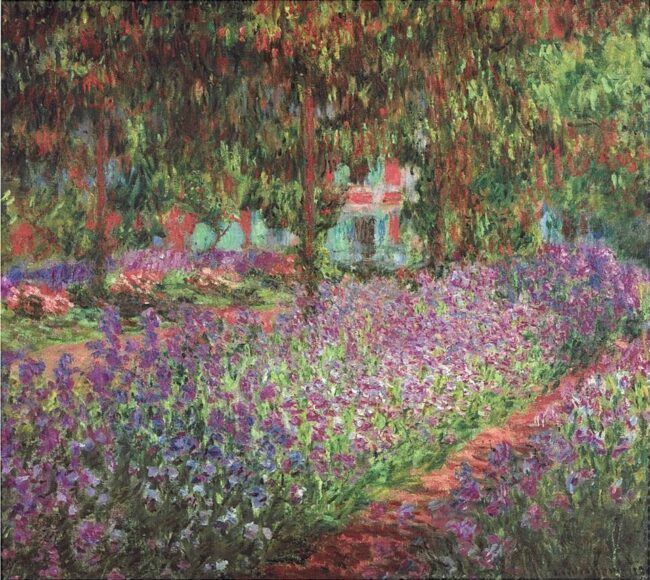
Claude Monet, The Artist’s Garden at Giverny, 1900, Musée d’Orsay
“Giverny is a splendid place for me”
Monet, his paramour Alice Hoschedé, and their combined family of eight children, first moved into the pink stucco house on Giverny’s main road in 1883. Alice was the estranged wife of a former patron of Monet’s, Ernest Hoschedé, whose art collection included Monet’s Impression Sunrise, the work that ironically gave the Impressionist movement its name. However, Hoschedé bankrupted himself, and his wife and children moved in with Monet’s family. After the death of Monet’s first wife, he and Alice fell in love, but were unable to marry without Ernest’s permission.
Always a step ahead of the rent collector, Monet and Alice had to pull up stakes and find a house roomy enough for their newly blended family, while being close enough to return weekly to Paris to promote his art.
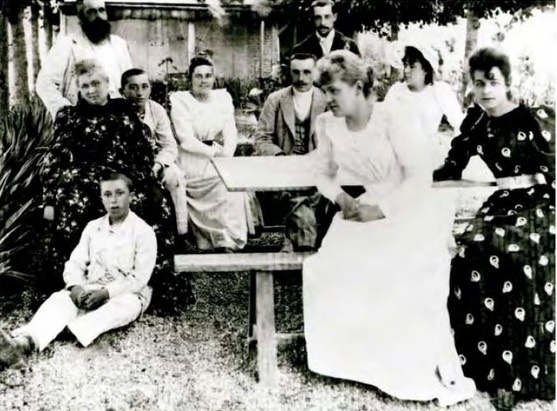
The Monet and Hoschede families circa 1880. Unknown photographer. Wikimedia commons
First spotted from a moving train, the couple found their ideal in the picturesque village of Giverny. Monet took a walk around the hamlet and fell in love with an empty house, called La Maison du Pressoir. The delighted painter immediately understood the site’s potential, saying, “I am in raptures. Giverny is a splendid place for me.” After staying at the village inn for several days, Claude Monet convinced Joseph Singeot, the owner of La Maison du Pressoir, to lease him the house and its lands.
The house stood apart from the limestone buildings of Giverny. Singeot was a trader with dealings in the French colony of Guadeloupe. Inspired by what he saw there, the pink clad house had a distinctly Caribbean feel to it. Monet soon painted the original gray shutters a brilliant green, now recognizable as Monet’s green.
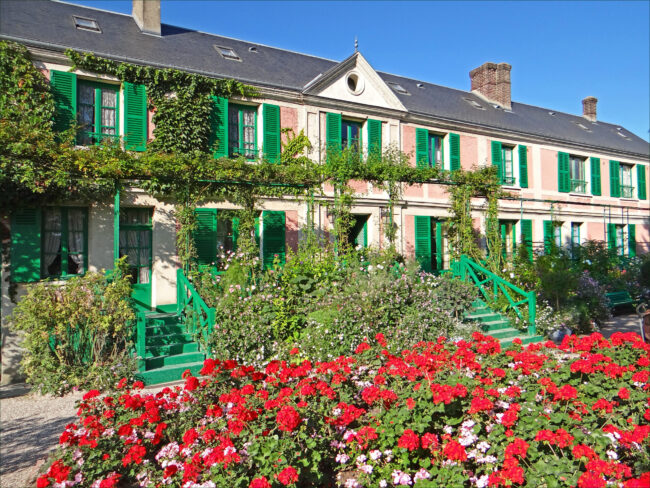
Monet’s house from the garden. Photo: Jean-Pierre Dalbéra / Wikimedia Commons
The enclosed garden needed considerable work. What came to be known as the Clos Normand had an apple orchard, vegetable garden, and several flower beds, but severely lacked inspiration. Monet loathed the hedges, and the spruce and cypress that shadowed the central path. Monet and his young brood replaced them with a polychrome palette of golden marigolds, nasturtiums, day lilies, and daffodils, red rambling roses and oriental poppies, clematis vines, the purple-blues of delphiniums, bellflowers, and irises, and the pink summer blossoms of phlox and peonies. Monet famously declared the Clos Normand flowerbeds to be his most beautiful masterpiece.
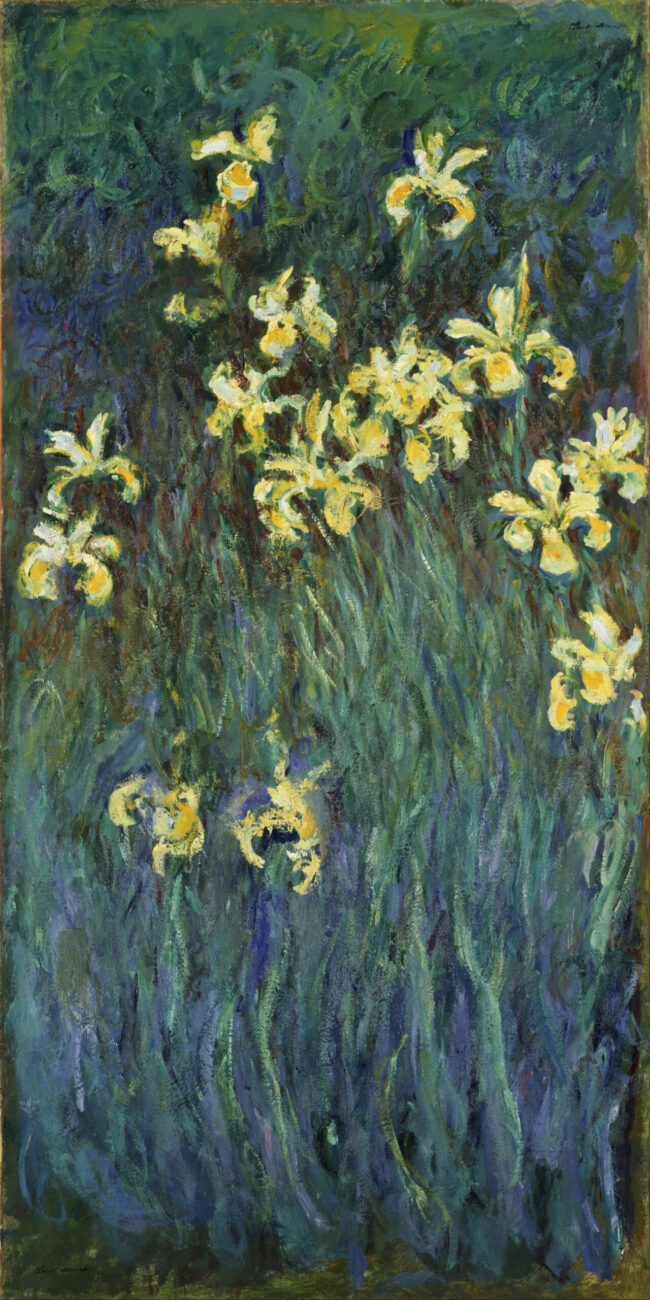
Claude Monet, Iris jaunes, 1914, National Museum of Western Art (Tokyo)
“We all got to work in the garden. I dug over the soil, planted and weeded, and in the evenings the children watered the garden.”
As his finances improved — soon Monet would be as rich as a millionaire — the artist invested in whatever flowering varieties caught his eye. Anticipating the seed catalogues and journals that would arrive at his door, Monet was ready to experiment. His expertise grew with his garden.
Monet bought the plot, Le Pressoir/Le Clos Normand, from Singeot in 1890, a few days after his 50th birthday. The house and land now his, Claude Monet’s destiny would forever be woven with that of Giverny.
Monet was on the lookout for transcendent examples of jardinage while on his painting expeditions. In 1884, he sought to reproduce the exuberance and bold blues he had seen on the Italian Riviera. A trip to Dutch tulip fields in 1886 inspired the artist to do some color blocking of his own in his gardens. At the 1889 Exposition Universelle, Monet was inspired by the Japanese garden and the rare hybrid waterlilies he had seen at the foot of the brand new Eiffel Tower. Monet was spurred on to create his own water garden in 1893. While working on his Rouen Cathedral series in 1892- 94, the well-traveled Monet visited the city’s Jardin des Plantes where he went into raptures about the orchids.
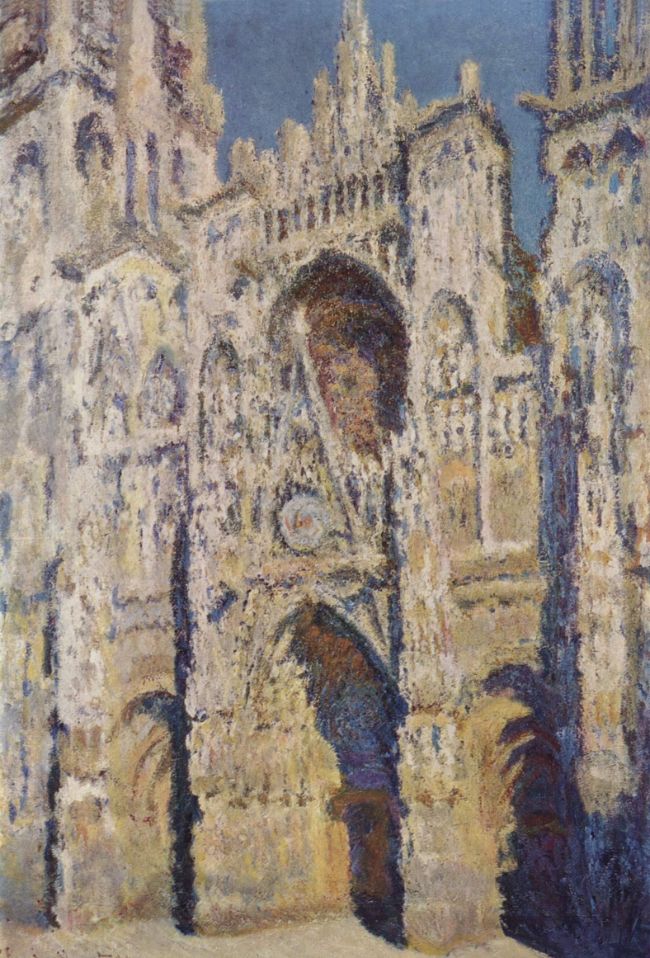
Claude Monet, Rouen Cathedral: The Door, Morning Sun, Blue Harmonie, 1892-93, oil on canvas. Acquired by Count Isaac de Camondo in 1894. Public Domain: Wikipedia
Monet traded ideas, addresses — and seeds! — with his gardening friends, the Impressionist painter and patron, Gustave Caillebotte and the nursery owner George Truffaut, whose Jardineries Truffaut are still in existence in 2026. Through the novelist Octave Mirbeau, Monet acquired one of his best gardeners, Felix Breuil.
Who were the original gardeners?
Felix Breuil was a good catch, but he was not the first gardener at the estate. The French censuses provide superficial look into who the Giverny gardeners were. We can only imagine them in worn boots, with suspenders under their waistcoats, strong arms, and luxuriant moustaches.
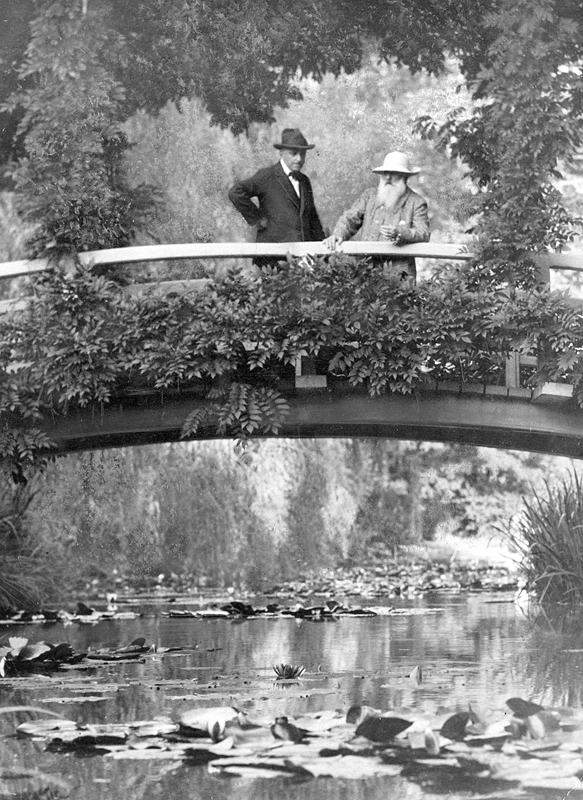
Claude Monet in his garden in Giverny. The New York Times photo archive, 1922, anonymous. Public domain/ Wikimedia Commons.
A private website dedicated to the history of Giverny is a treasure trove of letters, images, and stories. An image of one of the gardeners can be found there.
Louis Lebrun lived in the town of Giverny since 1890, and likely hired by Monet in 1892. Records prove he worked as a Monet’s gardener in 1896. By 1901, Louis was a successful market gardener himself. Louis Lebrun and his children Ernestine, Marguerite, Camille, Kleber, and Louis Jr, settled on Rue du Pressoir, with Monet as one of his immediate neighbors. His son Kleber would become one of Monet’s much-needed gardeners after the disastrous World War I.
In 1901, Monet employed Désiré Vavasseur and Francois Merry Delasse as gardeners. Désiré was just 26, but in 1896 Merry was 25 years older — born in 1846. He had once been a self-employed gardener, but 1901 and 1906 finds him gardening for Monet. He lived on the rue des Grands Jardins with his daughter and father. By 1911, he was back working for himself.
The Monets acquired another house, La Maison Bleue, with a garden large enough to meet the needs of the family’s kitchen, albeit a 20-minute walk away. Here, according to Claire Joyes, author of Monet’s Table, Florimond Bellanger was the vegetable gardener for a brief time. Bellanger appeared on the 1901 census as a 33-year-old gardener working for Claude Monet, installed, with his family, in the blue house on Rue du Chêne. A county boy, born in Guitry, Bellanger worked as an apprentice for local gardeners before he worked for the Monets.
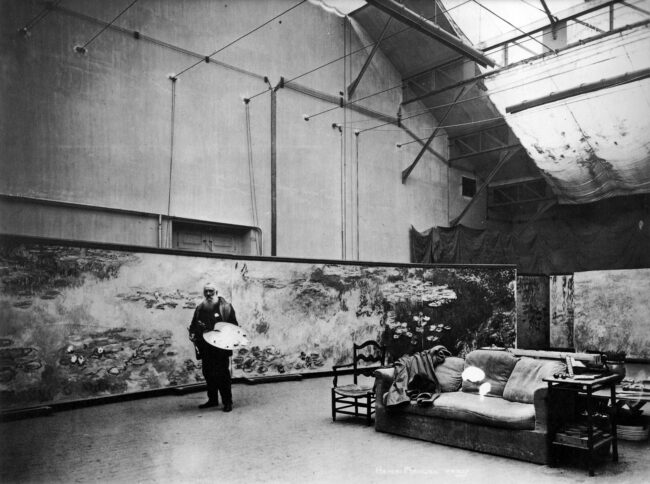
Claude Monet in his studio, 1920. Anonymous. Public domain. Wikipedia commons
Florimond was kept busy; constant irrigation of the abundant fruit and vegetables were a major concern. According to Joyes, the watering was completed with the aid of a devilishly loud pump. Bellanger honed his skill in the greenhouse and cultivated a garden of fine herbs, vegetables, aromatics, and plants from the Mediterranean coast, which his boss adored. Florimond was an expert at growing artichokes and well aware of Monet’s rages if the little globes were not picked at the right time. Perhaps the arguments were enough. Florimond had moved on by 1906, and was gardening for a patron named Pauthonier in Vesly, 25km up the road from Giverny.
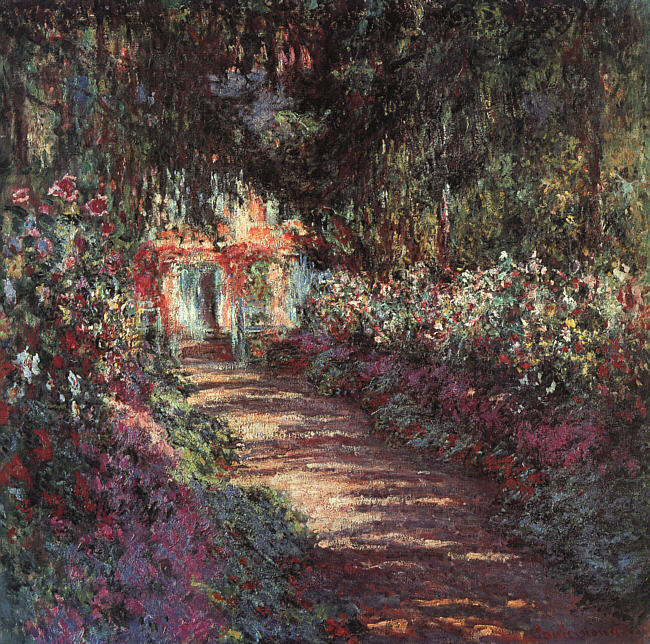
Claude Monet, The Garden in Flower, 1900.
In 1905, Florimond Bellanger was replaced as the vegetable caretaker by Joseph Philippe. Philippe, born in 1861, began working for Monet at age 44. A friend of Philippe’s forwarded him a newspaper advertisement placed by Monet himself, looking for a gardener. Joseph Philippe responded immediately to the advertisement on April 25th, 1905. The matter moved quickly, for on April 29th, Joseph Philippe received a letter from Monet asking for references:
I received your letter and I am writing to request information, but I must tell you that I need someone with expertise in growing early produce and all kinds of vegetables. I have other gardeners for the flowers, and I want someone who is very hardworking and absolutely sober. I offer 120 francs in wages and accommodation.
Once I have received the information, I will see if I can accept your proposal, but then I would need to meet with you, and I’m wondering where, especially since you would need to be ready to arrive by May 1st. Yours sincerely,
Claude Monet
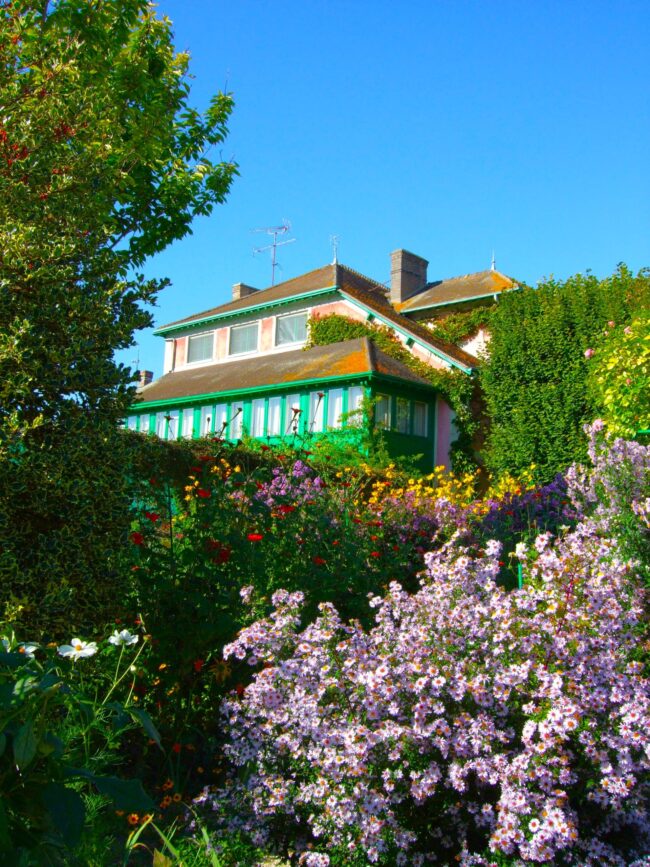
Claude Monet’s house at Giverny, 2010. Photo credit: Hazel Smith
By 1911 Joseph Philippe had moved on to work on the respected horse farm Haras de Neaufles with his son.
In 1904, another gardener wanted out. Details of this gardener are hidden in the years between the 1901 and 1906 censuses, but on Feb 17, 1904, this advertisement appeared in a journal named l’Acclimation des Animaux et des Plantes: “Head Gardener, 29 years old, one child 20 months old, desires a position in a chateau or substantial bourgeois house, knowledgeable in all aspects of gardening. Reference: First order. Recommended by masters. Mr. Henri Rambaud, at Mr. Claude Monet’s, near Vernon (Eure).”
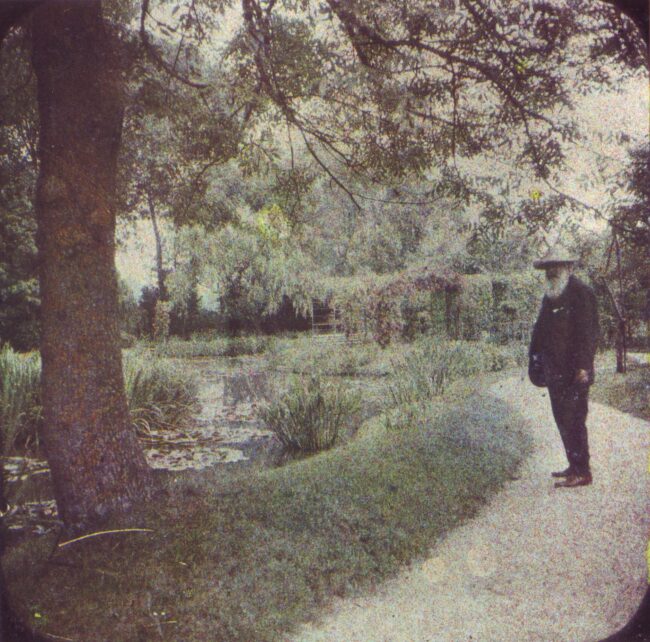
Claude Monet in his garden, taken around 1920 by his friend Étienne Clémentel. Public domain
The biggest employer in town
The artist was notoriously obsessive and exacting. Monet treated his gardening crew as an extension of his paintbrush, constantly barking orders to ensure the light, color, and positioning of the flora matched his exact vision for his canvas.
Showing up on the 1906 census are those who gardened at Giverny when the master no longer worked the soil. Every one of the 310 residents were counted, along with their occupation and, where applicable, the employer or patron for whom they worked. The fact that these journeymen, cultivators, and gardeners cite Monet as their employer means at that moment in time, they worked exclusively for the old master. It is worth noting that Monet was the largest employer in town.
In 1906, Monet employed the following people living in Giverny:
Felix Breuil, once the gardener of Octave Mirbeau’s father was now on Monet’s staff. Jackie Wullschlager observed in Monet: The Restless Vision (2023) that, “By 1904 [Monet] employed six gardeners, led by Félix Breuil… One was responsible for the water lilies alone; from a boat, he dusted and washed them, and cleaned the pond surface.” Monet went as far as paying for the paving of the public road bordering the water garden, to minimize dust on the lilies.
Félix Breuil, himself, born in 1867 in Rémalard, Orne, makes his first documented appearance as gardener at Giverny in 1906. He lived with his wife, Marie Saunier, and their son, Léon, in the house next to the Monets. Breuil tried to meet his employers exacting demands but sometimes their arguments became heated. Breuil was concerned with the quality of the plants. Monet was more concerned with the color, density, and texture in his garden. Even on the road, he sent Breuil copious, detailed instructions.
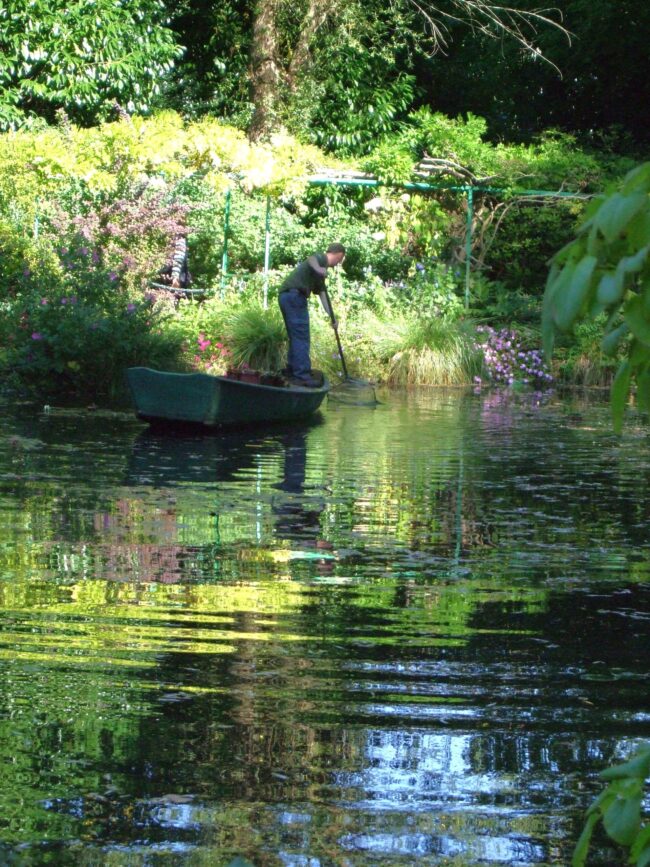
Gardener, Giverny garden, 2010. Photo credit: Hazel Smith
Léon Loisel, born in 1887, was also a gardener. He lived in the Monets’ house, perhaps in the second workshop. Loisel was gone by 1911, working for Bruguiere in Les Muids.
Jean Denais, born in 1859, was a day laborer. He lived on Rue aux Juifs with his wife and their young daughter. Denais moved along and by 1911, he was working for Monet’s neighbor, the sculptor MacMonnies, as a gardener. It is possible that Merry Delasse and Denais were assigned to the vegetable or flower garden depending on the needs.
Robert Le Gal is documented as one of Monet’s primary gardeners from 1912 to 1916. Though I can’t find any further information, Le Gal’s memoirs helped to complete the modern garden’s authenticity.
In 1911 Alice Hoschedé-Monet died. Increasingly the gardens at Giverny were looked after by Alice’s daughter Blanche. Blanche Hoschedé had married Monet’s son in 1897, so in Blanche, Monet had a stepdaughter and a daughter-in-law. Blanche was now in charge of the greenhouses and gardeners.
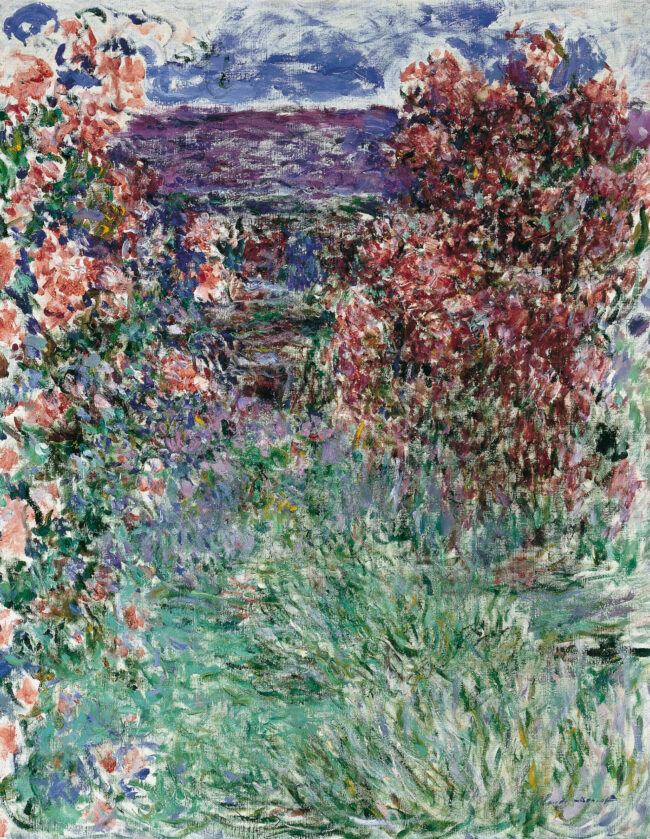
Claude Monet, La Maison entre les roses, 1925, Thyssen-Bornemisza Museum (Madrid)
The census of 1911 has Adolphe Darthenay born 1873 is a gardener for Monet. His wife is a blanchisseuse, a type of laundress.
At 17, Achille Lenoir was a gardener in his home village of Houdonville for M. de Poulignac; by 1911, Lenoir was a gardener from Monet. The same Achille Alfonse Lenoir of Houdonville died within the first month of World War I. In 1914 when Monet’s artist neighbors, the MacMonnies, founded an army hospital within their house, Monet’s gardens supplied them with 1000 francs worth of vegetables per month.
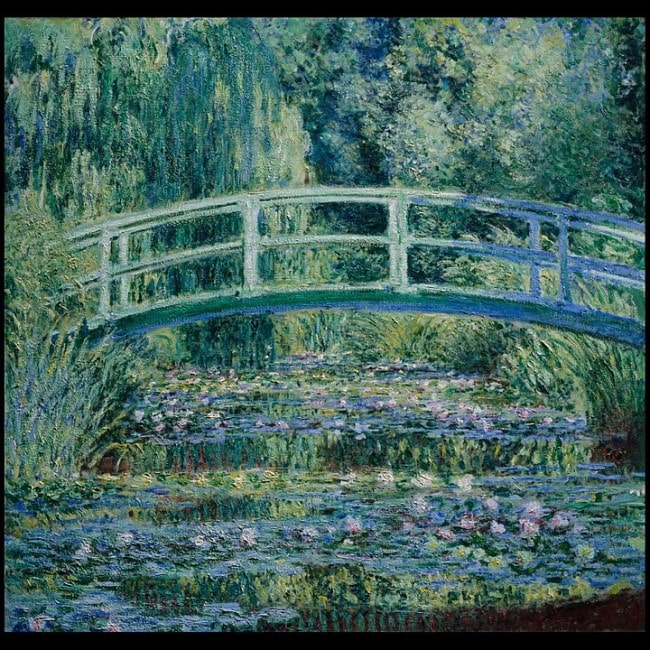
Claude Monet – Water Lilies and Japanese Bridge.
The effects of World War I
Most of Monet’s younger, able-bodied staff were conscripted into the French military during World War I. Leon Loisel, above, was another casualty, succumbing not to injury, but disease just days after the Armistice. Monet was left with an aging crew.
Keeping Monet’s living canvas thriving required an exhausting effort from his gardening staff, especially as Monet battled poor health and cataracts in his later years. As the censuses reveal, many gardeners and journeymen did not last more than five years under the constant haranguing of such a perfectionist. Claire Joyes recalled that Marguerite, Monet’s cook, expressed, “Oh, Madame Blanche, she must have wept into so many little handkerchiefs!”
Monet had lost his cook and his housemaid by the summer of 1919. There was massive labor unrest in France post World War I, and Monet wasn’t spared. All his faithful gardeners were gone. Even Felix Breuil left, returning to his home town.
Monet’s life was in complete disarray and he thought he might have to give up on his beloved gardens at Giverny.
However, Monet was lucky enough to acquire the services of a good gardener named Louis Lebret. In September of 1924, Lebret won a prize by the Agricultural Society in nearby Vernon. The paper, Paris Soir, quoted Monet who egotistically said, “He is my best student.” On the French censuses for 1921 and1926, there were just three gardeners on staff. Felix Breuil returned, only to leave for good in 1926 after Monet’s death.
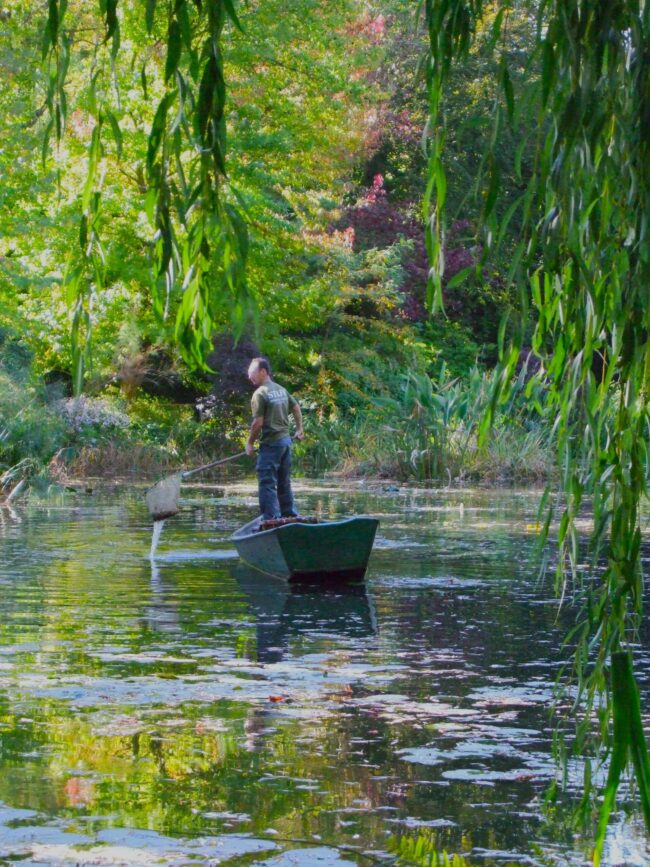
Gardener, Giverny, 2010. Photo credit: Hazel Smith
The loss of the great artist
Claude Monet died December 5, 1926; his funeral cart drawn to the churchyard by the gardeners at Giverny. One of his first gardeners, Louis Lebrun, led the cortege. It is known within the community that Lebrun helped commit Monet’s coffin to the ground in the cemetery at Saint-Radegonde. The next day it was business as usual: the gardeners were ordered to carry on as usual and could be seen tilling the earth.
After Monet’s passing, Blanche maintained the gardens until her own death. Documents from 1936 reveal that Blanche still employed Louis Lebret. Lebret and fellow gardener Kleber Lebrun took care of the flowers at the house; the vegetable garden was the domain of Orazio Zivacco, who lived on Rue aux Juifs.
Kleber Lebrun, born in 1894, was the son of Monet’s original gardener Louis Lebrun. While not watering the flowers, Kleber was also part of the Giverny volunteer fire brigade. Kleber’s family was closely linked to Giverny; his sisters modeled for Monet, and the family was present at the painter’s graveside as their father lowered his coffin into the ground.
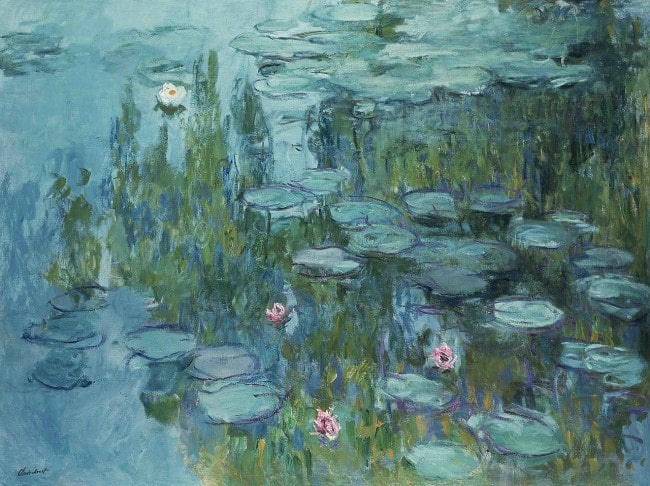
Claude Monet, Water Lilies
Originally a bricklayer, Orazio Zivacco was unfortunately affected by poison gas in World War I. He transitioned from mason to gardener and by 1926 was working on Claude Monet’s estate, first for Monet and then for Blanche who remained in the house. Historical research shows that Zivacco managed the potager, or vegetable gardens.
Orazio Zivacco and his wife Louise Marinello adopted his niece and nephew, who remembered playing at Giverny and receiving Christmas gifts from the Monet family. Orazio’s niece Raymonde remembered seeing Monet’s paintings stored in the large studio and garages.
An old gardener’s pilgrimage
The heyday of Giverny ended during World War II, as Blanche watched the last of the servants (save one) drive away in a borrowed red truck. For 20 years, Blanche Monet-Hoschedé admirably managed the gardens with the help of head gardener Lebret. However, when she died at the war’s end, the gardens were just a shadow of their former selves.
After Monet’s death, Felix Breuil never returned to Giverny. However, in 1949, a newspaper reported how the old gardener made a yearly pilgrimage to l’Orangerie to remind him of the garden’s glory.
Starting in 1977, the gardens were painstakingly restored. Its savior was Gilbert Vahé, head gardener at Monet’s estate for over three decades. Today, that role is performed by Jean-Marie Avisard.
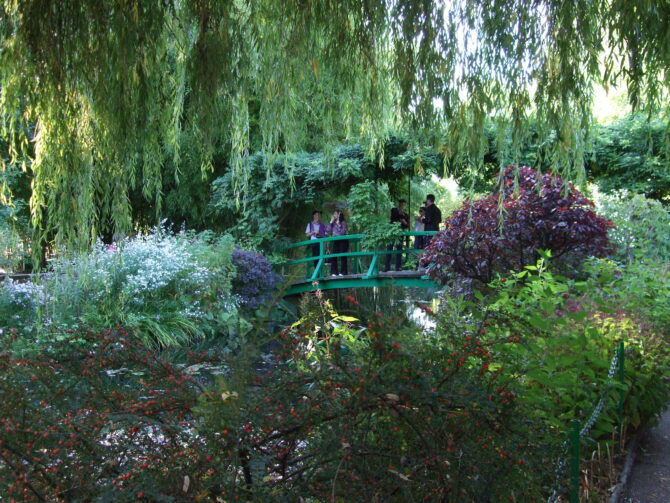
Lead photo credit : The Japanese Bridge, Giverny gardens in 2010. Photo: Hazel Smith
More in Claude Monet, gardens, Giverny
Related Articles