
From the Catacombs to the Sky: Nadar’s Pioneering Adventures

- SUBSCRIBE
- ALREADY SUBSCRIBED?
BECOME A BONJOUR PARIS MEMBER
Gain full access to our collection of over 5,000 articles and bring the City of Light into your life. Just 80 USD per year.
Find out why you should become a member here.
Sign in
Fill in your credentials below.
Nadar, an “influencer” before his time with over 10,000 followers, claimed to know everyone in Paris. Through his sheer force of personality, talent and entrepreneurial skills, Gaspard-Félix Tournachon, known widely by his pseudonym of Nadar, achieved all this long before the world of the internet and social media.
A flamboyant genius, Nadar is known nowadays for his connections with artists such as Delacroix and Manet and for enabling a group of young reactionary artists to hold their first exhibition by lending them his two-storey photography studio rent-free. Situated at 35 Boulevard des Capucines, the studio was already a meeting-place for the cultural intelligentsia of Paris irresistibly drawn in by Nadar’s irrepressible personality, boyish enthusiasm and constantly cheerful ego. The exhibition, which gave birth to the term “Impressionism,” openly challenged the traditional values of the art world. Nadar loved a bit of controversy and being a man who never made concessions to society’s rules, this would have undoubtedly made him smile.
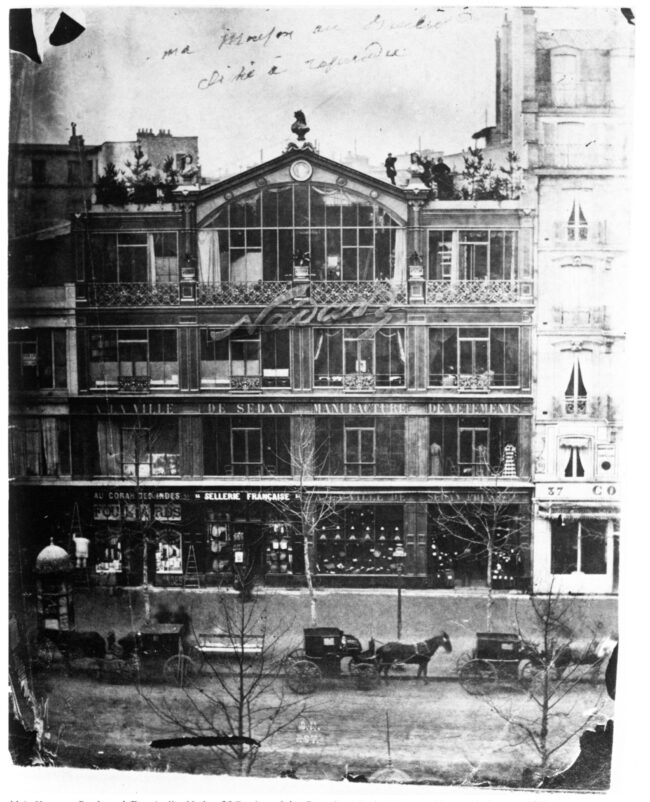
Nadar’s Studio at 35 Boulevard des Capucines in 1860. Public domain.
Nadar thrived on challenges. Woe-betide anyone who dared to tell him his dreams were impossible. His motto was that “nothing is easier than what was done yesterday; nothing is more impossible than what will be done tomorrow.” The first untethered, manned hot-air balloon flight created by the Montgolfier brothers took place in Paris in 1783. Nadar and several of his friends, including Jules Verne and Victor Hugo, were fascinated by the idea of human flight. He became a pioneer of both ballooning and photography, when after conquering the underworld by attempting to photograph the Catacombs under the streets of Paris, a place as forbidden to Parisians as Hades was to mere mortals, he looked upwards towards the skies, thrilling the French public with his Icarus-style attempts at flying.
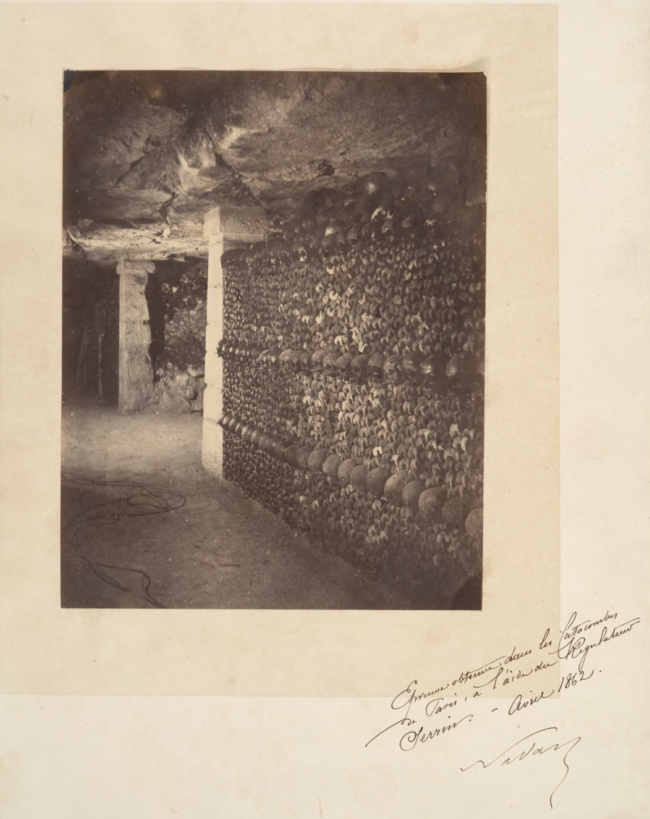
Nadar, Catacombs, 1862, public domain
In the 1850s, Nadar became obsessed with capturing the aerial views with photography. His first experiments inspired his friend Daumier to publish his cartoon, “Nadar elevating Photography to the level of art,” depicting Nadar taking photographs from the tiny, wildly swinging gondola of his balloon. Half a century later, the English cartoonist Heath Robinson’s (1872-1944) cartoon illustrations of whimsical hot-air balloons and improbable military machines are so reminiscent of Nadar’s that it is difficult to imagine that he was not familiar with Nadar’s work or even the man himself, as nothing thrilled Nadar or Heath-Robinson more than the enduring playfulness of invention.
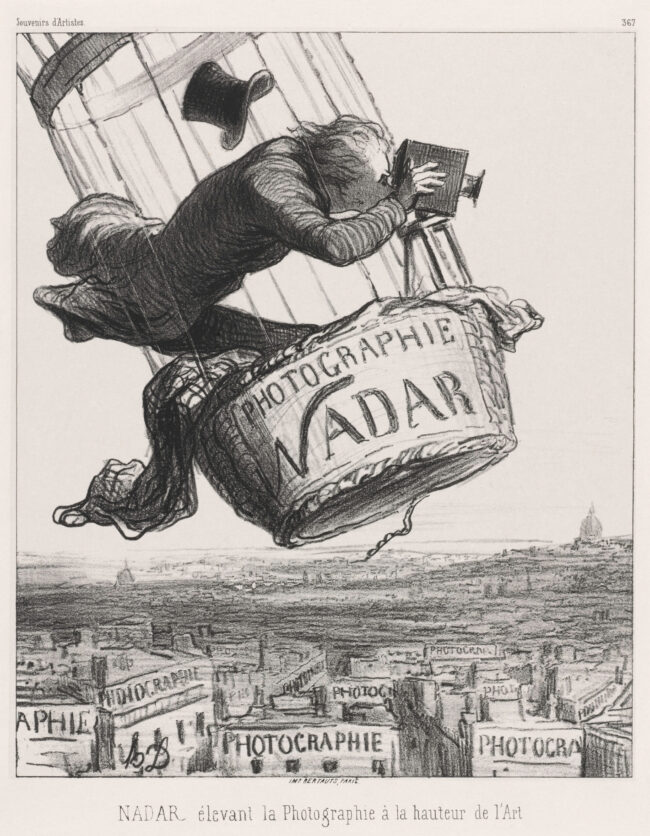
Nadar élevant la Photographie à la hauteur de l’Art (“Nadar elevating Photography to Art”). Lithograph by Honoré Daumier. Wikimedia commons
Nadar soon realized that navigable flight was only possible in a heavier-than-air machine. In 1863, he decided to make his photography studio, the headquarters of The Society for the Encouragement of Aerial Navigation by Heavier-than-air Machines. He was its President and Jules Verne, his friend and partner in fantastic inventions, its secretary. Later, Jules Verne in his science fiction novel From the Earth to the Moon, created a fictional Nadar as the character Michel Ardan, one of the astronauts who would “carry into outer-space all the resources of art, science and industry”.
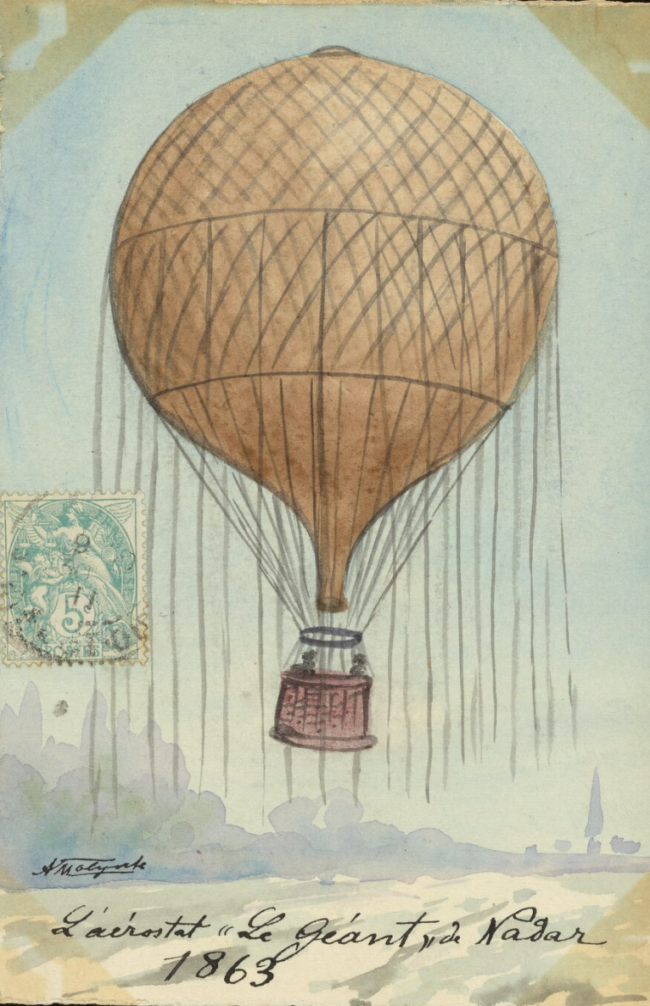
Balloon Le Geant flown by Gaspard-Félix Tournachon (Nadar), 1863. Public domain
Inspired by Jules Verne’s first novel, Five Weeks in a Balloon, in which he imagined a voyage across Africa in a giant hot-air balloon, Nadar began building the world’s largest balloon, which he called Le Géant (The Giant), outstripping even Verne’s imaginings. The basket was replaced by an entire wicker apartment, the size of a small, fully-equipped cottage, including a photographic laboratory, and a wine store. Carrying 12 passengers and the balloon’s engineers, the Godard brothers, Nadar planned to travel across Europe in Le Géant. To cries of amazement from the huge crowd gathered to witness its maiden flight, the balloon took off at great speed, coming to an ignominious end 15 minutes later, as it rapidly descended into a bog 25 miles from the starting point.
Unperturbed, two weeks later, watched by Napoleon III and over 200,000 spectators, Nadar and nine passengers set of again in Le Géant. After floating 400 miles in 14 hours, it fell indecorously to earth, continued to bounce across the countryside, narrowly missing a railway train before eventually bursting. Nadar and Ernestine his wife were among the injured. Miraculously no one died. Both Verne’s novel and Le Géant were still being referenced over 150 years later in the 2009 American animated film Up, featuring an elderly character who by attaching helium balloons to his house, is propelled by a storm all the way to South America, where he crashes and is dragged across a table-top mountain.
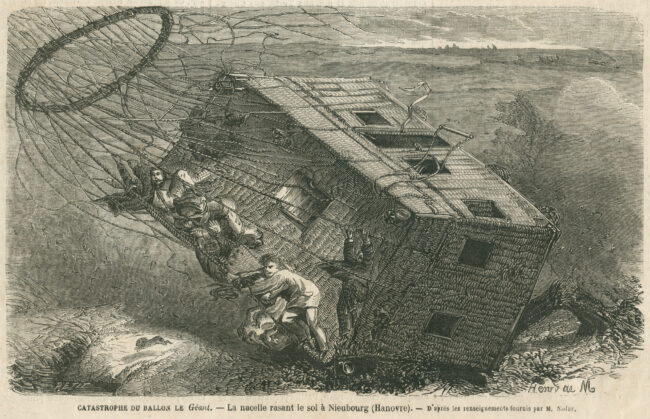
1863: Disaster with Le Géant at Neustadt am Rübenberge at Hanover. Illustration in a newspaper. Public domain
Nadar went on to write a potboiler account of the incident, exploiting its publicity while at the same time advocating for heavier-than-air machines being the way of the future. Then, in 1870, during a time of great national crisis, he became the hero who saved the day. France declared war on Prussia resulting in Napoleon III’s capture. Paris was besieged, making any communication with the outside world impossible. In a venture that would be his most innovative yet, Nadar suggested crossing Prussian lines using balloons to carry messages out to the rest of the world.
He was not the first to recognize the potential of aerial photography for military purposes. Over a thousand years before, the Chinese used sky lanterns for military signaling and the Mongolian army used the lanterns during the Mongol invasion of Poland in the 13th century. Nadar, encouraged by the first experimental balloons successfully floating out of reach of Prussian fire power, set up two factories making hot-air balloons. Paris Balloon Post was born, delivering over 2 million letters.
Of 60 flights made, only five were captured and three disappeared. “The wind was our postman, the balloon our letterbox” wrote the poet Theophile Gautier. In Victor Hugo’s words, “a mere bubble of air” had put Paris back in communication with the rest of the world.
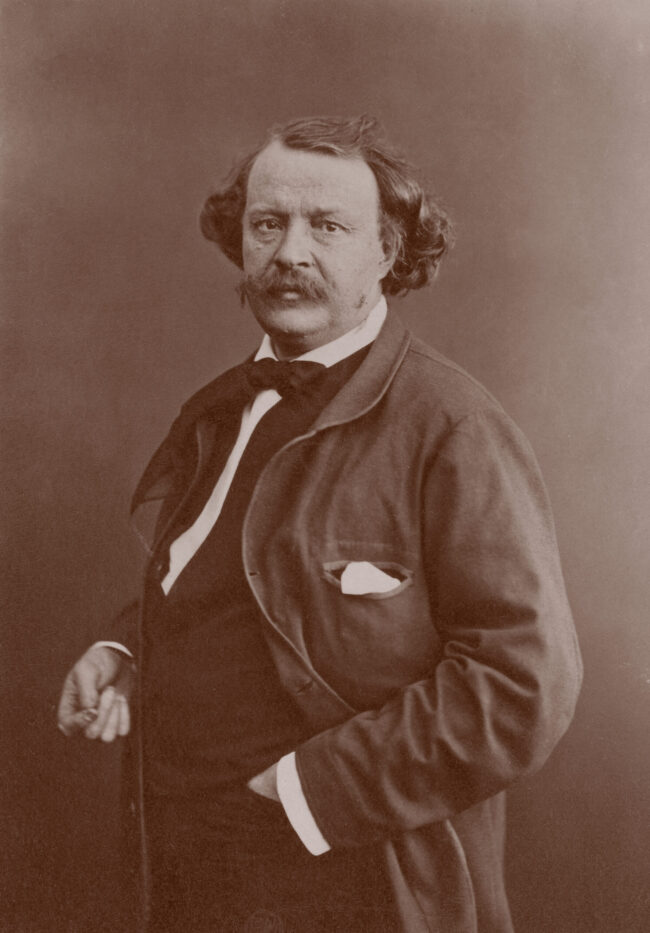
Self portrait of Nadar. Public domain
There was one problem – how to carry messages back into Paris. An anonymous citizen proposed a brilliant solution to Nadar. The idea was to place a number of Parisian carrier pigeons in each outgoing basket. Using the recent innovation of microphotography, they would return with micro-filmed messages strapped to their legs. Each pigeon carried almost a thousand messages. French airpower had overcome Prussian firepower, raising awareness of the potential for the use of aeronautics in warfare, predating present day’s use of drones. It is difficult to imagine what Nadar would have thought of the metamorphosis from a balloon carrying airmail, to today’s drones carrying highly sophisticated weapons.
Nadar continued unveiling new ideas, using his expertise and cheeky audacity to realize them. Ahead of his time, he was a great communicator and influencer without the shallowness the terms so often imply. Open-minded, he instinctively welcomed opportunities. Nadar lived to see the first powered flight in 1903. It took half a century but he’d finally been proven right about the future of aeronautics.
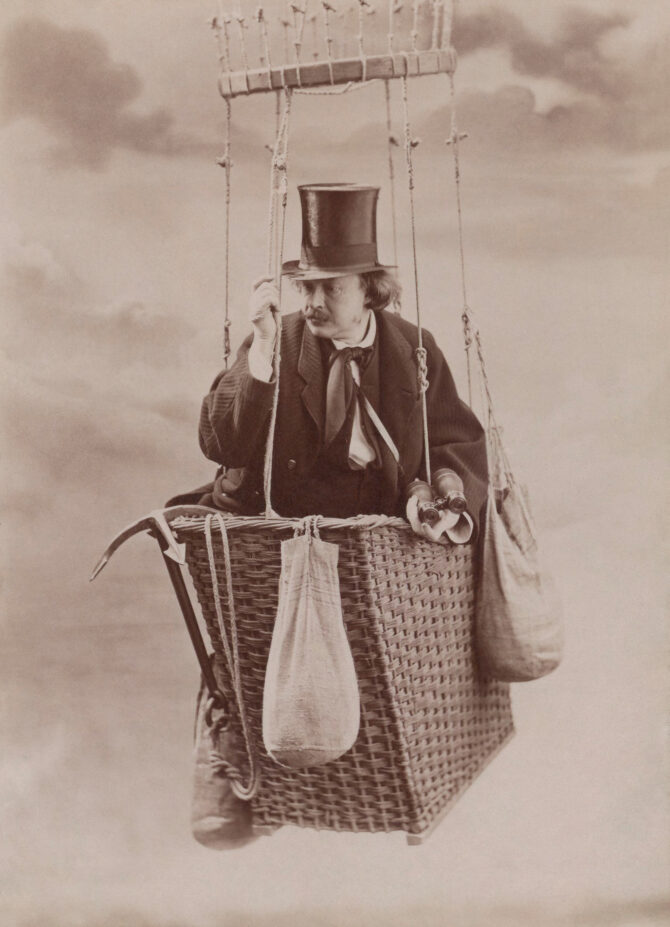
Lead photo credit : Studio portrait of Nadar in a balloon basket, c. 1863. Public domain
Related Articles

By Anne Price
REPLY