Interview with the American Love Coach in Paris
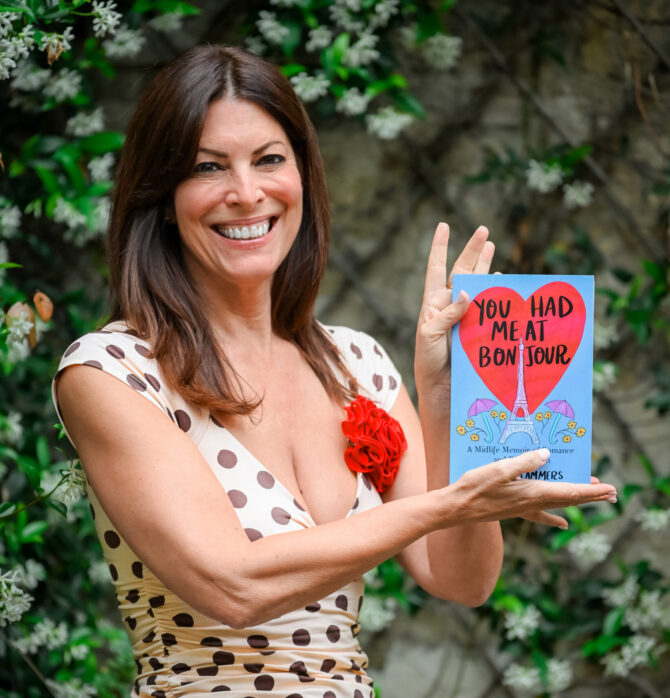
Dufflyn Lammers provides one-to-one relationship coaching to women all over the world, runs in-person workshops internationally, and is a popular speaker in the recovery space. Her writing and performance on relationships has been featured in Russell Simmons Def Poetry on HBO, Business Insider, the Los Angeles Times, The Good Life Review, and the Santa Fe Writers Project.
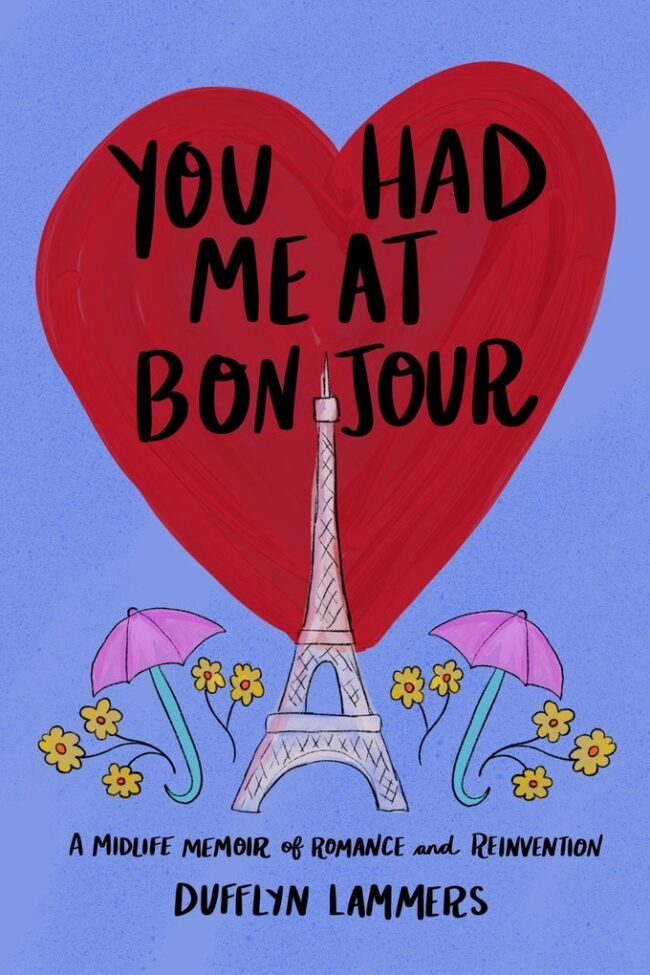
Her first book, You Had Me At Bonjour: A Midlife Memoir of Romance and Reinvention, was published in June by Rise Literary, an imprint of Simon & Schuster, and launched at the Red Wheelbarrow bookstore in Paris. Dufflyn recently took the time to answer Janet Hulstrand’s questions about her life, her work, and her book for this exclusive interview in Bonjour Paris.
Dufflyn, you have had such an adventurous life! Let’s start with some of your most recent work, and work our way back. Your bio says that you are “The American Love Coach in Paris.” So first of all, what does that mean? What does your work as a love coach entail?
Women come to me with one of three problems. 1. They are single and don’t want to be; 2. They are in a relationship and don’t know if they should stay or go; or 3. They are going through a breakup or divorce. I use coaching to help them stabilize and get on track to reach their goals, and then we do the deeper work.
You are also trained in attachment repair, tantra, and addiction treatment. How did you come to have these as your areas of professional expertise? And can you briefly describe what attachment repair and tantra involve?
I am certified in Ideal Parent Figure Protocol, (IPF) a meditation intervention for attachment repair which I learned from Daniel P. Brown and David Elliot. This allows a person to have a permanent change in how they see themselves and how they see the world that deeply impacts not only their relationships, but everything about life.
Your adversity is your advice! I struggled for many years with various addictions. In my early recovery I felt distanced from my body and my sexuality. I did seven years of intense study of Neo Tantra with Dawn Cartwright in Los Angeles. It involved structured exercises around movement, breathing, and meditation in a safe group environment. I found Tantra helped me feel more embodied, more present and more empowered. There is a chapter in You Had Me At Bonjour where my partner Benjamin tells me I need to “perd” the fat around my thighs and “remonter” my butt. It was painful to hear. But I responded by leading him through a Tantra ritual that honors the body, one part at a time, which helped me let go of that hurt and showed him how I wanted to be treated.
As I got better myself, women were coming to me for help and I saw that many times the reasons they were relapsing with an addiction – be it food or substances or shopping – underneath that was the attachment wounding. It was coming up because those old hurts had been triggered. Many times they weren’t even aware that they were reacting from that place. The emotional dysregulation that resulted was overwhelming, and led the person back to their old way of coping.
For example, one client I worked with was struggling with a new relationship. She was in recovery from substance use disorder and she was dating a new guy. The man she was seeing was showing up reliably, but if he didn’t reply to a text right away, or if he had lunch with a female friend, she would get very anxious and jealous. She was tempted to drink and nearly did several times. Even when she didn’t drink, she felt so uncomfortable in the uncertainty that she would break it off with him to alleviate that feeling, but she would call him several days later to apologize. He was getting pretty tired of that pattern and she knew she was going to lose him or drink if she couldn’t correct it. We talked it over and once she realized this was not about the man she was dating, but the chaotic, violent home she’d grown up in, she recognized she needed to heal the past. Through our work together she was able to calm the abandonment fear enough not to act on her fears — and she saved the relationship, and her sobriety.
I mentioned the mentors who taught me IPF. But Attachment Theory really began with British psychologist John Bowlby in the 1940s. The basic idea is that the way we were loved as children is the way we love as adults. But it’s also about our outlook, our way of being in the world, our mindset. And so it’s not only about our romantic relationships, it affects everything – work, money, family, friends, body image – everything. I wish I’d known about this sooner. By the time I found IPF I had read so many books and done so many workshops and done all the therapies. I felt like I had all the pieces of the puzzle, but this finally gave me the glue I needed!
Do you have any male clients? And have you considered doing couples counseling? Having read your book, I think you’d be great at it!
I don’t generally work with men. I work a lot with sex and love addiction, and it can be just a bit sticky. I’m not trained in couples work and it would be unethical to do couples counseling without that training. I’m focused more right now on more IPF training and writing.

Dufflyn Lammers. Photo credit: Krystal Kenney
You also have an interesting career as an actor behind you. Are you still performing? Or is that a thing of the past? And if it is, what was one of your favorite moments as an actor?
I wasn’t changing anyone’s life with my five-line part on Criminal Minds, although that was a fun moment. I went to high school with Shemar Moore. He didn’t know I was coming to set. So when he walked into the room and saw me he said “Oh my God, Duffi!” and threw his arms around me. For a moment he lost his Soul Train cool and was again that boy I knew at school with the Michael Jackson jacket and the Jerry Curl.
Now I use my performance skills every day, but they are in service of something larger. Ultimately I am a storyteller. I bring stories to life on my Instagram, in my public speaking, and in my writing. I am in my element leading a group through a transformation. Relationships are built through shared experience, and stories are about shared experience. I want to really bring that to life in a way that people get to live inside it and feel inspired and uplifted. So it’s not separate from the other work I do. What I’m working on now is an immersive storytelling experience based on my memoir, which I’ll be bringing to Paris, London, and LA this fall.
Now to your recently published memoir, You Had Me At Bonjour. Without giving too much away — because your story really is quite suspenseful — what can you tell us about this book? Who do you hope will read it? And where can people get it?
You Had Me At Bonjour is the story of an impossible love that actually works out. When I met Benjamin he was 18 months clean off of heroin and on probation for carjacking. He was seven years younger than me and we didn’t live in the same country or speak the same language. So on paper, this is just, girl – no! But I was in my 40s and I didn’t know how many more chances I would get at love; and he just kept showing up. Every time there was a challenge, he met it. He met me. And that helped me re-meet myself. Or reinvent myself.
I wrote this book during the first three years of my relationship with Benjamin because writing helps me make sense of life and I was feeling super insecure and full of self-doubt; I needed to find direction. Before I met him I had been through one heartbreak after another and I didn’t want to repeat the same mistakes. I really wanted to have a healthy relationship and I knew many of the reasons I didn’t have one were about me. I wanted to take that old heartbreak and make it into something beautiful and I wanted to remember what I had learned – to get the lessons I had been handed – so that’s what’s in this book.
I would love for this book to be read by anyone who wants to understand love and relationships, who worries they might be doing it wrong, or even that they might be too broken for love. It’s also just good entertainment. If you like Emily in Paris, enjoy this book. It reads like a romance novel, but it has depth. If you also like books like All the Way to the River you’ll enjoy You Had Me At Bonjour. What I’m hearing from readers is how much they appreciate that I’m able to go deep but also keep the humor and lightness; and they love the way the story brings both the magic and the gritty reality of Paris to life.
Right now the book is only being released as an audiobook, and as an eBook; this is a new publishing strategy to allow debut authors the chance to develop an audience. Although I’ve been writing and performing for a long time, this is my first book-length project. If it does well as an audiobook the ideal outcome would be for it to be picked up as a paperback or hardback — but that would probably be several years from now. The audiobook is getting great reviews, so I’m hoping it will catch on.
One of the things that most impressed me about your book is your ability to relate, by sharing the details of your own personal journey, just how much day-to-day work is involved in maintaining long-term relationships — not only romantic relationships, but also the sometimes difficult work of nurturing, healing, and improving family relationships. What do you think is the most important thing to know about love? And what do you think is the most important thing for people who are searching for love to know?
The most important thing to know about love is that it is what you are made of. You don’t have to search for it. It’s already yours. If you want a romantic relationship in which you witness that in each other, then choose someone and go for it. There is no perfect relationship, there is no perfect person. Love, at some point or other, means sitting across from another person and loving them as they are, not as you hoped they would be, or as you need them to be. And yes, that takes work. So choose someone who’s ready to do the work with you.
My partner, Benjamin, is French, so he is not down with air conditioning, he only eats things that are in season, and he insists on a proper vacation. In August. I love air conditioning, when I want strawberries I want strawberries, and I’d rather take my vacation when no one else does. These are simple things, but what’s not so simple is how we each respond when the other person doesn’t understand or do things the same way. It’s easier to attack and blame rather than be curious about the other person. Over time little things can build into resentment and disconnection. One thing we’ve done that has helped us is to practice structured communication. Every week we share with each other: our appreciations of the other person, new information, puzzles, complaints/requests for change, and wishes, hopes, and dreams. It keeps us current and gives space for the hard conversations. The trick is not to respond to what the other person says, but only to listen. I offer little tips like exercises to my clients all the time, but I also practice them myself.
The subtitle of your book suggests that there are two separate and distinct themes — what does reinvention mean in your story?
What people forget about reinvention is that there is a grief that has to come before the transformation. Before we become who we were always meant to be, we have to let go of who we thought we were, or of who we became for others. And that can be painful. We loved those versions of ourselves, we lived with them and cried with them and poured our energy into them. They may have been there to protect us. We might feel scared to let them go. A shift in identity means that something has to die so that something else can live. So in my story, I had to let go of a lot of old ideas– my idea of myself as a “good girl,” my idea of myself as an actor, my idea of who I needed to be to get my mother’s attention or keep my dad from getting mad at me. Benjamin was a part of that insomuch as he walked beside me on that journey; but it was my journey.
There is a story about The Golden Buddha that I learned from Joseph Campbell. There is a village with a temple, and inside the temple there is an enormous golden buddha. One day the villagers hear there is a war coming. So they pack mud and straw around the golden buddha to hide it, their greatest treasure, from looters. Many years pass and the war finally ends. A man is sitting in the temple meditating one day when some mud falls on his head. He looks up and sees gold. He calls in the villagers, and as they tear away the mud and straw at last, there is the golden buddha. This is reinvention. It is about uncovering a deeper layer of self, of humanity, which ultimately is universal. For me, reinvention is a deeply spiritual experience.
What words of wisdom do you have for those who might be contemplating life in a foreign country — specifically in France, but maybe also, generally elsewhere?
I’ve interviewed a lot of people about why they have left the USA recently. It’s interesting to hear the different reasons. Some move for political reasons, others for family reasons, health reasons, romantic reasons. I think the question is, are you running toward something or away from something? Are those things inside you or outside of you?
For me, living in France for 90 days at a time for three years helped me acclimate, and I would recommend that to anyone who’s considering a move. But honestly it wasn’t until about another three years living here that I felt settled. And I’m an adventurous person. So it takes time to adjust. Culture bumps are real. This is what happens when one culture butts up against another one. I got scolded many times in nail salons, on trains, and in restaurants by complete strangers before I stopped having phone conversations in those places. I cried more than once over it. It hurt. But it wasn’t personal. I just needed to learn the rules. And that takes time. Patience is a must if you’re going to move internationally. Be willing to give yourself and your new country a chance.
Your bio tells us that you can be found wandering the streets of Paris in search of Hellman’s mayonnaise — is there anything else you miss about your life in LA? And what do you love most about Paris?
Oh gosh, my friends and family most of all. I didn’t realize how much that would change. It’s a nine-hour time difference between France and California, so it’s tough sometimes to stay in touch with people. I miss fried chicken and ranch dressing and Mexican food. I miss the American attitude that anything is possible, and the warmth of communication, and smiles on the street.
But I love having national health care. I love going to the open-air market every Sunday. I love permission not to answer the phone on weekends. I love my French husband, who is unabashedly romantic. I love the way the arts are supported and respected in France. And I love the beauty of Paris. I live in a jewel box!
What’s next for you? Will you write another book? And do you perform anywhere in Paris?
I’m working on a novel set in 17th–century Venice. I’ll be bringing the interactive storytelling experience version of You Had Me At Bonjour to Paris soon. And meanwhile, the book is available both as an audiobook and as an e-book, on Amazon.
Thanks, Dufflyn! I can certainly add another enthusiastic response to the audiobook — I really enjoyed listening to it, even though normally I strongly prefer reading a book I can hold in my hands. No doubt your experience as an actor is part of the reason your reading is so good — you really make the various characters come to life. I don’t think people should wait for the paperback to come out, they should listen to your story right now — there’s so much valuable wisdom in it.
Lead photo credit : Dufflyn Lammers
Related Articles