Canal Cruise: Locking into a Paris Secret
- SUBSCRIBE
- ALREADY SUBSCRIBED?
BECOME A BONJOUR PARIS MEMBER
Gain full access to our collection of over 5,000 articles and bring the City of Light into your life. Just 80 USD per year.
Find out why you should become a member here.
Sign in
Fill in your credentials below.
Where are we when you …
- See the city through an integration of hidden history and iconic monuments.
Is this a Disney thrill ride? A John Wick film? The beginning of a mission of the impossible kind?
Although any of these answers might be true, you are actually on the Paris Canal Cruise, connecting the Musée d’Orsay with the Parc de la Villette/Canal de l’Ourcq, via the Canal Saint-Martin. What is hard to believe, however, is that this particular cruise is still a bit of a secret.
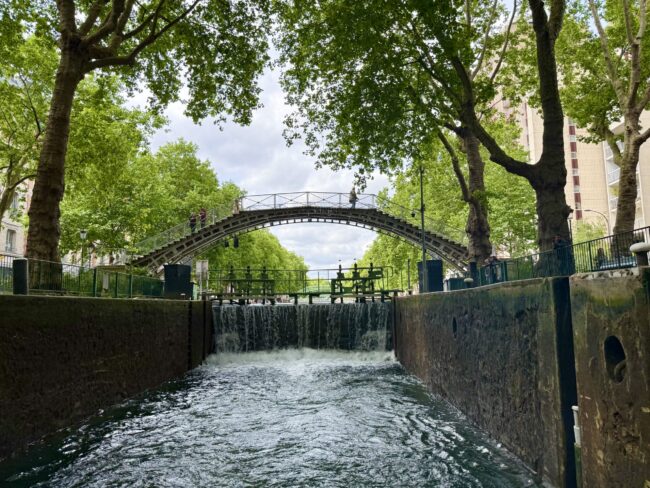
The Canal Saint Martin. © Meredith Mullins
The Paris Waterways
With a timeless river like the Seine interwoven into Paris life for centuries, boats and bridges have become an integral part of the landscape.
You can stroll along the quais or enjoy one of the many boat options, from the bargain Batobus to luxury boats serving lunch or candlelit dinners. You will always benefit from a unique water-level perspective.
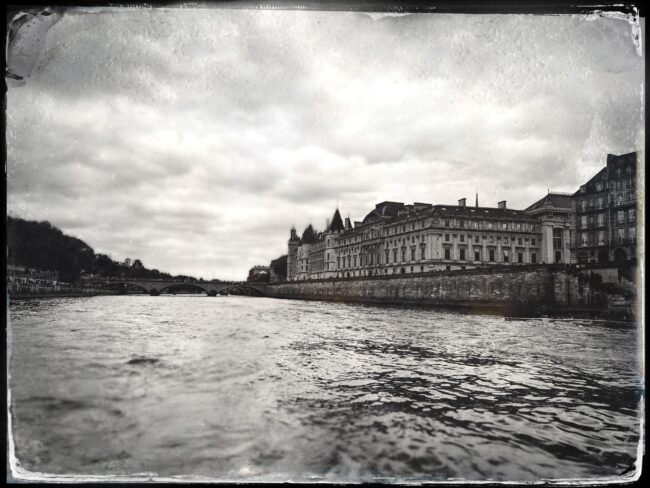
The Conciergerie from Seine-river level (where Marie Antoinette spent her final days before execution). © Meredith Mullins
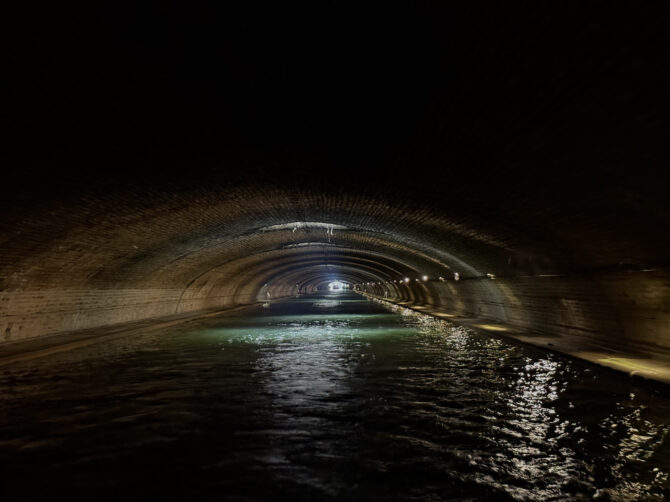
The Paris Canal Cruise, however, is unique. The journey shows you the iconic Seine-side monuments, but also travels through the 2.5–mile Canal Saint-Martin, with its nine locks built under Napoleon Bonaparte’s rule. Add to that a few mysterious kilometers in the tunnel waterway beneath the Bastille area and Boulevard Richard–Lenoir, and you have one of the most interesting and relaxing cruises in Paris.
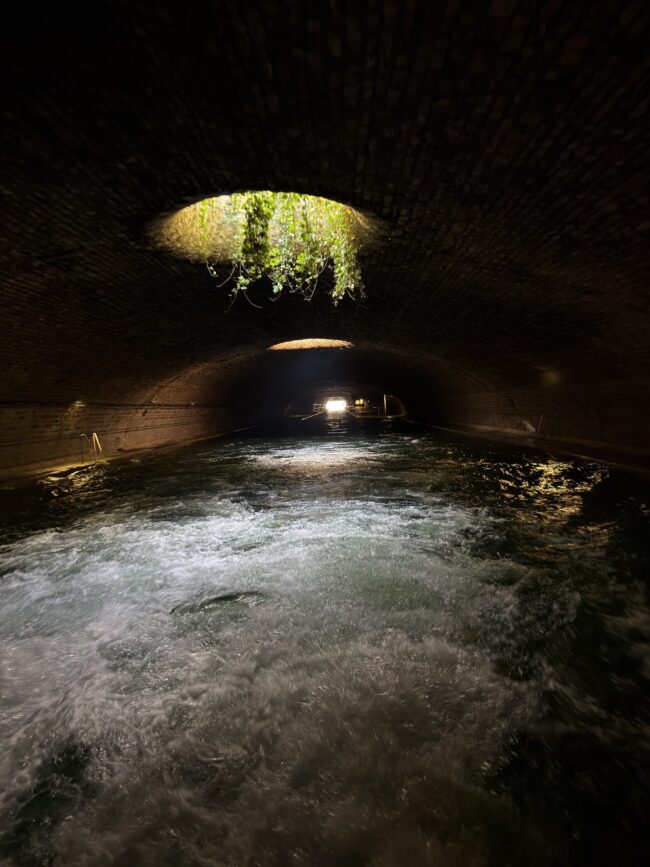
The mysterious tunnel waterway beneath the Bastille area and Boulevard Richard-Lenoir. © Meredith Mullins
The Paris Canal Cruise
There are several companies offering canal cruises, but the one featured in this article departs from either the Musée d’Orsay or the Parc de la Villette.
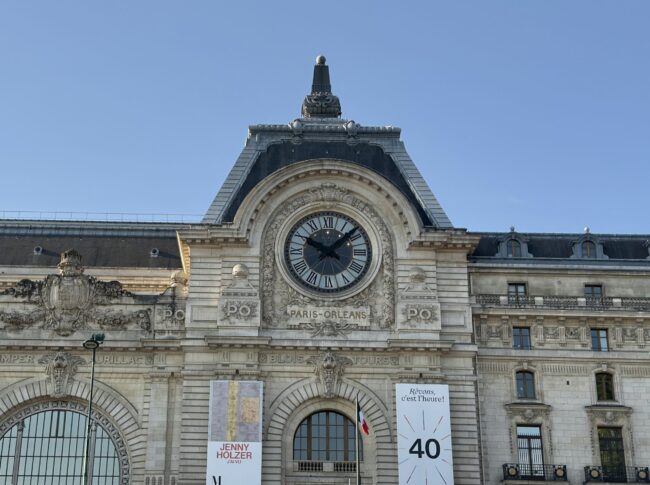
The iconic Musée d’Orsay clock. © Meredith Mullins
In either direction, you will cruise along the Seine, passing the most famous icons at an engine-churning clip. There is the Louvre, where the guide points out the window that allowed the jewel heist of 2025; then the Île de la Cité with its sweeping, weeping willows of the Square du Vert-Galant, the Pont Neuf (the oldest bridge in Paris), the Conciergerie (perhaps most famous as the prison where Marie Antoinette spent her final 10 weeks before execution), and Notre-Dame de Paris at the eastern tip of the island (still surrounded by cranes and scaffolding). Finally comes the quieter elegance of the Île Saint-Louis.
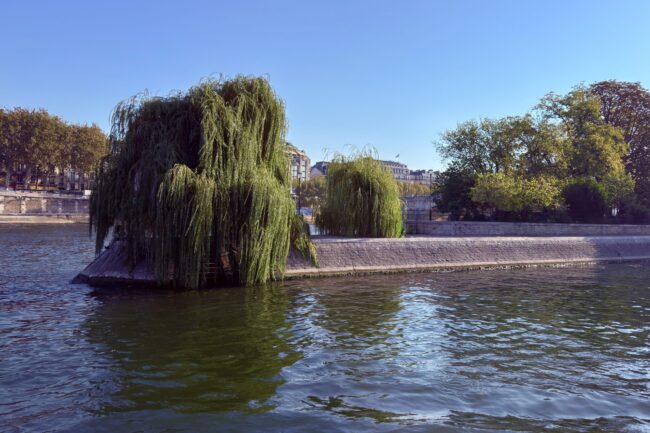
Caption: The graceful weeping willows of the Square du Vert-Galant. © Meredith Mullins
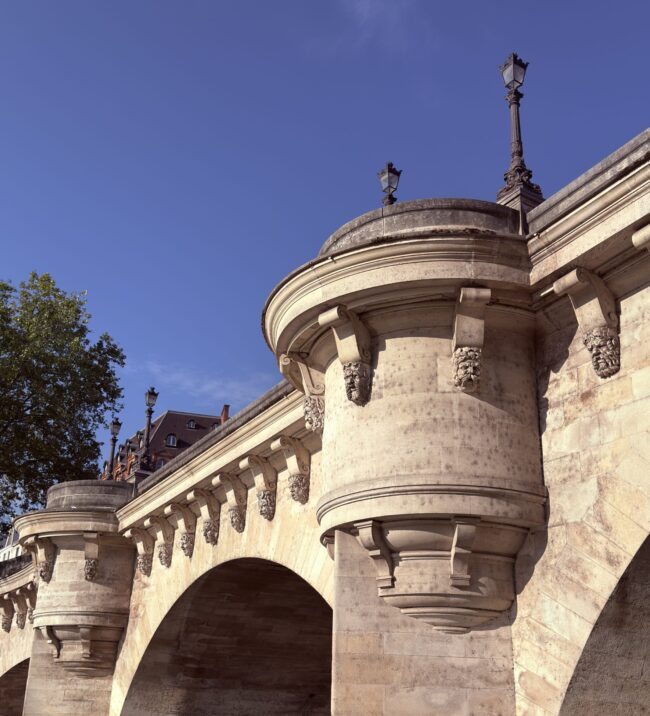
The Pont Neuf (which translates to “New Bridge”) is the oldest bridge in Paris. © Meredith Mullins.
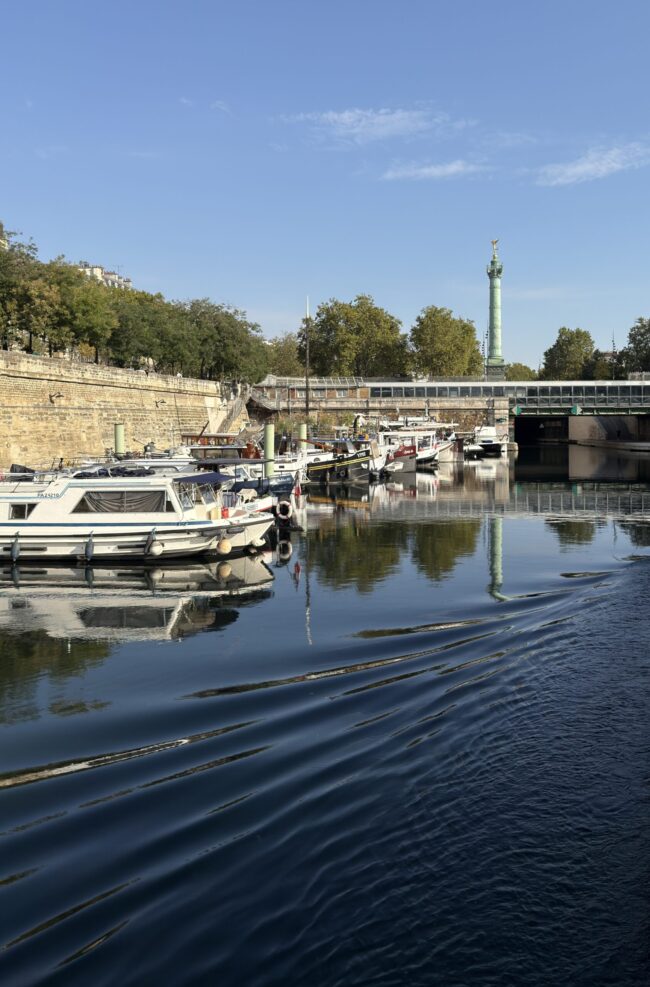
The Seine connects with the Canal Saint-Martin through the Port de l’Arsenal, where you might dream of living on a Paris boat while staring up at the Colonne de Juillet, a monument to liberty.
For some of the journey, the cruise enters into mysterious underground darkness. © Meredith Mullins.
The Canal Saint Martin
The main section of the cruise is the Canal Saint-Martin, built in the early 1800s and opened in 1825. Napoleon Bonaparte ordered the canal’s construction to bring fresh drinking water from the Ourcq River into the city. Water was also needed for sanitation, street cleaning, and firefighting. The canal soon became an important commercial artery, carrying food, building materials, and other goods into a growing city.
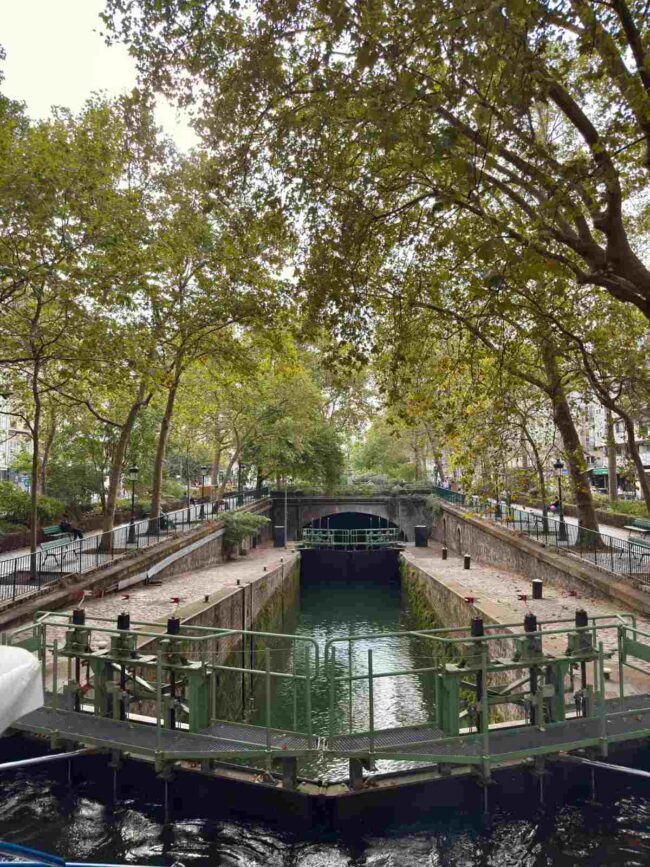
The Canal Saint Martin was built in the early 1800s to deliver critically needed drinking water into the city. © Meredith Mullins
A dramatic change occurred in 1860 when Napoleon III and Haussmann began to reshape Paris. Part of the canal was lowered and covered with a vaulted structure, allowing the creation of the broad boulevard above — today’s Boulevard Richard–Lenoir.
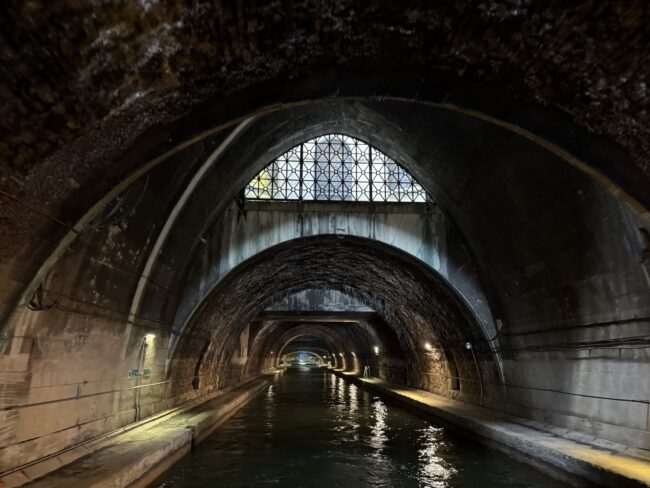
The vaulted portion of the Canal Saint-Martin under Boulevard Richard-Lenoir. © Meredith Mullins
Now, you officially enter (or prepare to leave) the canal near Bastille. You go under the streets of Paris for almost two kilometers, through a dimly lit vaulted underground passage, made even more mysterious and theatrical as the darkness is interrupted by sudden pools of light.
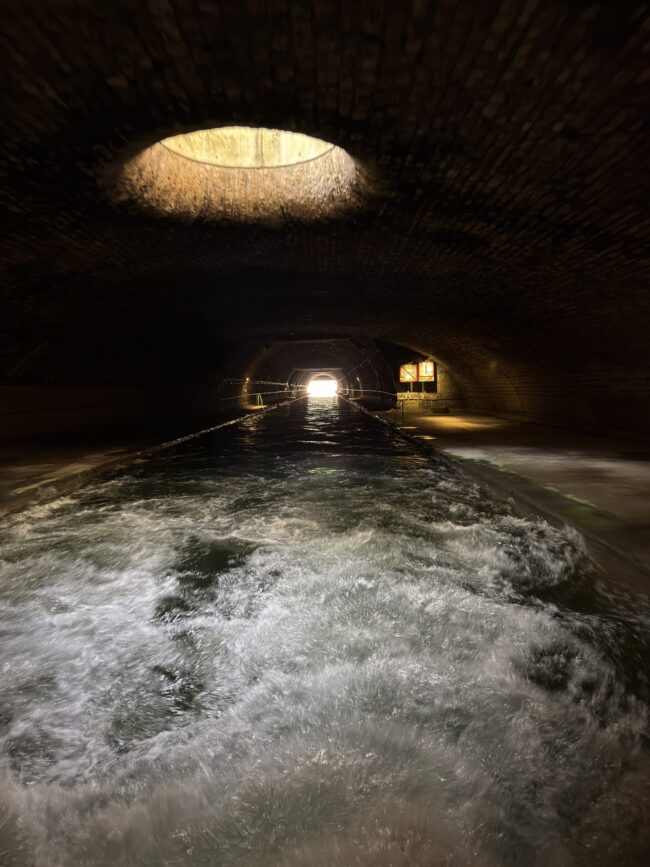
A scene so full of intrigue it has been used in several films, including Tom Cruise’s Mission Impossible/Fallout. © Meredith Mullins
The main section of the canal is the open-air portion, which slows life down a bit, as each of the nine locks (several arranged in pairs) takes time to empty or fill with water— an engineering feat that makes one admire the 19th–century engineers who designed and constructed them.
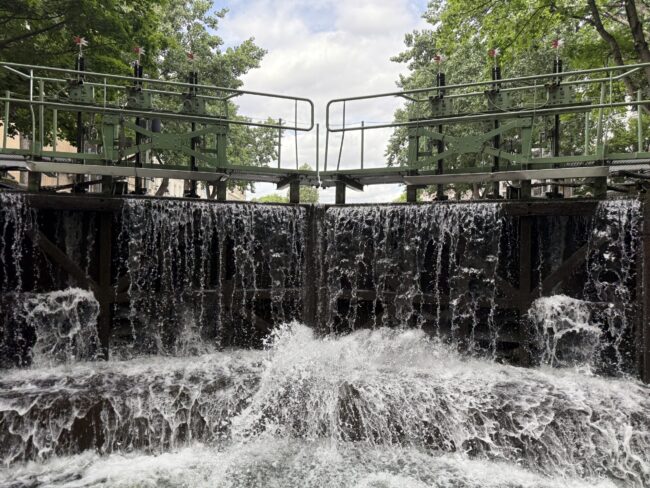
The locks in action—a feat of 19th-century engineering. © Meredith Mullin
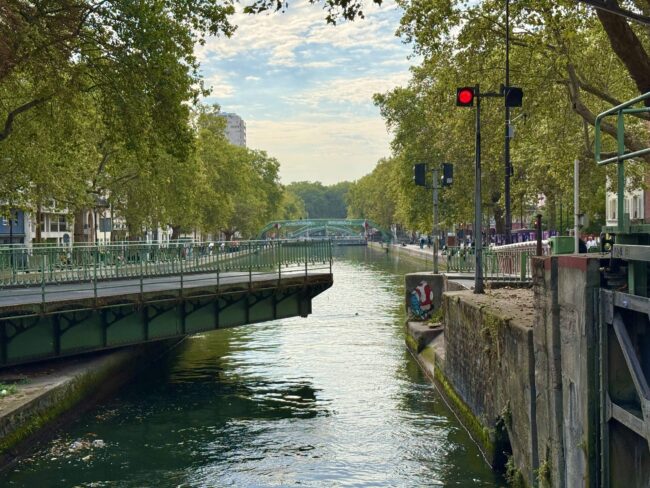
On a nice day, it is lovely to spend time on the canal, with the chestnut trees leaning protectively over the water and the elegant iron footbridges creating graceful arcs, as well as serving as pedestrian passerelles.
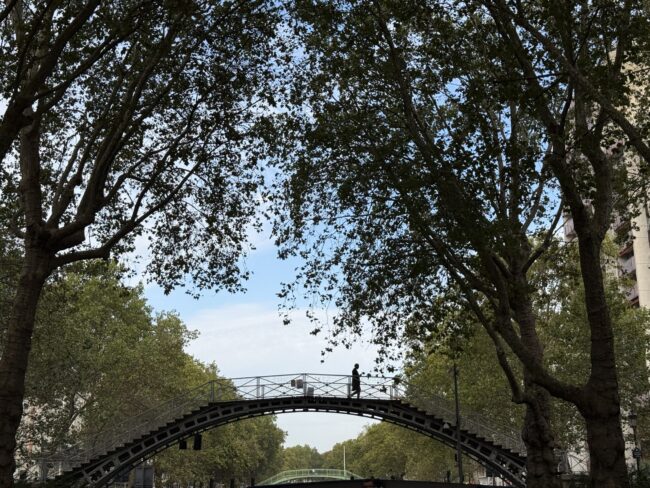
The overarching chestnut trees and iron bridges are an integral part of the Canal Saint-Martin. © Meredith Mullins
There is also something quite meditative about seeing the water power its way through the locks in different formations, all of them beautiful.
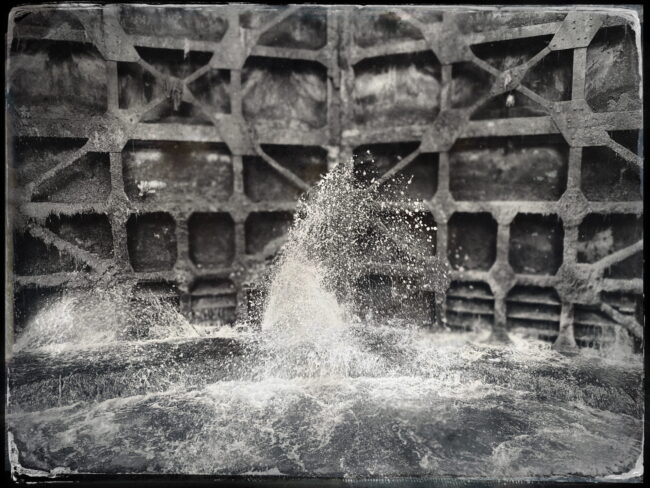
Meditating on the artistry of lock water. © Meredith Mullins
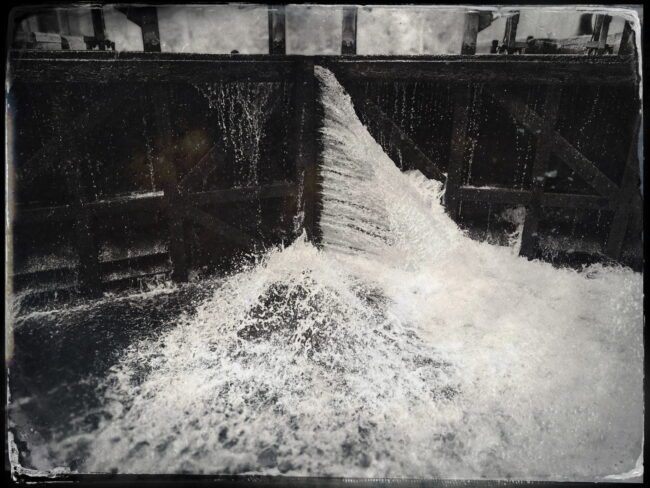
The art of lock water—so many ways it enters the lock. © Meredith Mullins
The good news … if you haven’t quite gotten the engineering gist after the first lock, there are eight more to go.
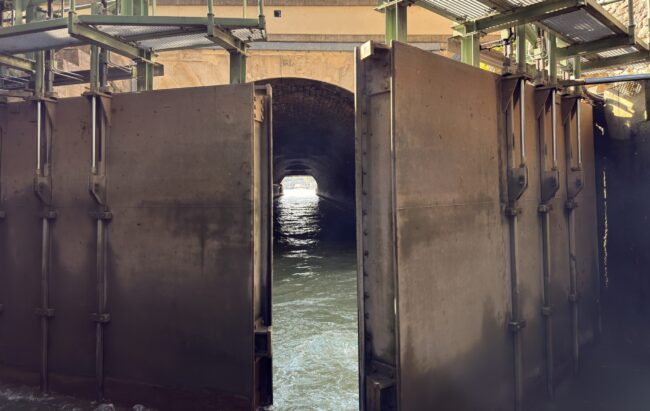
A study of the lock construction. © Meredith Mullins
The other good news is the guide (in our case, the excellent Luc who had a passion for French history and did not look at a note through the whole 2.5-hour journey). He had stories to tell about each of the locks, whose names have connections to Paris places and history.
For example, while in the Écluse des Morts (Lock of the Dead), he shared a few stories related to death — including the punishment for regicide (dismemberment by four horses pulling in different directions), as well as the introduction of the guillotine, which was first used in France in 1792 to provide a cleaner and more egalitarian method of execution. Before that, French execution methods varied by class. We were all glad to move on to “happier” locks.
Throughout the tour, Luc also mentioned the many films that have had scenes or themes related to the Canal Saint-Martin. From the Écluse des Récollets, you will see the famous Hôtel du Nord, immortalized by Marcel Carné’s 1938 film Hôtel du Nord (although the canal and the hotel were recreated in a studio).
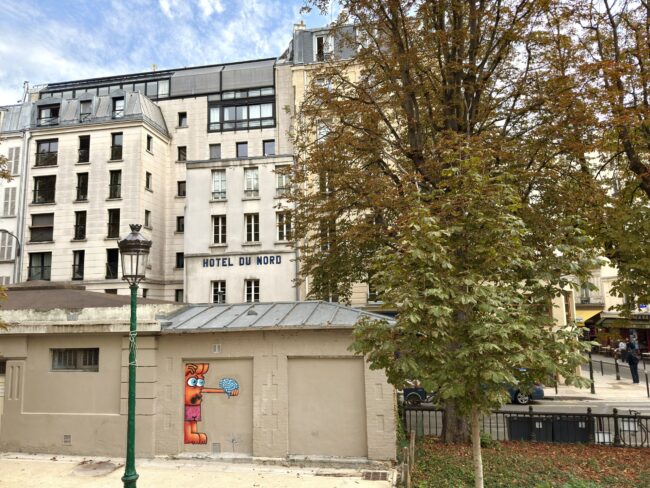
The real Hôtel du Nord, immortalized in the famous 1938 French film. © Meredith Mullins
You will also see the lock–crossing bridge where Amélie skipped stones in the 2001 film Le Fabuleux Destin d’Amélie Poulain (although Audrey Tautou couldn’t master the art of skipping stones, so that effect was added digitally).
A swing bridge on the canal that seems to indicate that Invader was here. (For all you Space Invader addicts, it only shows when the bridge is open.) © Meredith Mullins
A Unique Way to Spend a Few Paris Hours
Paris reveals itself differently from the water. But the Paris Canal Cruise adds another dimension as it travels beneath the city, rises and falls through its locks, and introduces neighborhoods that many visitors have not seen from this perspective. For a few hours, familiar Paris gives way to another Paris — timeless, unexpected, and still surprisingly secret.
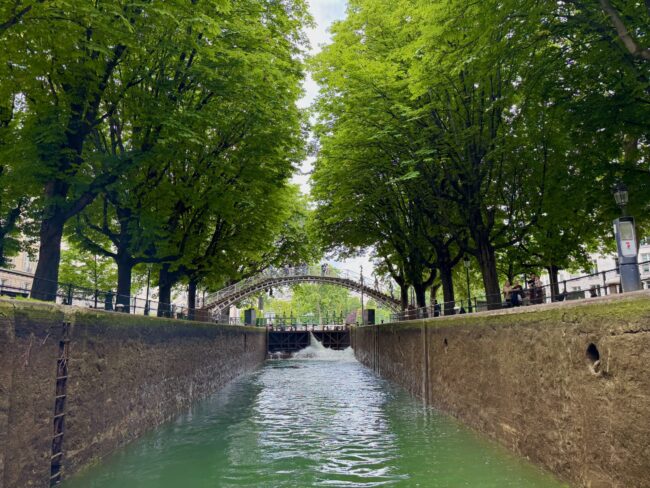
The Timeless Paris Canal Cruise. © Meredith Mullins
Special Note: I find the north to south passage (embarking at Parc de la Villette) more interesting for the action of the locks. It’s easier to see from the back of the boat. It should also be noted that not everyone can “meditate” on the artistry of the locks for all nine locks. Come with friends.
More information on the Paris Canal Cruise.
Several other canal cruises offer excursions, including Canauxrama.
Lead photo credit : The vaulted underground section of the Canal Saint-Martin. © Meredith Mullins
More in Canal Saint Martin, Napoleon, notre dame, Seine
Related Articles