Autumn Fetes and Fairgrounds in Paris
- SUBSCRIBE
- ALREADY SUBSCRIBED?
BECOME A BONJOUR PARIS MEMBER
Gain full access to our collection of over 5,000 articles and bring the City of Light into your life. Just 80 USD per year.
Find out why you should become a member here.
Sign in
Fill in your credentials below.
The Neuilly Fair, also known as the Fête à Neu-Neu returns to the Bois de Boulogne in Paris until October 11, 2026. Every year, this vast, temporary amusement park sets up on the western outskirts of Paris and keeps the holiday mood going weeks after la rentrée.
Families will find swings, slides, bumper cars, and fun houses here as well as and thrill rides designed to pump your adrenaline or make you lose your lunch. There are over 60 attractions plus ranks of stalls, where games of skill are designed to separate you from your Euros. This year most of the special events focus on internationally known cartoon characters. One weekend will feature Mario and Luigi, the next Playmobil pirates, and then Pokémon is followed by the ever-so blue Smurfs.
La Grande Roue is a towering, traditional Ferris wheel offering panoramic views above and beyond the lakes of the Bois de Boulogne to the Eiffel Tower. Adding to the festive atmosphere are strolling musicians, stilt-walkers and very rare fortune-tellers, touted as being among the last remaining classic fairground clairvoyants in France.
The Fête de Neuilly, nicknamed years ago by locals as the Fête à Neu-Neu (rhymes with bleu bleu), is one of the oldest fun fairs of the Île-de-France region, and second only in size to the Foire du Trône, which is a springtime event in Paris. Fête à Neu-Neu is yet another example of how Paris drips with history. Requested by the mayor of Neuilly, the fair was signed into creation by Napoleon Bonaparte on June 10, 1815. The festivities quickly grew, and the Neuilly fair was popular with all tiers of society.
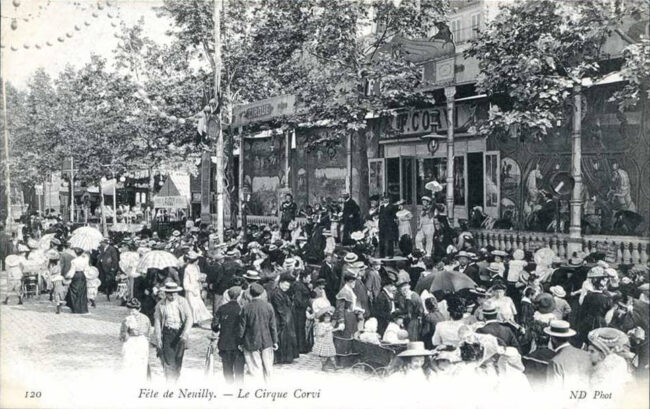
Fête de Neuilly, Le Cirque Corvi, c.1900. Public domain
From the Napoleonic era onwards, the Neuilly fair yearly attracted hundreds of thousands of visitors, all eager to try out the rides, stroll the hundred plus stalls, or watch the inexplicable fascinations of the side show.
With the widening of the Avenue de Neuilly in 1936, the festival ceased to be. In 1944, Maurice Chevalier recorded a nostalgic song lamenting the disappearance of this festival. Basically he missed eating pies and lollypops with a girl on his arm.
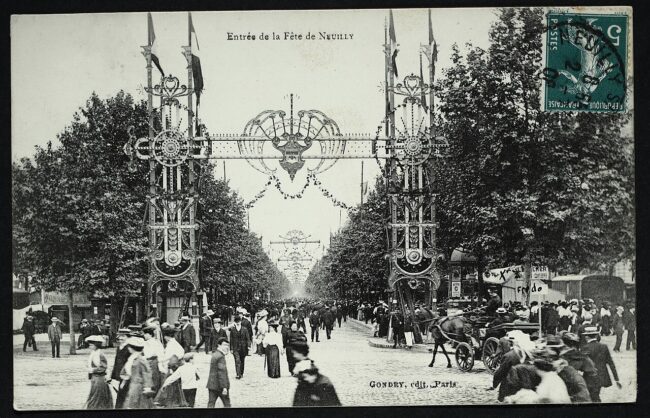
postcard depicting the entrance to the Fête de Neuilly. Public domain
The fair was revived in 1983 thanks to Marcel Campion, known as the “king of the fairground” for his massive influence over Parisian amusements and funfairs. However, little of the original atmosphere of the 19th-century attraction remains. Antique wooden carousels are replaced by the neon thrill of bright pinks and yellows. The oompah of the barrel organ has been replaced by hip-hop. Entrance to the fair is free, but most attractions come with a cost. The fair is only open in the afternoons and evenings. Check ahead on the official website.
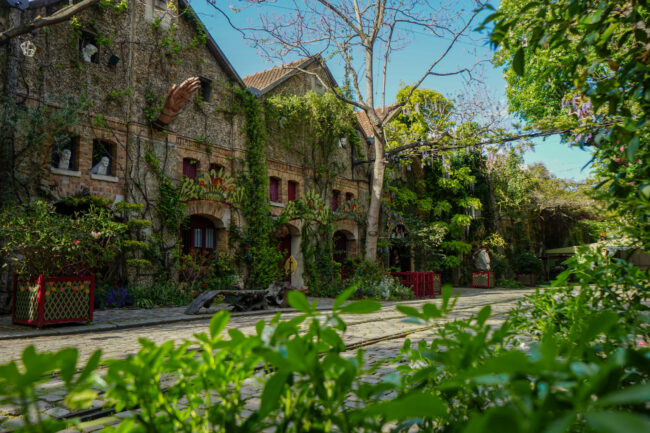
Exterior of Musée des Arts Forains, Pavillons de Bercy. Photo: Wikimedia commons
Yes, the Neu-Neu has modernized, but if you want to experience a Belle Époque fairground when women in ankle-length dresses and gents in boater hats strolled the funfair with their excited children replete with balloons and noisy kazoos, make sure to head to the other edge of Paris to see the displays at the Musée des Arts Forains. For people like me, dizzy at the very thought of carnival rides, it is the perfect museum.
Way, way off the beaten tourist path in the 12th arrondissement, the Musée des Arts Forains is celebrating its 30th anniversary this year. It is a museum made magical by a devoted collector of fairground curiosities some dating as far back as 1830. There are gentle rides, including a life-sized carousel, and a steam powered velocipede ride – a merry go round of gleaming, polished bicycles powered by willing visitors.
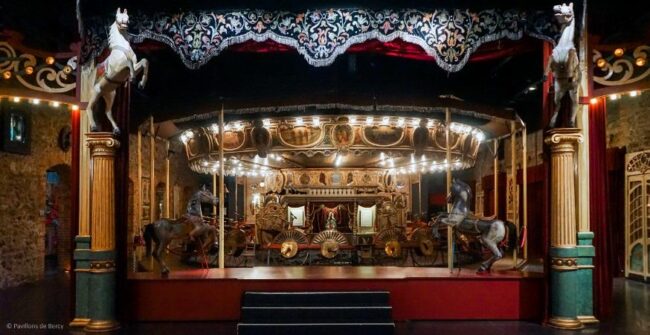
Manège de vélocipèdes, Musée des Arts Forains. Wikimedia commons
Audiences can participate in a variety of sideshow games involving horses, jockeys, even a derby of waiters based on the classic real-life Montmartre waiters’ race.
On hand are thousands of examples of fairground trimmings and detailed trappings, rich with the patina of 200 years. Distorting mirrors, mind-bending hybrids, flying pigs and elephants, and truly uncanny automatons add to the carnival theme.
The Musée des Arts Forains is a quieter, gentler antidote to the 21st-century fun fair.
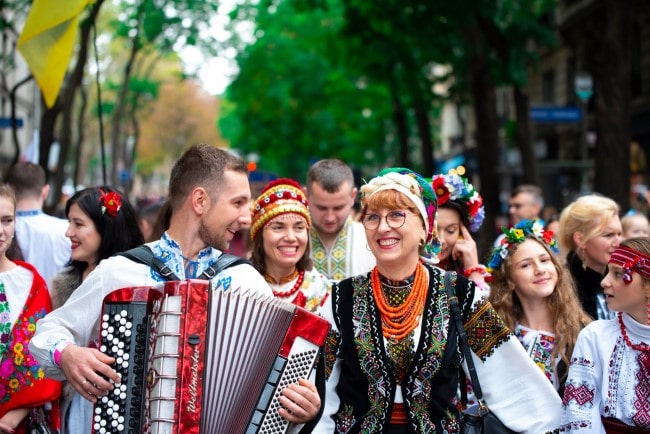
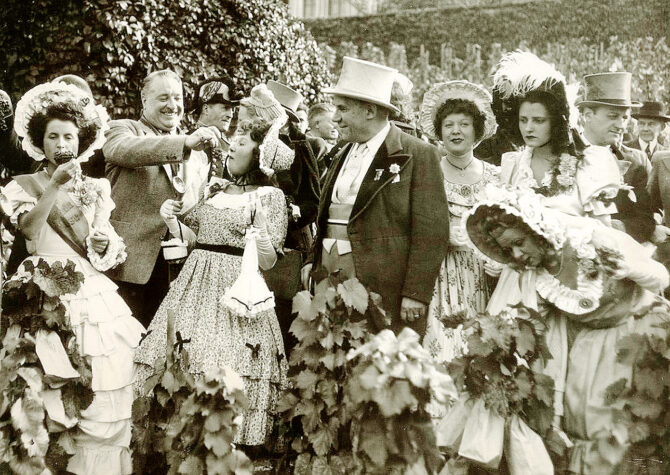
Festive activities at the wine harvest. Credit: Fête des Vendanges de Montmartre/ Facebook
To get back outside in the hopefully more temperate October air, let’s do the Fête des Vendanges de Montmartre (October 7–11, 2026) in its 93rd edition.
The Fête des Vendanges is a massive 5-day neighborhood celebration in the 18th arrondissement honoring the city’s last working vineyard, left to flourish for 11 months of the year on a quiet hill behind the Musée de Montmartre. This small defiant vineyard known as the Clos Montmartre is found at the corner of rue des Saules and Rue Saint Vincent.
The wines it produces are a locavore’s dream. During the autumn harvest, it is anticipated that this fraction of an acre will yield 1700 demi-sized bottles. Sold at auction, the previous year’s vintage raises money for local charities.
Festive activities. Credit: Fête des Vendanges de Montmartre/ Facebook
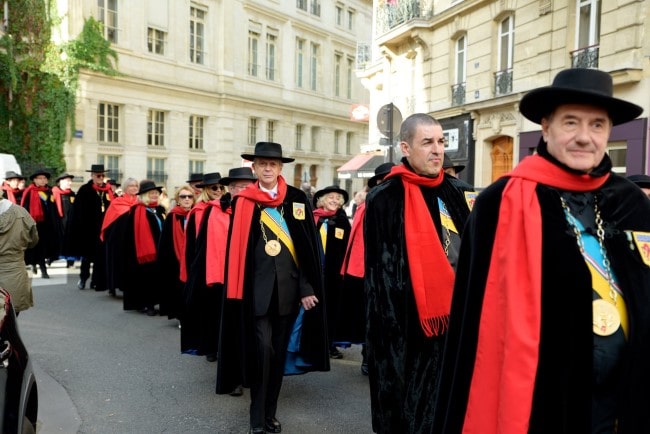
Le Clos Montmartre is only open to the public during La Fête des Vendanges. A whopping 400 – 500,000 attendees come to the slopes of Montmartre to enjoy this family-friendly bacchanal centering on the folklore of harvest time. In the so-called last village in Paris, expect to find food stalls boasting culinary specialities, wine tastings, brass bands, and a grand parade.
Running the show is a micronation called the Republique de Montmartre – members are distinguishable from the throng by wearing the outfit of Montmartre denizen, Aristide Bruant, immortalized by Toulouse-Lautrec in a red scarf, black cape, and floppy hat.
The wine events of the 2026 Fête des Vendanges are tied into the theme, “The 18th Arrondissement Leads the Beat” (Le 18e donne le rythme), celebrating music as a universal language. On October 7, the 93rd edition kicks off at the 18th arrondissement town hall, at 1 Place Jules Joffrin, with a festive evening of choirs and concerts paying tribute to the grape harvest and to Montmartre itself, with poetry and song. Be prepared for flash mobs.

Fête des vendanges. Photo: Erwan Floch/ Mairie Paris
October 8 is the Neon Night Run consisting of 5 km through the districts’ steep streets. For the seasoned runner or a casual jogger, it’s a friendly, non-competitive race open to anyone. Neon is worn to glow in the night.
Compared to the Neon Run, the Parcours de Gout (October 9-11) is a literal walk in the park. At the foot of Sacré-Cœur, the renowned “Taste Trail” will feature roughly 100 producers and winemakers gathered to sell their specialities. There’s lots of free sampling to be had. Friday night at the Grand Parquet, the urban symphony Fanfare Clandestine will turn the neighborhood into an outdoor stage as the musical procession winds its way through the streets, making many stops to involve residents young and old, and to draw in curious onlookers.
The Harvest Proclamation happens on Saturday, October 10 at 9:45 am at the Clos Montmartre. The parade carrying with it this year’s grape harvest winds through the steep and picturesque avenues to Montmartre’s town hall. Dressed in vibrant traditional costumes, the marchers include historic wine brotherhoods (confréries), folk music groups, brass bands, international delegations, and local neighborhood associations.
The closing dance begins on Sunday, October 11 at 4:30 at Square Louise Michel to a multi-generational assortment of music spun by DJs. At days-end, fireworks visible through out much of Paris, will silhouette the cathedral of Sacré Coeur.
All events are free-of-charge unless otherwise stated, so please have a look at the detailed program for further information.
Lead photo credit : Fête des vendanges à Monmartre 1939, old postcard. Public domain
More in Fête à Neu-Neu, Fête des Vendanges, Montmartre, Musée des Arts Forains
Related Articles