
Unraveling the Mysteries of the Panthéon

- SUBSCRIBE
- ALREADY SUBSCRIBED?
BECOME A BONJOUR PARIS MEMBER
Gain full access to our collection of over 5,000 articles and bring the City of Light into your life. Just 80 USD per year.
Find out why you should become a member here.
Sign in
Fill in your credentials below.
I found the Panthéon a tad confusing until the self-guided audio tour proved a welcome chance for me to unravel its mysteries. I spent about 90 minutes exploring all its nooks and crannies wearing a headset which provided a historical overview and lots of fascinating stories, and I finally understood those most basic questions, what is it and why is it so fundamental to French culture?
Is it a church? If not, why does it look like one, at least in parts? What draws everything together in a place where St Denis and Voltaire seem equally revered, where what looks like an altar turns out to be a monument to the French Revolution? There’s no immediate answer because in fact it has been both a place of worship and a secular site honoring the country’s great citizens and – more confusingly still – it has been each of those things more than once!
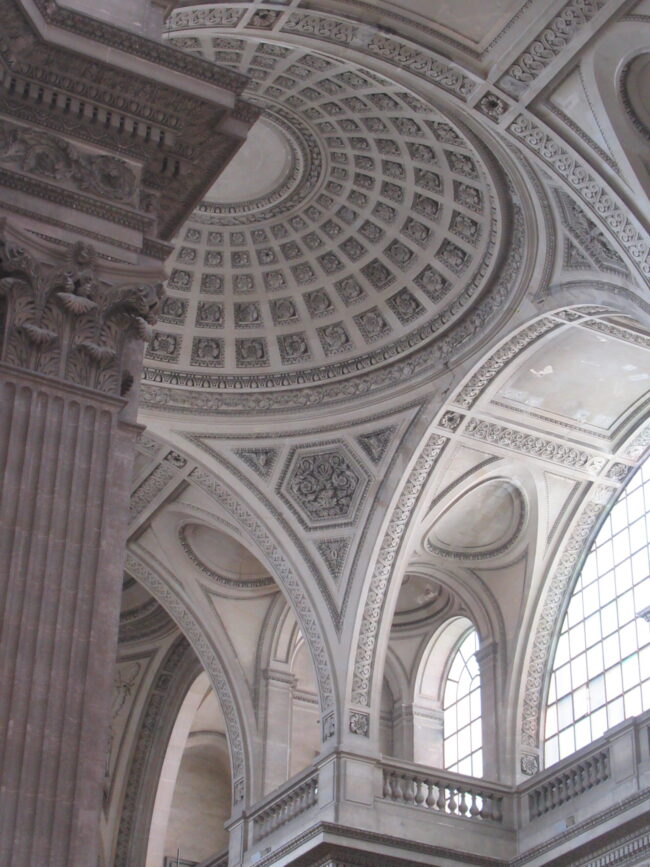
Ceiling detail inside the Panthéon. Photo: Marian Jones
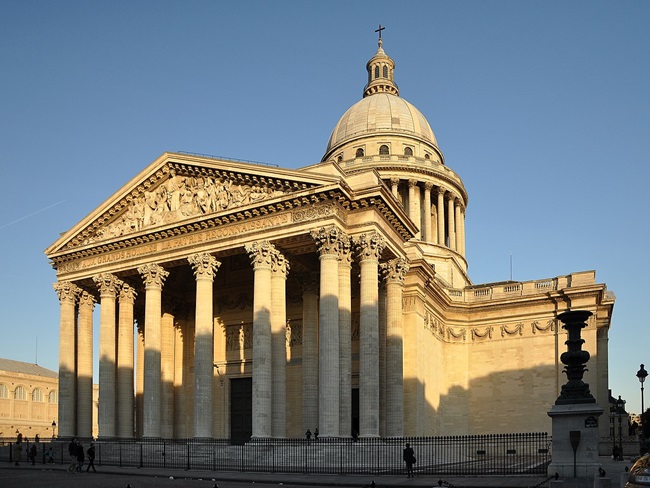
The Pantheon’s own website has a section labeled “church or secular site?” which explains that because of various political changes, “the function of the building has evolved no fewer than six times.” Two key facts serve as an overall summary. Firstly, it was built as a church by Louis XV in gratitude for his recovery from illness and dedicated to Sainte Geneviève, the saint to whom he had prayed that his life be spared. After a 20-year campaign to raise the money needed, Louis himself laid the first stone in 1764.
Secondly, at the height of the French revolution, the National Assembly voted to convert the building into a monument to the country’s “great men.” Various political changes meant that it alternated between the two, being, for example a church under the restored Bourbon monarchy in 1814, a “temple of humanity” during the Second Republic from 1848, and a church again under Napoleon III’s Second Empire. Ultimately, in 1885 when Victor Hugo was laid to rest here after a state funeral, it was definitively established as a secular site, the last resting place for those deemed national heroes. And yes, eventually that included women.
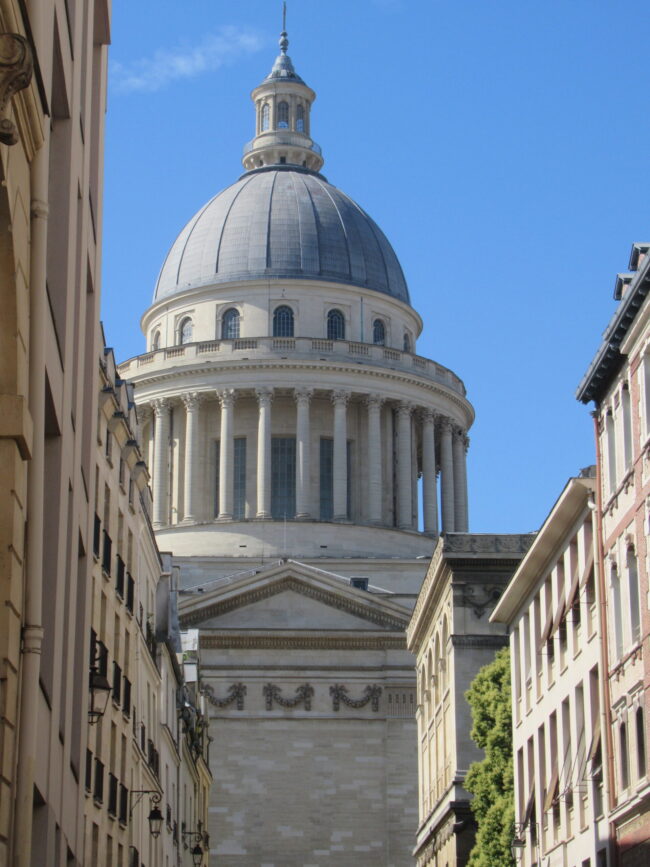
Exterior view of the Panthéon. Photo: Marian Jones
You won’t remember all the dates and details, but a grasp of this to-ing and fro-ing clarifies much of what you see as you go round. It explains why the inside of the building has the shape of a Greek cross and why the ground floor retains the atmosphere of a church even though some of the artwork on display is robustly secular. It means you won’t be baffled by the idea that some of those buried or commemorated in the underground crypt were atheists.
In the crypt, thick walls and pillars holding up the low ceiling create a funereal atmosphere. It has three main galleries where about 80 people are buried, all chosen because they, as the audio guide put it, “embody the values of the republic.” Immediately on entering, I passed the tombs of the first two people buried here, the Enlightenment figures Voltaire and Jean-Jacques Rousseau, choices which underlined the change of thinking after the Revolution. Voltaire, a persistent critic of the Catholic Church, had been denied a Christian burial, but 13 years after his death the newly formed Assemblée Nationale decided to honor him in this newly secular mausoleum.
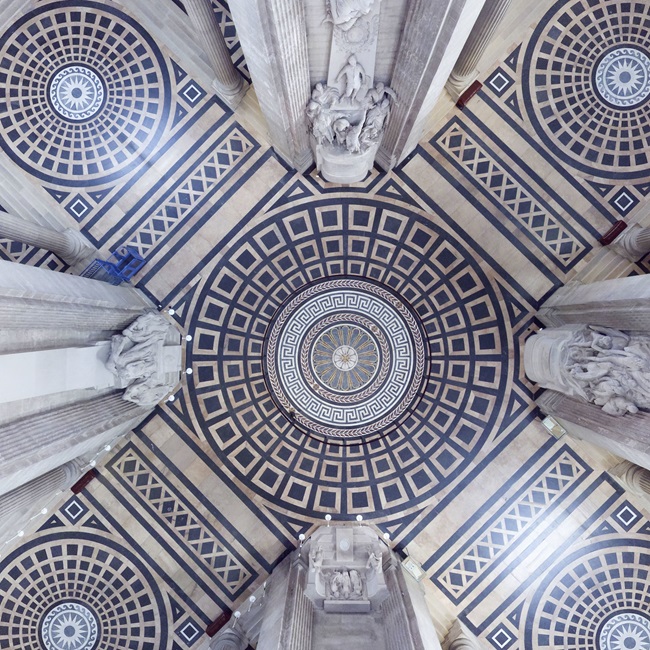
Inside the Panthéon. Photo courtesy of Centre des monuments nationaux
Another group, lying close together, are also highlighted as embodying republican values. The author Victor Hugo was a tireless campaigner for social justice and democracy, retiring into exile for 19 years rather than tolerating the empire of Napoleon III. Similarly, the prolific writer Émile Zola is honored here above all for his commitment to social causes and justice, particularly his defense of Dreyfus, the Jewish army captain wrongly accused of treason. Here too is the socialist prime minister Jean Jaurès, assassinated for his pacifist views on the eve of World War I. The speech made when he entered the Panthéon paid tribute to his lifelong struggle to alleviate “disease, distress and suffering” in society.
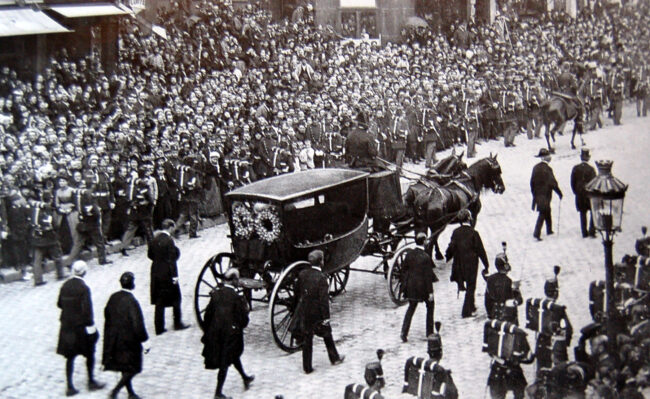
The crowd gathered along the route of the procession, Victor Hugo funeral. Public domain.
A number of tombs honor heroes from World War II, notably Jean Moulin, leader of the French Resistance, whose ashes were transferred here in 1964. The speech made on that occasion lauded his heroism, especially after his capture and torture by the Nazis, when he died without giving away any of his comrades. Addressing the assembled crowds, the Minister of Culture, André Malraux, explained that Moulin “never let fall a word of betrayal ….. his face was the face of France.” A nearby plaque commemorates all those who strove to shelter Jews in Nazi-occupied France, many of them unknown citizens who took huge risks to uphold the French values of “justice, tolerance and humanity.”

Tomb of Joséphine Baker in the Panthéon. Photo: Benoît Prieur / Wikimedia commons
Women honored in the pantheon include the Resistance fighters Germaine Tillion and Geneviève de Gaulle-Anthonioz, both of whom survived concentration camps and went on to fight for other causes, campaigning against poverty and the use of torture by French forces, for example. Simone Veil, also a concentration camp survivor, is honored for her political achievements, including becoming president of the European Parliament, but also for her work in preserving the memory of Holocaust victims. Josephine Baker, best known as a singer, was honored primarily for her role in the Resistance and, after the war, as a civil rights activist. She was, said President Macron, “an exceptional figure who embodied the French spirit.”
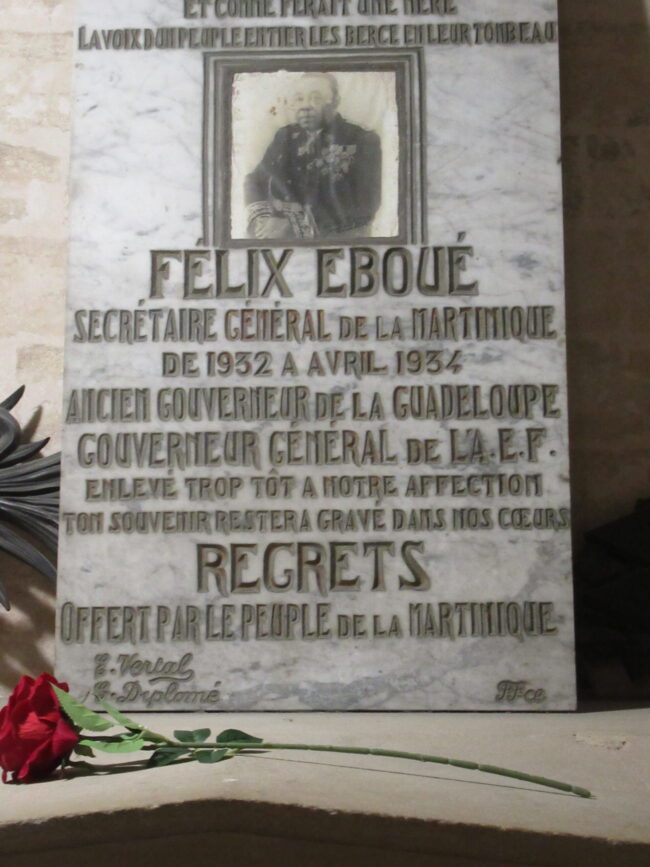
Plaque recognizing Felix Éboué. Photo: Marian Jones
A number of those honored represent France’s colonial past. Felix Éboué, pantheonized in 1949, was the first Black man to hold a high position in the French colonies, and as governor of Chad in 1940 he played a key role in the support of Free France under General de Gaulle. Near him lies Victor Schœlcher, transferred here on the same day as Éboué and honored as the man who drafted the 1848 bill which abolished slavery in the French colonies. Nearby is a plaque to Aimé Césaire, the poet who represented Martinique in the Assemblée Nationale for over 50 years, championing civil rights in the overseas colonies and founding the influential Négritude movement.
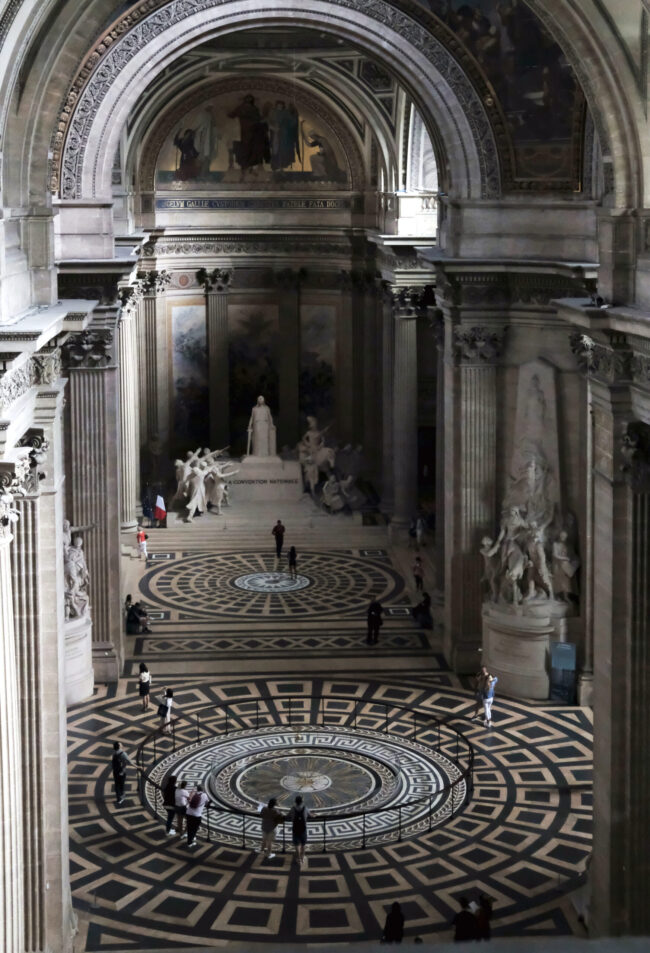
The nave of the Pantheon and Foucault’s pendulum. Photo: Mbzt / Wikimedia commons
The audio guide provided lots of useful context on the crypt, but proved even more useful in the main body of the building, where the layout and artworks can seem rather random. The themes vary, some religious, as appropriate to the building’s origins as a church, others referencing France’s history. To add to the possible confusion, a scientific experiment is prominently highlighted right in the middle of the space, where the four arms of the cross meet. That’s because the physicist Léon Foucault conducted his famous pendulum experiment here in 1851, proving that the earth spins on its own axis.
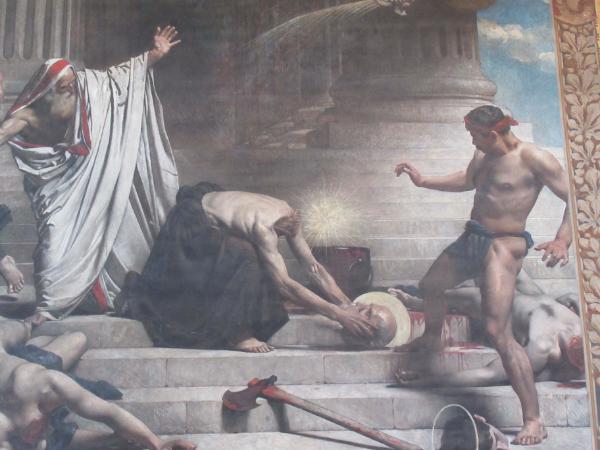
St Denis painting in the Panthéon. Photo: Marian Jones
One of the first paintings you see, prominently sited behind the audio guide collection desk, is a large depiction of St Denis, placing his severed head on the ground just where the Basilique St Denis was to be built. Sainte Geneviève is represented too, painted performing miracles in one work and shown on her deathbed in another. A series painted in the 19th century shows scenes from the life of Jeanne d’Arc and is said to have been commissioned to raise French morale after defeat by Germany. “Who better,” reads the accompanying text, “to restore hope to the country?” A painting of St Louis, dating from the 1870s, shows the one-time king of France holding court with some of his subjects, underlining his renowned commitment to justice.
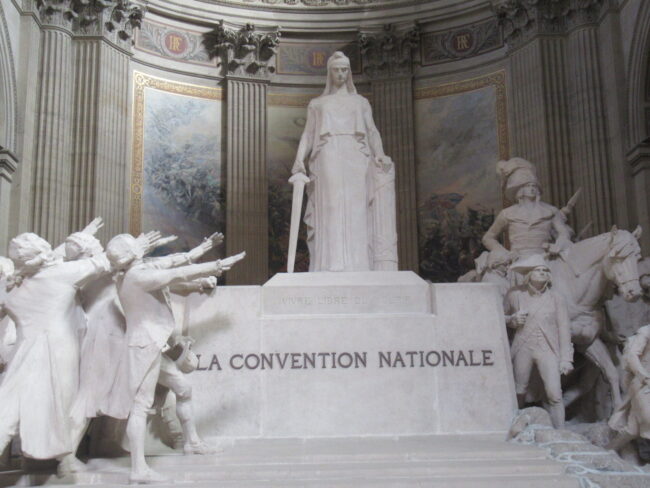
“La Convention Nationale” statue in the Pantheon. Photo: Marian Jones
The Revolution is another key theme. Particularly prominent, just where the altar would be if the building were still a working church, is a group statue called La Convention Nationale, depicting the first French government to rule after the monarchy had been abolished in the revolution. It’s a striking monument to republican values, showing the central figure of Marianne, symbol of the French Republic, with representatives of the Convention swearing their loyalty to her on one side and some of the republican soldiers who deposed the monarchy on the other. Statues elsewhere are reminders of the complexity of French history. One is titled “To the glory of the Generals of the Revolution,” another “To the Orators and Writers of the Bourbon Restoration.”
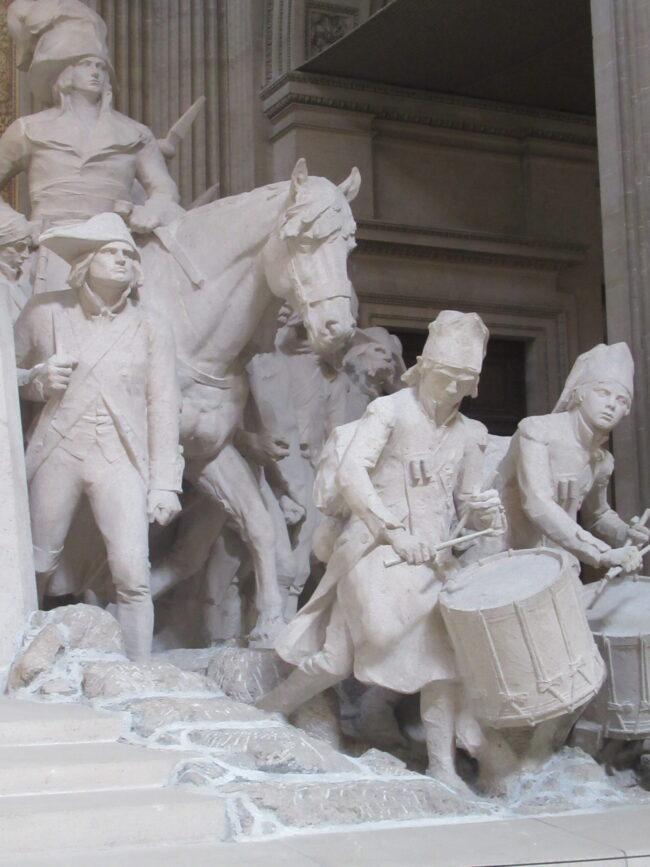
Detail of La Convention Nationale statue, Pantheon. Photo: Marian Jones
Artworks are still commissioned for display here in the Pantheon. For example, in 2020 when the writer Maurice Genevoix was honoured here, the artist Anselm Kiefer was commissioned to mark the occasion. The six display windows he created aimed to “evoke the reality of the Great War,” thus paying tribute both to Genevoix’s work and, more widely to all those who suffered the war’s consequences. Inside one glass case, the desolation of the battlefields is depicted through pieces of debris amid stalks of wheat, while others contain quotations from Genevoix’s book The Men of 1914 and a moving display of broken poppies.
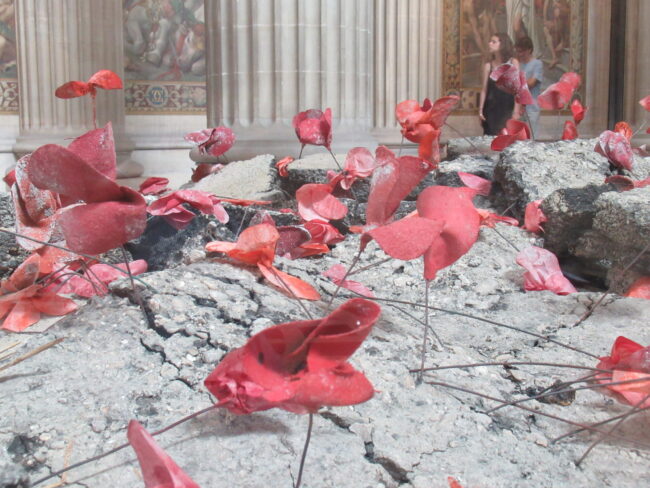
Artist Anselm Kiefer’s poppies at the Pantheon. Photo: Marian Jones
I fully recommend using the audio guide, available in 10 languages including English, when you visit the Pantheon. The extra cost, just 5 euros, is well worth it because it makes for a much more meaningful visit. You will emerge much clearer on everything to do with one of the most iconic buildings in Paris, understanding the main sweep of its history and, perhaps more importantly, clear on how the French Republic sees itself and what values it most wants to see honored.
DETAILS
Place du Panthéon, 5th arrondissement
Nearest metro stations Maubert-Mutualité or Cardinal Lemoine (Line 10), Place Monge (Line 7)
Open daily
1 April to 30 September 10 am – 6:30 pm, standard entry €16
1 October to 31 March 10 am – 6 pm, standard entry €13
Audio guide (available in English) €5
Lead photo credit : The Panthéon. Photo Credit: Moonik/ Wikimedia Commons
More in Jean Moulin, Jean-Jacques Rousseau, josephine baker, Panthéon, victor hugo, voltaire
Related Articles

By Marian Jones