
The Paris Love Affair with Céline Dion

- SUBSCRIBE
- ALREADY SUBSCRIBED?
BECOME A BONJOUR PARIS MEMBER
Gain full access to our collection of over 5,000 articles and bring the City of Light into your life. Just 80 USD per year.
Find out why you should become a member here.
Sign in
Fill in your credentials below.
Paris has always had a song to sing. From the smoky cabarets of Montmartre to the grand stages of the Olympia, music has drifted through the French capital for generations. Edith Piaf gave the city its voice, Jacques Brel brought its streets to life, and countless singers have since left their mark on its concert halls, theaters and café terraces.
Yet among the many international voices to have crossed the Atlantic, one particular singer has captivated French hearts: Céline Dion.
It might seem like an unlikely love affair. Céline Dion was born and raised in Québec, thousands of miles from Paris, and became a global superstar singing in both French and English. Yet France discovered her long before the rest of the world did. After more than four decades, the affection between the singer and the country remains unmistakable.
There was not a more fitting place for Dion to make her long awaited return to the stage. After six years away from giving live performances, she returned to the French capital in September 2026. But her relationship with the city began long before the latest chapter, when she was still a teenager with a remarkable voice and an unfamiliar name.

Céline Dion performing. Photo credit: Tom Rose, Shutterstock
France discovers Céline
Dion was just 14 when she first appeared on French television, singing D’amour ou d’amitié on Michel Drucker’s Champs Élysées in 1982. The program was one of France’s biggest television shows, bringing music and entertainment into living rooms across the country.
The following year, Dion became the first Canadian artist to receive a gold record in France. Her success was not simply down to speaking formidable French. There was something in the emotion and intensity of her voice that seemed to resonate with a country steeped in the tradition of chanson.
One of the people who helped shape that early French career was Eddy Marnay, the French lyricist who worked with Dion from the beginning. Marnay had written for artists including Édith Piaf and Yves Montand, connecting the young singer from Québec to an older generation of French musical culture.
Then came Paris itself.
A teenager at the Olympia
In October 1984, aged just 16, Dion performed at the legendary Olympia for five weeks, opening for French entertainer Patrick Sébastien.
The Olympia, with its famous red neon sign glowing over the Boulevard des Capucines, is one of those Parisian places where music history seems to linger in the walls. Piaf had performed there. So had generations of France’s greatest singers.
For Dion, standing on that stage as a teenager from Québec was a remarkable introduction to the city. It also marked an important shift. France was not simply discovering a foreign singer who happened to perform in French. Dion was beginning to find her place within the country’s musical tradition.
Eurovision takes her to Europe
By the time Dion represented Switzerland at Eurovision in Dublin in 1988, French audiences already knew her.
Eurovision was therefore not where she was discovered, but it was a major international turning point. She performed Ne partez pas sans moi and won the competition by a single point, suddenly bringing her voice to millions of viewers across Europe.
While the rest of Europe was only just discovering Céline Dion, France already knew her well.
That early connection would prove important as her career expanded internationally. While the world came to know the powerhouse behind My Heart Will Go On, France continued to know another side of Dion: the French-speaking singer who had grown up with chanson and never left it behind.

Grand staircase of the RMS Titanic recreated for the Titanic: The Exhibition. Photo credit: Chicago Photographer, Shutterstock
The French songwriters who made Céline’s music their own
Perhaps the strongest evidence of Dion’s relationship with France can be found in the French artists and songwriters she worked with. In 1995, Jean Jacques Goldman wrote much of D’eux, one of the defining albums of Dion’s career. Goldman was already one of France’s most respected singer songwriters, and his intimate, emotionally charged writing gave Dion a new French repertoire.
The album produced Pour que tu m’aimes encore and Je sais pas, songs that became enduring favorites with French audiences. Rather than simply translating the style of her English language hits, Goldman created songs that belonged naturally to the French musical tradition. The partnership continued with S’il suffisait d’aimer in 1998.
Dion also worked with other French and francophone songwriters, including Luc Plamondon and Jacques Veneruso, while recording songs connected to some of the great names of French chanson. She performed Jacques Brel’s Quand on n’a que l’amour and, decades later, would return to the music of Piaf.
It was a two-way relationship. France gave Dion some of its finest songwriting, and Dion carried those songs far beyond France. In 1996, she won two Victoires de la Musique, including “Female Vocalist of the Year” and “Song of the Year” for Pour que tu m’aimes encore. By then, she had become firmly established within the French music scene.
From the Olympia to the Stade de France
Her Paris stages grew with her fame. After the intimacy of the Olympia came Le Zénith, where Dion recorded Live à Paris in 1995. The album captured her performing French repertoire to a Parisian audience, including Brel’s Quand on n’a que l’amour.
A few years later, the scale was very different. In 1999, Dion performed two concerts at the Stade de France, attracting around 180,000 people across the two nights. It was an extraordinary journey from that teenage appearance at the Olympia to filling one of France’s biggest stadiums.
Why France loves Céline
Perhaps the secret of Dion’s relationship with France is that French audiences knew her before the rest of the world did. She continued her French love affair through recording in French, working with French songwriters and performing songs from the country’s musical heritage. Her voice was enormous, but so were her raw emotions of love, heartbreak and longing – she gives everything to her performances, a quality that feels particularly at home in the dramatic tradition of chanson.
For French audiences, her French career has never felt like a footnote to her international success. It is part of who she is.

Dion’s 2024 Summer Olympics performance projected at the Arc de Triomphe. Photo: ERIC SALARD / Wikimedia Commons
A song for Paris
At the opening ceremony of the Paris 2024 Olympic Games, Dion stood on the Eiffel Tower and sang Édith Piaf’s L’Hymne à l’amour. Below her, Paris stretched into the summer night. The Seine wound through the city, the rooftops shimmered in the darkness, and the Eiffel Tower became both stage and symbol.
It was a remarkable comeback after years away from live performance, but it was also something more personal. Dion, the young singer once welcomed by French television and the Olympia, was now standing above Paris singing one of France’s most beloved songs.
Piaf’s Paris was one of music halls, cafés, lovers and late night streets. Dion had carried that emotional tradition into arenas around the world. For a few extraordinary minutes, those two versions of French music seemed to meet above the city.
No wonder, that Dion chose Paris for her return to live performance in 2026.
The latest residency is only the newest chapter in a relationship that began more than 40 years ago. Long before the Eiffel Tower, there was a teenage girl from Québec, a French television audience and a stage beneath the red lights of the Olympia.
Céline Dion may have been born thousands of miles away, but somewhere between the Boulevard des Capucines and the Eiffel Tower, Paris became part of her story and she became part of Paris’s.
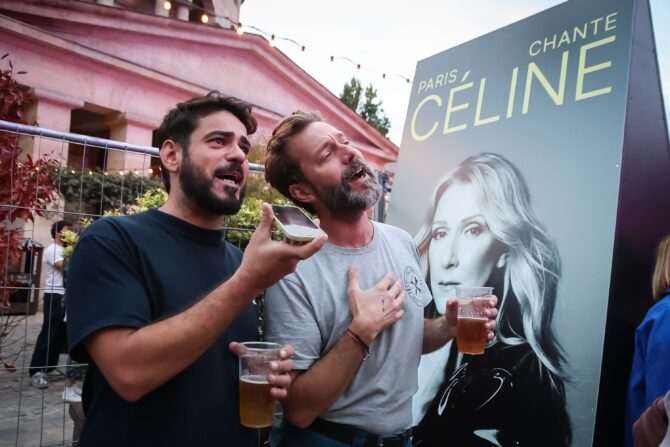
Lead photo credit : Céline Dion fans in Paris. Photo credit: Ninotnan, Shutterstock
More in Céline Dion
Related Articles



By Sophie Lee