
Flâneries in Paris: Explore the Seine Musicale
- SUBSCRIBE
- ALREADY SUBSCRIBED?
BECOME A BONJOUR PARIS MEMBER
Gain full access to our collection of over 5,000 articles and bring the City of Light into your life. Just 80 USD per year.
Find out why you should become a member here.
Sign in
Fill in your credentials below.
This is the 53rd in a series of walking tours highlighting the sites and stories of diverse districts of the Paris region
Mairie des Lilas, Créteil-Pointe du Lac, Château de Vincennes. There’s often a romance to the station names at the end of metro lines which makes me want to go exploring. At the western end of Line 9 is Pont de Sèvres, conjuring up images of porcelain and Madame de Pompadour who had the original factory built there, although my research revealed that the National Ceramics Museum is shut for renovation until 2030. However, the intriguing-sounding Seine Musicale is a just a five-minute walk uphill from the station.
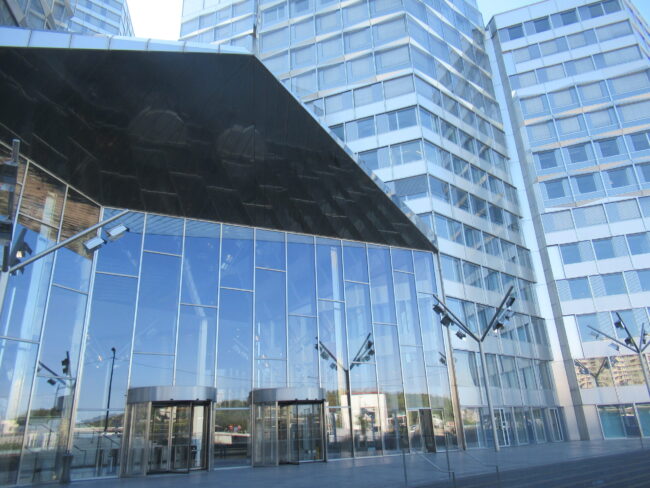
Near the Pont de Sèvres metro station. Photo: Marian Jones
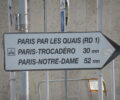
I’d entered the metro amid the 19th-century grandeur around the Grands Boulevards station, so the futuristic feel at Pont de Sèvres took me by surprise. As soon as I came up the station steps there were multi-lane roads, a complicated junction and snazzy high-rise blocks mirroring each other in reflective façades. A nearby sign said it would take only 30 minutes to cycle from here along the river to the Trocadero (and a further, very precise, 22 minutes to Notre Dame!) but the change in atmosphere could not have been starker.
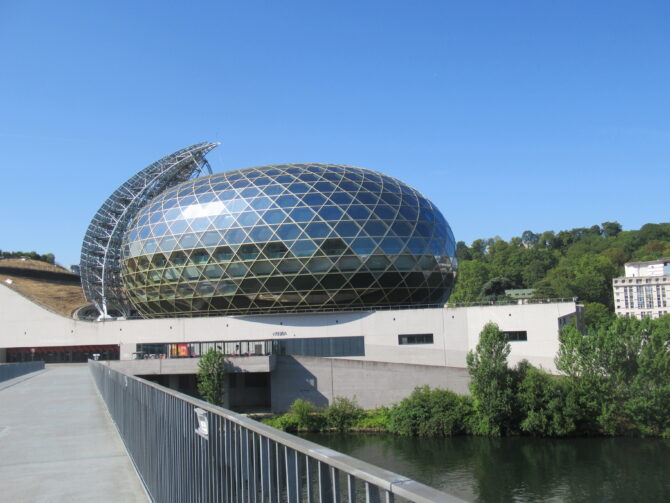
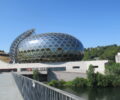
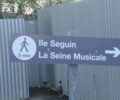
The walkway to the Seine Musicale led past glinting high-rise fronts, shining blue and silver to reflect the sky and the metallic fencing protecting their boundaries. It felt like a film set, designed to indicate leaving the past behind and climbing up to a bright new future, especially when I rounded the corner and the island’s centerpiece came fully into view. The concert hall is a long white building which sits on the tip of the island like an ocean liner in dock. Most visible from this angle was the giant nest-shaped roof and the “sail” which hugs one side of it, moving slowly round throughout the day to capture the sun’s rays and store them away for tomorrow’s clean power. Clever!
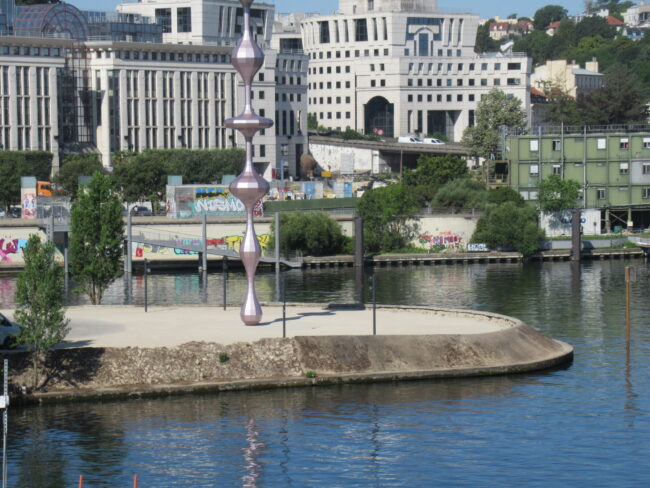
Tip of Ile Seguin with sculpture. Photo: Marian Jones
If I hadn’t read that this used to be an industrial wasteland, I’d never have guessed. The fruit trees and willows cultivated by monks here on the Île Séguin for centuries gave way to tanneries in the 19th century, then to the giant Renault works in the 20th. France’s largest factory, which employed 30,000 workers, dominated the area for decades until its closure in 1989 left the problem of what to do with the outdated facilities and the pollution left behind. A project gradually took shape to restore the land and bring in culture to regenerate the whole area.
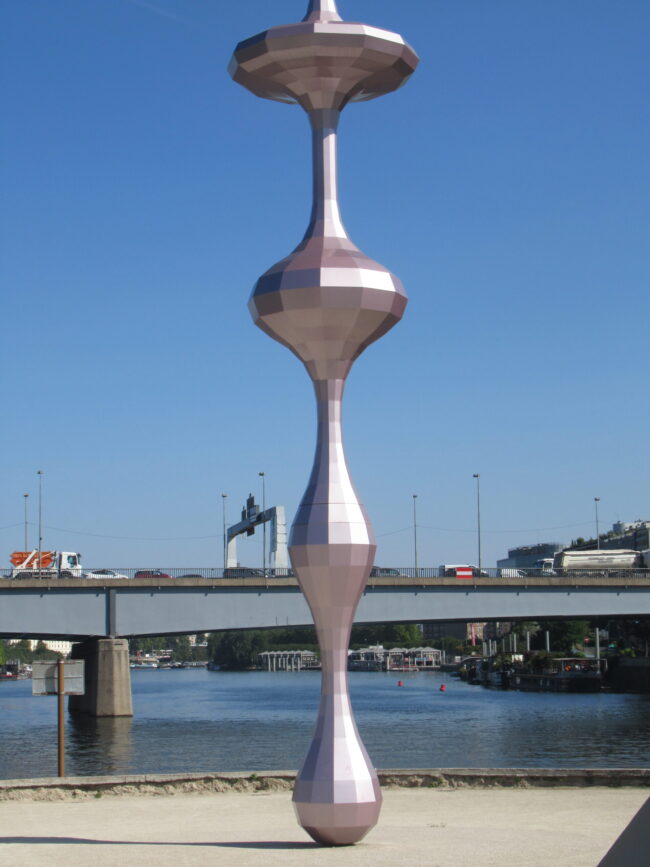
Sculpture on the Ile Seguin. Photo: Marian Jones
I visited on one of the hottest days of this record-breaking summer which perhaps explains the eerie emptiness which met me as I approached the complex. The whole thing looked shut and there was no one in sight. Rounding the building to the right, I found the tip of the island below me, marked by a strange pale pink steel sculpture. Its significance, explained AI when I asked, is that this “bubbling pillar” represents “balance, interconnectedness and equality.” Along the back of the apparently abandoned building were hints that it could spring into life: delivery bays, an office labelled RiffX Studios, an entrance marked “accès artistes.”
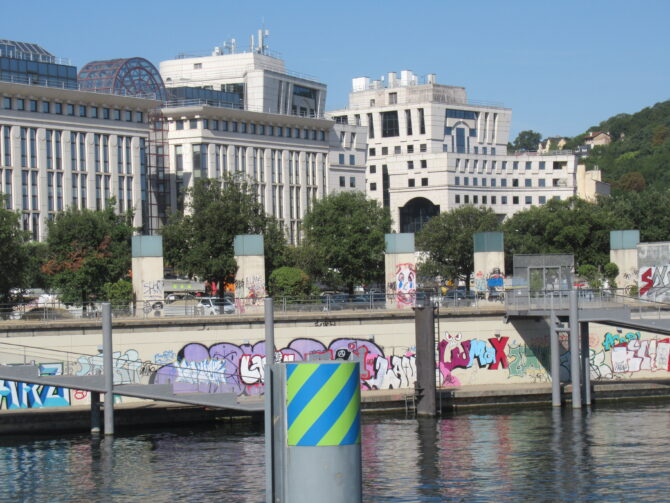

Along the river below, barges were moored and expensive-looking houses rose steeply up the banks. Then came the entrance to the Parc Gauthier Mougin, conceived, said its welcome sign, as a leisure area with a “panorama unique“ over the Seine, a natural park linking two cultural sites, the Seine Musicale and the Pointe des Arts cultural center a little further up the island. Exploration made it clear my visit was badly timed. Firstly, the scorching weather had nearly finished off the natural elements, as indicated by the few blades of brown grass struggling for survival against the many “keep off the grass” signs. And secondly, teams of workmen were still busily engaged on completing the cultural center.
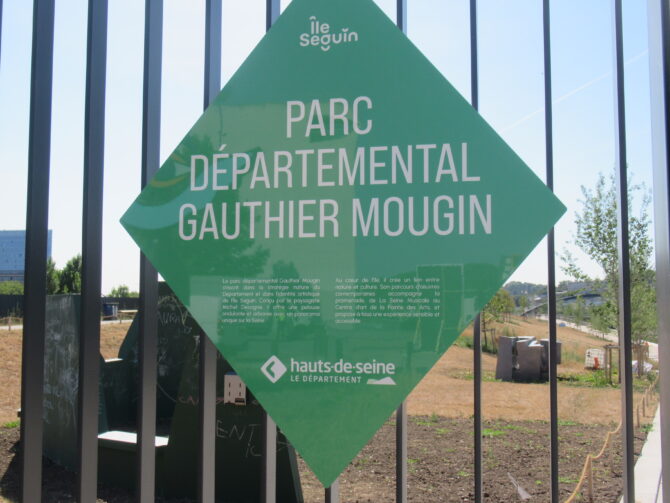

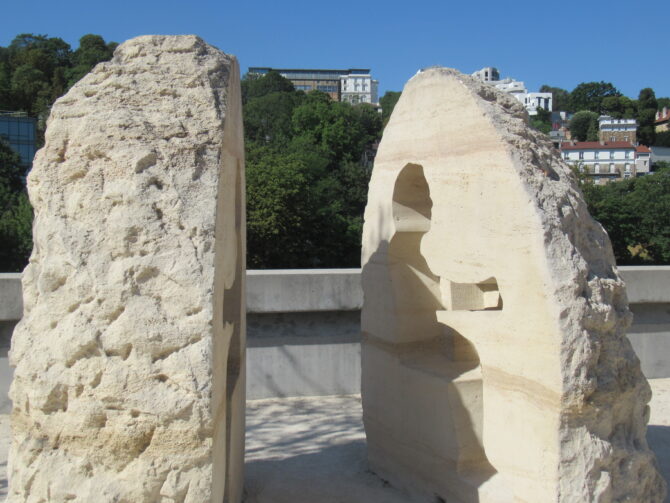
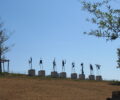
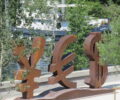
Okay, so there were indicators of what was to come: parched poppies and daisies, newly planted trees soldiering on inside supportive frameworks and an array of modern artworks, all helpfully explained by nearby plaques. Three giant symbols represented the yen, the euro and the dollar and their similarity to the word “yes” was, apparently, both affirmative and ironique. The person-shaped gap carved into two blocks of stone was also deliberate, left as une présence absente by the artist, Abraham Poincheval, who had spent a week living inside the stone in 2017. My favorite was the eight bronze figures silhouetted against the sky and titled Légendes urbaines, a tribute to all those who’d brought the Île de Séguin’s transformation into life.
I circled back towards the Seine Musicale, where I found an expansive set of concrete steps leading up to the Jardin Bellini. I was just deciding not to haul myself up in such in such heat when a staff member at the top beckoned me forward, so I drained the last of my water bottle and began the ascent. Hot, really very hot, I thought and eventually found the plants up there dehydrating away all along the pathway which curved round to what would, in a different season, have been a grassy mound. The folded deckchairs and the 1664 kiosk – shut! – were signs that in more temperate conditions it would be great to loll around up there, listening to music and surveying the river banks below.
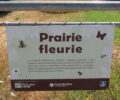
Info panels along the route explained the thinking behind this Jardin écologique where the plants are native to the area and left to self-seed. Insects and butterflies are encouraged, dead tree stumps have been left in place as wildlife habitats, all of which will hopefully work out eventually, even though the prairie fleurie (flowering meadow) was looking more than a little parched when I passed it.
Thus far, I’d seen river views and eco areas a-plenty, but still not really much sign of cultural events. But, as I made my way round towards the front of the building I found a red carpet, barriers indicating that long queues were anticipated and a number of people busying about in black t–shirts. Can I go inside, I wondered. Áh non, madame, aujourd’hui c’est privatisée, said one of the officials. But, he added helpfully, the ticket office was just around the corner. Its smoked glass door did indeed yield to my pressure, but immediately a security guard leapt forward to challenge me. He shrugged in bafflement at my idea of going inside, but sanctioned it anyway.
Inside I found a cavernous hall, empty except for a brand new red Porsche, parked on a square of carpet and a girl sitting behind an information desk. Here at last, I thought, I might penetrate some mysteries. Might she perhaps have a program of events I could take away? She got up and clacked her high heels a full 30 paces across the vast space to fetch one. When she had tottered back, I risked another question. Um, is it, you know, not really open here today? She smiled, yes, exactly so. Today was all about prepping for that evening’s major event, a razzamatazz opening ceremony for the E Sports World Cup which would star two of France’s best globally famous singers, the French-Malian Aya Nakamura and the French-Congolese rapper Theodora.
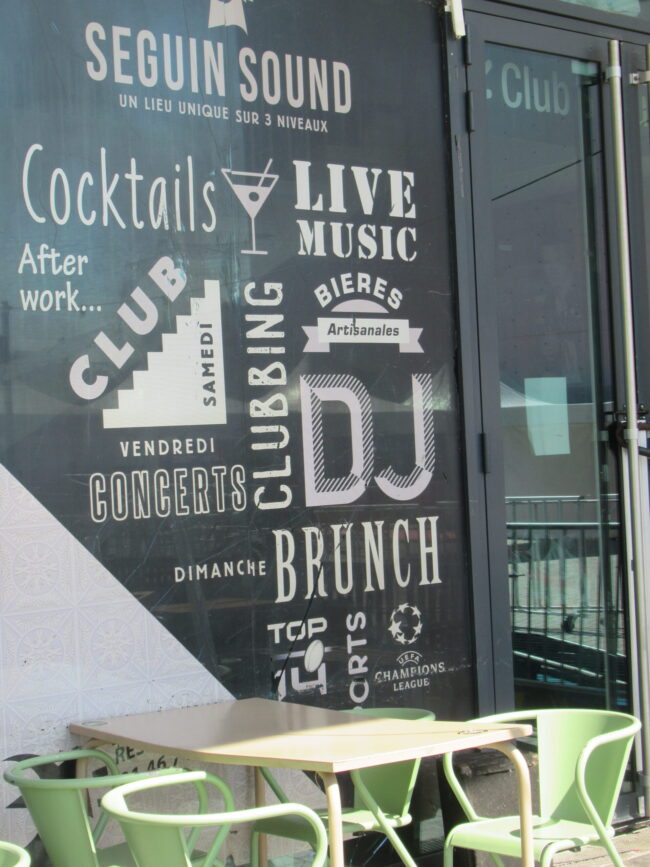
Cafe at La Seine Musicale. Photo: Marian Jones
Ah, that clarified things. I quizzed her about the Seine Musicale and discovered quite a lot. There’s an extensive program in the 1100+ seat auditorium where this autumn the 30 concerts range from the ultra-classic (Beethoven’s 5th Symphony) to original works (a pianist improvising to Walt Disney clips) via jazz, ballet and family events such as a version of Peter and the Wolf for anyone over 5. The vast Grande Seine hall, with space for 6,000 people, hosts concerts by major stars, musicals and music award ceremonies. Alongside all this, there are special events like the summer festival L’Été en Seine, free Tuesday lunchtime concerts called Les impromptus du mardi, and a series of improvisation workshops.
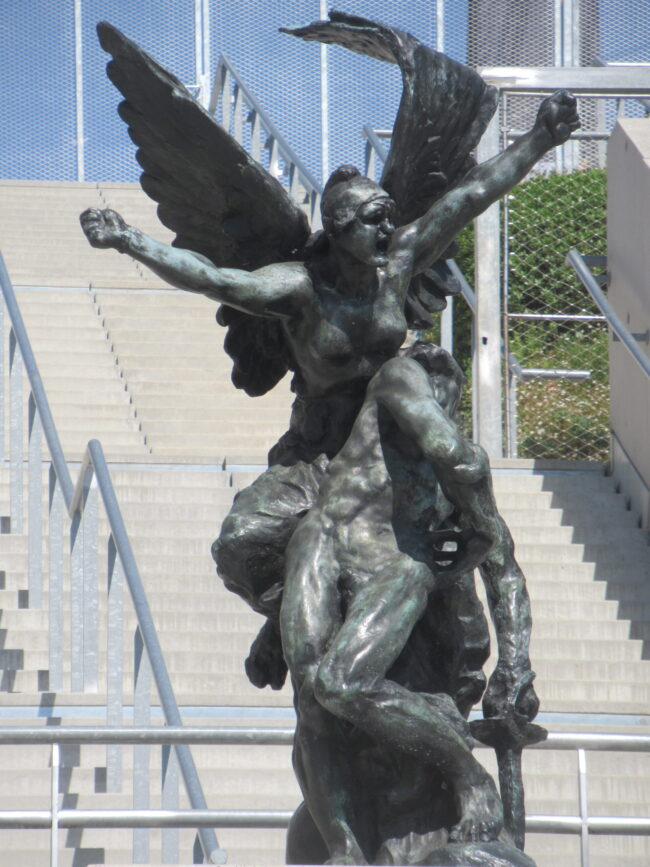
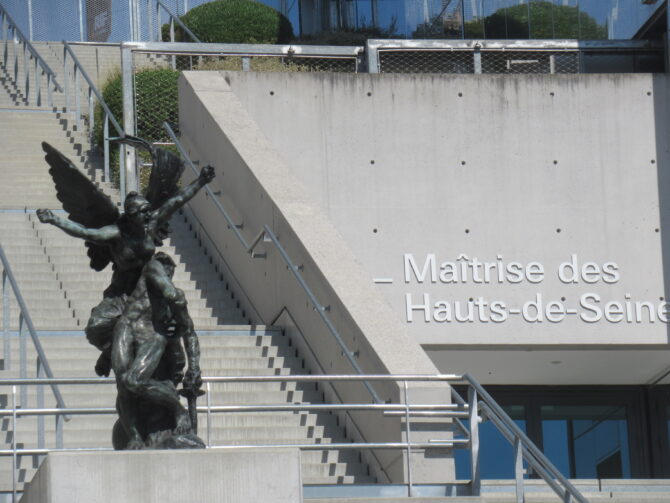
Rodin’s La Défense statue. Photo: Marian Jones
There’s definitely a music-for-all feel about what they do. The Nouvelle Maîtrise des Hauts-de-Seine is a collection of training choirs for children and young people of all abilities, while the Académie musicale and the Jeunes Talents program nurture talented youngsters, especially those from disadvantaged backgrounds, in order to “democratize access to classical music.”
On this flânerie I’d learned two main things. Firstly, that the Seine Musicale is an exciting cultural venue whose program I shall check on future visits to Paris. And secondly, that a wander around the Ile Séguin can be a slightly surreal experience, especially in a heatwave when the main attraction happens to be more or less closed. Before heading back down to the metro, I decided to finish my walk by checking out the two statues sited here which had been mentioned in all the descriptions I’d read.
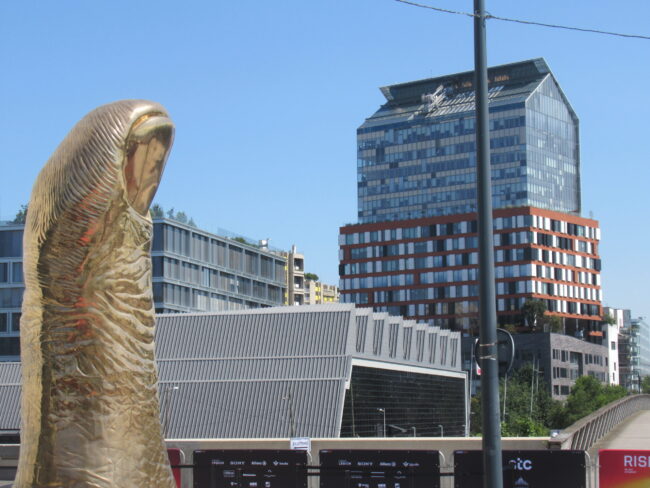
Cesar statue. Photo: Marian Jones
Rodin’s La Défense is a feisty 700 kilograms of bronze, a defiant winged figure designed to illustrate the spirit of victory, moved here in 2017 to mark the Seine Musicale’s opening exactly 100 years after Rodin’s death. And César’s Le Pouce is …. what exactly? A 6-meter-high thumb, modeled on the artist’s own thumb apparently, cast in bronze and pointing skywards on the forecourt, shining out against the futuristic blocks in the background. Kind of interesting, kind of strange, just like this flânerie in fact.
DETAILS
La Seine Musicale
Île Seguin, 92100 Boulogne-Billancourt
Nearest métro Pont de Sèvres
usually open Tuesday-Saturday, 11 am- 7 pm
Information on the Pointe des Arts
355 Quai Georges Gorse, 92100 Boulogne-Billancourt
Due to open October 2026
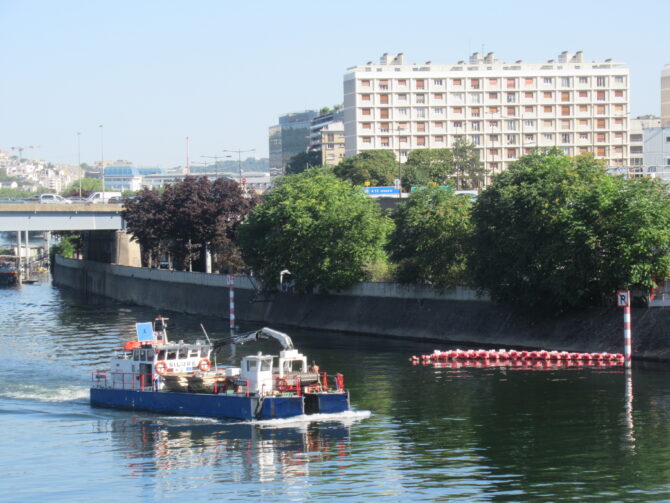
Lead photo credit : View from tip of Ile Seguin. Photo: Marian Jones
More in Flâneries in Paris, Ile Séguin, La Seine Musicale
Related Articles
By Marian Jones