L’Inconnue de la Seine: The Story Behind The CPR Dummy
- SUBSCRIBE
- ALREADY SUBSCRIBED?
BECOME A BONJOUR PARIS MEMBER
Gain full access to our collection of over 5,000 articles and bring the City of Light into your life. Just 80 USD per year.
Find out why you should become a member here.
Sign in
Fill in your credentials below.
It is one of Paris’s most haunting legends. Sometime in the late 19th century, so the story goes, the body of a young woman was pulled from the Seine.
She bore no obvious signs of violence and wore an unusually peaceful expression, leading some to believe she had taken her own life. Attempts to identify her proved fruitless, and so she became known simply as L’Inconnue de la Seine – the Unknown Woman of the Seine.
According to the legend, her body was taken to the Paris Morgue. Commissioned by Baron Haussmann and opened in 1868 on the Quai de l’Archevêché, behind Notre-Dame, the building resembled a small Greek temple, and unidentified bodies were laid out inside on marble slabs behind a plate-glass window.
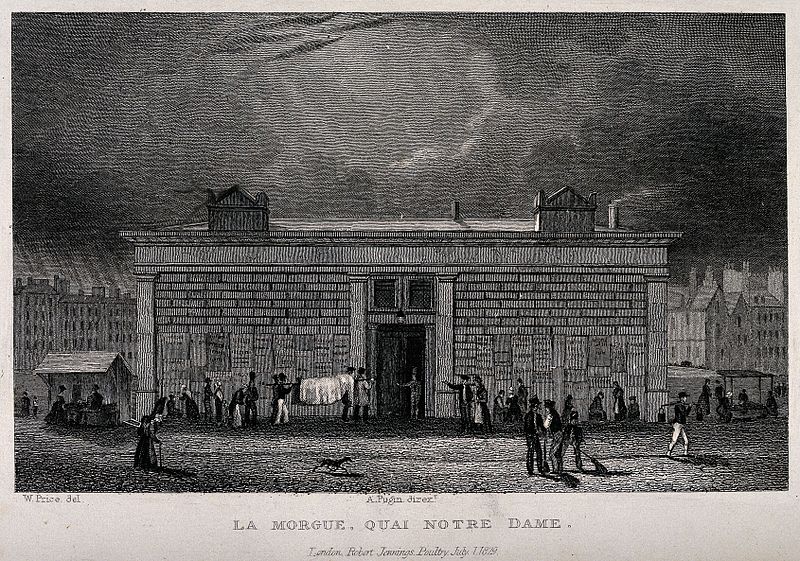
The Morgue, Paris; by Nôtre Dame. Etching, 1829. Image: Wikimedia Commons
Many visitors came not to identify anyone but to look. The morgue became one of the most popular attractions in the city, until Prefect Louis Lépine closed it to the public in 1907 on grounds of moral hygiene. It was demolished in the early 1920s, and the site at the eastern tip of the Île de la Cité is now the Square de l’Île-de-France and the Mémorial des Martyrs de la Déportation.
No one came forward to identify the mysterious young woman. A plaster cast was made of her face, supposedly by a pathologist struck by her serene expression. With her faint smile and delicate features, the mask seemed strangely lifelike, and copies soon began appearing in artists’ studios, fashionable homes and shop windows across Europe. Among the Parisian workshops turning them out was L’Atelier Lorenzi, founded in 1871 by an Italian moulder who had come to the city from Tuscany.
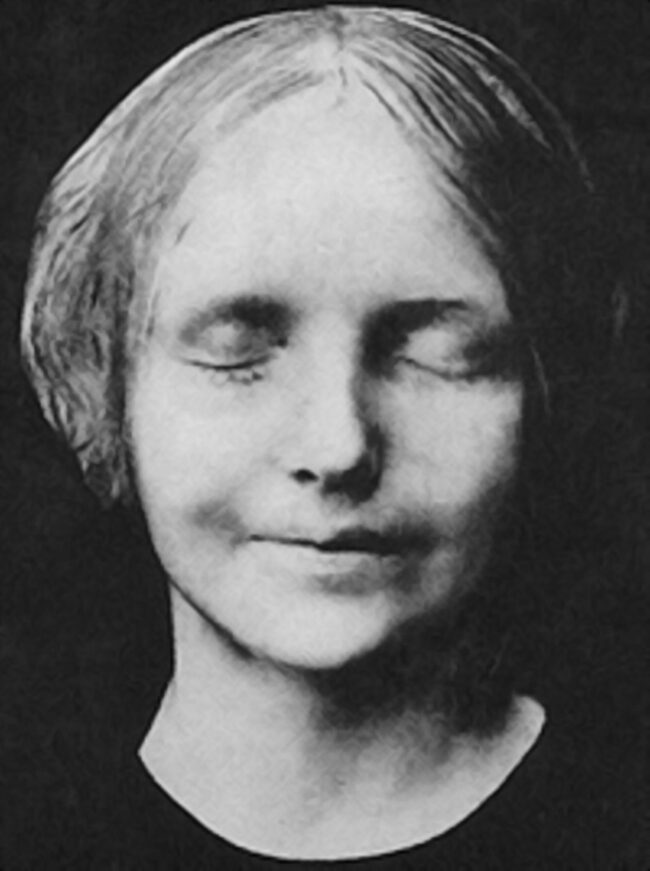
L’inconnue de la Seine, mortuary mask. Wikimedia commons
By the early 20th century, L’Inconnue had become an unlikely cultural icon. Albert Camus is said to have called her the drowned Mona Lisa.
Rainer Maria Rilke carried a copy back to Berlin from Paris in 1905, probably bought from Lorenzi, and the mask surfaces in his 1910 novel The Notebooks of Malte Laurids Brigge, in a passage describing two plaster faces hanging outside a moulder’s shop the narrator passes each day. Louis Aragon and Jules Supervielle later returned to her enigmatic image, and in 1966 the Surrealist photographer Man Ray photographed the mask for an edition of Aragon’s novel Aurélien – proof that L’Inconnue’s hold over the artistic imagination had lasted for decades.
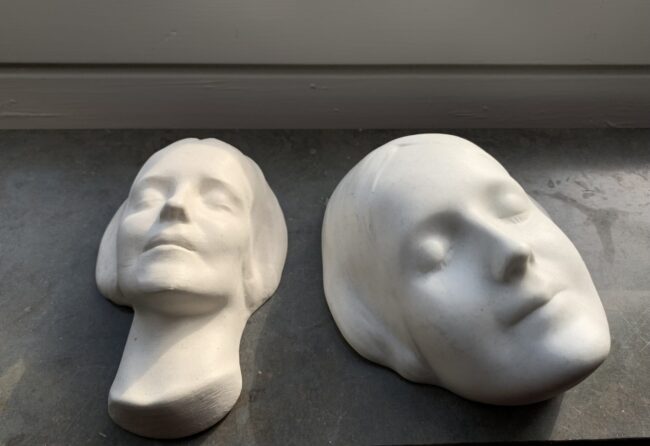
Two examples of 20th-century cast. Photo: Fluffigkatt/ Wikimedia commons
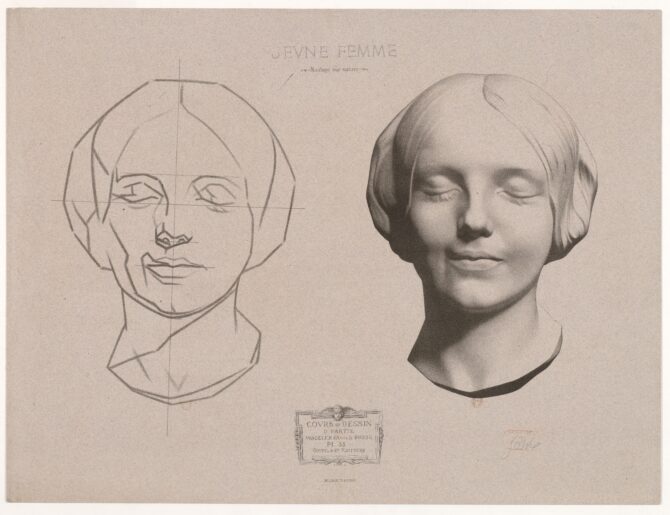
The earliest firm trace of the mask is not a police report or a morgue register. It is a drawing. A plate titled Jeune Femme, showing the same face, appears in Charles Bargue and Jean-Léon Gérôme’s Cours de dessin, the drawing manual used across European art schools, in an edition published in 1867 – potentially two decades before the supposed drowning. Of the legend itself there is no trace at all: no police record, no entry in the morgue books, nothing.
So who was she? The painter Jules Joseph Lefebvre told his pupil Georges Villa that the impression came from a young model who died of tuberculosis around 1875. Another account holds that she was the daughter of a German mask manufacturer, cast while alive. In the United States the same face circulated under a different name altogether, La Belle Italienne. Perhaps the romantic story of the drowned young woman was simply added later, giving an already beautiful face the tragic history people wanted it to have.
Whatever the truth, L’Inconnue’s greatest legacy came not from art or literature, but from medicine.
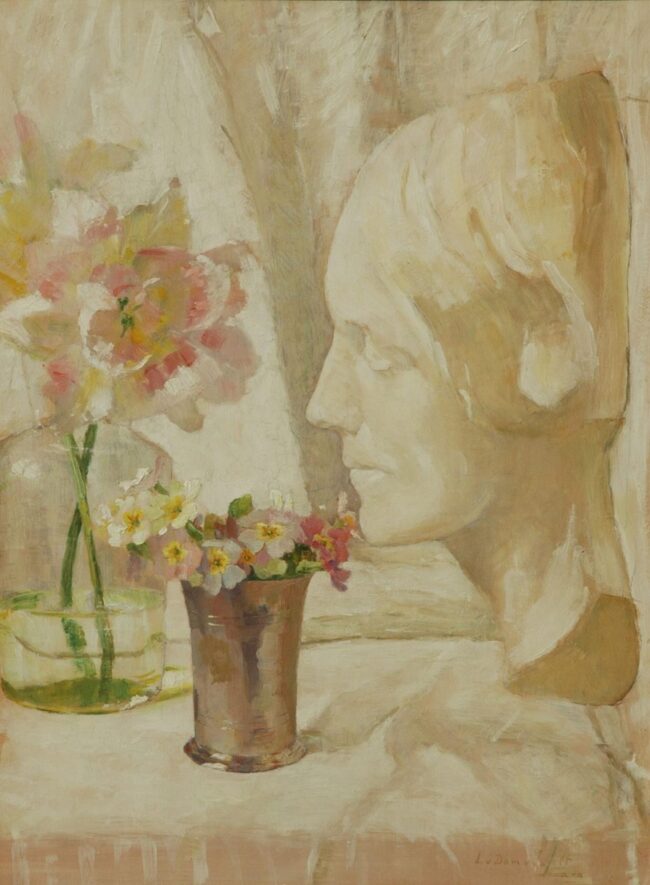
L’Inconnue de la Seine, Portrait by the Dutch painter Lucie van Dam van Isselt, 1914. Wikimedia commons
From the Seine to Resusci Anne
In 1955 the young son of Norwegian toy manufacturer Åsmund S. Lærdal nearly drowned near Stavanger. His father pulled him from the water, cleared his airway and warmed him until he came round. The boy recovered completely, but the experience marked Lærdal permanently.
So when Norwegian doctors approached him a few years later about building a mannequin for practicing the new mouth-to-mouth resuscitation techniques, he was not a reluctant contractor. He was a man who had already pulled someone out of the water. He had the manufacturing knowledge, too: his firm had recently mastered soft plastics, and one of its successes was a doll named Anne. The training mannequin needed a face. Lærdal remembered a plaster cast he had seen hanging on the wall of a relative’s house, and chose the serene features of L’Inconnue.
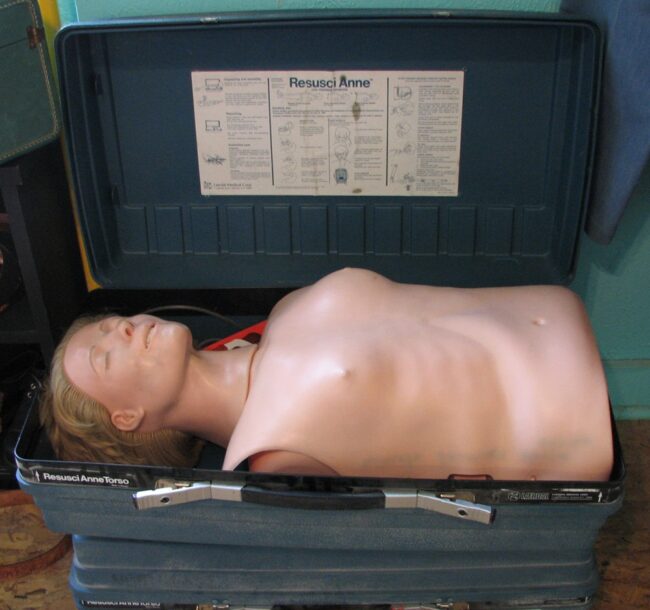
Resusci Anne mannequin torso in a storage case. Photo: ~aorta~/ Wikimedia commons
The result was Resusci Anne, presented in 1960 in Stavanger at the first international symposium on resuscitation. She was built for rescue breathing; the chest compressions we now think of as inseparable from CPR were only published that same year, and the ability to practise them was engineered into her shortly afterwards.
In one of history’s strangest reversals, a face supposedly taken from a dead woman became a tool for saving the living. Hundreds of millions of people have since trained on her, which has led L’Inconnue to be dubbed the most-kissed face in the world.
In Britain and America the mannequin is usually called Annie, and trainees are taught to check for a response by calling her name. Which is where Michael Jackson is said to have found the refrain of Smooth Criminal: “Annie, are you OK?”
She is still being made, too. At the Atelier Lorenzi, now in the southern suburb of Arcueil, the fourth generation of the family still casts her from a 19th-century mould, and she remains the piece they are best known for. They sell her as the Noyée de la Seine: the drowned woman of the Seine.
Lead photo credit : Cours de dessin - estampe - (Charles Bargue), 1867. Bibliotheque nationale de France, Wikimedia commons
Related Articles