
Comédie in English: Testing out Translation Glasses at the Theater

- SUBSCRIBE
- ALREADY SUBSCRIBED?
BECOME A BONJOUR PARIS MEMBER
Gain full access to our collection of over 5,000 articles and bring the City of Light into your life. Just 80 USD per year.
Find out why you should become a member here.
Sign in
Fill in your credentials below.
I love an evening in a Paris restaurant as much as the next hedonist, but sometimes it’s nice to ring the changes and what better way to dip into French culture than a night out at the Comédie Francaise? It’s the city’s premiere theater, founded in 1680 by Louis XIV and home of France’s best-known theater company whose varied repertoire always includes a good sprinkling of the classics alongside newer works.
Ah, you’re thinking, unless you are fluent in French and can handle the 17th-century language of, say, Molière, it’s not for you. Wrong! Mindful perhaps of attracting a larger anglophone audience to this most Parisian of venues, the Comédie Française has come up with an ingenious technical solution for anyone whose French is less than perfect or even non-existent. For every play staged in the main theater, the Salle Richelieu, translation glasses are now available at no extra cost. I went along to try them out.
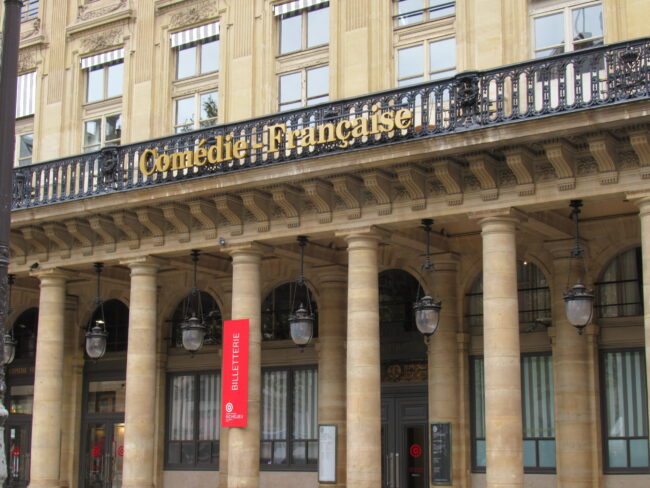
Comédie Francaise. Photo: Marian Jones
Actually, I went to a Comédie Française production staged as part of this summer’s hors murs program which takes its productions to other Paris theaters. I headed out to the 10th arrondissement to find the Théatre de la Porte Saint-Martin, a five-minute walk from République and sitting just east of the can’t-miss-it triumphal archway Louis XIV built to honor himself. The theater was built in the 1870s, boasting classical sculptures on its entrance pillars and a 1000-seater auditorium where three tiers of seating curve around a stage once graced by Sarah Bernhardt. The color scheme of cream, red and gold oozes opulence and it was no surprise to read that it is a monument historique.
There was a collection desk for translation glasses, where a helpful lady showed me how to adjust the fit, the volume and the size of text I found best and wished me une excellente soirée. As it turned out, this was one of the hottest nights of the whole boiling summer, so sweltering that the ushers handed out plywood expandable fans free of charge and an impromptu interval was announced even though the play had been scheduled to run straight through. All of this meant it was not an ideal time to try out a headset which, although not really heavy, felt like an unwanted encumbrance in these stifling conditions. I persevered, in the interests of research, until the interval, then peeled it off and enjoyed the second half without it.
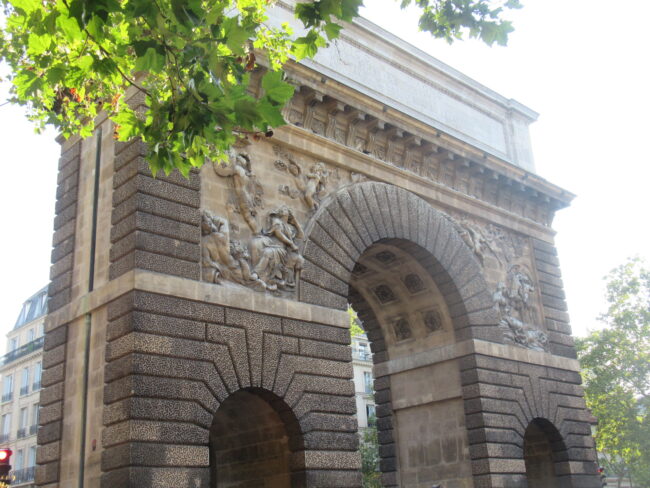
La Porte Saint-Martin. Photo: Marian Jones
How well did it work? Very well indeed, I’d say. English translations popped up, a line or two at a time, just as the actors spoke them and were, on the whole, clear and accurate. Of course, some of the wordplay got a little lost and an occasional nuance was perhaps not there in full, but to the question would it allow a non-French speaker to follow and enjoy the play, I’d answer a resounding yes. I’d still recommend reading an English version beforehand if time allows, because a Molière play such as I saw is fast-moving and it helps, I think, to have an idea of the plot and the characters beforehand. But if you just turned up, unprepared, I think you would still follow and enjoy the show.
I saw Molière’s Le Malade Imaginaire, usually translated as The Imaginary Invalid, a wicked portrayal of the hypochondriac Argan whose fixation with his bodily functions disrupts his entire household. It’s also a savage indictment of the doctors who hide behind Latin jargon and foist ever-more unlikely and expensive “cures” on their gullible patients. As in many of Molière’s plays, there’s a wise and scheming servant, Toinette in this case, who provides comedic insights and creates twists and turns in the action. Argan intends to safeguard his health by marrying his daughter off to a medical student she doesn’t love, but Toinette has other ideas and her intrigues, often enlisting other family members, ensure that Angélique ends up in the arms of her true love, Cléante.

The Imaginary Invalid, drawing by Honoré Daumier, c. 1857. Public domain
A visit to the Comédie Française is an insight into French culture. It’s said to be the oldest theater company in the world and the 3,000+ plays in its repertoire include French classics, French contemporary works and foreign plays in translation. Its 60 actors, some of the most talented performers of the day, perform up to eight plays each season, always including several long-standing classics. In the Salle Richelieu, the largest of their three stages, translation glasses are available for all performances, in English for non-French-speakers and in French for the deaf and hard of hearing. As I discovered, they are gradually widening the scheme and sometimes providing them when they play at other venues.
The program for the upcoming season, 2026-7, is typically full and varied. From the classical repertoire, there are two interesting Molière offerings starting before Christmas. The well-known comedy L’Avare (The Miser), will play on a number of dates from November 30th to March 9th, 2027 and is a classic drama of love versus money as the elderly miser Harpagon’s family try to ignore his penny-pinching schemes and follow their hearts. In Les Fourberies de Scapin (The Imposters of Scapin, playing from October 27th to January 17th, 2027), two young men who are hopelessly in love engage a wily servant to help them outwit their fathers who want to stop them marrying the girls of their dreams.
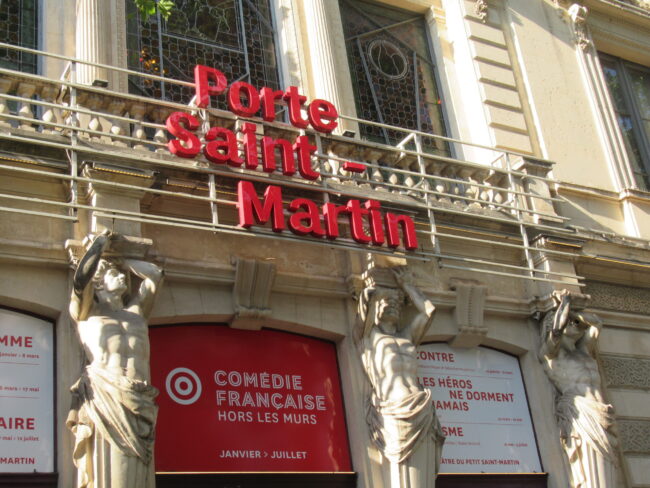
Théatre de la Porte Saint-Martin. Photo: Marian Jones
From January 1st to June 1st, there’ll be performances of Le Cid by Corneille, another major classical dramatist from the 17th century. It’s a Romeo-and-Juliet-type plot where young love and family honor crash up against each other, billed as a tragicomedy because it mixes grand and serious themes with a happy ending. Also on the program are two more Molière comedies, Les Femmes Savantes (April 1st – July 15th) and Le Bourgeois Gentilhomme (April 16th – July 27th) which satirize pretentious knowledge-seekers and a middle-class man who tries to elevate himself into high society respectively. Either will amuse anyone who enjoys a wry laugh at human foibles.
It has to be said that getting tickets for the Comédie Française can be a fraught affair and advance planning will certainly be required. Bookings open around the end of May for the first part of the season (September to February) and in January for performances scheduled between March and July. To make things trickier, tickets are not available to the general public for the first week after booking opens, so it’s important to start your search immediately after that. There is a section in English on the Comédie Francaise website where you can sign up to receive a monthly newsletter which includes information on when ticket sales will open.
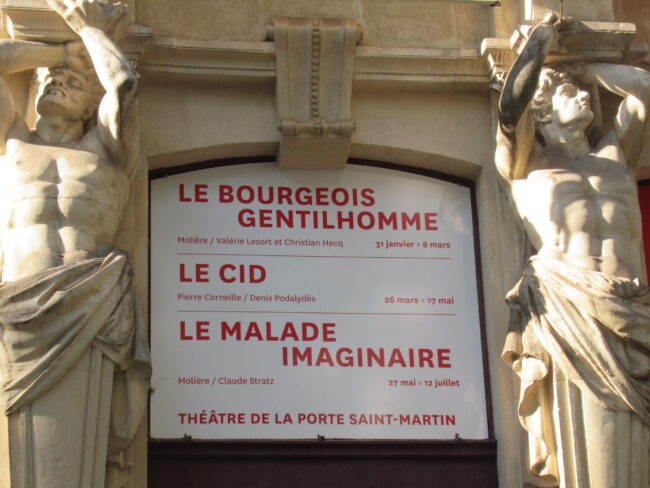
Théatre de la Porte Saint-Martin. Photo: Marian Jones
Translation glasses mean that this aspect of French culture, keenly enjoyed by Parisians most of the year round, is now accessible to anglophone visitors. You do need to request them in advance (details here) but there us no charge and they are user friendly, designed to fit over prescription glasses if required and with adjustable settings for sound, brightness and text size and color. The staff manning the collection desk spoke good English and I found the whole process very helpful. To leave the last word to Barbora Tvrdik, an American visitor quoted on the Friends of Fondation de France website: “The glasses were a fantastic way to enhance the experience of the show. The subtitles were seamless, with no lag time, and allowed me to appreciate the humor and nuance even more.”
DETAILS
Comédie Française
1, Place Colette (1st arrondissement)
Nearest metro Palais-Royal-Musée du Louvre (Lines 1 and 7)
Théatre de la Porte Saint-Martin
18, Boulevard Saint-Martin (10th arrondissement)
Nearest metro Strasbourg St-Denis (Lines 4, 8, 9) or République (Lines 3, 5, 8, 9, 11)
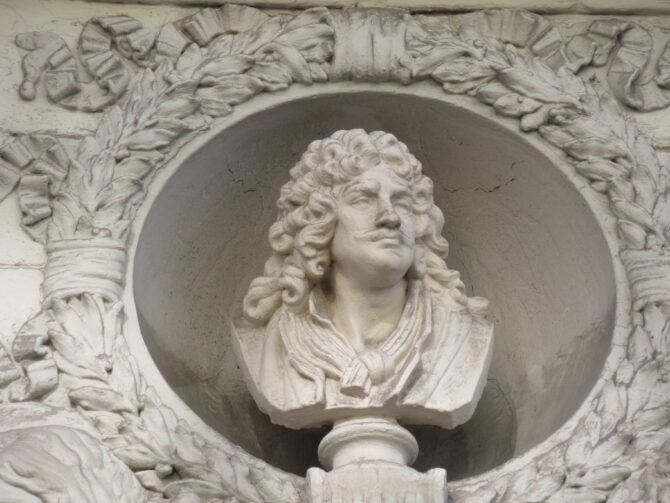
Lead photo credit : Molière bust on the wall of the Comédie Francaise. Photo: Marian Jones
More in Comédie Française, Théatre de la Porte Saint-Martin
Related Articles



By Marian Jones