Why You Have to See the Hit Comedy about the Comédie Française
- SUBSCRIBE
- ALREADY SUBSCRIBED?
BECOME A BONJOUR PARIS MEMBER
Gain full access to our collection of over 5,000 articles and bring the City of Light into your life. Just 80 USD per year.
Find out why you should become a member here.
Sign in
Fill in your credentials below.
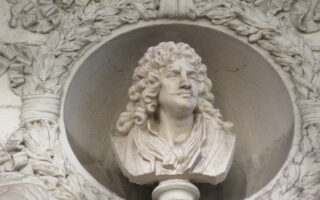
Certain institutions are indispensable if one wants to know Paris. One of these is the Comédie-Française, a national theater dedicated to Molière but which also puts on plays by other classic French dramatists, foreign greats, and some modern playwrights. The theater has a dedicated corps of players, and when they join the elect henceforth have “de la Comédie-Française” attached to their names, like British lords and ladies. The cast of the new comedy De La Comédie-Française are all real-life members, as the opening credits dutifully show.
The two directors, Martin Darondeau and Bertrand Usclat, have their own names in the credits cheekily followed by “not of the Comédie-Française.” This indicates that the filmmakers intend to give the sacred institution a mischievous poke in the eye. The film’s premise is simple: a young actress, Nina (Pauline Clément) is having her first directorial effort, a staging of Macbeth, put on at the theater and must overcome a number of obstacles. Actually, a slew of obstacles. First and foremost, the friend she chose to play Lady Macbeth is stuck in a provincial town somewhere and can’t make it to Paris on time. Yikes!
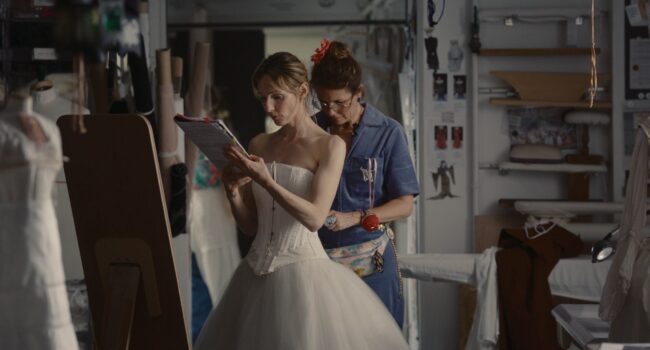
© De la Comédie-Française/ Atelier de Production/ France 2 Cinema
Another issue concerns the stage manager’s responsibilities, whether for proper lighting or configuring of props. Their views often diverge, to say the least, though the manager (Christian Hecq) tends to add as a disclaimer, “You’re the director.” He also has a way of making short stories long and complaining about the way he’s treated. A major concern of the film is the class system within the theater, with blue-collar technicians taken for granted. As with other issues dealt with in the film, the directors have a touch which isn’t exactly light, but can be quite funny.
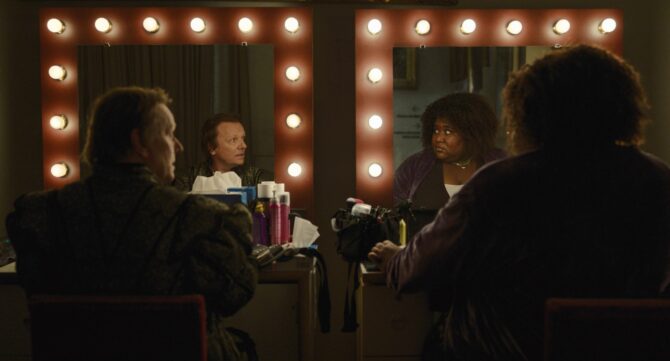
The directors also tackle the situation of minority people working — or trying to work — in the elite theater. A young black man (engagingly played by Sefoa Yesboa) works as an usher, but is also an aspiring actor waiting for the results from a conservatory. He’s been reading up on Macbeth, and so is ready to help the actors with their lines, but is treated as a nonentity. Another person of color (Séphora Pondi), who’s replacing the regular make-up artist, is determined to get the respect she deserves for her work (though her make-up choices are on the eccentric side). Here the directors use not just humor, but skillful grafts of le happy end, to get the audience thinking (but not too hard).
© De la Comédie-Française/ Atelier de Production/ France 2 Cinema
Nina navigates these sticky issues with aplomb. Every pitfall gives her a momentary shock but she intrepidly keeps on with the-show-must-go-on perseverance. It might be sacrilegious to point out, but Ms. Clément’s pertness and sprightliness recall none other than Emily. Yes — Emily in Paris. (Or in this case, Nina in the Palais Royal.) We can reckon this a sort of turnabout fair play as Emily seems to have been at least loosely inspired by Amélie Poulain.
As a character, Nina is more adult than Emily. Aside from the gravity inherent in directing at the Comédie-Française, she’s a wife and mother who must balance life and theatrical work. At one point the father dumps their baby boy on her because he too has cultural commitments. Domestic entanglements of a different sort involve the actor playing Macbeth (deliciously egocentric Laurent Stocker, worthy of Molière himself) and his actress companion (Marina Hands), who’s having a dalliance with a young player. These might seem the clichés of French farce but they really do happen to real people (I’ve known them).
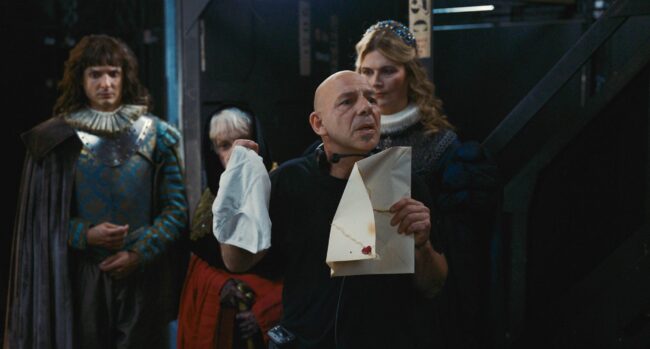
© De la Comédie-Française/ Atelier de Production/ France 2 Cinema
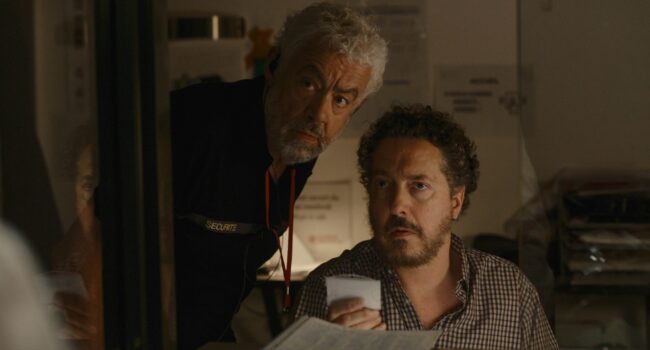
As a public institution in France the Comédie-Française has its bureaucracy, and the directors make wicked fun of absurd rules, which inevitably result in equally absurd efforts to get around them. One entertaining scene has to do with the requirement to have a badge to enter the premises, even if you’re a well-known member of the troupe —and now director, like Nina. Forgetting one’s badge is, needless to say, inexcusable and results in a rapid escalation of hostility between a guard just doing his job (a hilarious bit part played by the renowned Guillaume Gallienne) and more privileged employees.
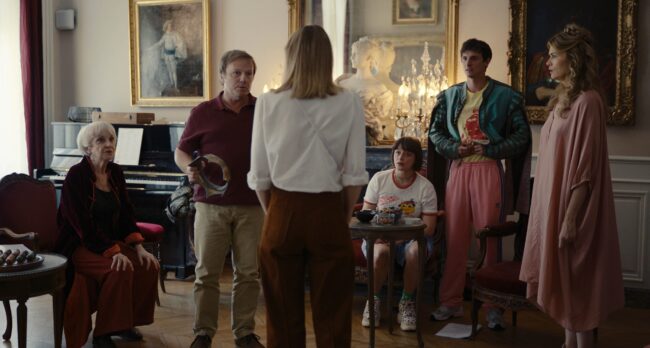
© De la Comédie-Française/ Atelier de Production/ France 2 Cinema
When it comes to the production, it’s not for nothing that Macbeth is considered the cursed play. It must be referred to as “the Scottish play”, so when the star flouts the superstition, mockingly repeating the title, the result is double toil and trouble. But in this film mayhem is the mother of invention. The godmother of invention is Nadine Guimard, delightfully played by the great Daniele Lebrun. She’s the oldest cast-member, with fond memories of the crazily improvisatory ’60s and ’70s (and still has a penchant for smoking spliffs at meetings). Nadine prods Nina into finding original solutions for the production’s problems.
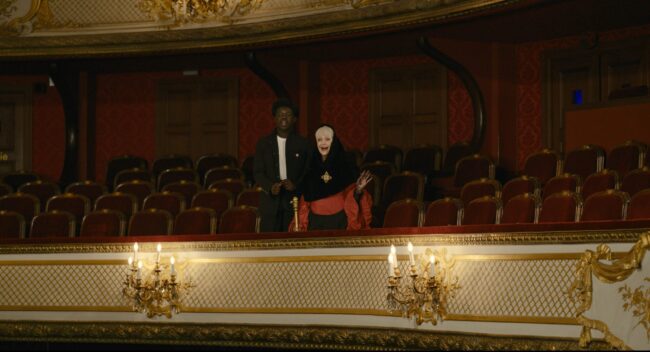
© De la Comédie-Française/ Atelier de Production/ France 2 Cinema
Innovation v. Tradition. Youth v. Experience. English v. French culture. Molière v. Shakespeare. The directors deal with all of these, mostly surfing along the surface of things. They’ve chosen low farce instead of high comedy (let alone tragedy). The comic invention is there, directorial style and technique less so. It’s not clear why there are two directors. At best we can suppose that it keeps the comedic imagination churning. At not-so-best it’s a move towards television style, where directing merges into show-running.
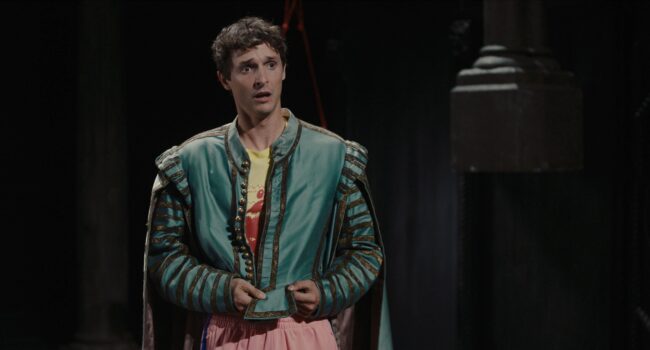
© De la Comédie-Française/ Atelier de Production/ France 2 Cinema
There’s some Woody Allen-style fantasy that just about redeems them. In any case, it’s the wonderful cast that carries De La Comédie-Française. As highly-talented troupers they dive into their roles, and enjoy making fun of the theater that employs them, of each other, and of themselves. In winter, we might reflect sardonically about how going through the motions of social critique may actually reinforce an established order. But in our Long Hot Summer of ’26 we sit back and enjoy the comedy, along with the A/C.
Production: Atelier de Production, France 2 Cinéma, Comédie-Française, Canal+, Ciné+ OCS, France Télévisions, Cinécap 9
Distribution: Zinc/Warner/Charade (international)
Lead photo credit : © De la Comédie-Française/ Atelier de Production/ France 2 Cinema
More in Comédie Française
Related Articles