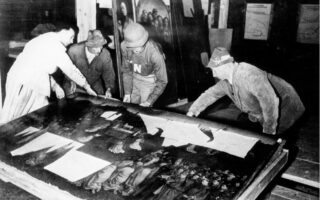
Priceless Crown Jewels Stolen from the Louvre
A spectacular burglary took place at the Louvre on Sunday, October 19, 2025. According to preliminary findings, masked thieves entered the building on the side facing the Seine, where construction was underway. Four men appear to have been involved: two managed to gain entry, and two others were getaway drivers waiting to escape on scooters. Using a cherry picker, possibly present at the construction site, they gained direct access to the Apollon Gallery on the museum’s second floor after breaking through a window with an angle grinder.
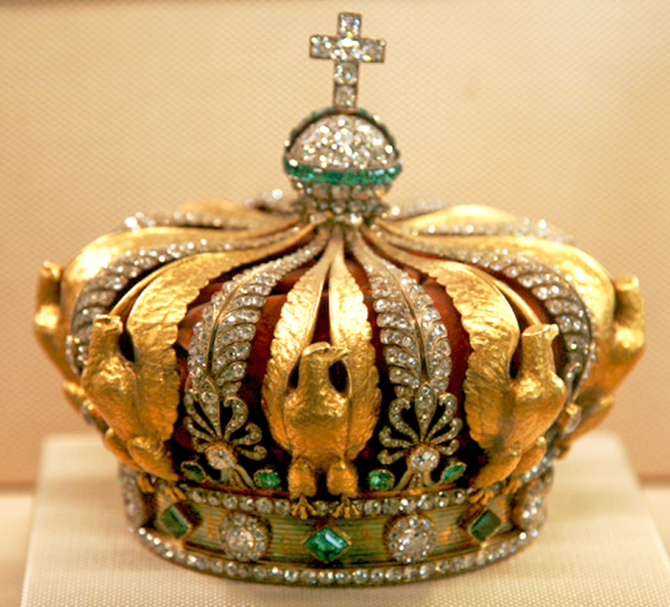
The Galerie d’Apollon houses some of the Louvre’s most precious historical collections and the thieves targeted its French Sovereign Gallery, containing a collection of Crown Jewels. In just seven minutes, the thieves reportedly stole nine priceless pieces. Among the stolen items were two crowns, including one belonging to Empress Eugenie, adorned with more than 2,000 diamonds and 56 emeralds, which was found on the ground in front of the Louvre. French Culture Minister Rachida Dati reported that the crown was broken as it was most likely dropped by the thieves.
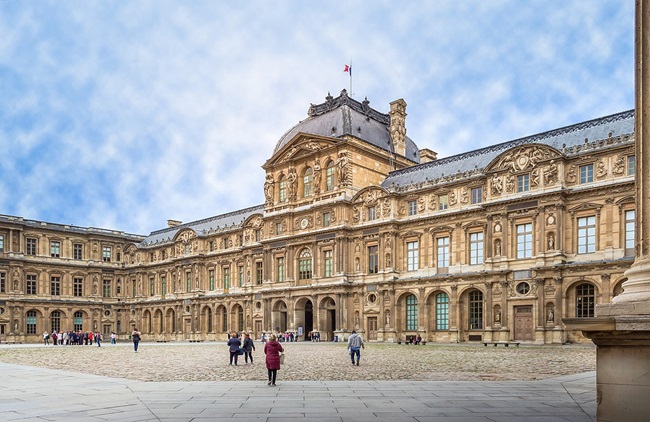
The Louvre Palace. Photo Credit: Ali Sabbagh/ Wikimedia Commons
While all visitors were safe, witnesses say they were herded under the pyramid’s entrance, crammed inside, until the doors to the outside were unlocked.
This theft, committed in broad daylight and in public, certainly raises questions about the security of the works. Thefts from the Louvre are rare, but not unprecedented.
In 1976, in an attempt suggestive of this week’s robbery, three masked burglars used scaffolding to climb to the second floor, smashed a window, and entered the museum’s Galerie d’Apollon, which, as we learned from the press, housed the collection of French Crown Jewels and stole a diamond-encrusted sword. This sword has never been recovered.

NANTEUIL Robert, Portrait of Jean Dorieu, 1660.
On July 11, 1994, a valuable 17th-century pastel by Robert Nanteuil was stolen during a break in security patrols. Thirty years ago, the “Portrait of Jean Dorieu” was estimated at $75,000 to $100,000.
On January 11, 1995, thieves took less than a minute to cut a 19th-century landscape painting, “Fallow Deer in a Landscape,” by Lancelot-Théodore Turpin de Crissé, from its frame. Less than two weeks later, a vandal — or possibly a thief — wrenched a meter-long, 17-kilogram battle axe from a 1685 bronze by Martin Desjardins, housed in the Richelieu Wing. It was found 12 days later in the Louvre’s courtyard.
The last recorded, and rather embarrassing, theft at the Louvre took place on May 3, 1998. While hundreds of visitors were enjoying the Louvre on a Sunday afternoon, a clever and unnoticed thief opened a security display case in the quiet Sully Wing, which contained a 38 x 43 cm Corot canvas, and snatched it from its frame. The stolen Corot, “Chemin de Sèvres” is estimated to be worth $1.3 million and has still not been recovered.
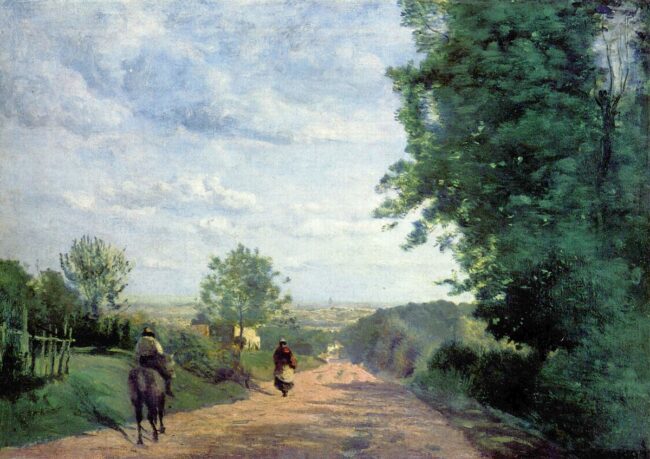
Jean-Baptiste-Camille Corot, Chemin de Sèvres
But of all the thefts at the Louvre, the cause célèbre is the theft of the Mona Lisa. The 16th-century masterpiece by Leonardo da Vinci was stolen on August 21, 1911, in one of the most audacious thefts in art history. In short, Vincenzo Peruggia, a glazier, removed the glass and left, at closing time, with the canvas hidden under his coat. In late 1910, Vincenzo Peruggia was working for a company subcontracted by the Louvre to prepare protective cases for the museum’s valuable pieces, and was clearly experienced in removing glass. Mistakenly believing that the Mona Lisa had been looted in Italy by Napoleon’s army, Peruggia wanted the masterpiece returned to its country of origin — until, of course, he tried to profit from it.
Picasso and the poet and playwright Apollinaire were briefly prosecuted for the theft of the Mona Lisa. Picasso was deeply impressed by the Iberian art in the Louvre’s permanent collection. Four years before the theft of the Mona Lisa, Géry Pieret, Apollinaire’s former secretary, began compulsively stealing from the Louvre and sold two Iberian statues to Picasso. Fernande Olivier, Picasso’s partner at the time, recalled: “Pieret gave Picasso two small statuettes without revealing where he had acquired them. He only told him not to display them too ostentatiously. Picasso, delighted, carefully preserved these gifts and buried them at the bottom of a closet.” Picasso incorporated the stolen statuettes into his famous 1907 work, “Les Demoiselles d’Avignon.”
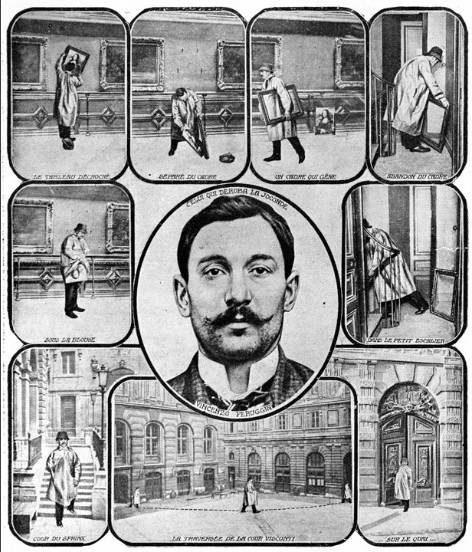
Vincenzio Peruggia stealing Mona Lisa. Wikipedia/ public domain
In 1911, Géry Pieret continued to steal Iberian pieces. In a letter to the Paris Journal, a week after the Mona Lisa theft, he confessed to stealing at least a dozen objects from the Louvre and passing two on to his artist friend. Clearly, Géry Pieret, who had already successfully targeted the Louvre, was the prime suspect in the Mona Lisa theft.
Marilyn Brouwer explains in her BP article “Stealing the Mona Lisa” that when Géry fled the country, the police turned their attentions to Apollinaire and Picasso – who were both complicit in the theft of two ancient Iberian statues taken from the Louvre in 1907. On September 7, 1911, Apollinaire and Picasso were arrested on suspicion of involvement in the theft of the Mona Lisa. The police were no doubt eager to solve the case and thought a catchy headline would no doubt raise their reputation. The duo were detained for a few days. Picasso not only denied any knowledge of the theft, but also, annoyingly, denied knowing his friend Apollinaire. The three men had nothing to do with the theft of La Joconde but Apollinaire eventually handed the busts over to the Paris-Journal under the condition of anonymity, and the works were returned to the Louvre.
The Mona Lisa was found two years later in Florence, Italy, after Peruggia tried to sell it to a local art dealer.
Let’s hope the treasure from today’s theft will also be recovered quickly.
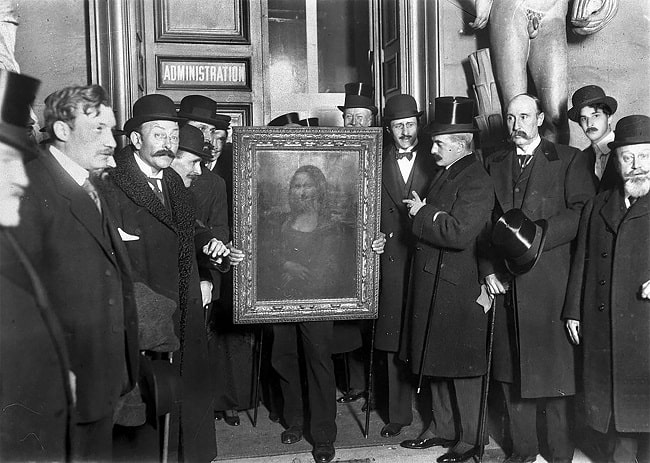
The Mona Lisa returned at the Louvre Museum, 4 January 1914. Photo: Roger-Violett/ Public domain
Lead photo credit : Crown of Empress Eugenie, part of the French Crown Jewels at the Louvre. Photo: David Liuzzo/ Wikimedia commons
More in French Crown Jewels, Louvre, Paris heists
Related Articles