Past and Present in the Marais at Historic Musée Cognacq-Jay
Sometimes it takes an old museum to underscore the missives of modern art. This is the case with the Correspondances exhibition of modern artist Agnès Thurnauer at the Musée Cognacq-Jay which offers a dialogue between her contemporary work and selected 18th-century artists, writers and scientists. The museum, with its small rooms and curving staircases, provides the perfect environment for Thurnauer’s art to hold a dialogue about past and present with women artists and creators.
French artist Thurnauer often deals with language in her art. From painting endearment words over famous paintings such as Edouard Manet’s Olympia to playing with the shape and form of alphabet letters, her work often questions language and traditional interpretations. In Correspondences, she uses her art to converse with and about artists while providing an updated way to look at their work by comparing old interpretations with her new.
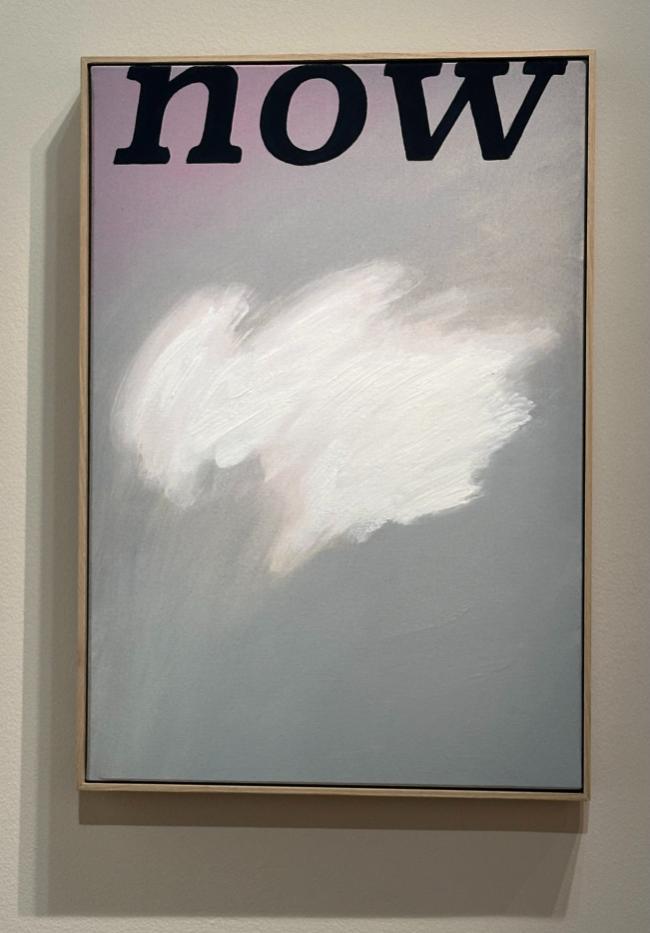
The result is six rooms where her art converses with 18th-century art in several forms and opens a dialogue between past and present. The art that inspires the discussions is provided by museums around the world including the Musée Cognacq-Jay which is home to the collection of Ernest Cognacq and Marie-Louise Jay, the founders of the Samaritaine department store. Their collection of 18th-century paintings, sculptures, porcelain, gold objects and period furniture from artists such as Fragonard, Chardin, Boucher and more was bequeathed to the City of Paris in 1929 and installed in the historic Hôtel Donon (now Musée Cognacq-Jay) in the Marais in 1990. Prior to 1929, the collection of 18th-century interior design was in the Samaritaine de Luxe, an offshoot of the store launched in 1917 at 25-29 Boulevard des Capucines.
The exhibit starts by walking up ancient, worn steps to the salon featuring early women painters such as Angelica Kauffmann and Elizabeth Vigée Le Brun who were finally recognized by Academy of Arts in the late 1700s. Thurnauer’s art is large buttons using male artist names that she changed to female versions. Thus François Boucher becomes Françoise Boucher and Emmanuel Kant becomes Emmanuelle Kant. The art correspondence, between women artists who had a difficult time getting recognition for their work and men artists who didn’t, becomes evident.
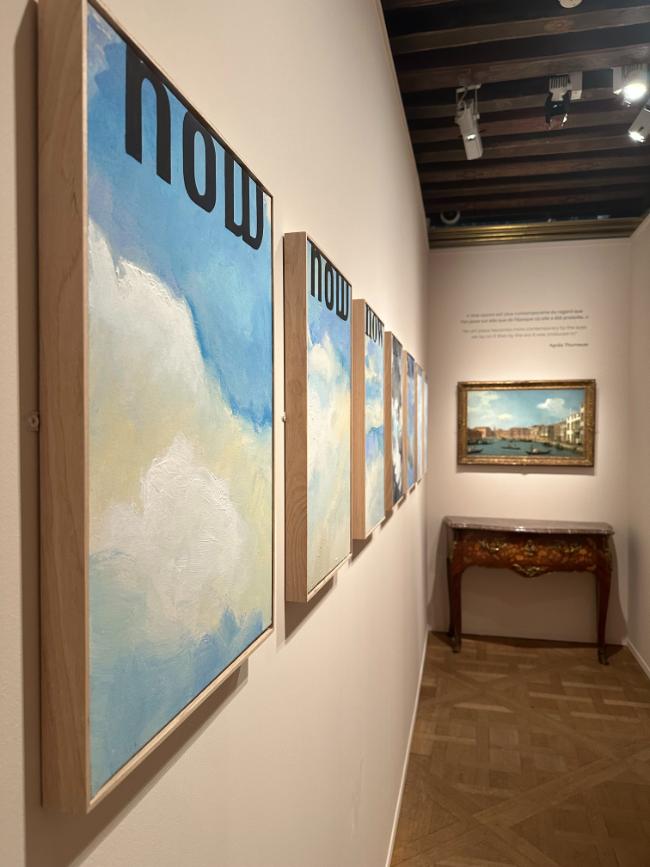
Canaletto’s Venice and Thurnauer’s skies Now. Photo: Martha Sessums
The second room of the exhibit is a narrow rectangle. At the far end is Giovanni Antonio Canal’s (Canaletto) painting of Venice with its ship-studded canal and blue sky featuring floating white clouds. Located along each side are Thurnauer’s pictures of sky and clouds with the word “Now” on each one. It’s a discussion of the heritage of classical painting and the strength of modern art. All parts of an art piece can be broken down into an experience. The Venice painting tells a story of life of a time, but the sky is universal and can be enjoyed now.
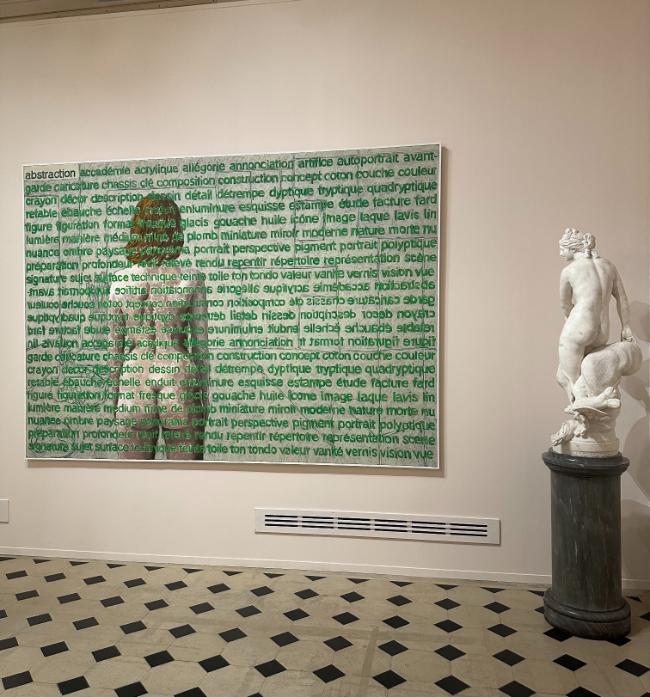
Modern and old nudity. Photo: Martha Sessums
The next two rooms focus on male artists who traditionally have shown women in a sexual form from statues to paintings. Juxtaposed against François Boucher’s painting L’Odalisque featuring a naked woman lying face down on a bed, Thurnauer poses naked standing with her backside covered by a stream of words in various languages that make her non-sexual. Paintings of Thurnauer undressing are shown next to Jean-Honoré Fragonard’s painting of a milkmaid who has fallen exposing her personal parts with a man watching in the background. There are several statues of naked women in the rooms too. Thurnauer uses her Matrices series of fragmented letter statues to reveal language as the foundation of thought and communication. The correspondence in the two rooms becomes how the art of nudity today is often neutral instead of showing women as an object of desire.
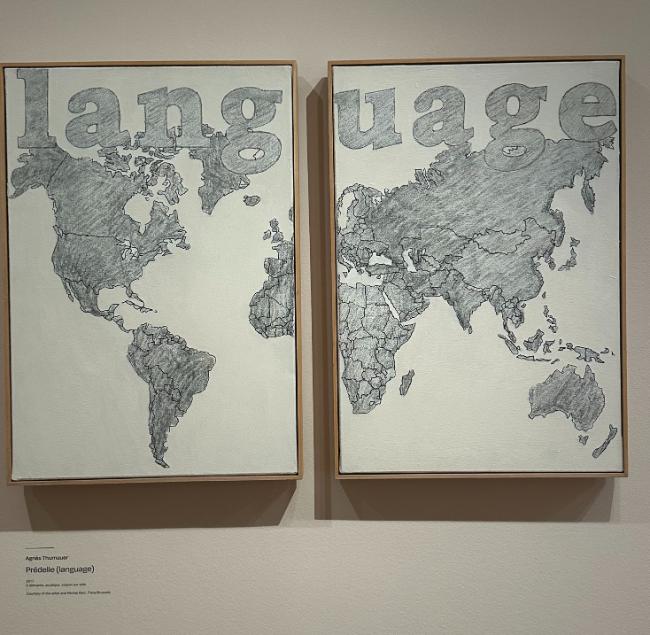
Thurnauer’s Languages the world around. Photo: Martha Sessums
Language is the focus in the last two rooms. Many women from privileged backgrounds in the 18th century gained access to education and contacts that resulted in excelling in traditionally male fields such as math, physics, astronomy, history, writing, painting and more. Émilie Le Tonnelier de Breteuil was a renowned physicist and mathematician. Émilie du Châtelet explained Newton’s planetary system theories. Nicole-Reine Lepaute developed astronomical calculations. Thurnauer holds these women in great respect by exploring the link between language and knowledge with a series of diptychs and tablets of letter mold shapes that explore the structure of language for meaning and connection with these invisible women in history.
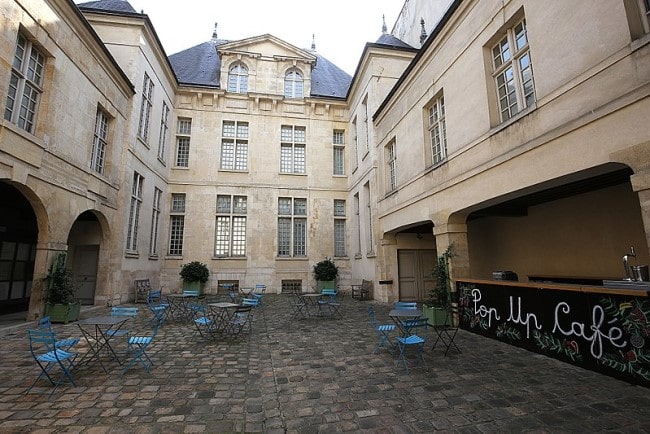
The museum itself helps communicate the message of connections. The museum is a 16th-century townhouse (Hôtel Donon) in the heart of the Marais. It features small rooms, windows looking down into the courtyard, winding staircases and wooden walls. Add the intermixing of furniture and silver pillboxes from Cognacq and Jay’s collection with Thurnauer’s art, and it all helps engage viewers and enhance the exhibition’s correspondence of old and now.
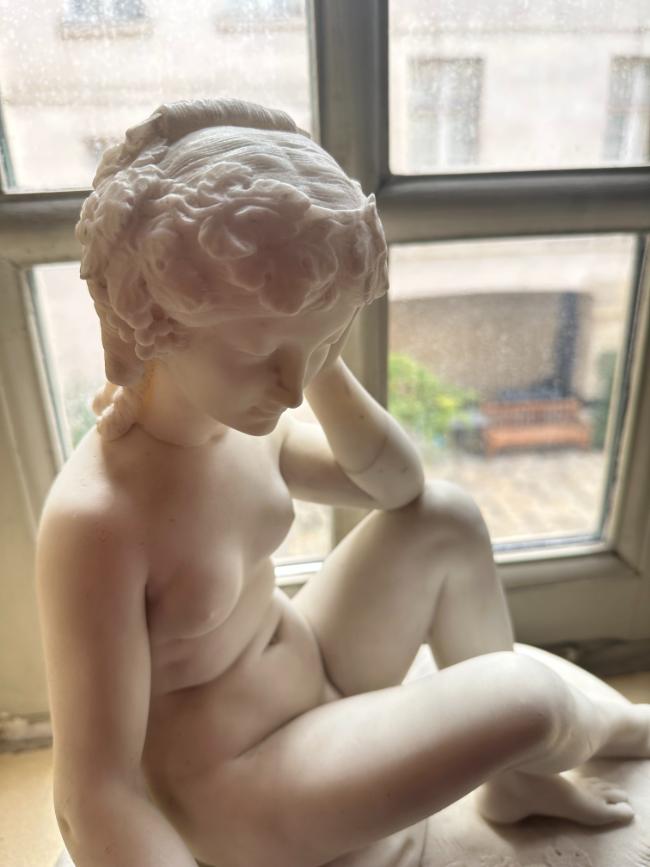
A view of the museum’s courtyard. Photo: Martha Sessums
After enjoying the exhibit, explore Cognacq and Jay’s art collection and 18th-century interior design. As Thurnauer said, “An art piece becomes more contemporary by the eyes we lay on it than by the era it was produced in.”
After seeing Correspondences in this 16th-century townhouse turned museum, Thurnauer’s message of old and now communicates the best meaning of art.
DETAILS
Musée Cognacq-Jay
8 rue Elzévir, 3rd arrondissement
Tel: +33 (0)1 40 27 07 21
Open Tuesday – Sunday, 10am- 6pm
Exhibit price is 11€
Lead photo credit : The exterior of the Cognacq-Jay museum, Paris. © Isogood/ Wikimedia Commons
More in Marais, Musée Cognacq-Jay
Related Articles