The Comeback of Bouillons in Paris: A Restaurant Guide
- SUBSCRIBE
- ALREADY SUBSCRIBED?
BECOME A BONJOUR PARIS MEMBER
Gain full access to our collection of over 5,000 articles and bring the City of Light into your life. Just 80 USD per year.
Find out why you should become a member here.
Sign in
Fill in your credentials below.
The recent renaissance of these affordable, handsome restaurants shows no signs of slowing down
Around 1900, hundreds of bouillon restaurants lined Paris’s ever-busier streets. While their formula would vary, most observed a few strict norms: vast art nouveau rooms, sometimes glass-roofed; a front bar area and restaurant seating behind; and traditional French food at modest, working-class prices. Then came changing tastes and two wars, not to mention the evolution of restaurants and cooking techniques, plus that most invasive of culinary species: fast food. All of which were bad news for the bouillon, and meant that, come the new millennium, exactly one remained operational in France’s capital: the Bouillon Chartier, a survivor still doggedly serving blanquettes de veau or cups of crème Chantilly.
Since 2017, however, a renaissance has been taking effect, with old premises reopening and new examples opening quicker than you can say poireaux vinaigrette. In 2023, there were 10 bouillons in Paris, according to Le Parisien, while Nathalie Louisgrand, an academic and French restaurant specialist, estimated that one was opening each month nationwide. By April this year, the restaurant consultant Bernard Boutboul was claiming that “253 bouillon restaurants have opened in France in four years.”
Paris’s numbers speak to a similar growth curve; we reckon there are now 17 bouillons knocking about the City of Light. Most faithfully follow the same time-honored principles: good Gallic food, decent portions, low prices (three-course meals for €20, say), speedy sittings and still-stunning décor. Now, however, bouillons are truly vogue: hundred-strong lines and hour-long waits have become a common tale from Pigalle to République while Italian variations (Ma!) have emerged and big-name chefs are getting involved. Below, we’ll outline some stand-out options but, first, a brief history lesson.
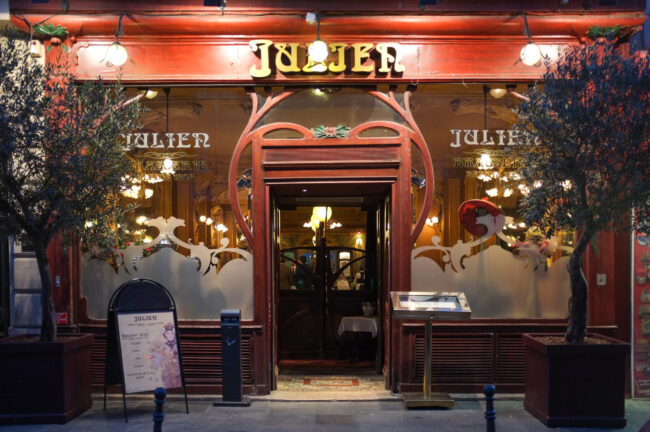
Bouillon Julien, 16, rue du Faubourg-Saint-Denis. Photo: Vinceloo / Wikimedia commons
How bouillons began
A chain of restaurants offering affordable meals. We could be describing McDonald’s but, in fact, we’re talking about the Compagnie hollandaise, for that’s exactly what this forgotten firm is believed to have launched in Paris in 1828. Its canteens allegedly served a dish of boiled beef bone broth, aka “bouillon”, to the city’s then-burgeoning working-class population.
The Compagnie hollandaise seems to have gone kaput in 1854, but no matter; step forward one Pierre-Louis Duval — or possibly Adolphe-Baptiste Duval or Baptiste-Adolphe Duval. While his name is the subject of much disagreement, historians generally agree that Duval was a butcher on Rue Coquillière who had grown frustrated that his bourgeois customers only purchased prime cuts, leaving him with much waste.
His eureka moment led first to a proto-“bouillon” (again serving slow-cooked stews, cooked using the other cuts) on Rue de la Monnaie, catering mainly to workers at Les Halles’s wholesale market. With business booming, a bouillon proper was soon forged from a vast ex-ballroom on nearby Rue Montesquieu, somewhere between 1854-6. Duval’s menu soon expanded too, encompassing French classics, as the notion caught on and more bouillons followed — a trend being echoed today.
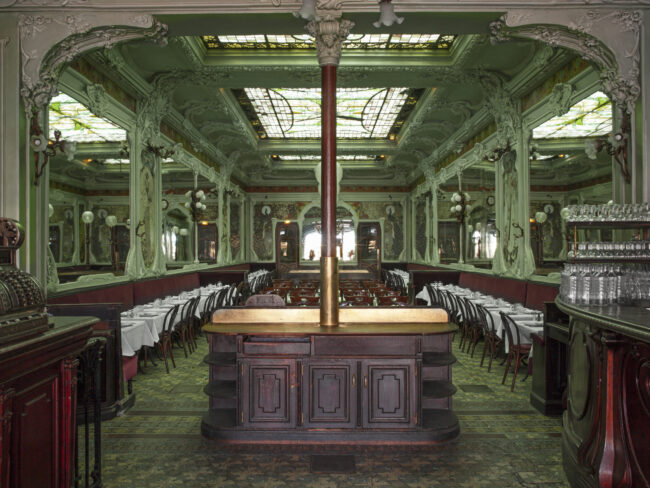
Art Nouveau decor in Brasserie Julien, a historic monument. Photo: Wikimedia commons
Eight bouillons to seek out
Interrupting the Porte-Saint-Denis’s epiceries and kebab shops, this former fave of Édith Piaf returned to a bouillon format in 2018 after spending 43 years as a brasserie. Happily, much of its old Art-Nouveau majesty survives from more than 100 years ago, including a glorious stained-glass ceiling and ornate woodwork. An original promise from 1906 of being “beau, bon, pas cher” — attractive, tasty, inexpensive — also endures, and remains defensible, despite some bouillons proving slightly cheaper. Be it escargot, a pork sausage with mash or chestnut mousse and meringue, three quality courses here will cost a mere €20-30.
16 Rue du Faubourg Saint-Denis, 10th
You can’t start a fire without a spark, as we all know, and this retro-cool hotspot provided that impetus when launching in 2017 to single-handedly initiate bouillons’ comeback. Reinventing the overall experience, it proffers simple, traditional fare, low prices and rapid service amid striking red banquettes — perhaps a nod to surrounding Pigalle’s sex shops. Five minutes’ walk from the Moulin Rouge, its long communal tables help 2,000 customers be served daily; even so, epic queues remain a constant. Parisians just seemingly can’t get enough of the award-winning oeufs mayonnaise, beef bourguignon or île flottante.
22 Boulevard de Clichy, 18th
This not-so-little sister to Bouillon Pigalle opened in 2021 on the spot where Chez Jenny had hitherto served Alsatian fare since the 1920s. Its grand, mirror-lined rooms and intricate woodwork have been retained, while menus faithfully follow the bouillon textbook: wine in carafes and giant portions of beef tartare and cordon bleu before crème brûlée. There’s even, neatly, a chicken version of bouillon broth itself. In other ways, however, Paris’s largest bouillon is a distinctly modern operation. Menus have multiple languages and waiters note down orders on iPads as, again, around 2,000 guests pass through each day.
39 Boulevard du Temple, 3rd
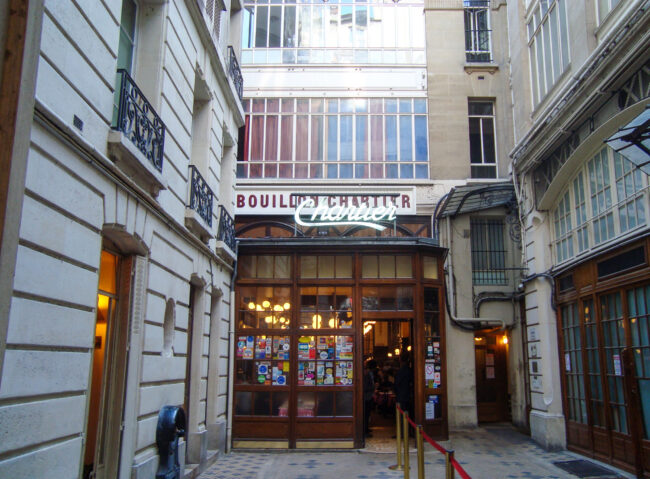
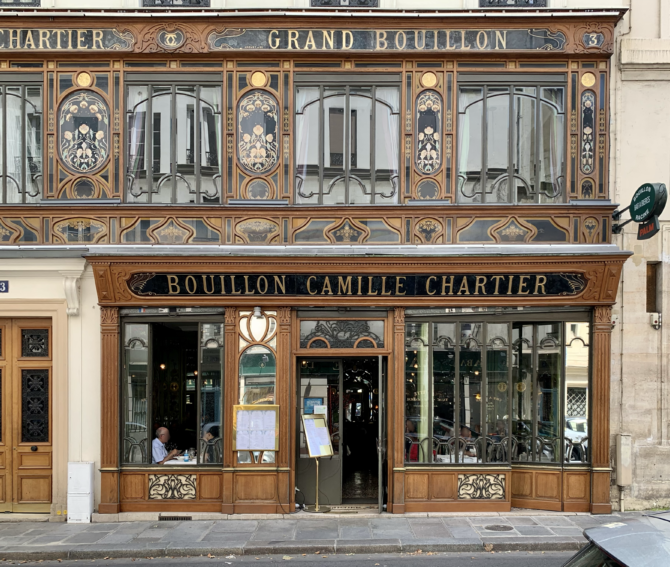
Entrance to the Bouillon Chartier. Photo: LPLT / Wikimedia commons
Though continuously open since 1896, Chartier’s current successful form dates back to a 2007 takeover by the Joulie brothers. While its kitchen was modernized, menus were reversed, including a much-requested return for beef bourguignon with macaroni. Confit duck is another speciality, despite mixed reviews, as are giant profiteroles wallowing in chocolate sauce. Two siblings (Montparnasse and Gare de l’Est) have lately followed, yet this Grands Boulevards original still has the most delightful hubbub below magnificent chandeliers — much aided by bow-tied waiters who scribble down your order on paper tablecloths or napkins before unsubtly encouraging haste.
7 Rue du Faubourg-Montmartre, 9th
A spin-off by Bouillon Chartier’s owners — hence the lovely frontage mentioning one Camille Chartier — in 1906 and, much later, a Sorbonne staff cafeteria, Racine returned to restaurant form during the Nineties. While it has the same spectacular Art Nouveau looks, especially upstairs thanks to stained glass panels and marble mosaics, two elements help it to stand out from the Parisian bouillon crowd. First, unlike at most rivals, one can reserve a table. Secondly, the service is almost disconcertingly friendly. Just as winning are its mango pavlovas, a must-order for first-timers.
3 Rue Racine, 6th
Deep in revamped Les Halles, Pharamond long ago succeeded a Norman brasserie whose name still anoints its exterior. Chicken Normandy is served, appropriately, as are steak tartares and the like at piffling prices. You’ll be following in the footsteps of Ernest Hemingway, Oscar Wilde and F. Scott Fitzgerald, all of whom have passed under the timber-framed façade, eaten at elbow-knocking tables and, probably, been chivvied along by impatient servers. A suburban spin-off materialized last year — Asnières-sur-Seine’s Le Petit Bouillon de la Gare — but only the original has pretty fin-de-siècle tiles portraying fruits and farm animals.
24 Rue de la Grande Truanderie, 1st
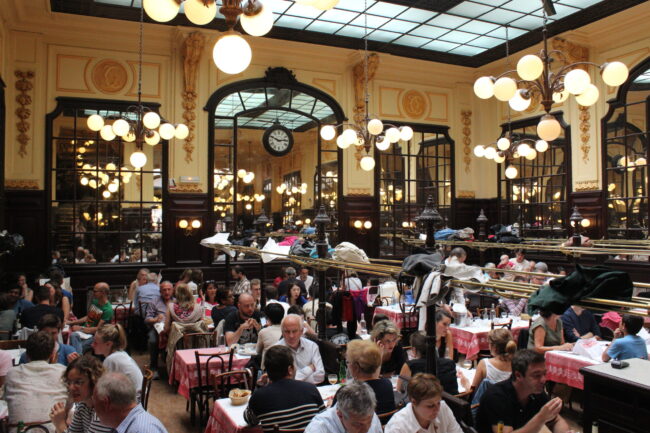
Interior of the Bouillon Chartier. Photo: Michel wal / Wikimedia commons
Thierry Marx has had a career studded with Michelin-star approval. The chef’s decision, then, to open a bouillon in 2024, then, says everything about the sector’s newfound buoyancy. In northern Greater Paris, amid Saint-Ouen-sur-Seine and close to its famous flea market, Le Bouillon du Coq adheres to a standard, classic-laden menu. Its emphasis on presentation is far greater than in most bouillons, however, while the atmosphere is, predictably, more stilted. Prices impress, though, even if portions are smaller than normal; three courses under €20 remain possible.
37 Boulevard Jean-Jaurès, Saint-Ouen-sur-Seine
Nor is the bouillon train stopping anytime soon. Opened this month in Boulogne-Billancourt within the Île Seguin’s Pointe des Arts complex, Bouillon sur Seine comes courtesy of Christopher Préchez and Benjamin Moreel, who helped revive Pharamond and also launched Lille’s Bouillon Alcide. They’ve appointed Nicolas Rodier, trained at L’Arpège and Le Bristol, as executive chef, too. Including a vast, river-facing terrace, it’s France’s largest bouillon yet.
2 Île Seguin, Boulogne-Billancourt
The 17 bouillons in Greater Paris:
Inner: Chartier Grands Boulevards, Chartier Montparnasse, Chartier Gare de l’Est, Julien, Racine, Petit Bouillon Pharamond, Petit Bouillon Vavin, Pigalle, République, Chez Marguerite (Montmartre), Bouillon de Paris (République), and Ma!
Further out: Le Bouillon du Coq (Saint-Ouen), La Petite Marguerite (Saint-Ouen), Le Petit Bouillon de la Gare (Asnières) and Petit Bouillon Versailles
Lead photo credit : Bouillon Racine, created by the famille Chartier. Photo: Neoclassicism Enthusiast/ Wikimedia commons
More in bouillon
Related Articles