10 Surprising Facts and Mysteries of Notre Dame
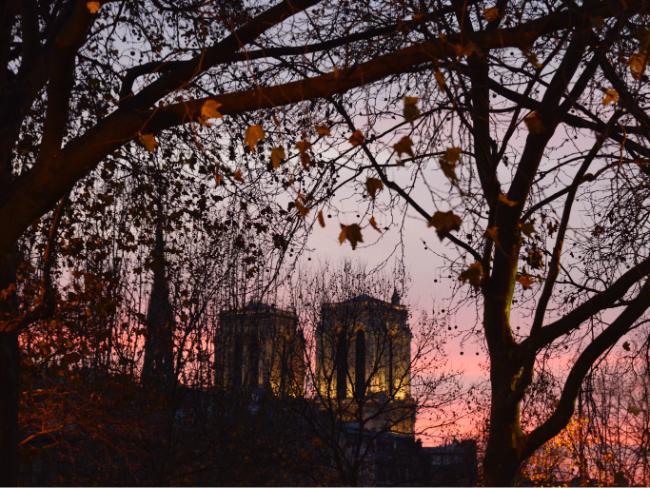
When the April 2019 fire devoured Notre-Dame’s spire and wooden roof and damaged the central nave and transept, the world came together in universal heartbreak. And yet, somehow we knew that the eight-century–old cathedral was not lost forever.
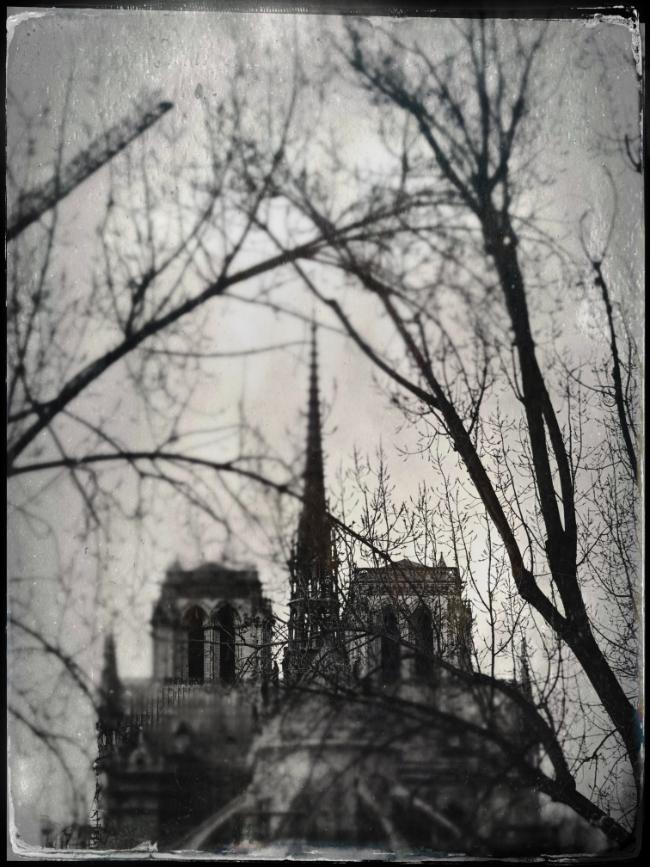
Reborn into its centuries-old heritage. © Meredith Mullins.
“Our Lady of Paris” reopened in December 2024 — majestic on the outside and rich with treasures and mysteries within, all interwoven through its many layers of history.
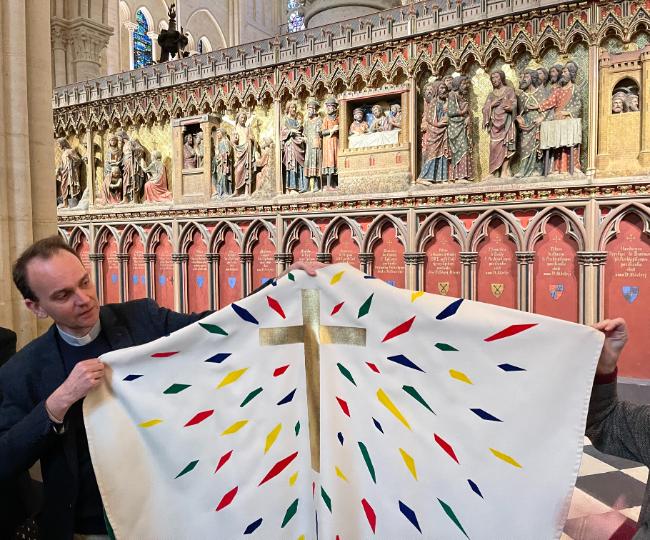
The centuries-old choir enclosure wall is backdrop for the contemporary vestments designed for the reopening of the cathedral. © Meredith Mullins
As a tribute to the cathedral’s painstaking restoration and the profound Lent/Easter season, I share 10 surprising facts and mysteries that you may not know about Notre-Dame.
1: The Virgin of the Pillar (Our Lady of Paris)
The Virgin of the Pillar statue, rising just to the right of the main altar, could be considered nothing short of miraculous.
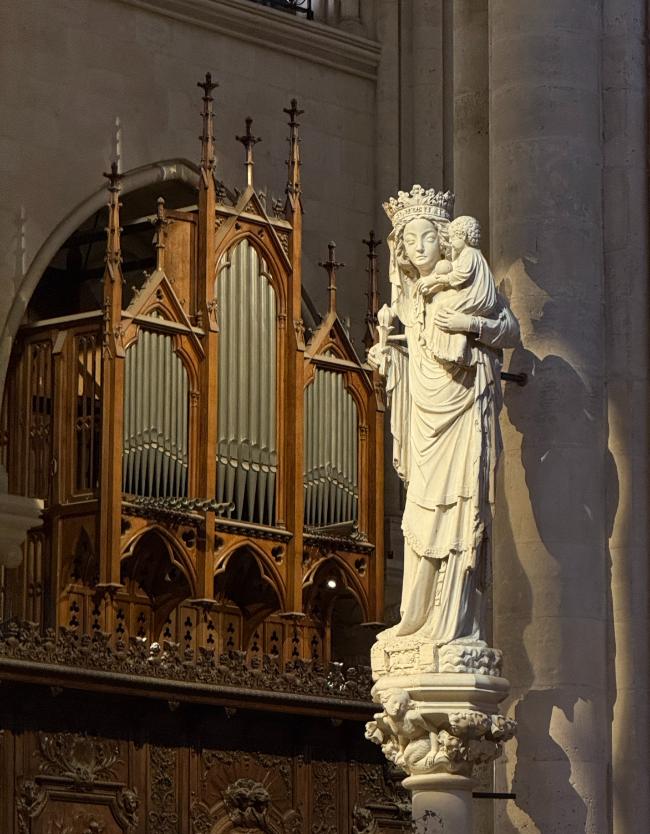
The miraculous Virgin of the Pillar statue. © Meredith Mullins.
When the cathedral ceiling and spire collapsed above the statue during the fire, everything around her was destroyed. She, however, remained unharmed.
The statue, also called “Our Lady of Paris,” dates to the mid-14th century and was originally in the Chapel of Saint-Aignan on the Île de la Cité. The sculpture was transferred to Notre-Dame in 1818 to the Virgin’s Portal and then, in 1855, moved by Viollet-le-Duc to the southeast pillar of the transept. It is here that she continues to stand tall and seems to emanate light no matter what time of day or night.
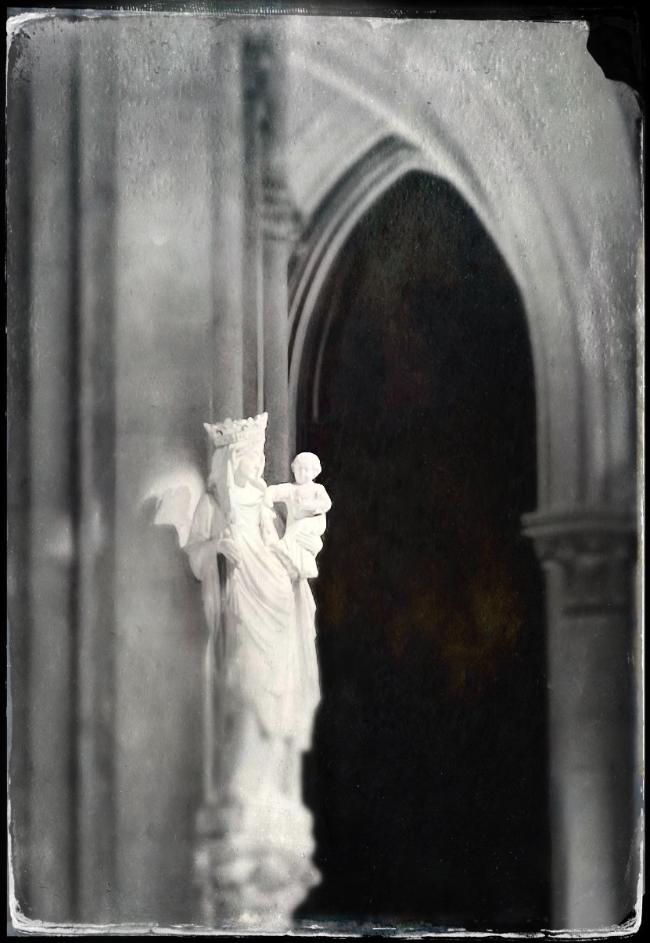
The 14th-century statue retains its place of honor to the right of the altar. © Meredith Mullins.
2: The Crown of Thorns
Notre-Dame houses one of Christianity’s most revered relics — the Crown of Thorns —encased in glass and gold and bravely saved from the 2019 fire.
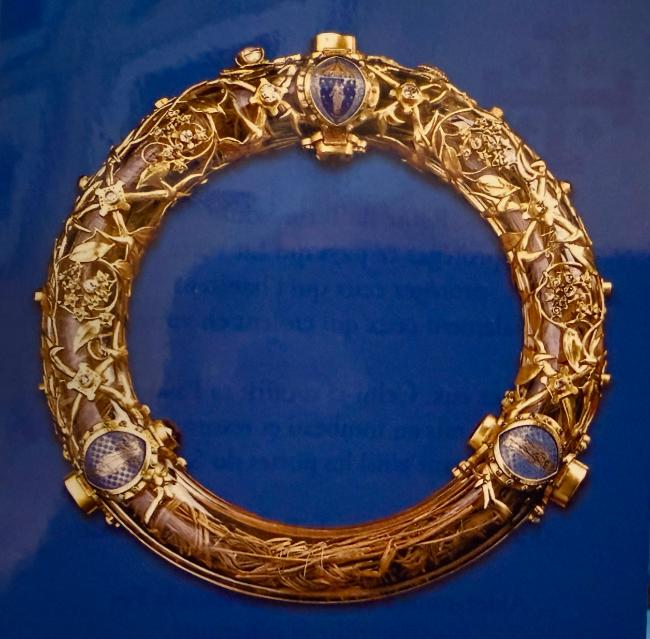
The Crown of Thorns, acquired by Louis IX in 1239. Photo courtesy of Notre-Dame.
This historic artifact has been in France’s possession since Louis IX purchased it from Emperor Baldwin II of Constantinople in 1239. We may never know if it is the true Crown of Thorns, but its nearly 800-year presence in France makes this wreath of woven reeds an undeniable historic treasure.
Ironically, there are no thorns. These were purportedly given as gifts over the years to rulers and churches to strengthen alliances and garner donations.
During Lent, the crown is presented every Friday afternoon from 3 to 5 p.m. for veneration. Visitors are invited to approach the crown to pay tribute (a kiss, a touch, a bow, a genuflection, a prayer).
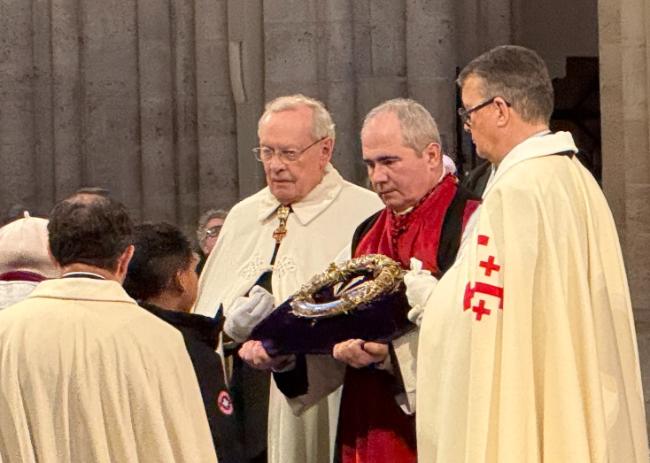
The solemn veneration ceremony for the Crown of Thorns. © Meredith Mullins.
The white-robed, white-gloved Knights of the Holy Sepulchre keep the line moving silently and efficiently. The experience can be meaningful and emotional for visitors of all backgrounds and beliefs.
Outside of Lent, the crown is presented on the first Friday of every month.
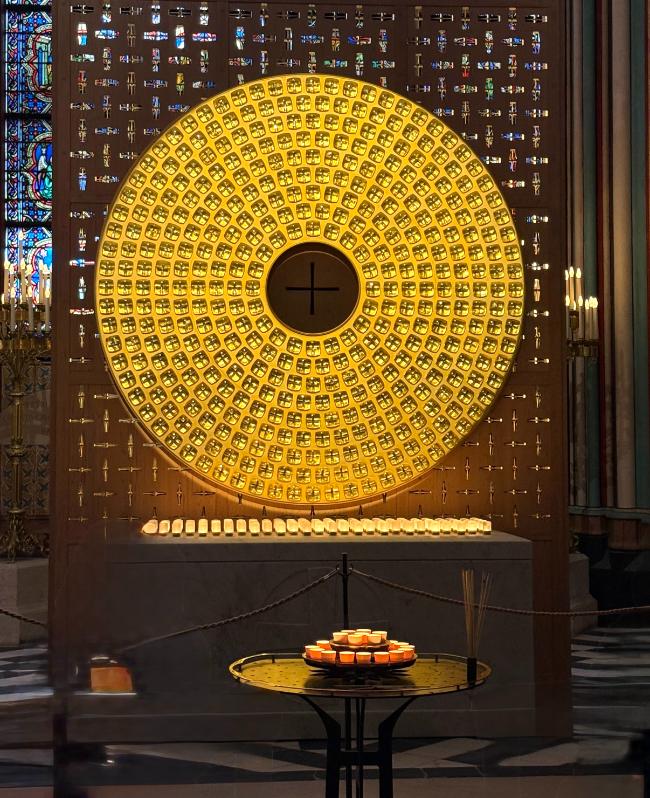
The Crown of Thorns Reliquary designed by Sylvain Dubuisson is the new home for the relic—an integration of modern design and medieval symbolism.
3: Sculpted Stories in Stone
Some of my favorite scenes in Notre-Dame are the colorful stories sculpted on the walls of the choir enclosure. The northern wall features tableaux from Christ’s life, such as the Nativity, the Flight into Egypt, the Baptism of Christ, and the Last Supper.
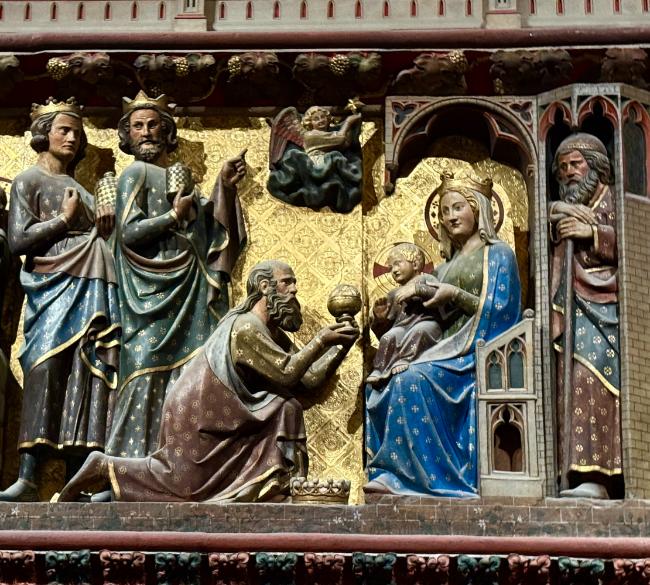
The Magi bearing gifts on the north choir enclosure wall. © Meredith Mullins.
These relief sculptures were begun in the early 14th century by architect Pierre de Chelles. In 1316, architect Jean Ravy took over the work on the southern wall, which includes scenes after Christ’s Resurrection, such as his appearance to Mary Magdalene and the moment he asked Thomas to place a hand in his wound to offer proof that he was resurrected.
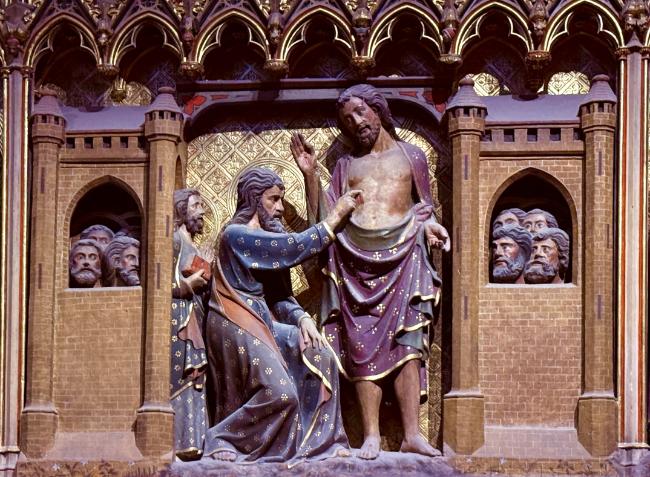
Christ proves to “doubting” Thomas that he has returned from the dead. © Meredith Mullins.
Although the carvings look like wood — and many guides will tell you they are wood —the work is, in fact, limestone. This type of stone is softer than marble or granite and easier to carve into finely detailed images. And, when exposed to air, limestone hardens over time and can last for centuries.
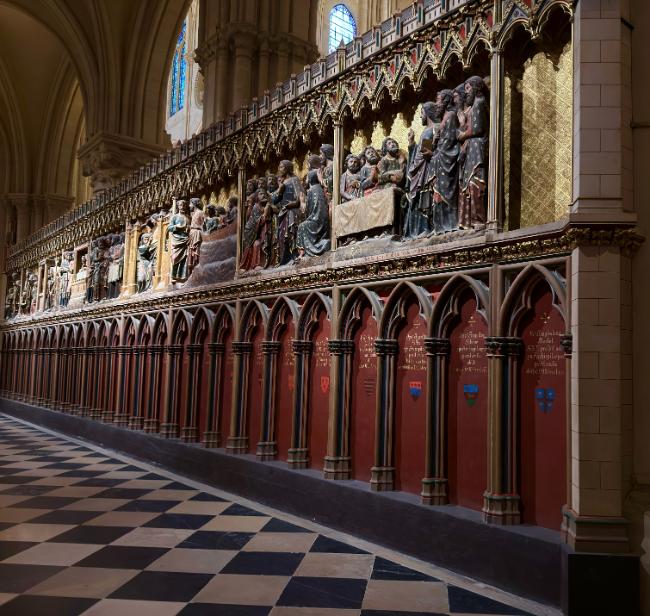
The south choir enclosure wall, filled with stories. © Meredith Mullins.
4: The Legend of the Devil Doors
Attention, conspiracy theorists! The extraordinary wrought ironwork on the side entry doors of the cathedral seems almost too intricate to be hand forged by medieval techniques. Or so some believed.
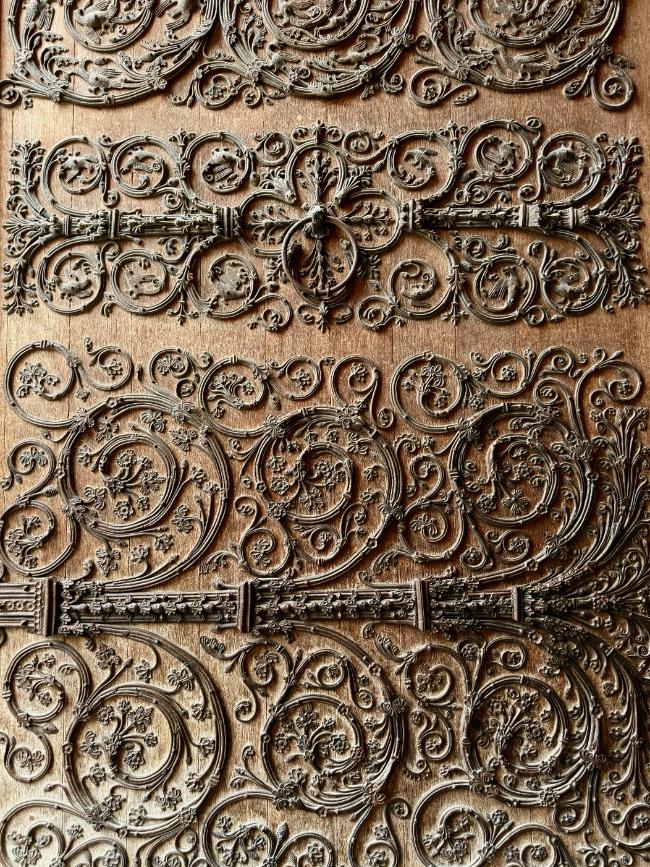
Biscornet’s extraordinary wrought ironwork. © Meredith Mullins
The doors are covered with elaborate scrolling patterns and floral motifs, all attributed to the 14th–century blacksmith Biscornet. Such remarkable craftsmanship invited both admiration and skepticism. How could one man, using the small forges of the time, heat and hammer iron into such refined detail?
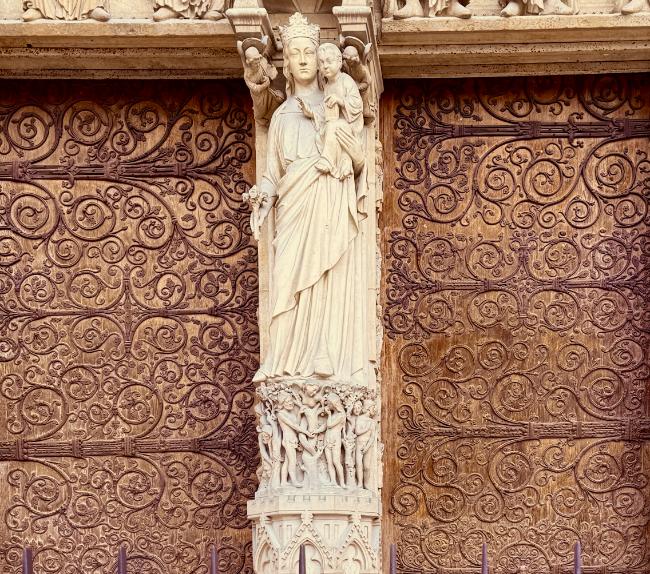
The Devil Doors? © Meredith Mullins
Stressed and behind schedule, Biscornet was believed to have made a pact with the devil to complete the work. “Proof” of this pact came on inauguration day when the “Devil Doors” would not budge. A sprinkling of holy water did the trick, and they magically opened.
We will never know if Biscornet was inspired by his own creative spirit or his pact with the devil — a mystery that will remain unsolved.
5: The May Paintings (The “Mays”)
Hidden in plain sight throughout Notre-Dame, you will find monumental paintings from the 17th and 18th centuries depicting scenes of the apostles. These works, known as the “Mays,” were presented to Notre-Dame each May 1 by the Paris Goldsmiths’ Guild.
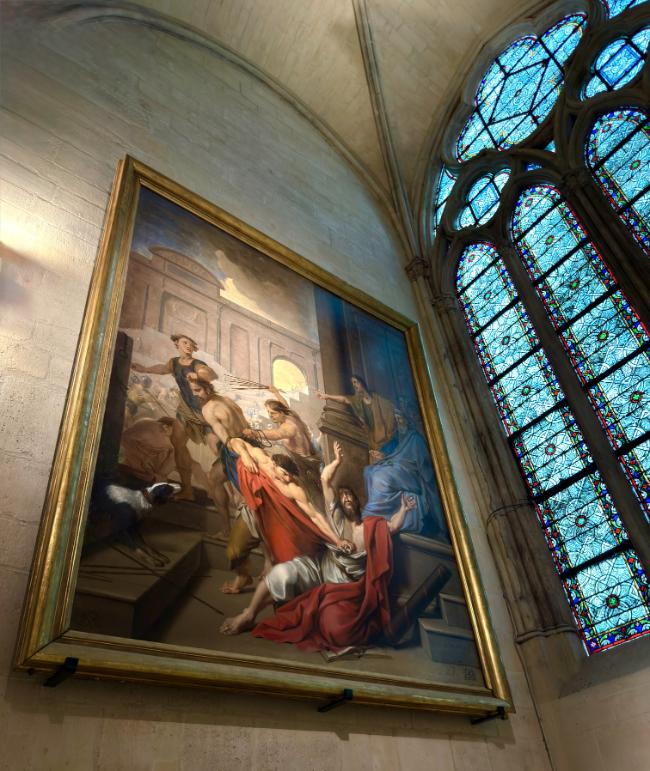
The Flagellation of Saint Paul and Saint Silas by Louis Testelin (1655). Photo © Meredith Mullins.
Some of the most famous artists of the time were commissioned for the high honor of having the work placed in Notre–Dame for thousands of people to see. The Goldsmiths’ Guild also gained respect as a patron of the arts, not to mention earning a bit of divine favor.
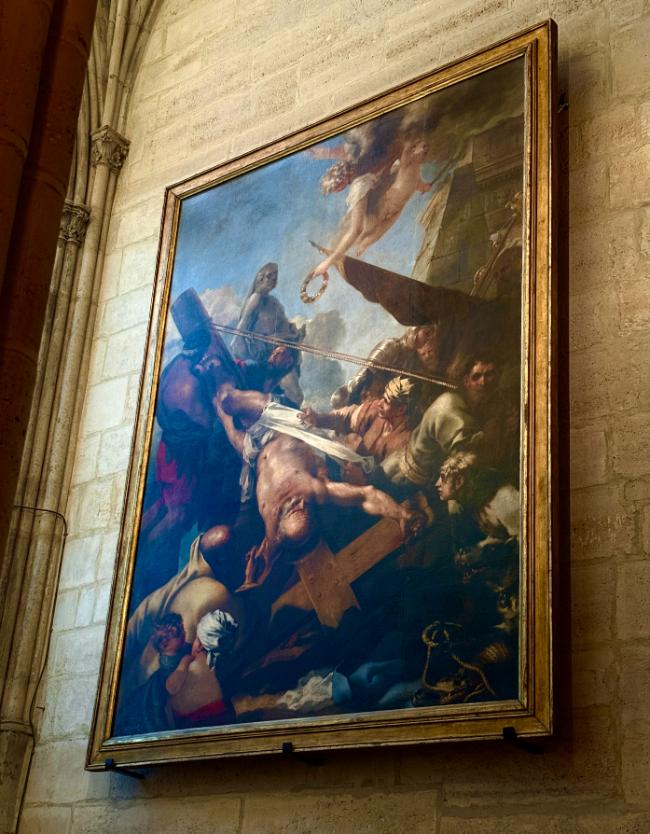
The Crucifixion of Saint Peter by Sébastien Bourdon (1643), portraying Saint Peter’s wish to be crucified upside down as he felt unworthy to be crucified in the same way as Christ. Photo © Meredith Mullins.
Some of the “Mays” are also displayed in the Louvre and in other churches and museums throughout France.
6: The Wrong-Way Bishop
Simon Matifas de Bucy rests in marble effigy near the east end of the cathedral. He served as bishop of Paris from 1290 to 1304. A lion snuggles at his feet as a symbol of protection and a guardian of faith. His elegant, multicolored jewels are not usually thought of as “glitzy,” but rather as a means of reflecting (and connecting with) God’s light.
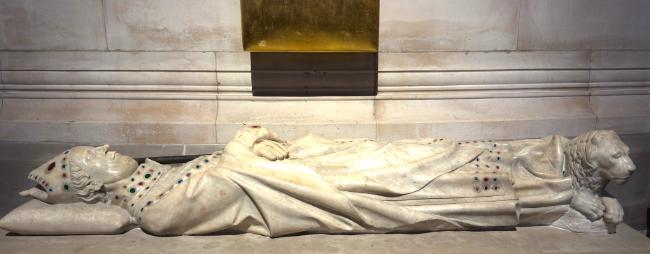
The marble effigy of Bishop Simon Matifas de Bucy. © Meredith Mullins.
Good detective work will reveal that Bishop de Bucy has been moved from his original spot because he is facing north in his current orientation. Customarily, one faces east toward the rising sun and resurrection, symbolizing the promise of eternal life.
7: The Stained-Glass Superstars
Notre-Dame is filled with glorious stained-glass windows from several centuries of the cathedral’s life, sharing Biblical stories and letting light dance into the Gothic structure.
Two of the most famous windows are the north and south rose windows. These masterpieces are worthy of close study, revealing both subtle and striking differences. After you’ve spent some time with them, can you see the differences?
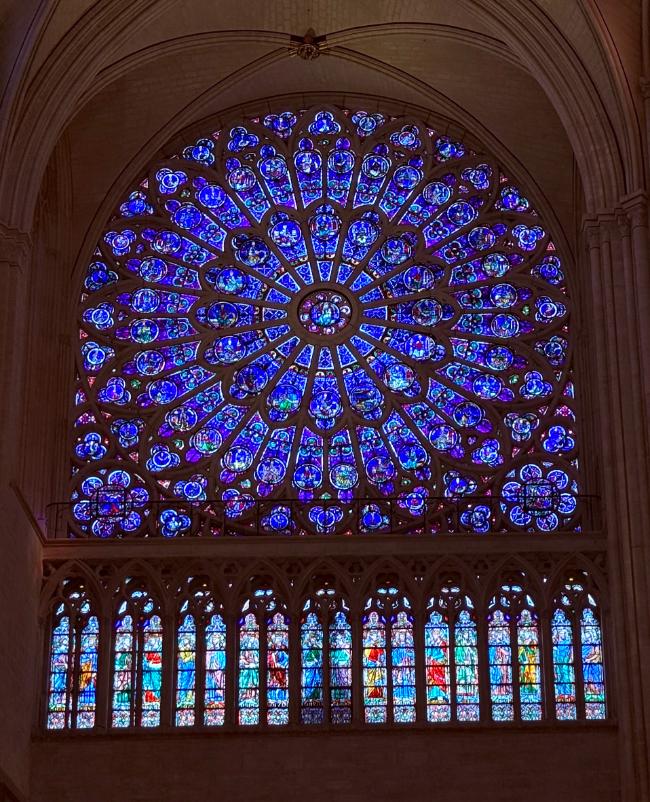
The northern rose window. © Meredith Mullins
The north window, built in 1250, celebrates themes from the Old Testament, with a palette favoring blues and purples. The stories radiate organically, like a flower, from the center image of the Virgin Mary holding the Christ Child.
The south window was built in 1260, focusing on the emergence of Light and the birth of Jesus. The overall palette is still in blues and purples, but there are more touches of warmth, with saturated reds, golds, and oranges.
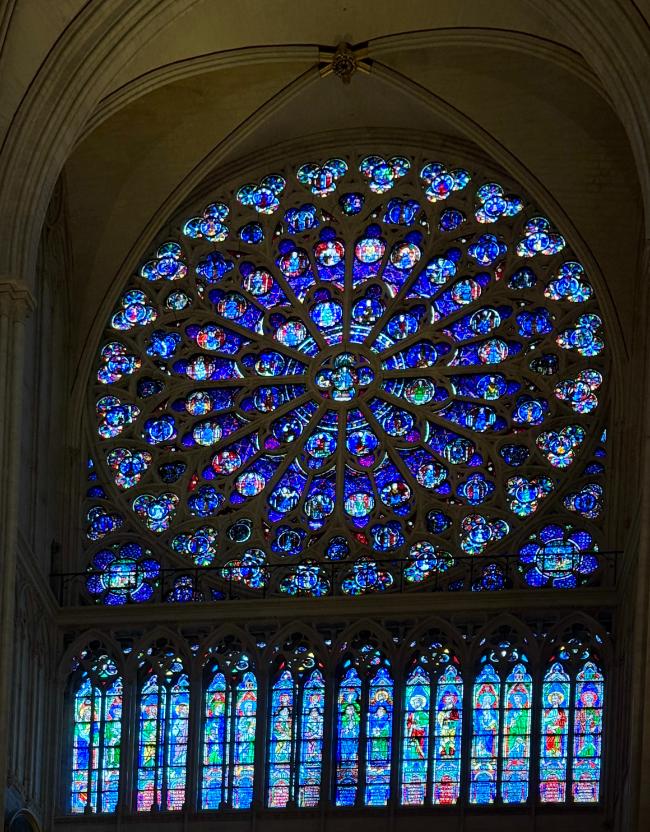
The southern rose window. © Meredith Mullins.
The window also has more inherent warmth because the afternoon sunlight warms the window and the cathedral interior. The theme includes stories of the apostles, martyrs, and saints, emanating from the center image of Christ enthroned.
The design is more geometric, has thicker lead lines, and has straighter reinforcement lines (a vertical and a horizontal) added for structural support during Viollet-le-Duc’s renovation in the 1800s.
8: Make Room for Contemporary Stained Glass
As in many moments of French history, innovation and change have sparked debate. Think Eiffel Tower, Louvre Pyramid, Pompidou Center, or the brief period when a swimming pool or rooftop garden was proposed to take the place of the collapsed Notre-Dame spire.
Several new elements were introduced during the cathedral’s restoration after the fire, such as the altar, the baptismal font, the chairs, and the temporary tapestries (e.g., Matisse).
More dramatically, new stained-glass windows have been commissioned for six chapels on the south side of the cathedral.
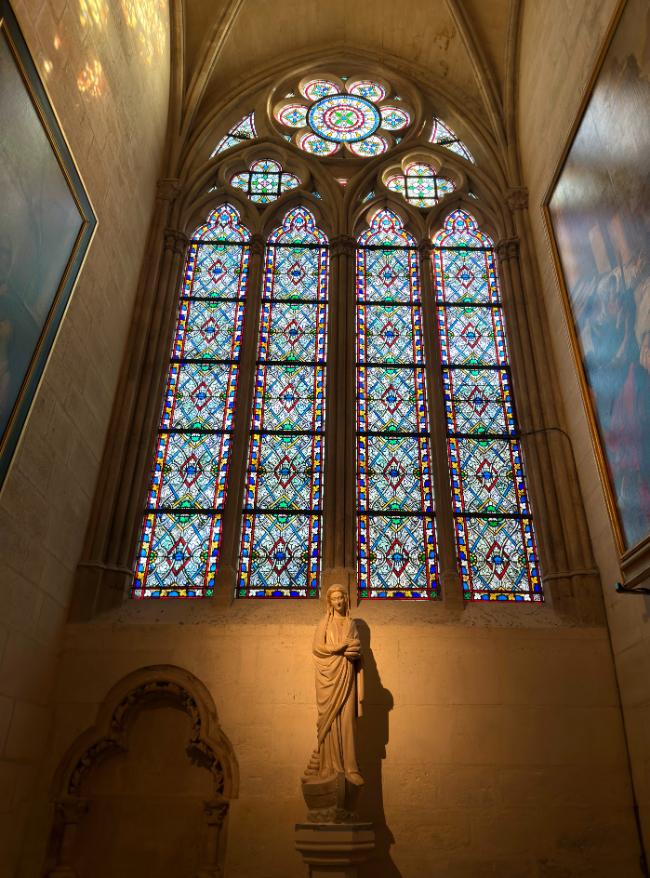
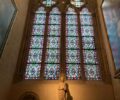
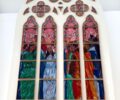
The artist, Claire Tabouret, was selected from 110 candidates for the somewhat controversial project. Detractors argue that the original windows from the 1800s survived the 2019 fire and should remain on view.
However, Mme. Tabouret has created a thoughtful set of designs in vivid colors —figurative but also including what she calls “emotional abstraction.”
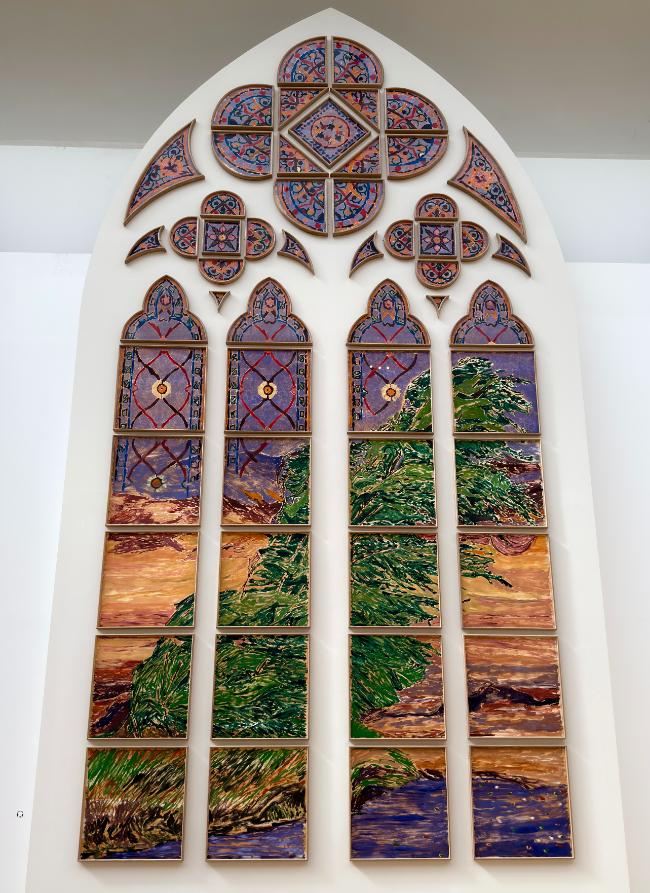
The new stained-glass design for the Chapel of Saint Vincent-de-Paul, capturing the “breath of the spirit.” © Meredith Mullins
Each design reflects the spirit of the Pentecost, as well as representation of different cultures. Models of the windows are on exhibit until March 29 at the Grand Palais. We will soon see how her contemporary vision will fit into a cathedral with so many layers of history.
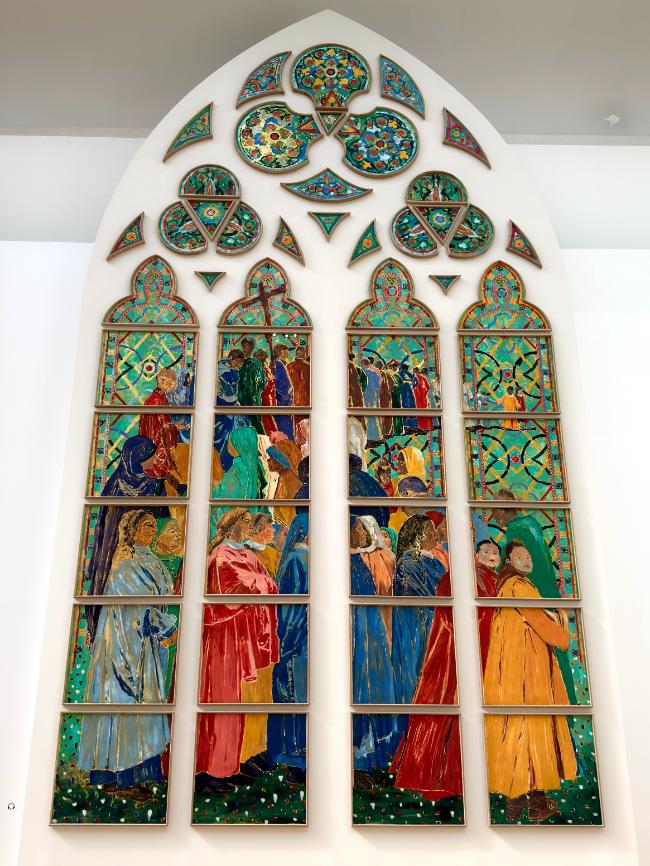
The new stained-glass design for the Chapel of Saint Paul Chen, capturing a diversity of cultures. © Meredith Mullins.
9: A Quiet Corner of China
In the last chapel on the cathedral south side, you’ll find a surprising fusion of Chinese art and Gothic architecture. The newly dedicated Chapel of Saint Paul Chen (previously named the Chapel of the Holy Childhood) honors the young Chinese saint, known for spreading a message of peace, unity, and love. He was beheaded at age 22 during anti-Christian persecutions and was canonized in the year 2000.
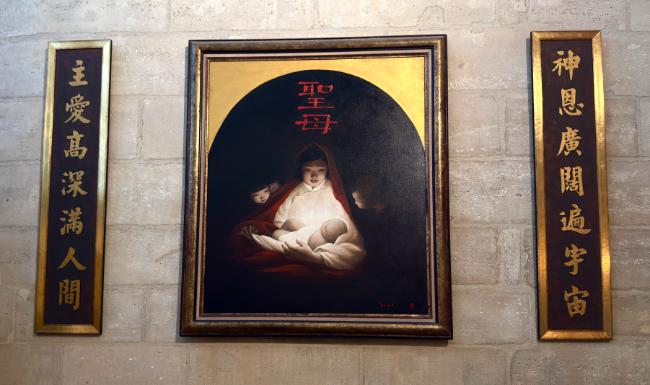
Chinese influences for the Chapel of Saint Paul Chen. © Meredith Mullins
A likeness of him by Yin Xin hangs in the chapel along with a Chinese-style portrait of the Virgin Mary and Child accompanied by calligraphic panels. After viewing this last chapel, visitors may leave Notre-Dame with a powerful message of global faith and unity.
10: Free Guided Tours
The best surprise is saved for the grand finale. Notre-Dame offers frequent free tours, but the link on the official site can be difficult to find. The tour leaders are volunteers with CASA (Communities of Welcome in Artistic Sites), an organization that has been giving tours of Notre-Dame (and other sites in France) for more than 50 years. The guides are trained in the artistic, historical, and spiritual dimensions of the cathedral.
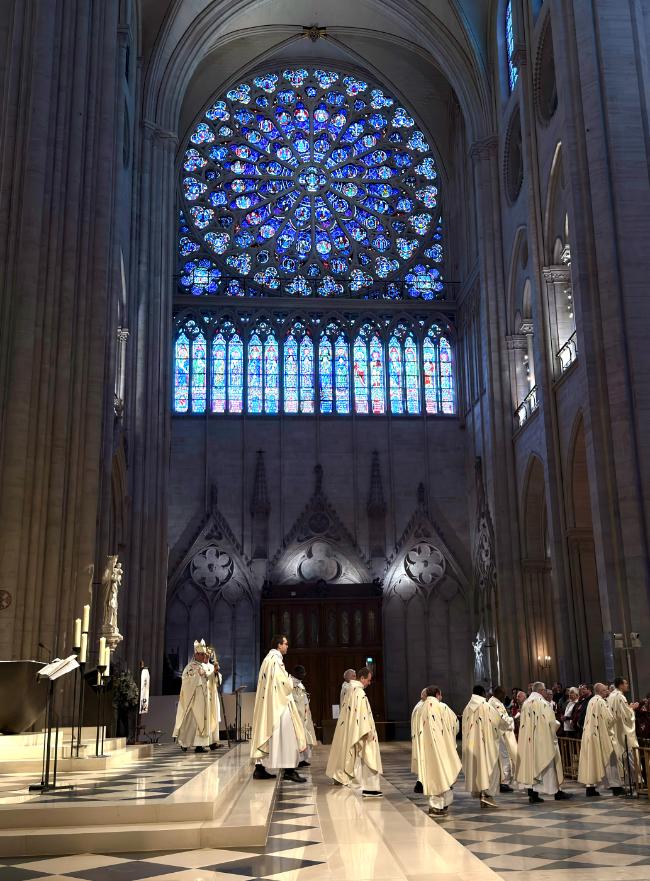
Notre-Dame, a living cathedral. © Meredith Mullins
Interior tours take place throughout the week (with audiophones), and exterior tours are given on Saturday afternoons and Sundays. Tours are offered in English, German, Spanish, French, and Italian. You can find a schedule of tours and languages here. Reservations are not needed. However, you can book for groups of 10 or more on the website.
For the tour guides, being in such a wondrous place seems a reward in itself. As one guide said after a tour, “Each time feels like my first time — magical and mystical.”
Such a response at Notre-Dame de Paris seems to be universal.
For more information about Claire Tabouret’s stained-glass window designs, stay tuned to Bonjour Paris for an upcoming feature article.
Lead photo credit : Notre-Dame Cathedral—The spiritual and literal (0-kilometer) heart of Paris. © Meredith Mullins.
More in Easter, guided tours, notre dame
Related Articles