
Flâneries in Paris: Celebrating Franco-American Ties

- SUBSCRIBE
- ALREADY SUBSCRIBED?
BECOME A BONJOUR PARIS MEMBER
Gain full access to our collection of over 5,000 articles and bring the City of Light into your life. Just 80 USD per year.
Find out why you should become a member here.
Sign in
Fill in your credentials below.
This is the 54th in a series of walking tours highlighting the sites and stories of diverse districts of the Paris region
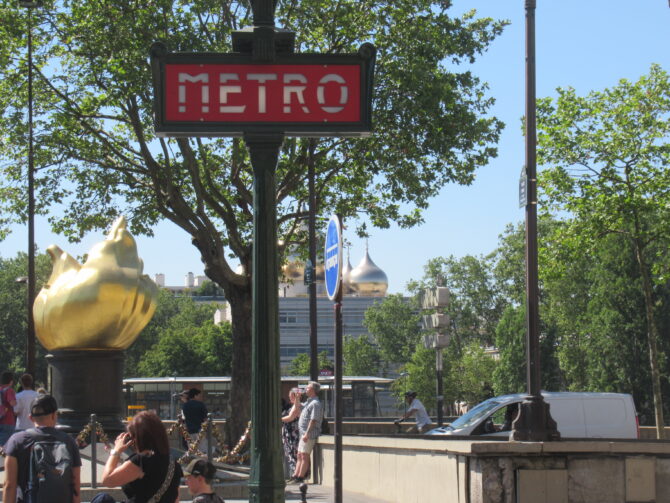
The 250th anniversary of American Independence has been marked all over Paris (see here) and inspired this flânerie, beginning at the Flamme de la Liberté, just off the Place de l’Alma. It was a fitting place to start because it marks Franco-American friendship and a route linking the Alma-Marceau metro station, just nearby, to the one at Passy would take me past memorials to such key players as Benjamin Franklin, George Washington, Thomas Jefferson, and the Marquis de Lafayette.
The flame, shining so beautifully golden on the sunny day I chose for this walk, is an exact replica of the flame on the Statue of Liberty in New York and both symbolize the links between the two countries. France supported the original 13 colonies in their quest for independence from Britain 250 years ago, and a century later marked the anniversary by sending the statue, designed by Frédéric Bartholdi, as a gift from the people of France.
A hundred years after that, the American newspaper the International Herald Tribune celebrated its century of publishing in Paris with this model of the statue’s most important part, a gilded copper flame of liberty. Today it’s covered in padlocks and mementoes left in tribute to Princess Diana who died nearby, but its key message remains: France and America celebrate liberty together.
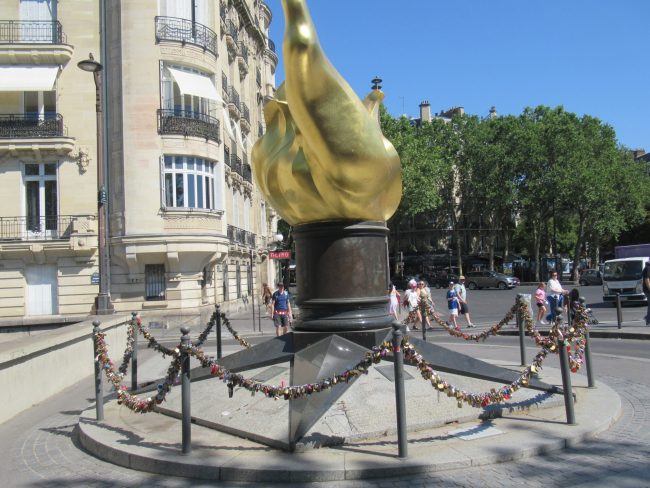
Flame of Liberty. Photo: Marian Jones
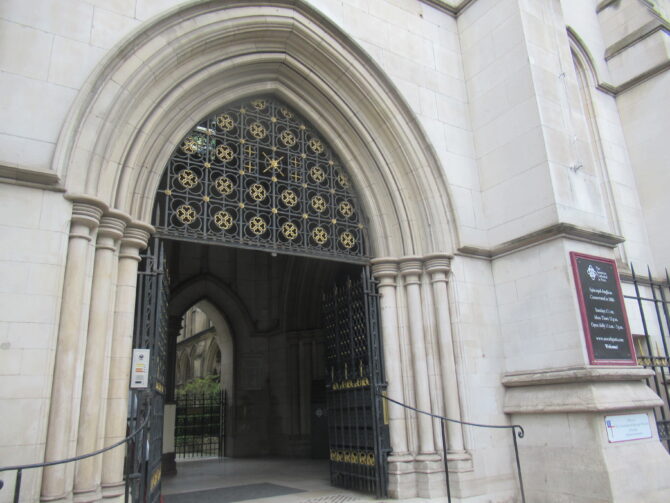
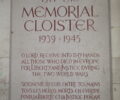
My route took me up the Avenue George V, where the café on the corner offered a Petit George breakfast formule for 9€ and a lunchtime two courses and coffee for 24€. Very reasonable, I thought, for a street lined by high-end shops like Fendi and Balenciaga, not to mention the exclusive Four Seasons George V Hotel. Sadly, the American Cathedral, my next planned stop, was closed for maintenance, but I lingered outside for a moment, recalling some of the things I’d seen inside on a previous visit. The memorial cloister is unforgettable, dedicated to 138,000 members of America’s armed forces who, as a plaque explains, “died in Europe for liberty and justice during the two World Wars.”
I resisted the urge to stop off at such distractions en route as the massive St Pierre de Chaillot church where mass is held regularly in French, Spanish and Italian, or the enticing food shops in Rue de Chaillot, the Jolie Niche, a boulangerie gourmande and Au Bonbon Royal, a chocolaterie artisanale. I headed straight up the steeply sloping Avenue Georges Bizet and into the Avenue d’Iéna, named, said the street sign, for the Victoire de Napoléon en 1806. I’d not considered the emperor’s intrusion into this America-themed walk, but this was another reminder that he’s really quite hard to avoid.
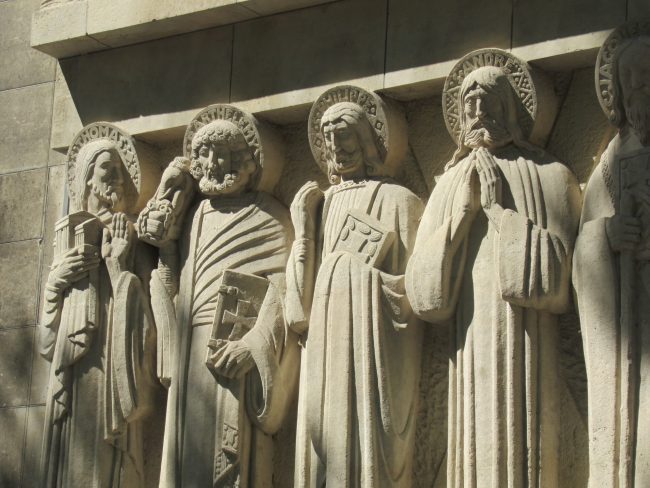
St Pierre de Chaillot church. Photo: Marian Jones
The square – actually an oblong – which opened up before me is named Place des États Unis and its design was based on Battery Park in New York. It has the benches, picnic tables, Wallace fountain and colorful play areas typical of Paris parks, but its theme is most definitely American. This is made clear by its statues and by the fact that one end is named the Square Thomas Jefferson. Jefferson served as America’s First Minister to France in the 1780s before becoming the third President of the United States and remained a lifelong Francophile.
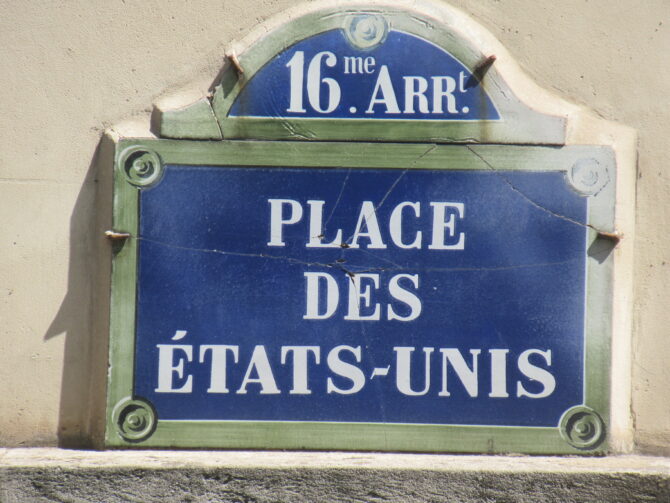
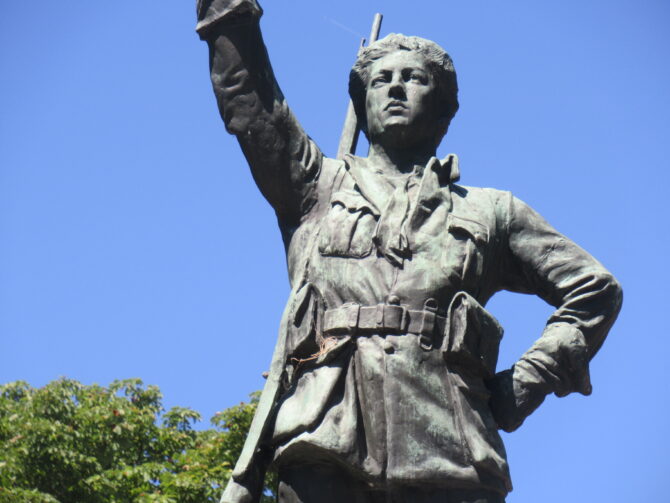
The statue I found at the Avenue d’Iéna end was the moving Memorial to American Volunteers, erected in 1923 to pay tribute to some 100 Americans who had fought alongside French troops before America officially entered the First World War. The names carved on the back represent volunteers who served as medical aides, resistants or in the French Foreign Legion, men from a faraway country and another age such as Ely Dinsmore, Sidney Drew, John Howell Westcott Junior, and the soldier-poet Alan Seegler, whose words are inscribed on the monument’s sides in both English and French. They begin “Hail brothers and farewell,” and go on to recall those who “died for France, yet sought no recompense.”
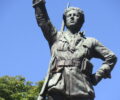
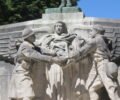
At the far end came an imposing statue by Bartholdi, sculptor of the Statue of Liberty, which depicts General Washington and the Marquis de Lafayette, shaking hands in friendship. It’s a reminder of the close bond between the two men, formed when the young Lafayette served alongside Washington in the struggle for American independence. Their father-son bond lasted for the rest of Washington’s life and Lafayette, whose own father had been killed in battle when he was only two years old, named his only son George Washington Lafayette. The sculpture captures their mutual respect and the inscription explains that it was placed here in “hommage à la France“ and in memory of the country’s “generous assistance in the struggle of the people of the United States for independence and liberty.”
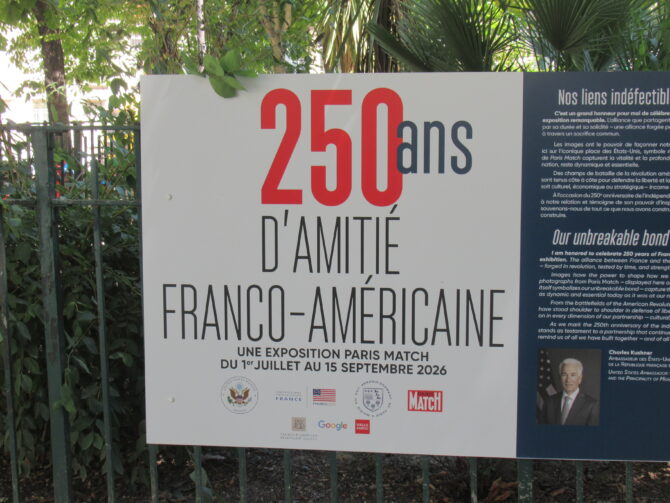
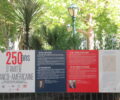
On the railings outside this end of the park was an exhibition of photographs from Paris Match, published to mark the 250-year anniversary. Charles Kushner, the US Ambassador to France, was quoted in the introduction, explaining how important he finds the link between the US and France and how long it has lasted. He wrote, “From the battlefields of the American Revolution to the beaches of Normandy, our two nations have stood shoulder to shoulder in defense of liberty and democracy.”
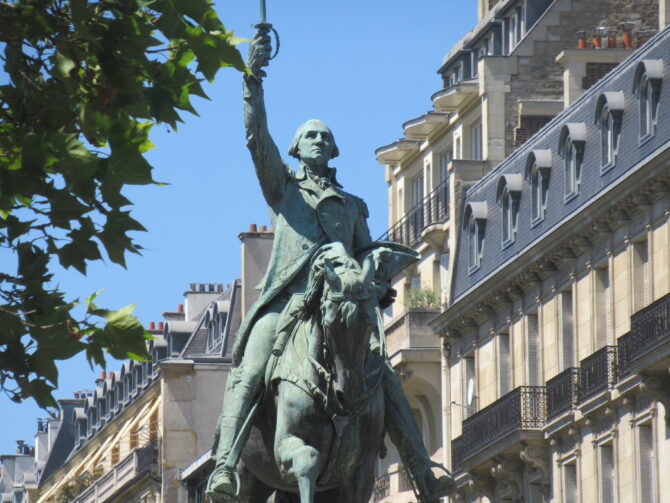
A little further along, I arrived at the Place d’Iéna, dominated by the huge central statue of George Washington on horseback. Placed here in 1900, it has lost none of its impact, depicting the future first President of the US as a general, sword aloft, his face set in determination, riding off at the head of his troops. Washington never came to Paris, but commanded French troops, alongside American soldiers, during the War of Independence, most significantly in the Siege of Yorktown, when the British were forced to surrender. The American Daniel Chester French was commissioned to sculpt this gift to France, whose inscription explains that it was from the women of America in memory of the French contribution to the founding of their new nation.
From the Place d’Iéna I walked along the majestic Avenue Wilson, named in honor of the American President who committed the US to fighting alongside Britain and France in World War I. Then came an immediate change of atmosphere. Entering the Place du Trocadéro, the quiet elegance of Avenue Wilson gave way to a tourist-central, where guides waved flags to marshal their groups and street-sellers vied with each other to offload pocket-sized Eiffel Towers and cheap umbrellas. I walked all around the square, admiring the colonnaded facades of the grand museums, the Cité de l’Architecture and the Musée de l’Homme, and smiling at a street sign chastising impatient motorists which read, “Slow down, you are driving round a work of art.”
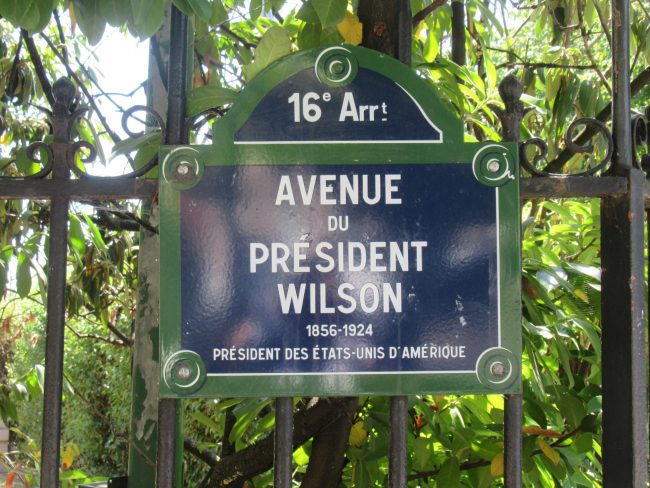
Avenue President Wilson. Photo: Marian Jones
Then, in the far corner, came the last memorial I sought. Just at the top of Avenue Benjamin Franklin was the little Square Yorktown, home to a statue of Franklin who spent seven years in Paris, gaining admiration for his enlightened, humanist views and for his push for independence and democracy in the US which so inspired the French Revolution a few years later. When he died in 1790, the French Assemblée Nationale declared three days of official mourning, the first time such an honor had been granted to a foreigner. Franklin’s statue shows him sitting atop a plinth, gazing reflectively around the little area of Paris where he used to live. A stone tablet nearby recalls his famous commitment to “the best of all works, the work of peace.”
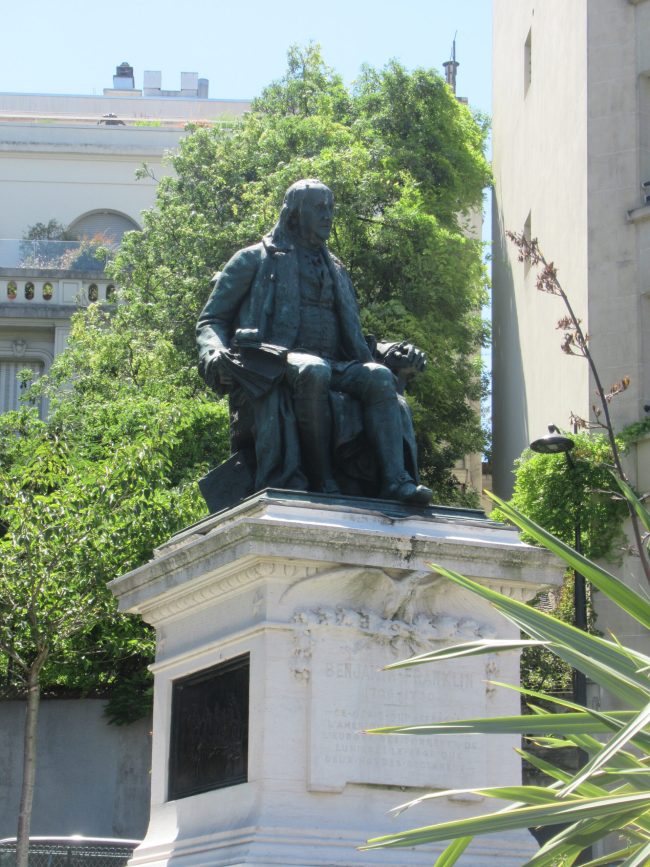
Benjamin Franklin statue. Photo: Marian Jones
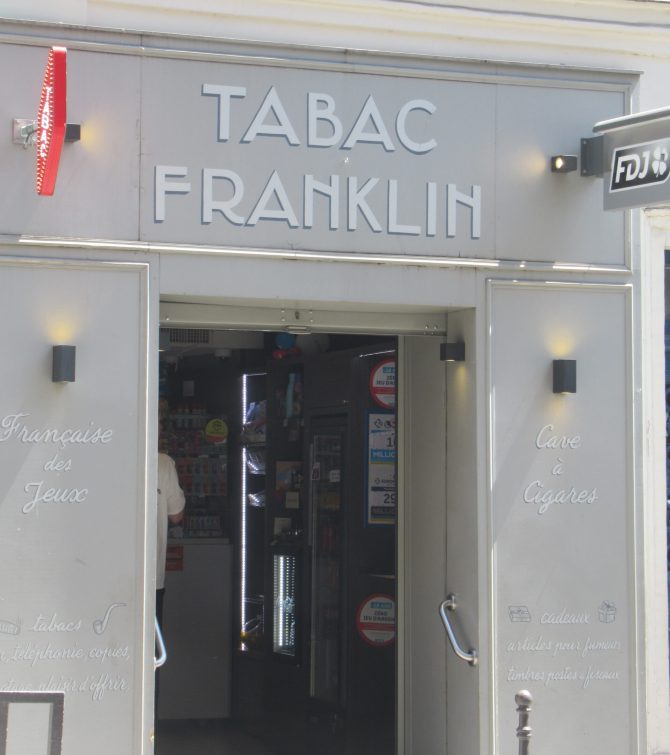
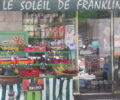
As so often, I find the words more resonant in French: “Au plus beau des ouvrages, l’élaboration de la paix.” I enjoyed rolling them around in my mind while making my way down the Avenue Benjamin Franklin to the Passy metro station. I was amused to pass a number of shops named after this erudite and much-respected statesman. After Le Soleil de Franklin, a fruit and veg shop, came Franklin Optique and the Tabac Franklin. But this didn’t diminish all that I had learned on this walk about the friendship and shared values of France and the United States.
In addition, the Franklin quotation reminded me of something one of his contemporaries wrote, a sentence which perhaps sums up my love of Paris better than any other. It was Thomas Jefferson who commented that, “a walk in Paris will provide lessons in history, beauty and in the point of life.” That’s as good a definition of my aim for every flânerie I undertake as I think I will ever find!
Lead photo credit : Flame of Liberty. Photo: Marian Jones
More in Benjamin Franklin, Flâneries in Paris, Lafayette, Thomas Jefferson
Related Articles
By Marian Jones