
Flâneries in Paris: Walk Between Two Medieval Towers
- SUBSCRIBE
- ALREADY SUBSCRIBED?
BECOME A BONJOUR PARIS MEMBER
Gain full access to our collection of over 5,000 articles and bring the City of Light into your life. Just 80 USD per year.
Find out why you should become a member here.
Sign in
Fill in your credentials below.
This is the 48th in a series of walking tours highlighting the sites and stories of diverse districts of the Paris region
Walking west along the Rue de Rivoli, just past the Hôtel de Ville, I kept my eye out for the building which soars skywards like a finger of wedding cake, signaling that this area was once a center of medieval Paris. Today, the tower – for that is all that remains of the Saint-Jacques-de-la-Boucherie church – stood proudly silhouetted against a bright blue sky. A few streets north is the Tour Jean Sans Peur, wonderfully named after “John the Fearless,” and I wondered how much of late medieval Paris I would find if I walked between the two towers, built in the early 16th and 15th centuries respectively.
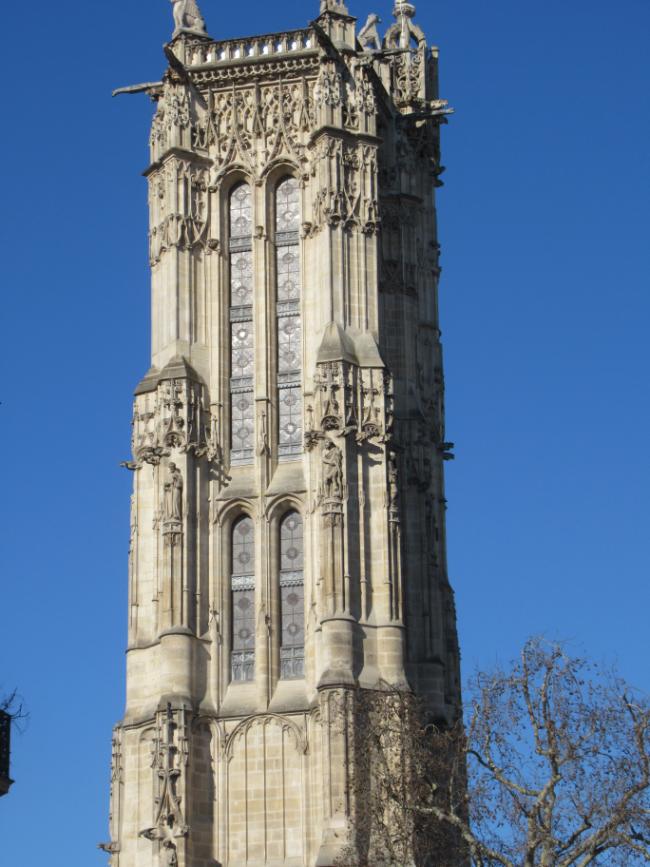
Tour St Jacques. Photo: Marian Jones
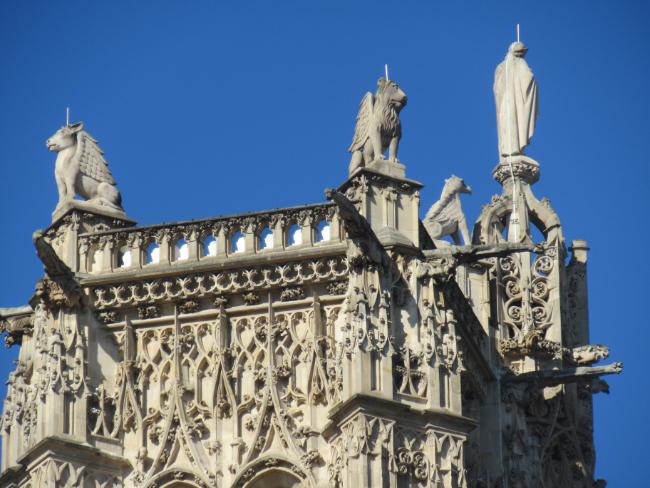
At ground level, the scene in the garden around the Saint-Jacques tower was very contemporary. Mums chatting while their offspring bounded around, passers-by who had stopped at a bench to read a newspaper or take a moment to tilt their head appreciatively upwards at the cloudless sky. Looking up at the tower itself, I could wonder at the beauty early 16th-century man had carved in stone: pointed arches, statues and gargoyles, lacy frills, seemingly piped by a master-baker, up and up and up. And right at the top, the sculpted symbols of the four evangelists – the lion of St Mark, the bull of St Luke – and standing over them, St James himself, after whom the church was originally named.
The wealthy butchers of this area, which was once known as la Grande Boucherie, had clubbed together to finance this dramatic tower, strategically situated in the heart of their city, just where today’s Rue de Rivoli crosses the Boulevard de Sébastopol. Notable citizens like Nicolas Flamel were already buried in the church on this site and pilgrims had been gathering here since the 10th century before embarking on their 600-mile walk to Compostela in Spain. But the look-at-me new tower did much to put this site more firmly on the map, attracting both trade and admiration. Even during the French Revolution, when so many churches including this one were demolished, the Tour Saint-Jacques was spared.
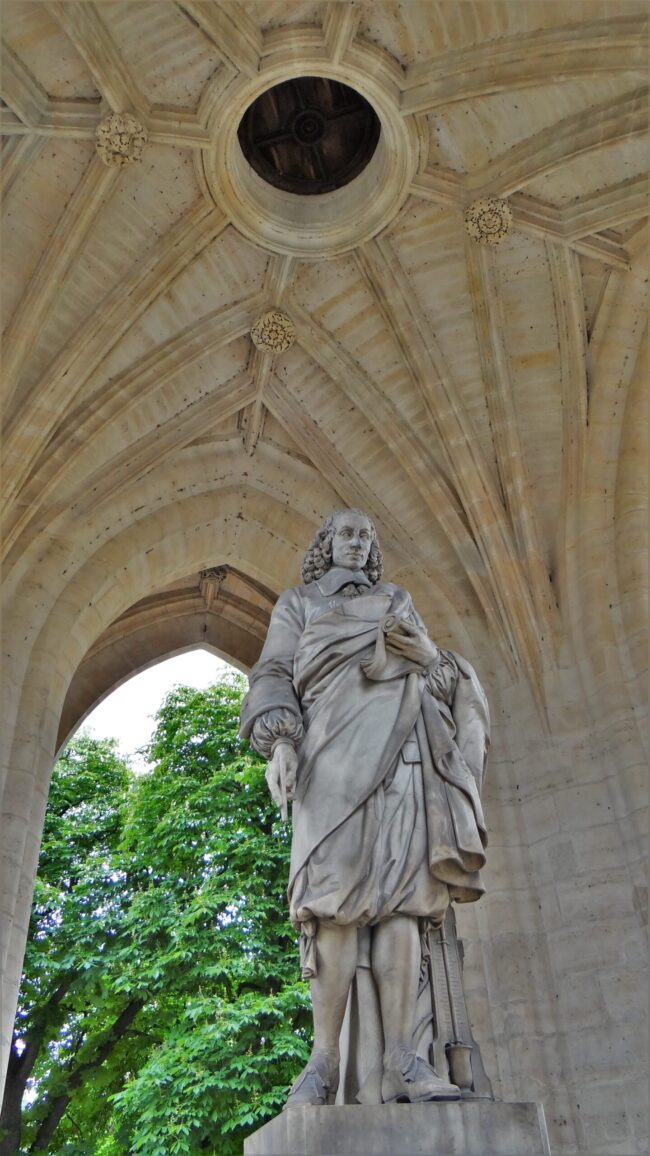
Statue of Blaise Pascal by Jules Cavelier under the tower. Photo: Ibex73 / Wikimedia Commons
The revolutionaries claimed they saved the tower because it was a site of scientific heritage, once used by Blaise Pascal for experiments on atmospheric pressure. They rejected the building’s spiritual significance, but kept the tower as a monument to reason and science. I gazed at Pascal’s statue, prominently installed at the base of the tower and wondered what the medieval pilgrims who gathered here to pray before their long journey would make of it all. I think they’d be pleased to know that centuries after they had set out, in 1965 in fact, the Tour Saint-Jacques was officially redesignated as the official starting point for the Saint-Jacques-de-Compostelle pilgims’ route. The tower is still there, a spiritually and historically significant marker amid the bustle of the Rue de Rivoli.
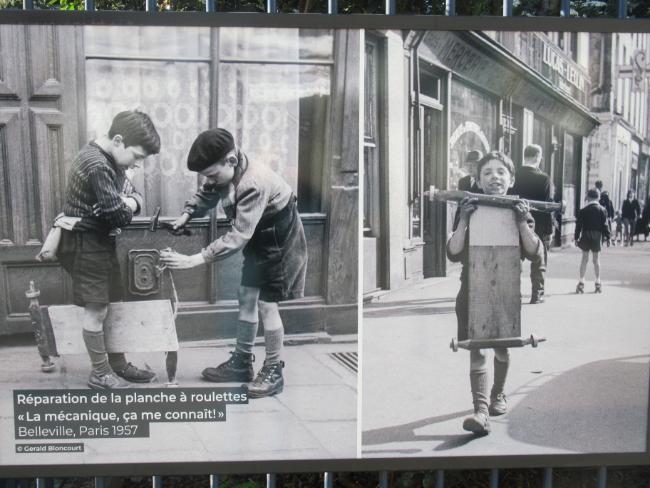
Along the fencing outside the tower, another clash of ideas came into view. There are often photographic displays there and this time I found an exhibition dedicated to Gérard Blancourt. Exiled as a militant from his native Haïti, he made a new life as a photographer in Paris, calling his camera his “weapon against injustice.” He captured many memorable images of post-war France: striking workers at Renault’s Billancourt plant, slum conditions at Noisy-le-Grand and children playing in the streets of 1950s Belleville. His arresting images stared out at me from beneath the tower, the 20th century crashing up against the medieval background.

As I walked along the Boulevard de Sébastopol, more time periods jostled against each other. The road names left and right recalled the 12th-century Italian money-lenders who settled here (Rue des Lombards) and those who plied their trade as butchers (Rue Aubry le Boucher) or metalworkers (Rue de la Ferronerie), but the buildings told a different story. Actually, more than one story. Looking up I could see a row of Baron Haussmann’s beautiful limestone buildings, built when he cleared the narrow streets in the 1850s and widened many, including this one, into boulevards.
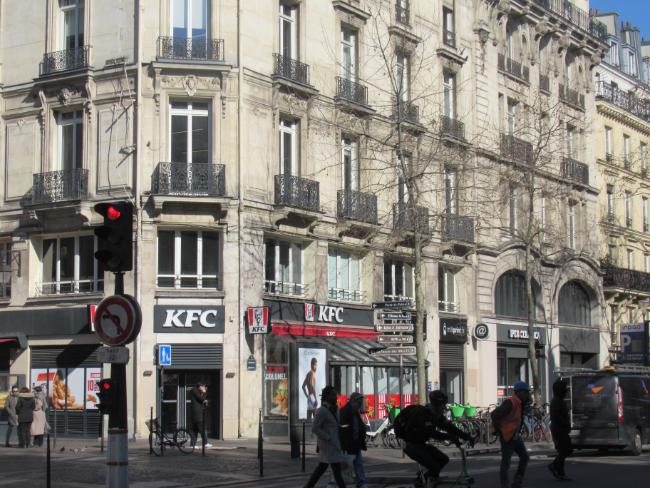
But at ground level, the sights were very contemporary: “everyday” cafés with competitive prices, a KFC and a lantern-bedecked Chinese restaurant, a “Hippy Market” with a slogan advertising its maximum price of deux euros, a car dealer with the almost-English name of “By My Car.” It was hardly medieval, but it was still a trading hub, a place to come to fulfill your everyday needs. Rue des Halles off to the left leads straight past the city’s central transport hub, Châtelet les Halles, to the 1970s Forum des Halles, seen by many Parisians as a concrete abomination on the site of the city’s former bustling food market.
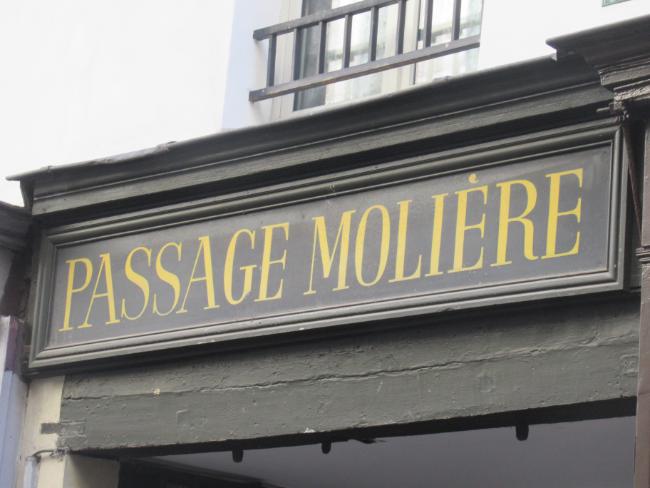
Passage Molière. Photo: Marian Jones
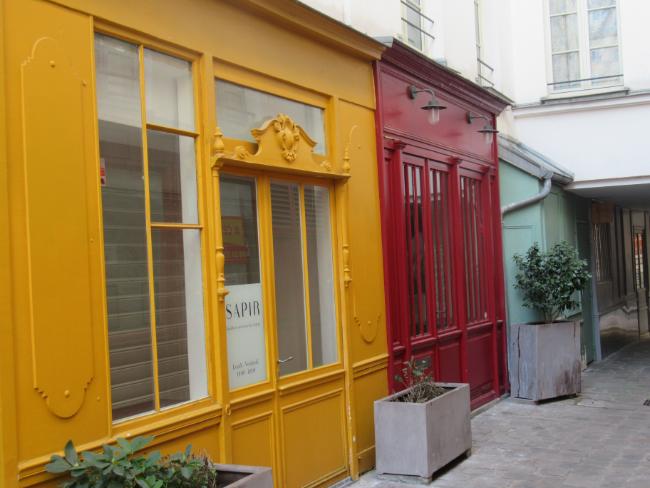
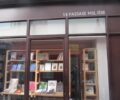
I found more evidence of shifting time periods in the Passage Molière, built just as the Revolution began, then promptly renamed Passage des Sans-Culottes in honor of the working-class militants whose demands led to the fall of the monarchy. It was renovated recently and behind its brightly colored shopfronts were a vintage bookshop, an upmarket stationers called L’Écriture and the city’s poetry center, the Maison de la Poésie. Just outside the passageway was the Rue Bernard Clairvaux, named after a 12th-century monk, but the poster outside one of its cafes, inviting customers to “entrez, travaillez, chillez” (come in, work, chill) yanked me straight back to today.
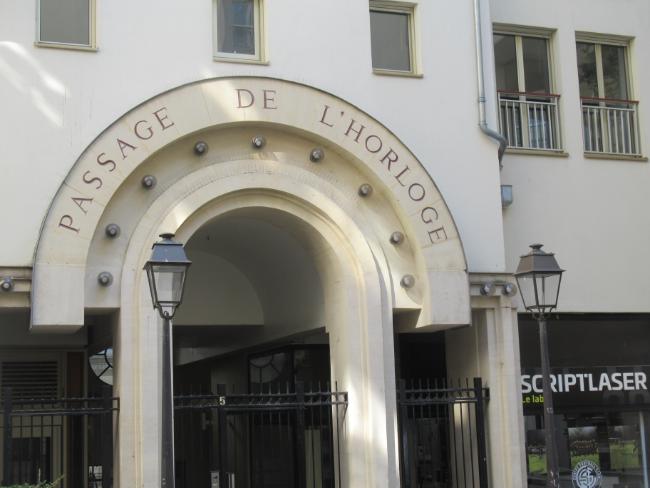
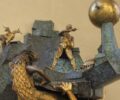
The nearby Passage de l’Horloge looked inviting and I entered with high hopes of seeing a medieval clock, so the modern flats which rose up all around square opening up inside were a surprise, as was the clock which turned out to date from the 1970s. The “Defender of Time” still had its explanatory plaque, promising that the little figure of a man would struggle valiantly against a crab, a dragon and a bird to sound effects of crashing waves and rushing wind. I waited, but nothing happened. Research revealed that it stopped working in 2003 and has never been restored. I imagine it was meant to be a modern take on valiant knights fighting all-comers, but instead it had become a sad reminder that nothing lasts forever.
There were eye-catching murals at the end of the passage where the walls of the “Marais Laser Center” were completely covered in bright cartoon figures dispensing nuggets of wisdom on the meaning of life. It seemed a little out of place, but turning into the Rue aux Ours, (Bear Street) all was very normal again, shops and cafes lining the pavement as traffic passed by. I love a Parisian cliché, so I was delighted to hear the strains of Les Champs Élysées emerging onto a terrasse and I smiled again to find a human-sized stuffed bear sunning himself at a roadside table outside the Brasserie Balou. He didn’t look all that much like his Jungle Book namesake, but be seemed welcoming enough.
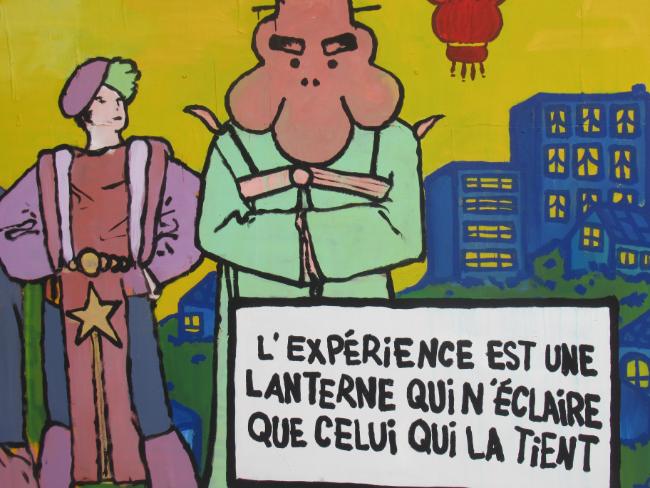
Passage de l’Horloge mural. Photo: Marian Jones
Bear Street led into the Rue Étienne Marcel, home of the Tour Jean sans Peur, all that remains of the magnificent residence of the Dukes of Burgundy. The tower was once the highest non-church building in the whole of Paris and its new-fangled (by 15th century standards!) latrines were the talk of the town, as related here by Pat Hallam. I knew from a previous visit that you can go inside to discover its medieval staircase, its tapestries and its models of kings with colorful names like Philip the Good and Charles the Timid.
You can learn the amusing fact that John the Fearless, knowing he had many enemies, had two identical bedchambers set up so that his valet slept in the first one, shielding him from intruders. Anyone breaking in to murder him would, the fearless one reasoned, mistake his servant for himself and attack the wrong man.
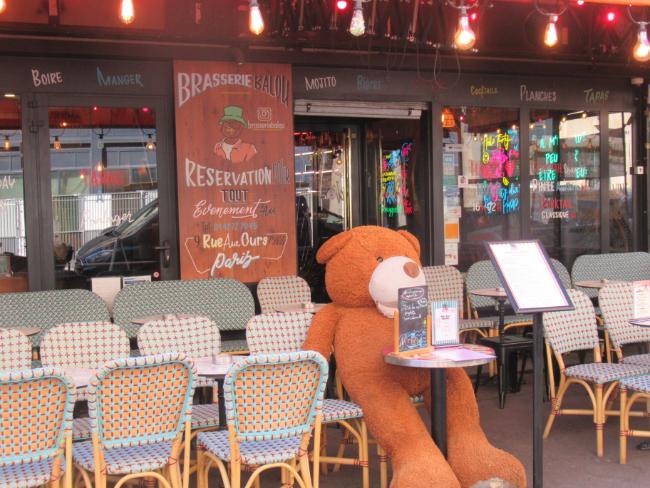
Brasserie Balou. Photo: Marian Jones
Today, my quest had been to seek out medieval Paris in this little area which had once been at its center. The towers at each end of the walk had illustrated it, with their tales of piety and derring-do, their traveling pilgrims and battle-hardened monarchs. In between, I’d found other eras as varied as the revolution, the transformation of the area under Baron Haussmann and the 1970s. And right next door to the Tour Jean Sans Peur, was something from today’s Paris, a primary school decked in banners protesting against la fermeture des classes (class closures). I wondered how much the children I could hear, but not see, playing noisily behind the buildings knew about the many-layered past of the area they call home.
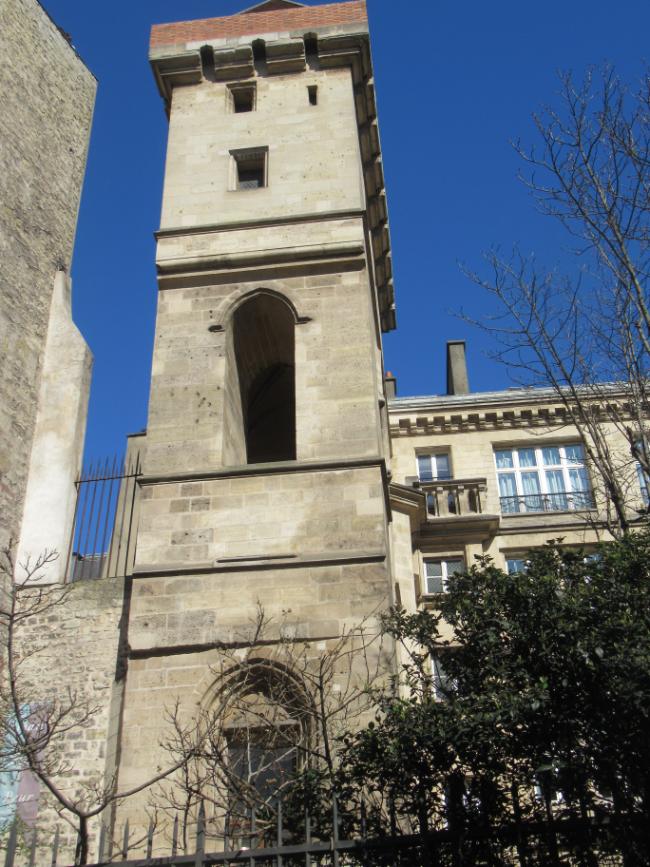
Tour Jean Sans Peur. Photo: Marian Jones
DETAILS
Tour Saint-Jacques
39, Rue de Rivoli (nearest metro Châtelet or Hôtel de Ville)
Entry €12. Reduced entry €10
Usually open mid-May to mid-November
See the website for exact details
Tour Jean Sans Peur
20, Rue Étienne-Marcel (nearest metro Étienne Marcel)
Entry €6, reduced entry €4
See the website for opening hours and details of guided tours
Lead photo credit : Tour St Jacques. Photo: Marian Jones
More in Flâneries in Paris, medieval, middle ages
Related Articles
By Marian Jones