
Flâneries in Paris: Walk the Rue de Rivoli

- SUBSCRIBE
- ALREADY SUBSCRIBED?
BECOME A BONJOUR PARIS MEMBER
Gain full access to our collection of over 5,000 articles and bring the City of Light into your life. Just 80 USD per year.
Find out why you should become a member here.
Sign in
Fill in your credentials below.
This is the 45th in a series of walking tours highlighting the sites and stories of diverse districts of the Paris region.
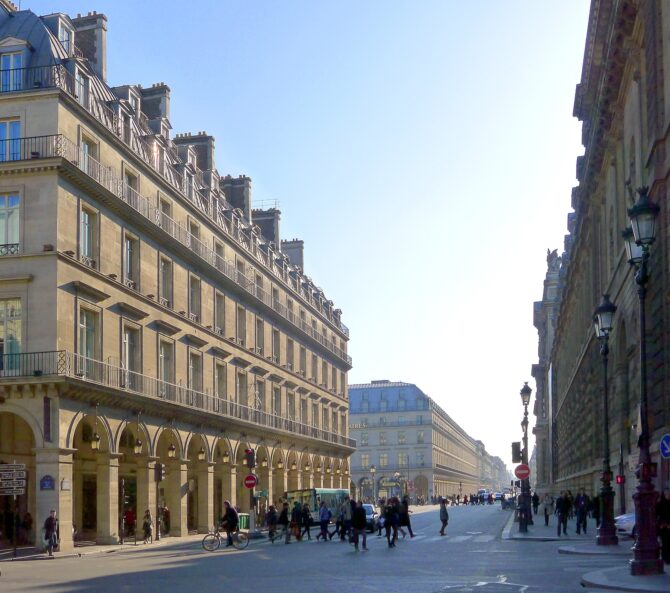
The Rue de Rivoli began life as yet another of Napoleon’s show-off projects, a long straight road eventually connecting Place de la Concorde with (if you count the last stretch, actually named the Rue St Antoine) Place de la Bastille. Victor Hugo complained that it turned old Paris into one “eternal road,” but an AI search yields a more positive description of it as a “bustling, historic Parisian artery.” What, I wondered, would I find if I walked it end to end with an open mind? The answer turned out to be that enticing Parisian mix of art, history, gastronomy and shopping.
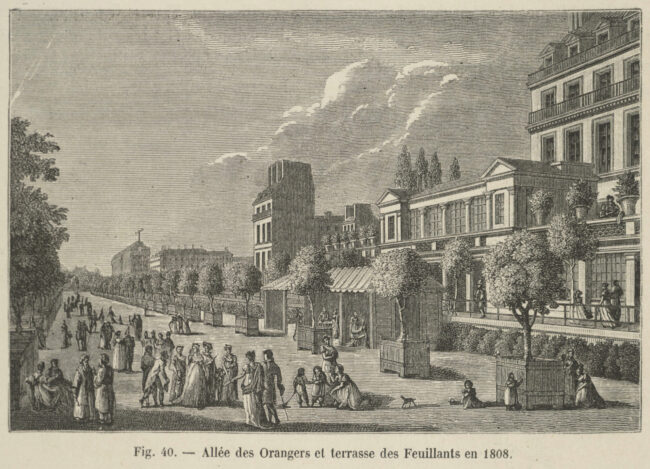
Allée des Orangers et terrasse des Feuillants en 1808. Depicting the buildings destroyed when the rue de Rivoli was created. Public domain.
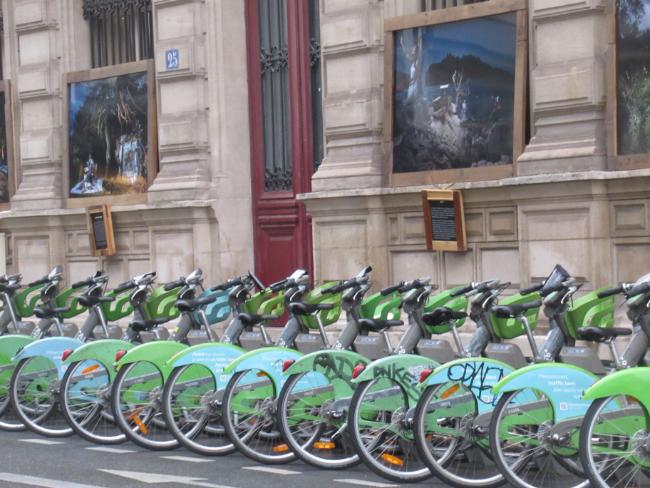
I started at the St Paul metro station, just where it first becomes the Rue de Rivoli, it’s romantic-sounding name actually referring to one of Napoleon’s victories in Italy. It was a drizzly day and at first, nothing much leapt out at me. I took a few pictures, one of passers-by and their umbrellas outside a tabac, another of a rack full of Vélib bikes, seemingly not popular in this weather and began to wonder if the three-kilometer stretch might seem over long. But things livened up when I passed the Cave du 38Riv, a jazz club offering new fewer than three events that very evening: concerts at 19h30 and 21h30 and, advertised in English, a ‘Jam Session 23h-1.30’. I resolved to put this new (to me!) venue on my must-check-out list.

The road names off to the right and left were reminders of the area’s history. To the right, into the Marais, were Rue Pavée, presumably referring to when the muddy roads of the marais, or “marshland,” were first paved over, then Rue Vieille du Temple and Rue des Archives. To the left, Rue du Pont Louis Philippe, a reminder that Loius-Philippe, triumphant after the three–day revolution which brought him to the French throne in 1830, laid the bridge’s first stone to celebrate. But the first historical blockbuster came just a little further on, the Hôtel de Ville. I can never pass it without recalling its colorful history, everything from public executions and mob riots to de Gaulle’s triumphant balcony appearance at the Liberation of Paris, all of which feature in a separate flânerie.
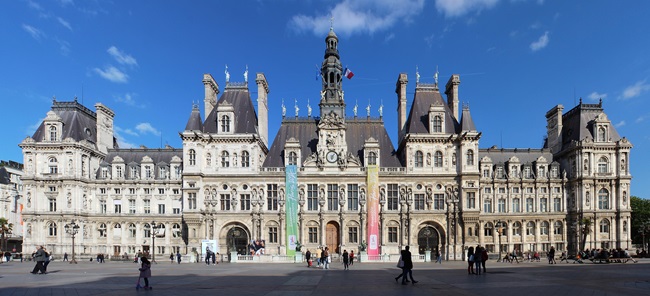
Main facade of Paris City Hall. Photo credit: Chabe01/ Wikimedia Commons
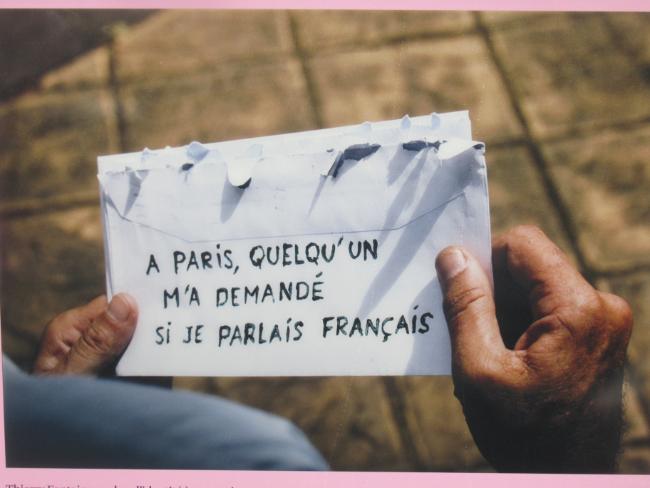
I always look out for the photo exhibitions often displayed along the railings outside the Hôtel de Ville and today there were two. First, Paris en Vues, a collection of thought-provoking pieces by contemporary photographers. Adel Abdessemed’s picture of a girl walking down a Paris street arm in arm with a skeleton was arresting, as was the pair of hands photographed by Thierry Fontaine, through which he made an interesting point about identity. Born in Réunion, an overseas département just as French as the Île de France, Fontaine portrayed the hands holding an envelope on which someone had written (in French), “In Paris, someone asked me if I spoke French.”

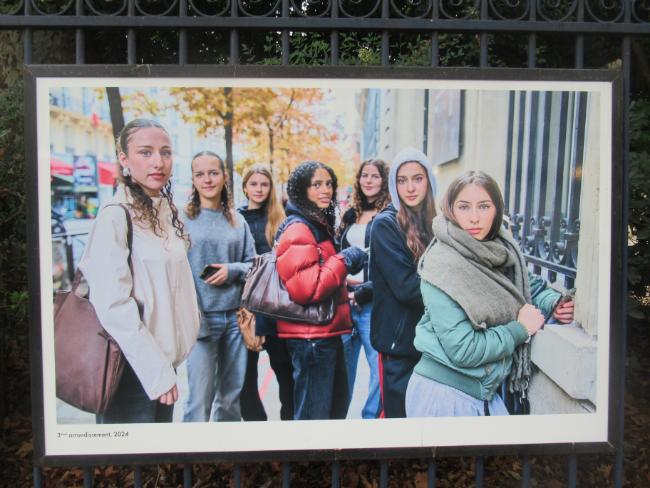
Between the two exhibitions came the Tour Saint Jacques, the remains of a soaring 16th-century tower which is all that was left of the Église Saint Jacques after the Revolution. On the railings outside were the opening pictures of a second display, Jeunes Parisien(ne)s, whose theme was outlined in the words, “What do young Parisians look like? You want to know? Well look at these.” Groups of youngsters had been photographed just as they were, leaning against a wall at a metro station or pausing confidently on a street corner, looking straight at the camera. Their sassy expressions and louche poses made a 21st-century contrast to the walls of the tower behind.

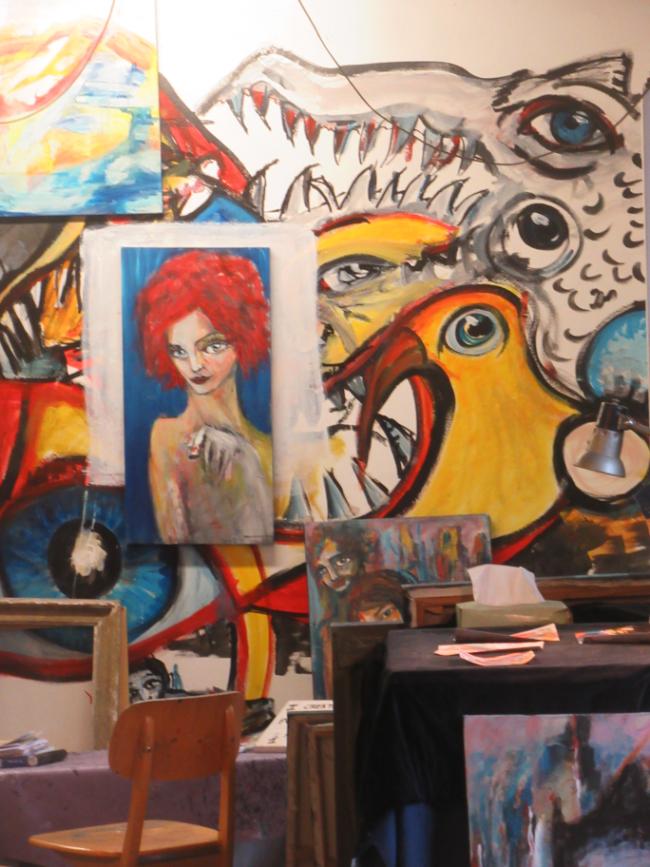
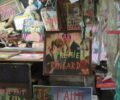
Passing La Place du Châtelet marked the move from the 4th to the 1st arrondissement, so it was a surprise that thereabouts, at number 59, I found a bohemian art space, home to about 30 different artists-in-residence where you are free to walk right in and see what they’re up to. Inside 59 Rivoli, I found a staircase winding its way up several floors, every inch of space covered in art: abstracts, fantasy scenes, sets of staring eyes, daubs of color flung apparently in sheer abandon. A detour into any of the floors led to a maze of little workshops, some manned by creators in mid-flow, all crammed with art: paintings, collages, 3D models, sketches covering the walls, jammed into corners and hanging from the ceilings.
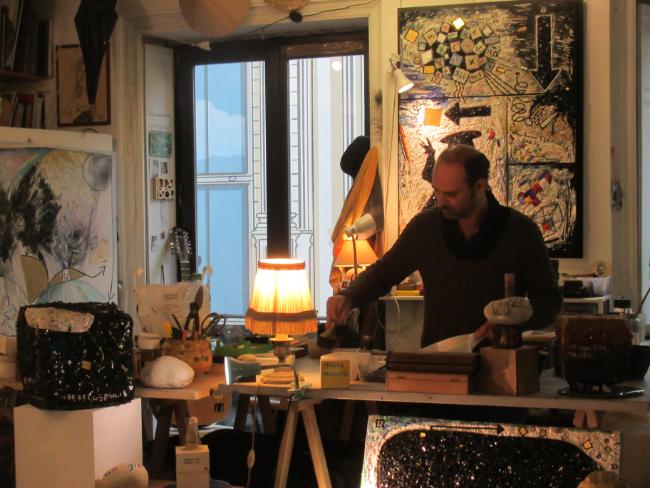
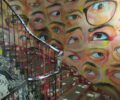
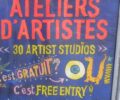
It was fascinating to wander round, past artists at work and little spaces crammed with the unexpected. In Negin Rouhbakhsh’s workshop, exquisite, patterned wall hangings filled the walls, their bright colors and golden highlights interwoven like a mosaic and I wasn’t surprised to read that she had studied art in Tehran. But, when I looked her up later, I found that her work was also inspired by 20th-century patterns, especially computer chipboards and that she seeks to blend ancient Persian influences with modernity. Visual surprises were everywhere, artistic influences from multiple sources, mostly with a contemporary twist, for example a beautifully painted Mediterranean cove with the words “I’ll love you ‘til the airport” scrawled over it in neon colors.

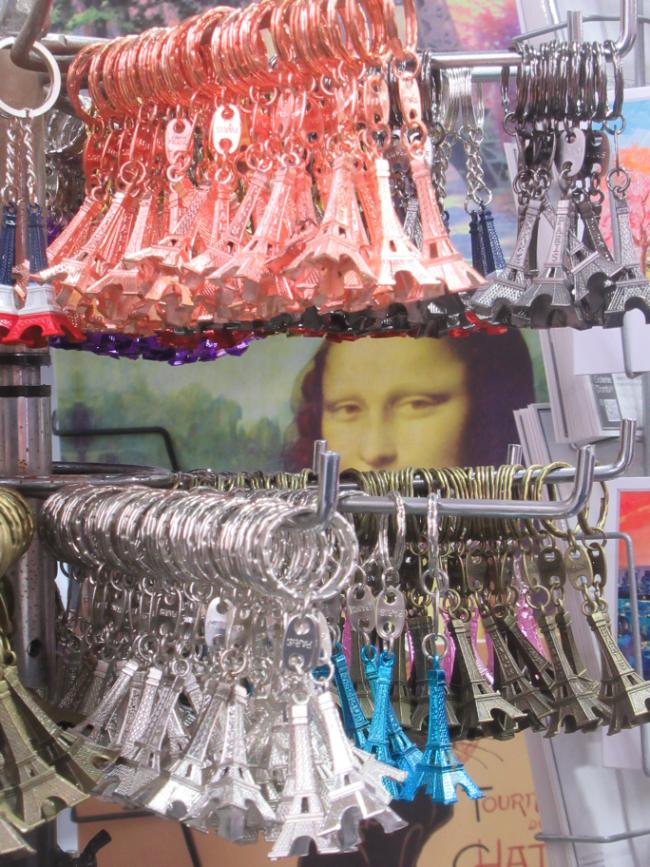
Further into the 1st arrondissement came the familiar arcades, designed in Napoleon’s time to provide a classy up-market shopping area opposite one long side of the Louvre.* The statues and columns decorating the northern face of the museum were in stark contrast to the hectic jumble of tourist souvenirs filling the arcades opposite: Emily in Paris berets in every hue, flashing pink models of the Eiffel Tower, 3D models where Gustave Eiffel’s iconic landmark soars over the Moulin Rouge “next door” when surely it would take an hour to walk between the two. It all seemed a far cry from the exclusivity the original architects had in mind when they banned butchers’ shops from setting up here for fear of lowering the tone.
*(Editor’s note: the Fondation Cartier has since debuted on the rue de Rivoli, occupying a gorgeous Jean Nouvel-designed space in a former department store, and you can even peek into the museum spaces directly from the arcades. This contemporary art museum makes a fabulous detour from a Rivoli wander.)
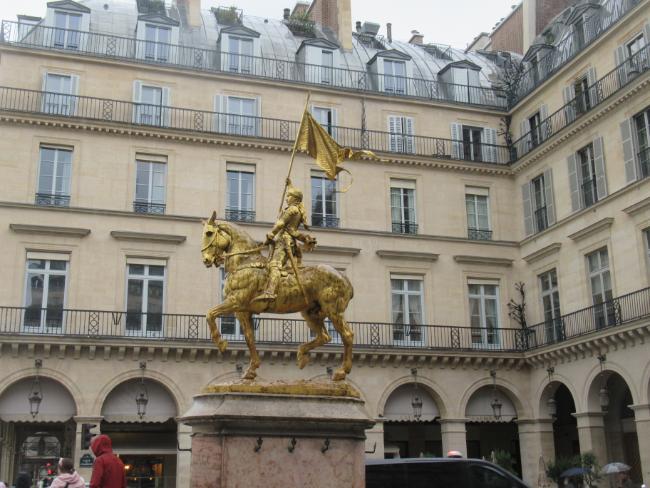
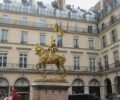
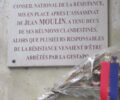
My inner snob was fully aroused, but then I realized there were things of interest too. On Place des Pyramides, named after yet another Napoleonic victory, the golden statue of Joan of Arc towered over the square, flag aloft as she and her horse trotted purposefully off to confront the English. I always keep an eye out for plaques commemorating moments of history and this little stretch did not disappoint. One told me that at no 182, members of the French Resistance held two crisis meetings just after their leader Jean Moulin had been assassinated. A faded bouquet, its stems turned to straw, was pinned to the plaque. Leo Tolstoy lived at 206 while on a youthful trip to Paris, his stay forever linked in his mind with trauma of the public execution he had witnessed while there.
Then came the Hôtel Le Meurice, where the German military command was based during the occupation and where its leader General Dietrich von Choltitz ate a last fine lunch on August 25th, 1944, before leaning over a billiard table to sign the German surrender document that afternoon. Just opposite the hotel, a worn plaque stands against the railings outside the Tuileries Gardens. On this spot, it reads, once stood the royal riding school, taken over by the Convention Nationale who met here and voted, on September 21st, 1792 to execute their king and make France a republic.
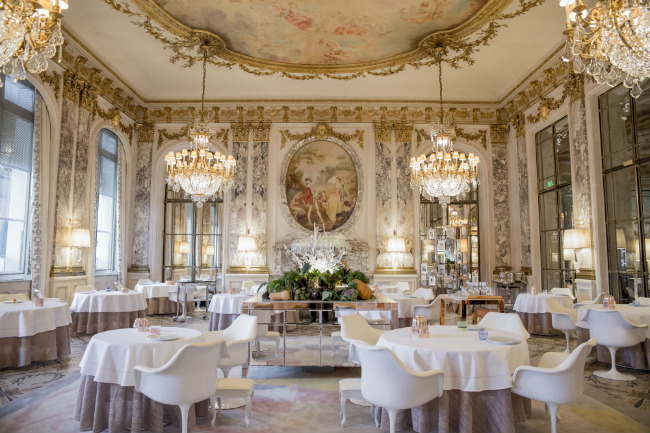
Restaurant Le Meurice Alain Ducasse. Photo: Pierre Monetta
It’s trivial in comparison, I thought, to recall that the Meurice today is famed, among other things, for its patisserie, pastry masterpieces finely crafted by Cédric Grolet, winner of the World’s Best Pastry Chef award, which you can buy just around the corner in Rue Castiglioni. A little further along came Angelina’s where, as ever, a queue long enough to spoil the afternoon snaked out of the doorway and down the street. One day I will indulge, but on this occasion, I nipped a few doors along to the Hotel Impérial where a thé gourmand, tea with three exquisite little sweet treats, was to be had for a fraction of the price and no waiting at all. Top tip!
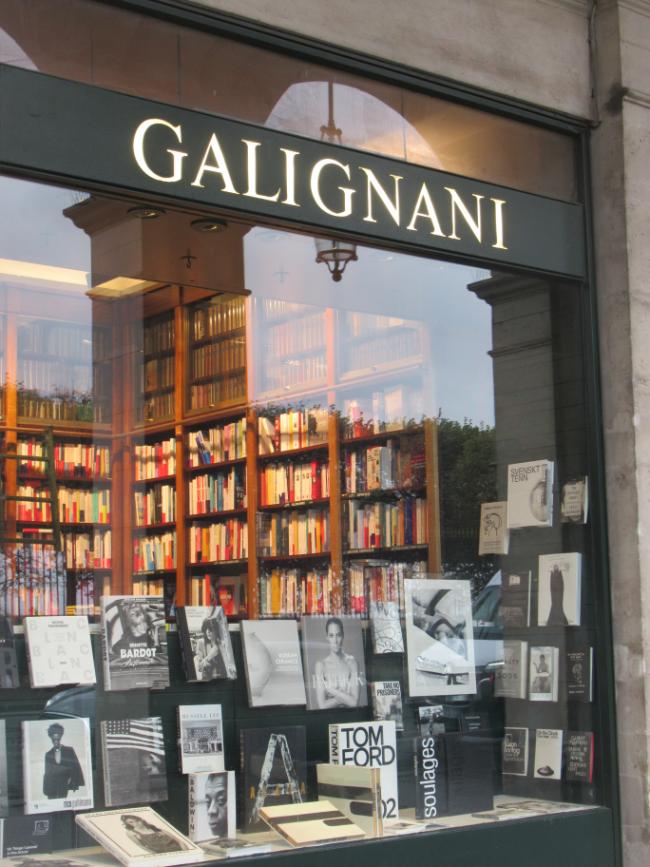
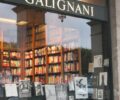
The final points of interest, as Place de la Concorde hove into view, were two of the city’s excellent English-language bookshops. Galignani, at number 224, displays a plaque proudly boasting that it was “the first English bookshop established on the continent,” and dates back to the Napoleonic Wars. I briefly wondered how many English tourists made it to Paris back when Napoleon was our enemy, but the establishment got through somehow and today it’s still going strong, selling both French and English books.
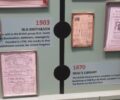
A few doors further up came Smith and Son, dating “only” from 1904, but so proud of its past that it has a history timeline display listing everything including its 1908 refurbishment – the fine wood paneling and stained glass is still there today! – to its requisitioning by the Germans in 1940 when it became a purveyor of propaganda. I browsed the books, I stared in wonder at the little corner selling English groceries, pleased to know that if I ever set off to Paris without Jacob’s Cream Crackers or Rose’s Marmalade, all will not be lost.
By this time, a couple of hours had drifted pleasurably by and I had reached the spot where the 1st arrondissement melts into the 8th. I’d explored the length of one of the best-known streets in Paris and found that its history and culture far outweighed the tacky tourist trinkets. I decided not to venture into Place de la Concorde this time, but rather to browse the shelves at Smith and Son and choose a new book. On a finer day, I’d have popped across the road to the Tuileries and sought out a bench on which to read it. Today, I gave in at last to the drizzle and headed back to my hotel.
Useful to know
Metro Line 1 runs under the Rue de Rivoli and there are 7 different stops along its length: St Paul, Hôtel de Ville, Châtelet, Louvre – Rivoli, Palais Royal – Musée du Louvre, Tuileries and Concorde.
Lead photo credit : Rue de Rivoli. Photo credit: Mbzt / Wikimedia commons
More in Flâneries in Paris, rue de Rivoli
Related Articles

By Marian Jones