
Flâneries in Paris: Free Art Galleries and a Riverside Stroll
- SUBSCRIBE
- ALREADY SUBSCRIBED?
BECOME A BONJOUR PARIS MEMBER
Gain full access to our collection of over 5,000 articles and bring the City of Light into your life. Just 80 USD per year.
Find out why you should become a member here.
Sign in
Fill in your credentials below.
This is the 51st in a series of walking tours highlighting the sites and stories of diverse districts of the Paris region
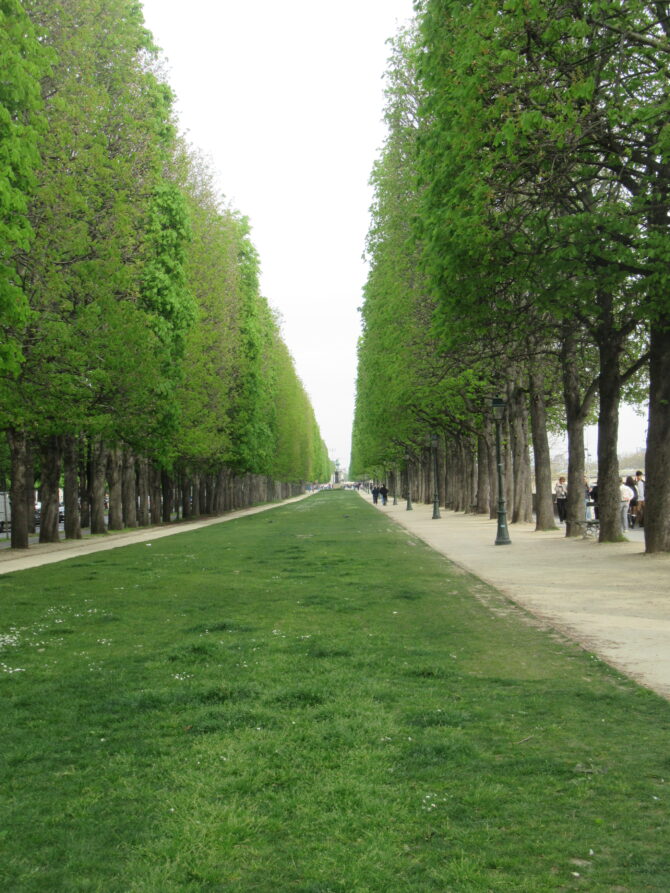
I’d long been intrigued by the Cours de la Reine, the walkway carved out along the Seine for Marie de Medici, who became Queen Consort of France when she married Henri IV in 1600. She was nostalgic for her native Florence and missed the garden strolls she’d enjoyed there, so she had this kilometer-long park created along the Seine, just west of the Jardins des Tuileries.
The Italian word corso, or “pathway” in English, became cours in French, used to describe the area, shaded by rows of tall trees, where Marie and those nobles to whom she gave permission could promenade or take a carriage ride, enjoy the river views and feel safe knowing that the general public would not be allowed in. A ditch dug around the edge, fencing and gated entrances saw to that.
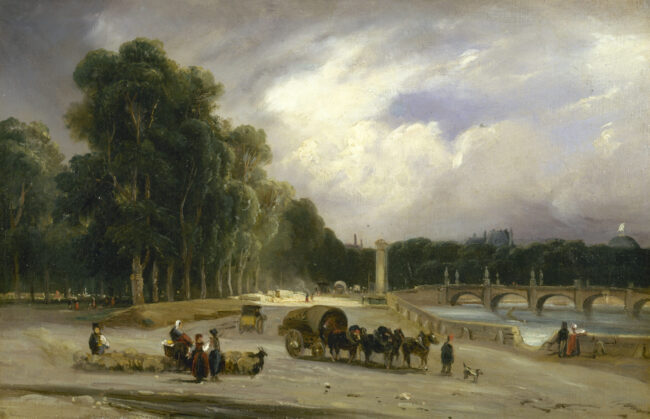
Théodore Gudin (1802-1880). “Le Cours-la-Reine”. Huile sur toile, vers 1828. Paris, musée Carnavalet.
On a map of today’s Paris, the Cours de la Reine stretches from the Place de la Concorde to the Place du Canada. Its continuation, leading further west to the Place de l’Alma, has been renamed after France’s World War I ally, Albert I, King of Belgium. Completely open on both sides and home to a number of imposing statues, the walkway is perfectly suited to a quiet meander with riverside views. Even better, there’s a Ville de Paris art gallery close to both ends, the Musée d’Art Moderne and the Petit Palais, each offering free entry to its permanent collection.
I began at the Musée d’Art Moderne, housed in the Palais de Tokyo, built in 1937 for the International Exhibition of Arts and Technology. Gazing uphill at the colonnades separating the east and west wings, each a series of stark rectangular blocks relieved here and there by classical-inspired bas-relief, I wondered if it was open. There seemed to be no one around. But, after climbing the wide central steps, I found a way in and went to do a little exploring. I’ll just wander, I thought and see what strikes me from the collection of 20th century art, which spans such movements as Cubism, Fauvism, Abstraction, and New Realism.
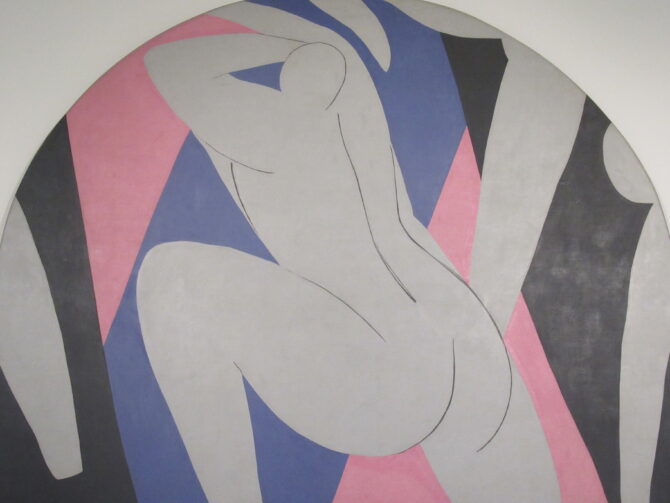
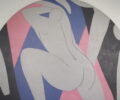
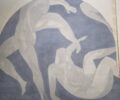
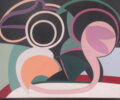
The first highlight was a room dedicated to Matisse’s huge mural, La Danse, created in the early 1930s. Two of the three versions he made are here, pale, leaping silhouettes of dancers set against a background of pinks and blues, covered the walls. In one corner a grainy black and white film was showing the artist working in the garage in Nice he made into a studio. The main gallery is spacious and light-filled, curving round past views of the Seine and a sighting of the Eiffel Tower.
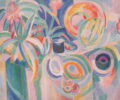
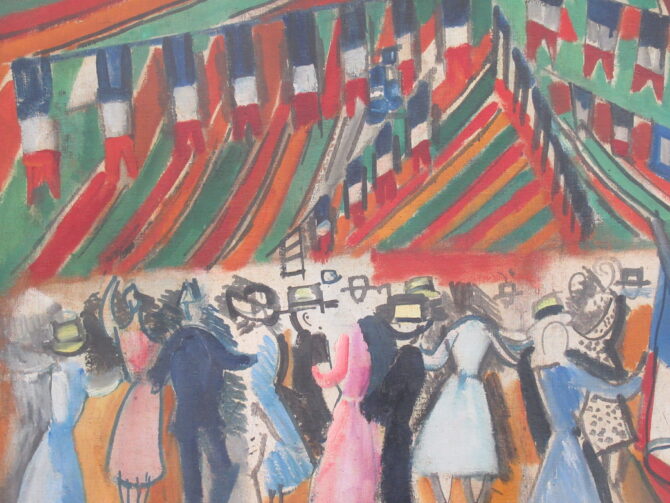
I passed geometric designs, colorful abstracts like Robert Delaunay’s Symphonie colorée and a loosely painted scene of Le Havre on le 14 juillet in 1912 by Raoul Dufy. From Alain Jacquet’s 1960s take on Manet’s Le déjeuner sur l’herbe I learned a new word: sérigraphie, a technique for pushing ink through a fine mesh screen.
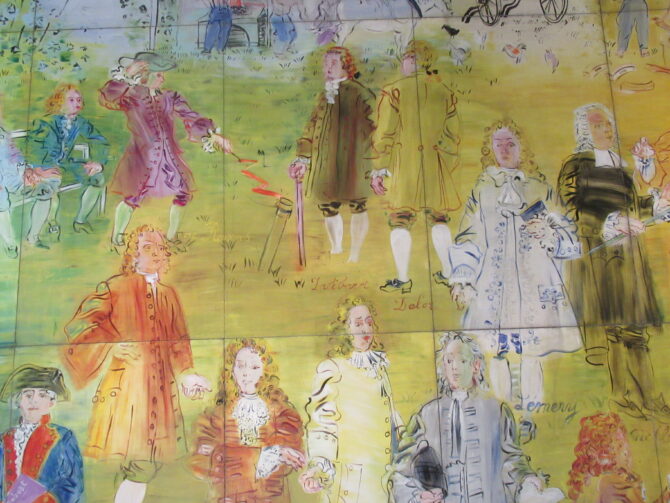
I’d planned a spontaneous visit, just stopping here and there, but I did deliberately seek out Raoul Dufy’s enormous La Fée électricité (The Spirit of Electricity). It was commissioned by the Compagnie Parisienne de Distribution Électrique to celebrate all things electric at the 1937 Arts and Technology Exhibition and Dufy was given free rein to interpret this as he wished. The result, a 60m long fresco, fills a whole room where luminous colors seem to have been washed across the walls, depicting over 100 scientists from across the ages. Some are labeled – Thomas Edison, the Curies – and many feature with their gadgets and gizmos. Together they are a testament to invention and human ingenuity.
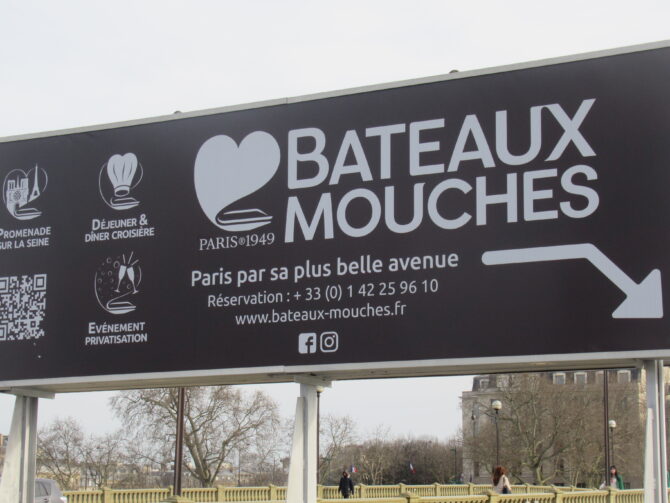
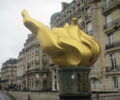
On with the walk! It took several zig-zags to make my way across the Place de I’Alma, past the Flamme de la Liberté¸ installed as a symbol of Franco-American friendship and doubling nowadays as a memorial to Princess Diana whose fatal car accident happened in the tunnel just underneath. The walkway begins on the Pont de l’Alma, where bâteau mouche signs invited me to explore Paris “along her most beautiful avenue,” ie the Seine, and I set off along the raised bank to find out what remains of Marie de Medici’s garden.
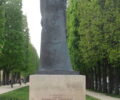
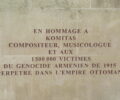
Tall trees along its length give some seclusion, making it a pretty spot for moments of reflection and a monument or two. One, with a fresh wreath in the red and white of the Polish flag, pays tribute to Adam Mickiewicz, the poet who sought exile in Paris in the 1830s and became a leading figure in the émigré community and a friend of Chopin. Another displays the tall figure of the Reverend Father Komitas and is inscribed in both French and Armenian in memory of his work as a “savior of his country’s heritage,” and of the many thousands of Armenians who fought with France in both World Wars. Both statues, in their different ways, highlight the role of Paris as a world capital, a place of safety in troubled times.
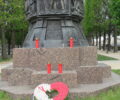
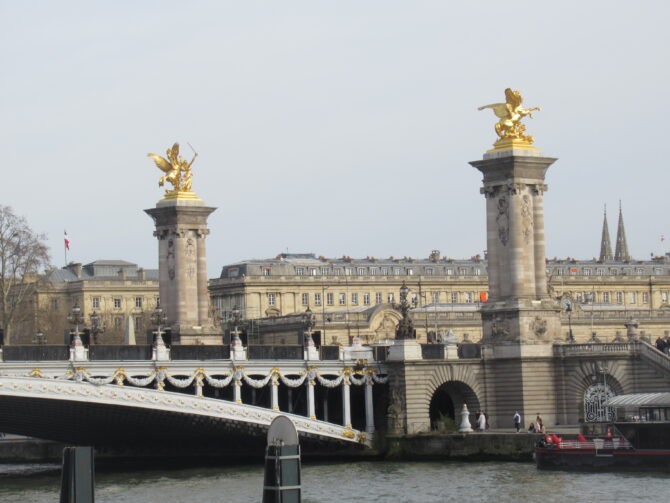
The Alexander III bridge is always a highlight and I paused to admire its exuberant mix of decorations: golden winged horses rearing up at each end, nymphs and cherubs, a stately line-up of art nouveau lampposts. The Russian connection – it was named after Tsar Alexander III who signed a Franco-Russian alliance – makes this the very spot for the next statue on the Cours de la Reine. It stands in honor of the 20,000 Russian soldiers sent to fight alongside the French in the World War, 5,000 of whom lost their lives on French soil. A Russian soldier stands tall beside his horse, representing them all and the inscription, in both French and Russian, ends with an expression of gratitude from both countries: La France et la Russie reconnaissantes.
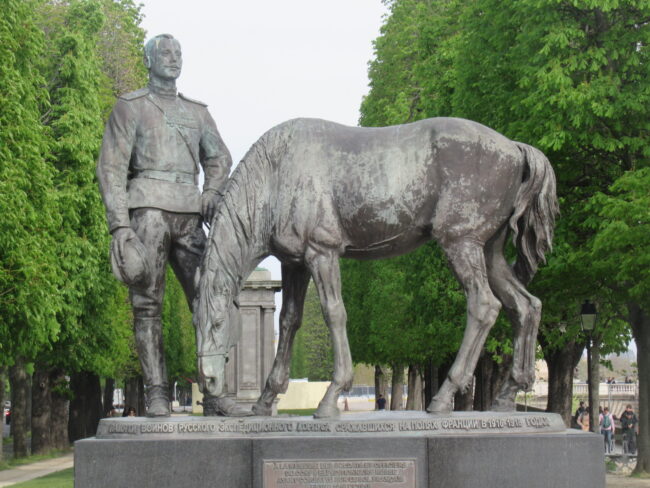
Russian monument. Photo: Marian Jones
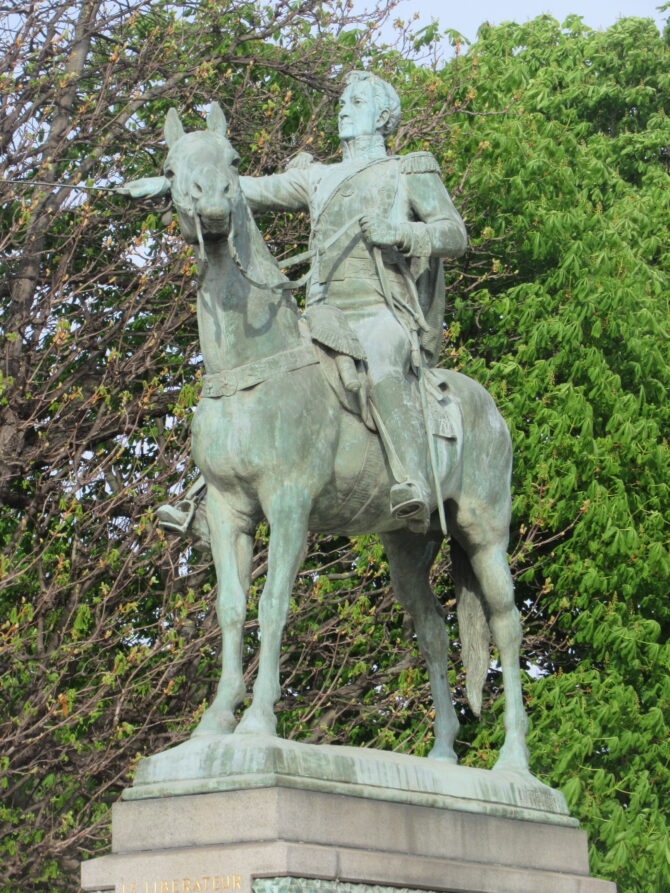
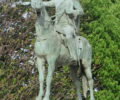
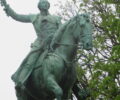
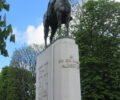
Then come more statues of three very different heroes with links to Paris, all mounted on horseback. There’s Simon Bolivar, who took the concepts of liberté, égalité, fraternité from Paris back to South America where he led the fight for independence from Spanish rule. He is remembered here as a “world citizen, friend of French culture.” The statue of Lafayette, sword aloft, was paid for by American schoolchildren in memory of the “soldier of two countries” who fought for independence in America before returning to France to play his part in the revolution of 1789. And “a grateful France” has sited a statue of Albert I, King of the Belgians at the walkway’s end, inscribing it with some of the stirring words he spoke in August 1914 about the “single vision” of patriotism which united France and Belgium. Around the base are the names of major battles fought in Belgium – Ypres, Flandre, Liège – alongside the dates 1914 and 1918.
From the end of the Cours de la Reine, it’s a short loop back to the Petit Palais whose elaborate façade immediately captures the spirit of the Belle Époque: the gilded wrought-iron gate set in the grand pillared entrance, its decorative swirls mirrored by the stone carvings curving around it. Come in, it seems to say and see what fine things are here. It houses the art collection owned by the City of Paris, always good for a browse, but today I’m most struck by the beauty of the building itself: the grandeur of the opening gallery, devoted to sculpture, the magnificent spiral staircase curving downwards, its wrought-iron balustrades designed with art nouveau-style floral motifs, the intricate mosaic floor tiles, the flamboyant ceiling paintings.
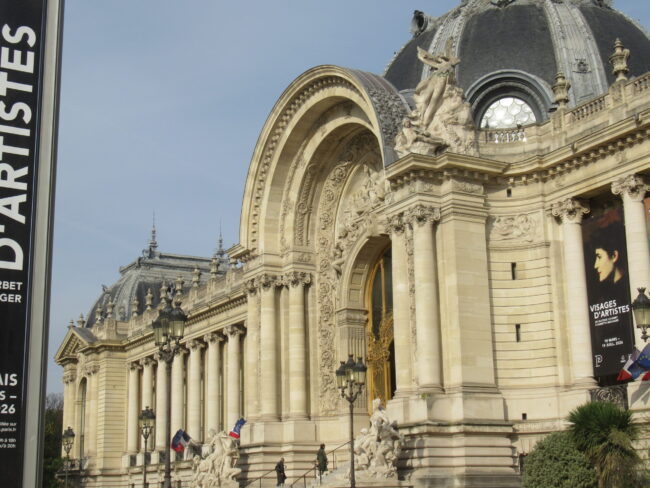
Petit Palais. Photo: Marian Jones
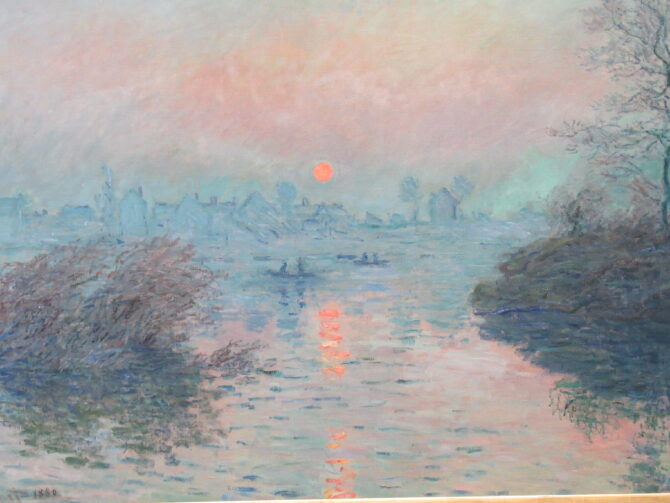
The collection is eclectic, a whole range of things acquired by the City of Paris, from the splendor of a gilded wooden sedan chair from the early 1700s to the hazy beauty of Monet’s Sunset on the Seine at Lavacourt. It’s not a huge collection, but very varied, just the place for a whistle-stop tour of lots of different eras and genres. Today, things that strike me particularly include a number of paintings by women, all grouped together, including The Servant at the Gate by Eva Gonzales and Mary Cassat’s Two Mothers and their Children in a Boat, both familiar to me, and others I don’t remember seeing before, such as Marie Braquemond’s Portrait of a lady taking tea.
On my way out to the café, a painting stops me in my tracks. It’s André Gill’s Newborn, a touching scene of a new father sitting on his wife’s bed, cradling their tiny baby son. But the information panel reveals that the baby died shortly after birth, a trauma which led the artist into a downward spiral until he ended his days in an asylum. Until now, I had only known André Gill for one work, his jolly rendition of a rabbit leaping out of a cooking pot which became the sign for the Montmartre drinking den Le Lapin Agile in the days of Picasso. Here was a different, much sadder side.
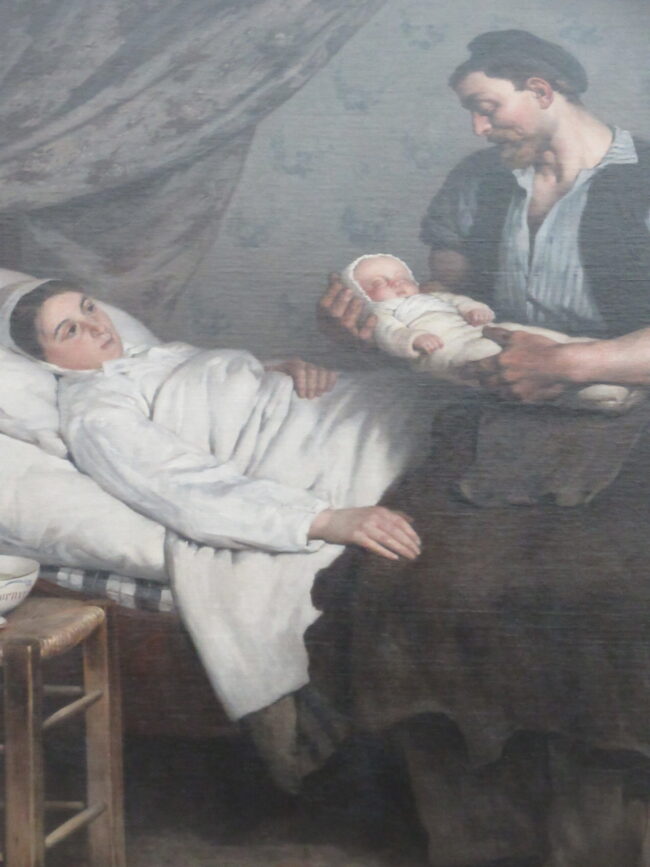
Le Nouveau-né by Andre Gill. Photo: Marian Jones
The café at the Petit Palais is the perfect place to end a morning of wandering and musing. Its circular terrace is colonnaded and curves around a pretty garden, with views of three sides of the palace and its elegant cupola. Just the place to sip un crème and reflect on all the stories unveiled in an hour or two spent exploring the Cours de la Reine and its immediate surroundings.
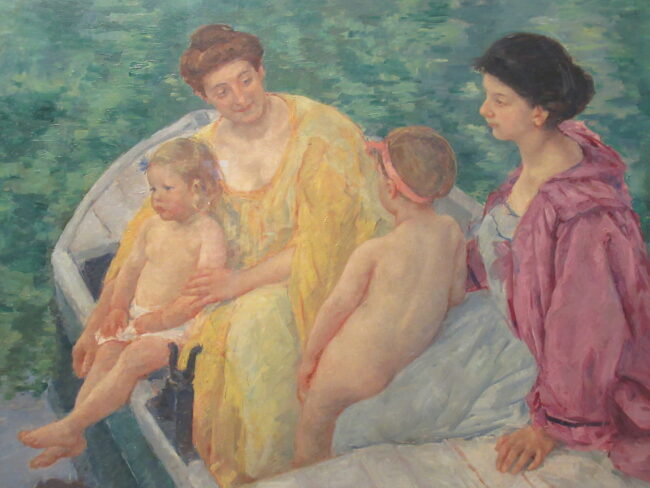
“Two Mothers and their Children in a Boat” by Mary Cassat. Photo: Marian Jones
Lead photo credit : Alexander III bridge. Photo: Marian Jones
More in Flaneries in Paris, Marie de Medici, Matisse, Petit Palais
Related Articles
By Marian Jones