
Eva González: The Rediscovery of a Spirited Artist

- SUBSCRIBE
- ALREADY SUBSCRIBED?
BECOME A BONJOUR PARIS MEMBER
Gain full access to our collection of over 5,000 articles and bring the City of Light into your life. Just 80 USD per year.
Find out why you should become a member here.
Sign in
Fill in your credentials below.
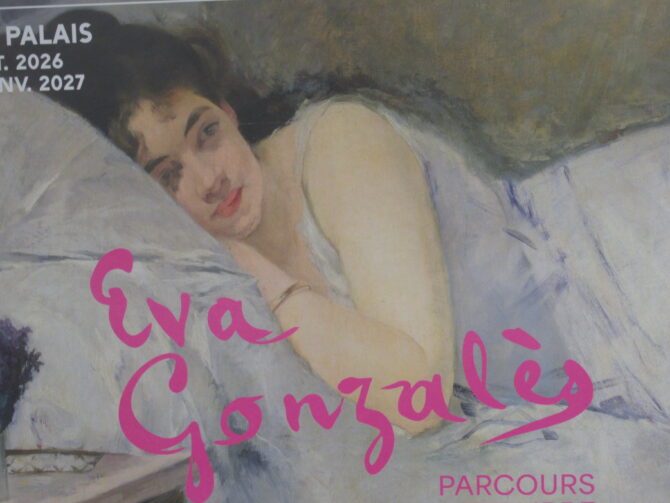
The most arresting ad currently attracting attention in metro stations all over Paris must surely be the one featuring the 19th-century painting Le Réveil (The Awakening). Painted in 1877, it shows a young woman dreamily waking up, a quiet moment captured in the soft curves of her shape, the whites of her bedding and sleeveless nightdress and her reflective expression. The artist’s name – Eva Gonzalès – is scrawled in bright lipstick pink across the poster, a jarring modern twist added because this is an ad for one of the most popular exhibitions currently showing in Paris.
Titled “Eva González, a Free-spirited Artist” in English, the exhibition, showing at the Petit Palais until January 24th, 2027, tells the story of this talented but relatively unknown painter. It’s the first major retrospective of her work, a long-overdue opportunity to discover her story and her art, both of which got a little lost when she died suddenly, aged only 36 and many of her paintings were sold to overseas buyers and scattered far from France.
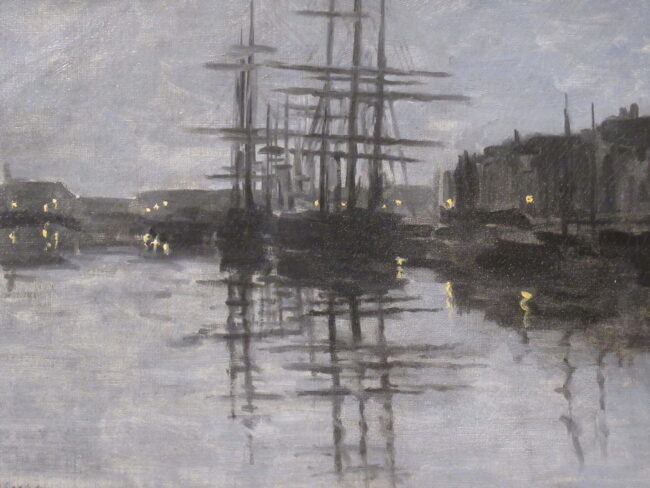
Dieppe at Night by Eva Gonzalès. Photographed at the exhibit by Marian Jones.
It’s significant that The Awakening is the picture selected for the exhibition’s publicity poster for it is one of her later pieces, painted when she had finally found her own style. Eva Gonzalès is so often described in terms of others, as a daughter and wife, as Édouard Manet’s only pupil, as a contemporary of the Impressionists, as one of a group of female painters alongside the better-known Berthe Morisot and Mary Cassatt. But her full story shows her rising above all of this to find her own voice and the stated aims of the exhibition are to “restore her to her rightful place on the artistic scene of her time” and to let her, finally, “become herself again.”
The story is told chronologically, beginning with her upbringing in a middle-class family, her father a journalist and homme de lettres, her mother a musician who held her own salons. Both encouraged her interest in art and in 1866, when Eva was 19, they agreed to her attending lessons with the artist Charles Chaplin, something which might have been frowned upon in less liberal families. Unlike so many other young women of her time, Eva was allowed some freedom to follow her own interests.
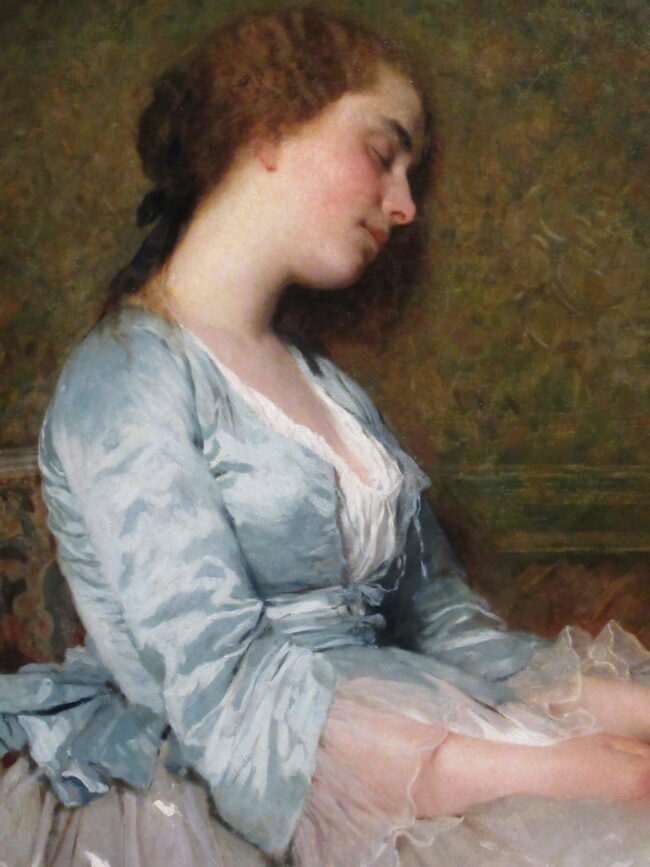
Chaplin’s Le Rêve. Photographed at the exhibit by Marian Jones.
Chaplin was a major influence on her development as an artist. He was renowned for his elegant portraits of women, for example Le Rêve (The Dream), painted in 1857 and its influence on Gonzalès is clear in a picture shown nearby, her La Toilette. Both pictures feature young women in pastel colors and shimmering fabrics. Alongside them is the explanation that the paintings Eva did during this period “combine silver greys, soft pinks and velvety blues,” and were very close in style to Chaplin’s works. Her Catéchisme, also here, shows a similar influence.
Studying with Chaplin was certainly a key stage in Eva’s artistic journey, yet after a period of a year or so with him, she began to yearn for more and to talk of hiring her own studio and working independently. Chaplin made it clear that he thought this idea inappropriate for an unmarried young woman, yet Eva chose to leave his studio, showing a quiet determination to follow her own course, again something a little unusual for a 19th-century Parisian woman.
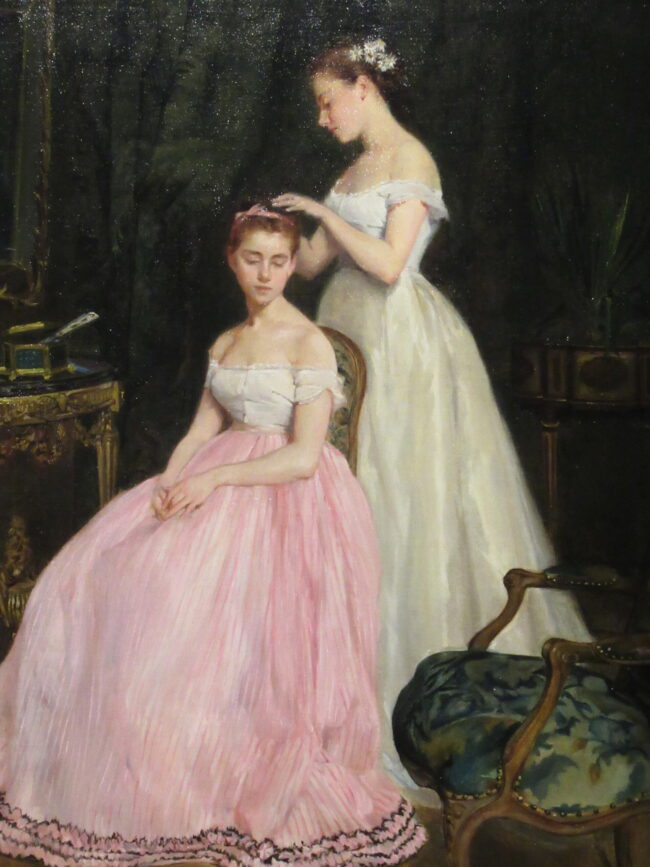
La Toilette by Eva Gonzalès. Photographed at the exhibit by Marian Jones
In 1869, began the next crucial phase in Eva’s artistic life. She met the artist Édouard Manet and a supportive relationship began which would last the rest of their lives. Her acceptance of his guidance was another sign of her independence of mind, for Manet was a scandalous figure at that time, having shocked society with his Déjeuner sur l’herbe, in which two fully clothed men are seen picnicking with a naked young woman. Critics were scathing about Manet’s portrait of Eva at her easel, criticising her “dirty white dress” and sneering that far from being an artist, she was nothing more than a young, decorative model sitting for an older male painter.
Eva, although careful to describe herself as Chaplin’s pupil when applying to show works at the influential Paris art salon, became the only pupil Manet tutored and the paintings she produced next show how her style developed under his influence. The pastel colors are gone in Girl with Cherries, painted in 1870, where the subject wears a black and white striped tunic and the same colorway appears in The Full Length Mirror, known as La Psyché in French. The subject, actually Eva’s sister Jeanne, appears alone, not a young girl engaged in her toilette, but a more contemplative, perhaps more knowing, young woman who has her back to the viewer and is seen in the mirror though her own eyes, rather than someone else’s.
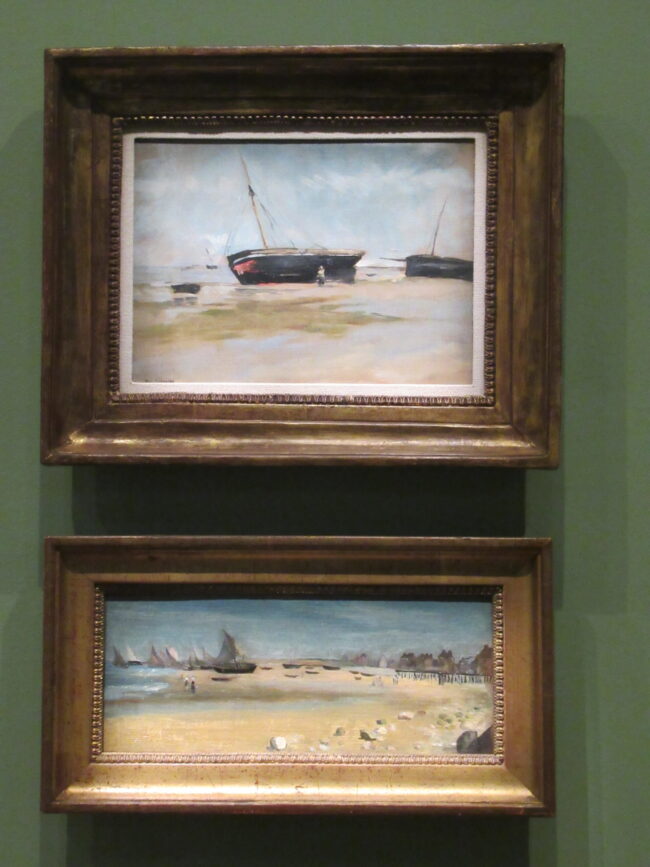
Boats at Low Tide by Eva Gonzalès. Photographed at the exhibit by Marian Jones
Darker colors feature too in The Bugler, where the young boy in military uniform is set against a somber background, a painting with a clear echo of Manet’s The Fifer, painted just a few years earlier. Interestingly, Manet’s work had been rejected by the Salon, yet Eva’s Bugler was one of three works accepted in 1870, a significant moment in her developing career. Her best-known work is A Box at the Theatre des Italiens, painted in 1874 and here too comparisons were made with Manet. Pale-skinned figures set against a dark background reminded the critics of his style and they drew attention to the bouquet of flowers which was very reminiscent of one painted by Manet in Olympia, another of his most controversial pieces.
It was through Manet that Eva met the painter and engraver Henri Guérard, whom she married in 1879. His support and the financial stability they enjoyed meant that Eva was able to continue her artistic career at a point when women often gave up their independence. It was now that she began to develop her own style, to receive more favorable criticism and to find herself on a more equal footing with Manet who was quick to praise her for the successes she was beginning to enjoy. Eva now took her inspiration mainly from her everyday life, often painting family figures and domestic scenes, drawing on all she had learned from Chaplin and Manet to portray the life she knew as a married woman in late 19th-century Paris.
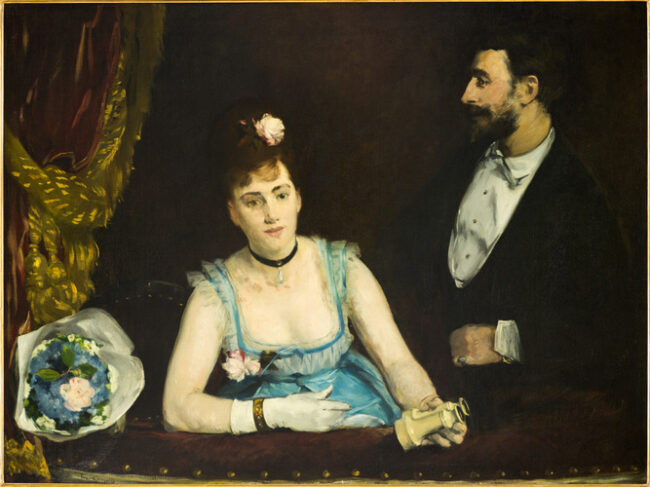
Copy caption Eva Gonzalès Une loge aux Italiens vers 1874. Musee d’Orsay
Eva began to use a lighter palette, especially evident in the pictures she painted on her many family trips to Dieppe such as Children in the Sand Dunes at Grandcamp. Critics have noted that her use of color here and the way she captured the light in depictions of Dieppe at night or of boats at low tide are reminiscent of the Impressionists. In fact, Eva never exhibited with the Impressionists and is seen more as their contemporary than as part of the group. Once again, she seemed to favor quietly following her own instincts, rather than joining a movement.
Le Réveil, chosen as the motif for this exhibition, exemplifies her mature style. The painting of her sister Jeanne in an “ordinary” moment of waking up one morning shows a dreamy young woman, not one of Chaplin’s pastel-dressed demoiselles, nor Manet’s brazen Olympia. She is shown in a moment de torpeur, as the accompanying text puts it, yet also with une certaine sensualité. She is not viewed through the eyes of a male painter, but rather depicted just as she was with une simplicité nonchalante seen again in The Alcove, another early morning scene featuring Jeanne, barefoot and very natural.
Tragically, Eva died in 1883, suffering an embolism shortly after giving birth to her son Jean-Raimond when she was only 36. Two years later her family organized a posthumous exhibition and then an auction of her work at the Hotel Drouot in Paris. Her paintings were thus dispersed, quite a few being taken abroad and this meant that despite the reputation she had begun to acquire in the last years of her life, she was largely forgotten as the years passed.
Throughout the exhibition there are instances of critics viewing Eva’s work through her gender. Some commented on her “feminine technique” and her Box at the Theatre des Italiens was rejected at first by the Paris salon because they found its “masculine virgor’ inauthentic. Yet the chronology of her work shows her gradually finding her own style and the exhibition concludes that she “showed great determination in forging her own path.”
The 19th century posed many challenges to creative women, but this exhibition shows Eva Gonzalès to have been a “spirited artist” who made her own choices. She may have been largely forgotten for well over a century, but in the words of its curators, this exhibition allows her, “at last to become herself (again).”
Eva Gonzales: The Journey of a Free-Spirited Artist
At the Petit Palais until Jan 24th, 2027
Opening hours: Tuesday – Sunday 10 am – 6 pm (8 pm on Fridays and Saturdays)
Nearest Metro Champs Elysées-Clémenceau (Lines 1 and 13)
Full Price €14. Reductions €12.
Tickets available here
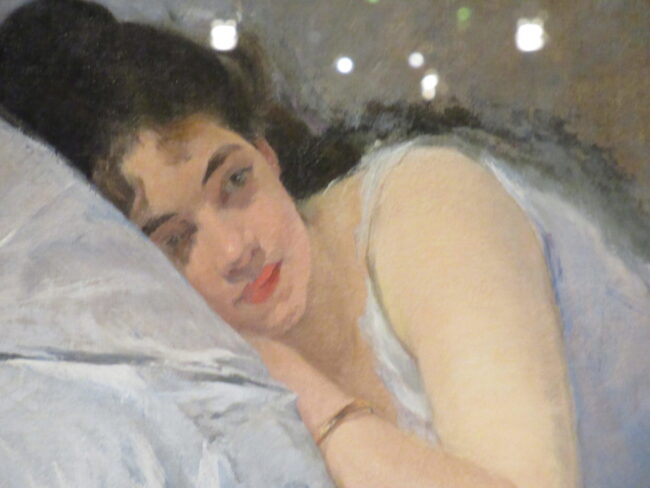
Close up of Le Reveil by Eva Gonzalès. Photographed at the exhibit by Marian Jones
Lead photo credit : Eva Gonzalès exhibit poster. Photo: Marian Jones
More in Petit Palais
Related Articles
By Marian Jones