Book Review: The Renoir Girls
- SUBSCRIBE
- ALREADY SUBSCRIBED?
BECOME A BONJOUR PARIS MEMBER
Gain full access to our collection of over 5,000 articles and bring the City of Light into your life. Just 80 USD per year.
Find out why you should become a member here.
Sign in
Fill in your credentials below.
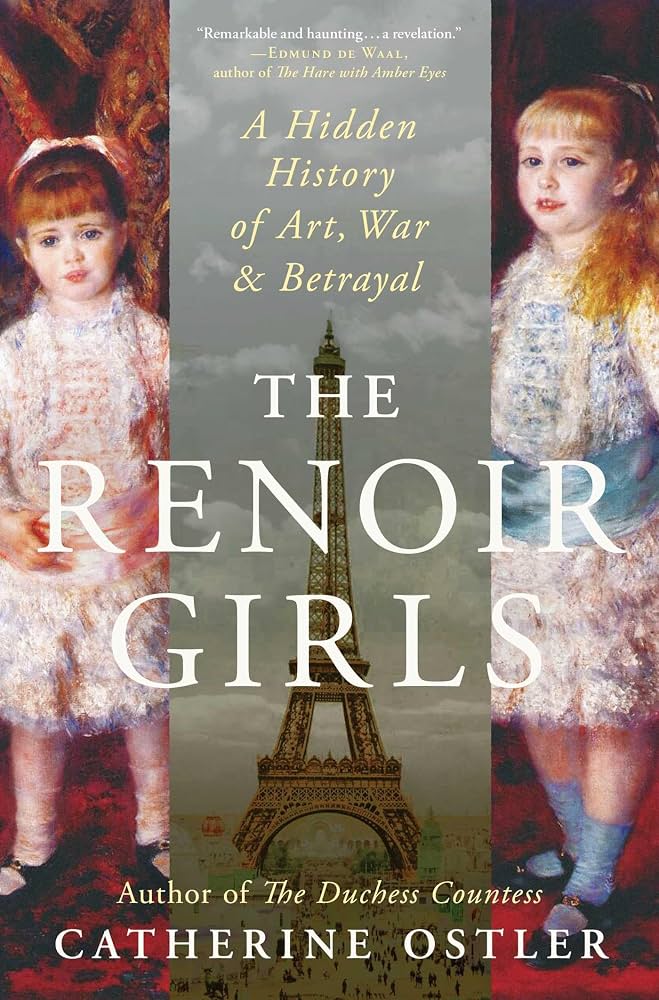
“In 1881, Pierre-Auguste Renoir painted two young sisters from a Jewish banking dynasty at their home in Paris’s grand 8th arrondissement. ‘Pink and Blue,’ a portrait of Elisabeth and Alice Cahen d’Anvers, captures a fleeting moment of innocence and beauty, and today it is one of Renoir’s most celebrated works. His portrait evokes the glamour of the Belle Époque: days at the races, nights at the opera, sun-soaked chateaux, brilliant salons filled with art, music and conversation. Paris at its most dazzling…” from the publisher’s description of The Renoir Girls: A Hidden History of Art, War & Betrayal.
This is a fascinating book, and through reading it I learned a great deal that I would no doubt have never learned any other way. For that reason alone, I strongly recommend it to those who are fascinated by — or simply just curious about — the life and work of Renoir; the Belle Epoque in Paris; the belle monde meticulously described in Marcel Proust’s In Search of Lost Time; the history of antisemitism in France (especially as manifested in the Dreyfus affair); France under Nazi Occupation; and the aftermath of World War II.
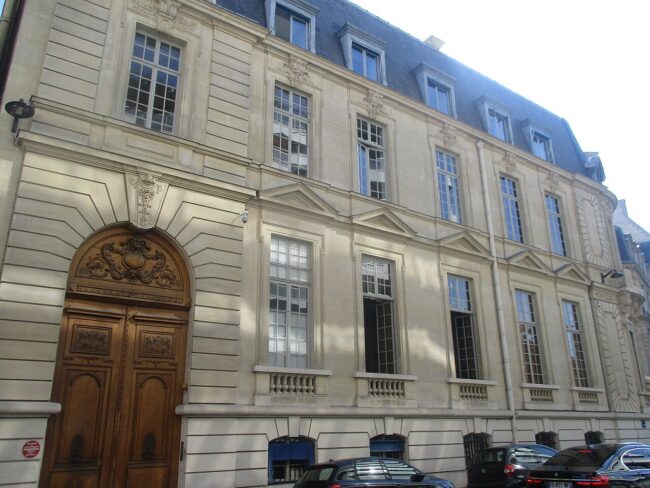
Hôtel Cahen d’Anvers, 2 rue de Bassano, 16th arrondissement. Photo credit: Thomon/ Wikimedia commons
Rigorously researched and intricately interwoven, the story of this wealthy and socially prominent Jewish family is a sprawling historical tapestry that both explores and exposes the lives of the super-rich in Paris from the late 19th century through the Nazi Occupation in the middle of the 20th. The lives and fates of three sisters from this prominent Jewish family who were painted by Renoir as young girls reflects the wide range of human responses to that period of history: some of the members of this extended family were brave résistants; some were collaborators; and some met a tragic end to their lives as prisoners in Auschwitz.
This is an immensely complicated story, with a sometimes overwhelmingly rich cast of characters that can be hard to follow. However, family trees in the front matter, and a “cast list” in the back are very helpful for those who get lost along the way, or who want to sum it all up in the end. There is also a very detailed timeline that plots not only major events in the lives of this family, but the historical, political, and cultural events and developments of the time. In addition, extensive endnotes as well as abundant footnotes provide plenty of documentation that is helpful for those who either already know a lot of the history of the English and French aristocracies of the period and are interested in the sources for particular details — or who know very little, but would like to learn more.
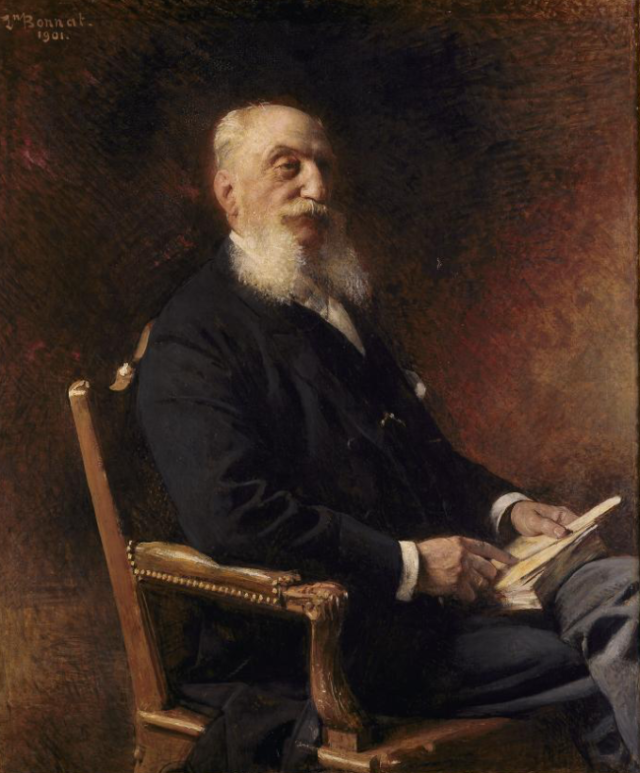
Portrait of Louis Cahen d’Anvers, by Léon Bonnat. Centre des monuments nationaux/ Public domain
This may all sound a bit academic and textbook-y, and indeed the amount of exhaustive research that has gone into this work — and the abundance of historical detail that the author shares with her readers — can be a bit tedious at times.
But it shouldn’t be. Because interwoven with what can be an overwhelming amount of detail, there is a damn good story, and it is very well told.
The story begins with recounting how the not-yet-famous painter Pierre-Auguste Renoir came to be commissioned to paint the two sisters pictured in Pink and Blue. (In fact, this was not the only family portrait Renoir produced for this family — he had also painted Alice and Elisabeth’s older sister, Irène, the year before, in another very well-known painting, The Little Girl with the Blue Ribbon (La petite Irène).
And while it may be tempting to see this as a sad “riches to rags” story, with all the happiness in the beginning, and all the sadness in the end, that would be too simplistic. For this reader, anyway, there is something very sad about the length to which some of the members of this Jewish family went to spend, marry, convert, or otherwise insert themselves into the French (and British) aristocracies of the time; and the fact that in the end they were not protected in the least from the worst and most vicious antisemitism the world has ever known makes the story that much sadder.
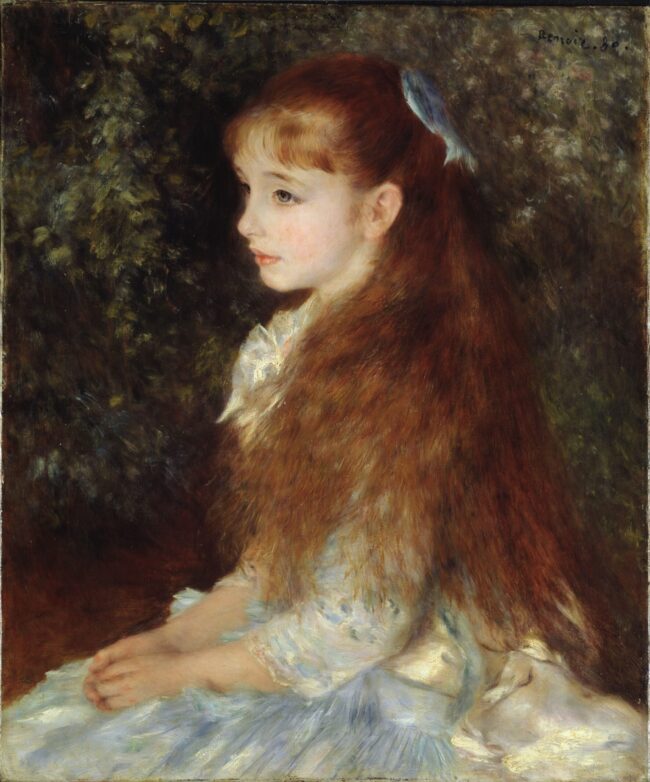
The Little Girl with the Blue Ribbon (La petite Irène), Pierre-Auguste Renoir, 1880
But there is also plenty of sadness in the failed marriages, and the frustrated dreams and ambitions, even in the glittery-whirl-of-Parisian-high-society-life part of the book. The bountiful details about the races (horse, yacht, automobile); the hunts; the high-society weddings, art openings and other social events; and the hats, scarves, gloves, furs that the stars of this world wore to these spectacles shows us not only Paris of the ultra-rich. We also get glimpses of Nice, Biarritz and Deauville, London and Cairo, and other playgrounds of the ultra-rich as well. The abundant descriptions of such excessive profligacy, at least for this reader, eventually became a bit dispiriting, especially with the knowledge of where it was all heading. Perhaps a more rigorous editorial process would have trimmed some of that.
Still, it is easy enough to gloss over those parts for readers who have little interest in the hats and scarves and furs; and the amount of exhaustive detail given to other parts of the story, parts that are not at all elegant — the horrors of trench warfare, the siege of Kut, the sinking of ocean liners with thousands of refugees aboard, the turning of rural chateaux into hospitals during World War I — and eventually the terrible details of the internment camps in France and the horror of Auschwitz during World War II — do balance the scale. And those ugly parts are educational in a way that, at least in my opinion, can never be overdone.
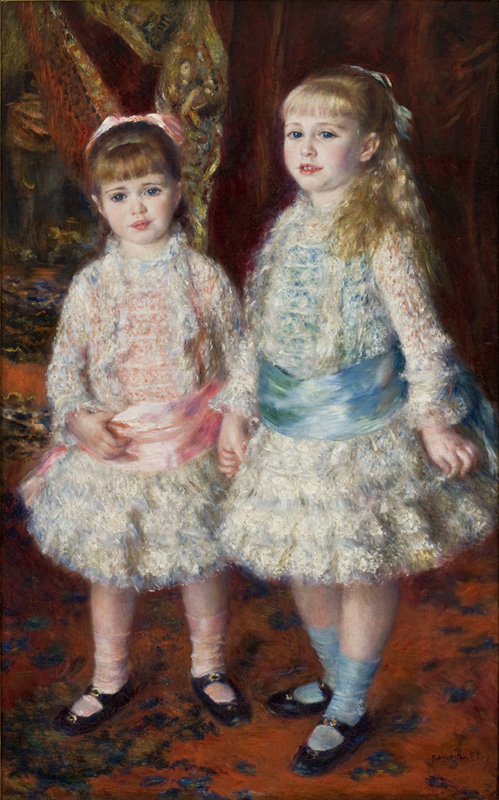
Pink and Blue (Mlles Cahen d’Anvers), Pierre-Auguste Renoir, 1881
Despite the title of the book, Renoir’s presence is a relatively minor one. His role in the narrative for the most part reflects the subsidiary role that the servant class always tends to play in stories of the super-rich. He’s just the painter who has graduated from painting porcelain to decorating menus and place cards and murals in the homes of the wealthy, to painting portraits of aristocratic young heiresses. In the case of the Cahen d’Anvers girls, the paintings were apparently not even very well appreciated by the family, and the artist was disgruntled by their slowness in paying him for them. And once we learn the details of when and how the portrait was painted, we don’t hear a lot more about the artist who painted it.
Toward the end of the book, however, an anecdote about Matisse puts Renoir back in the spotlight.

Portrait of Pierre Auguste Renoir. Musée d’Orsay, Dist. RMN-Grand Palais / Patrice Schmidt
“When [Pink and Blue] was lent to the Tate in 1954, Alice Townshend [who had been the little girl dressed in pink in 1881], according to her granddaughter…liked to stand next to it to tell strangers that it was her in the portrait. Did spectators see the spirit of the young girl in the old lady?…When he met Alphonsine Fournaise…who had been painted by Renoir as a child, Matisse had said, ‘I remember the shock of recognition when, after gazing at the painting, I turned to offer her a compliment — and there it was: the very expression I had just seen on the canvas, shining through her aged features, outside of time. In that moment, I understood that Renoir had captured the essence of her being. That, I believe, was the true gift of life that the painter possessed.’“ (The Renoir Girls, p 376-77)
Related Articles