
The Nightlife of St Germain des Prés: When Paris Youth Captivated the World

- SUBSCRIBE
- ALREADY SUBSCRIBED?
BECOME A BONJOUR PARIS MEMBER
Gain full access to our collection of over 5,000 articles and bring the City of Light into your life. Just 80 USD per year.
Find out why you should become a member here.
Sign in
Fill in your credentials below.
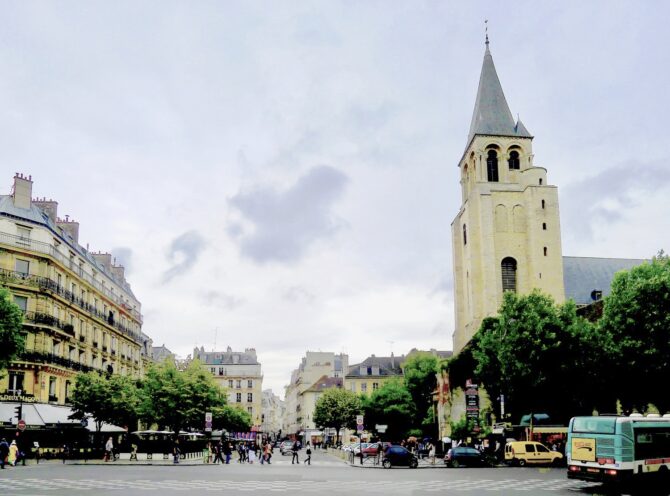
Standing in the middle of the Place Saint-Germain-des-Prés today, surrounded by tourists from around the globe thronging the terrasse of Les Deux Magots and the luxury store of Louis Vuitton, it takes some imagination to step back 80 years and see it as an 18-year-old Juliette Gréco did in 1945. Having been beaten and imprisoned by the Gestapo after helping her mother and sister in their Resistance activities, she found herself alone, penniless and homeless on the streets of Paris. She knew only one person, a friend of her mother’s called Hélène Duc who lived in the 6th arrondissement. To her credit, Hélène took her in, fed and housed her in her own home. The only clothes available to her in this grim aftermath of the war were those of Hélène’s sons, so Juliette went around in an oversized coat and trousers held up with a belt. Thus the bohemian look of Saint-Germain-des-Prés was born.

Juliette Gréco in 1966. Photo: Ron Kroon for Anefo/ Wikimedia commons
Juliette wasted no time in acquainting herself with the young intellectuals of the quartier. In particular she struck up friendships with the writer and musician Boris Vian and Anne-Marie Cazalis and the three of them formed a nucleus of young people who patronized Le Bar Vert in Rue Jacob. Trouble was, once the bar closed at around 1am there was nowhere else to go. They became used to having chamber pots poured over their heads by irate neighbors as they hung around the doors talking and smoking until dawn.
They moved to another café on the corner of Rue Dauphine and Rue Christine also frequented by writers and intellectuals, Le Tabou. In early 1947 four of its regulars persuaded the owners, a Toulousain couple called the Guyonnets, to convert the cellar into a nightclub. And after a minimal makeover, the nightclub Le Tabou was born, setting the template not just for cellar clubs everywhere, but for the frenetic, if short-lived, flourishing of Saint Germain’s nightlife. It opened its doors in the spring of 1947. The house band was fronted by talented trumpet-player Boris Vian, who brought with him his young friends who, in turn, made the club the hippest night spot in Paris.

Boris Vian in 1948. Photo: Studio Harcourt/ Public domain
From the outside it just looked like a drab bistro but crowds lined up to be allowed inside, down a winding stone staircase to a low-ceilinged vaulted passageway. Here people came to dance the night away until 2 am in a fug of cigarette smoke and sweat. It was said that if you put a loaf of bread on the table in the evening, by the morning it would have deliquesced into a moldy lump.
In that typical way the French have of taking English words and co-opting them to mean something entirely different, the dances were known as “bebop,” although the moves were actually the jive and jitterbug. Bebop jazz, just emerging in New York, wouldn’t reach France for another couple of years and the musical background was mostly jazz standards from the ’20s and ’30s. No matter: girls and boys danced recklessly while Vian poured his heart and soul into his trumpet-playing.
Juliette and Anne-Marie stood on the door, inaugurating that time-honored door policy of fashionable clubs – do you meet the dress code? With a raised eyebrow Juliette would let in people who made the grade while those who dressed like “squares” or simply didn’t look right would be turned away. She once said that sometimes she would only admit philosophers, though how can you tell what a philosopher looks like?
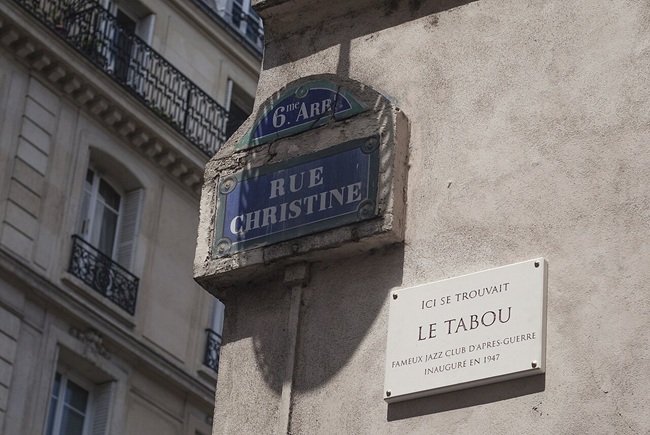
Commemorative plaque honoring Le Tabou on rue Christine. Photo: GANAS/Wikimedia Commons
For a while Le Tabou’s success rested on word-of-mouth buzz but then Anne-Marie staged a publicity stunt by inviting a Paris tabloid, Samedi-Soir, to visit and write a piece on the club. The ensuing article, suitably entitled ‘This is How the Troglodytes of Saint-Germain-des-Prés Live,” had the equivalent effect of a viral TikTok video today. When asked what she believed in, Anne-Marie fired back “Existentialism” and so the legend of Saint Germain was born. Forever after, the quartier would be associated with black-clad, dishevelled, disaffected youth smoking Gauloises and discussing jazz and philosophy until the sun rose. Jean-Paul Sartre and Simone de Beauvoir were not amused.
Of course, and as always happens, once Le Tabou hit the headlines everyone descended, wanting to join the “in” crowd. It lasted a couple of years, by which time the club had become a tourist attraction and its original habitués had long moved on.
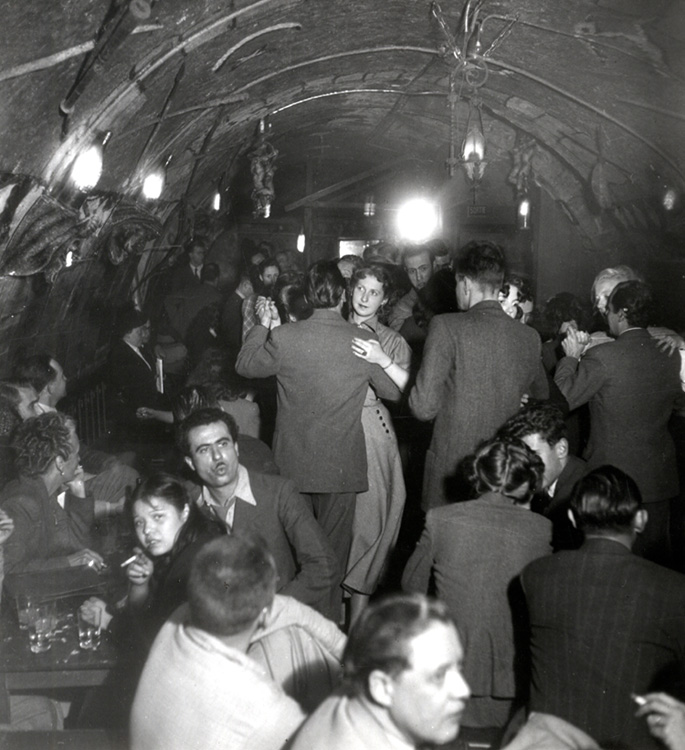
Le Tabou by Robert Doisneau, 1947
They moved to other clubs: Le Club Saint Germain des Prés, Le Saint-Yves, Le Vieux-Colombier, La Rose Rouge a little further away. Le Club Saint Germain des Prés actually occupied three interlinked cellars with vaulted roofs which stretched from the building on the Place Saint-Germain-des-Prés that once housed the Société d’Encouragement pour l’Industrie Nationale (it’s still there) to no.13 Rue Saint-Benoît behind.
Although many of the young customers from Le Tabou frequented it, from the start it was a more upmarket venue: a plain shirt and tie were required and as musical director, Vian not only played in his own orchestra but soon attracted many of the great names of American jazz, which established the club’s reputation. Lester Young, Art Blakey, and Coleman Hawkins all played there. This encouraged musicians to cross the Atlantic to play in other clubs and in 1949, Miles Davis met Juliette Gréco who fell in love with him. But eventually, the Club Saint Germain des Prés, too, succumbed to the coach tours of tourists and closed in the 1960s.
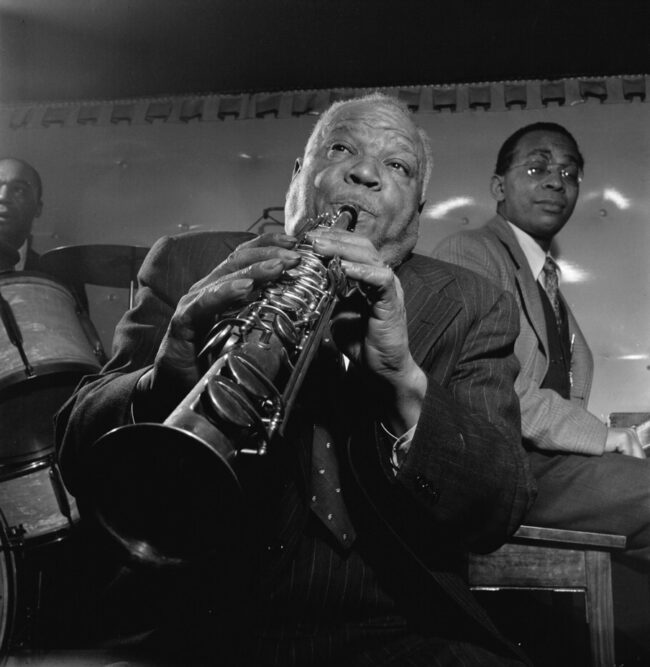
Jazz musician Sidney Bechet in St Germain in 1947. Photo: William P. Gottlieb / Public domain
La Rose Rouge was something a bit different. It began as an African restaurant in the Rue de la Harpe in the 5th arrondissement when the poet Jacques Prévert and some friends persuaded its owner to put on small-scale shows combining song, dance and theater. It opened in 1947 as a cabaret-théâtre and after a slow start it began to attract some of Paris’s leading intellectuals including Louis Aragon and his wife Elsa Triolet, and Jean Genet.
In 1948 it moved to the basement of no. 76 Rue de Rennes. After another slow start, success came quickly when the young song-and-mime group Les Frères Jacques became the main attraction (the quartet went on to become one of France’s best-loved singing groups). La Rose Rouge in its heyday was never a dance club, however, aspiring to a more intellectual program of entertainment and therefore attracting a slightly older audience. For all that, for eight years it was a fixture on the Saint-Germain-des-Prés nightlife scene and after its closure in 1956 it reopened as a fully-fledged nightclub.
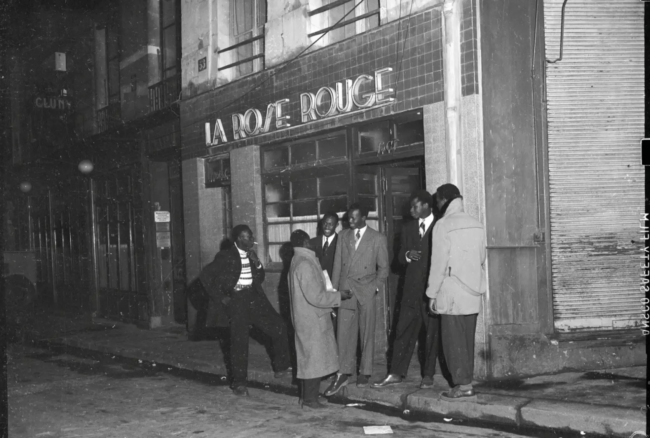
In front of the cabaret La Rose Rouge, Rue de la Harpe. Photo: Bettman Archive/ Getty
Le Vieux-Colombier opened at the end of 1948 in the basement of the theater of the same name and thrived under the musicianship of a band led by Claude Luter, another talented French jazzman of the period. If its roster didn’t reach the heady summits of the Club Saint Germain des Prés, it still attracted many of France’s leading performers. Other popular clubs included Le Quod Libet in the basement of a hotel in Rue du Pré-aux-Clercs which featured the upcoming chanson singer Léo Ferré, and Le Saint-Yves, a prewar survivor in Rue de l’Université which was, a bit like La Rose Rouge, more of a café-théâtre.
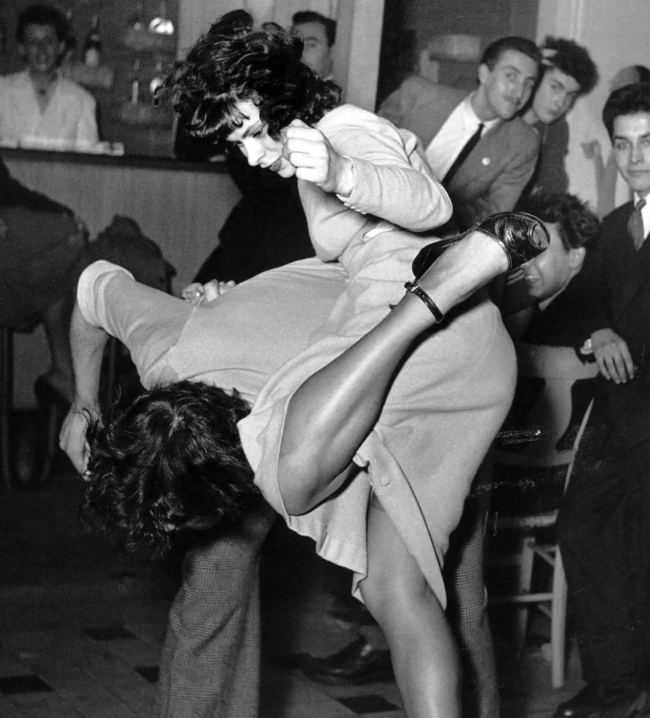
Robert Doisneau, Café Saint Yves, Saint Germain des prés, Paris, 1948
Nightlife anywhere is evanescent, attracting a certain clientele for a while before it moves on to pastures new. Saint-Germain-des-Prés was no different. In time, all the clubs mentioned here closed or evolved into something different. In the 1960s and 70s the Right Bank asserted itself as a nightlife hotspot, with acclaimed clubs like Le Rex inside the renowned Art Deco cinema, Les Bains Douches, decor designed by Philippe Starck, and Le Sept in Rue Sainte-Anne. Saint Germain carried the flag for a little longer, notably with Chez Castel in Rue Princesse, welcoming Mick Jagger in the 1960s, and the mythic Chez Régine which opened its doors in Rue du Four in 1956 although its glory days as a celebrity hangout really belong to its later incarnation in Rue de Ponthieu next to the Champs Élysees.
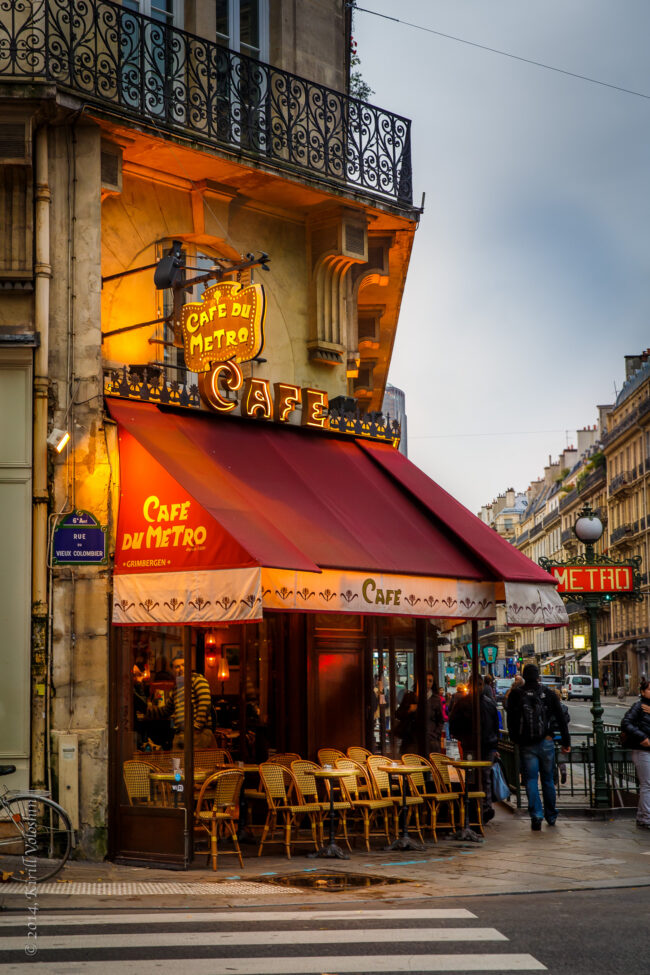
Café du métro, on the corner of rue du Vieux-Colombier and rue de Rennes. Photo: kvoloshin/ Wikimedia commons
But for a brief few years, fluttering like mayflies, the youth of Paris crammed itself into a few damp, sweaty, smoke-filled cellars around the venerable church of Saint-Germain-des-Prés to dance the nights away. To the rest of the world they personified the epitome of Parisian “cool” and inspired numerous teenage boys to wear lumberjack shirts and maybe read Camus, or if you were a girl, grow your hair long, dye it black, and create feline eyes with kohl à la Gréco, maybe whilst reading de Beauvoir. There are worse ways to pass your adolescence.
Lead photo credit : Place Saint-Germain-des-Prés. Photo: Mbzt / Wikimedia Commons
Related Articles

By Pat Hallam