
Connaissez-Vous Paris? Raymond Queneau’s Fabulous Urban Trivia
- SUBSCRIBE
- ALREADY SUBSCRIBED?
BECOME A BONJOUR PARIS MEMBER
Gain full access to our collection of over 5,000 articles and bring the City of Light into your life. Just 80 USD per year.
Find out why you should become a member here.
Sign in
Fill in your credentials below.
“Do you know Raymond Queneau?”
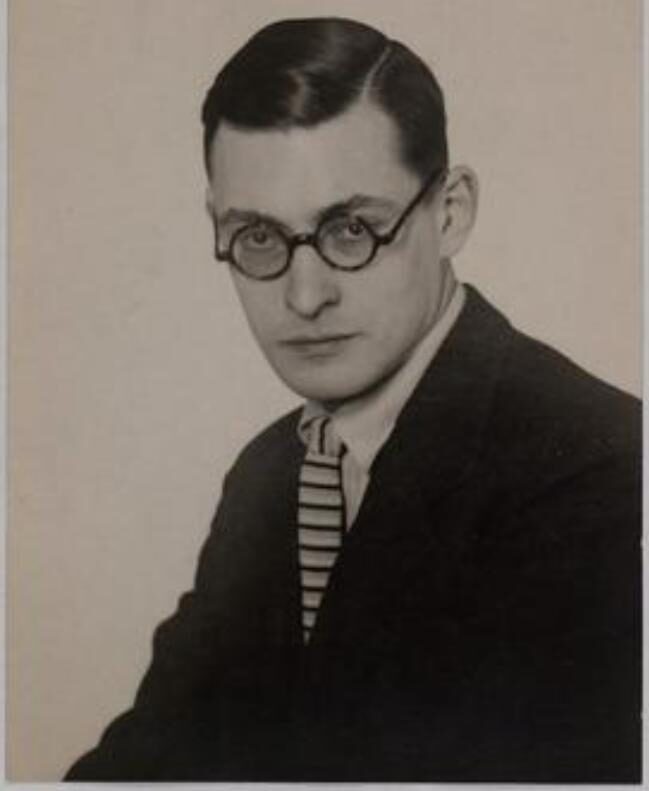
Raymond Queneau was a polymath of the highest order, just reading his CV is exhausting. A poet, scriptwriter, translator, film director, lyricist and mathematician, he studied philosophy at the Sorbonne, and hung around with the brainiacs of the Paris intelligentsia. In the 1930s he joined the prestigious reading committee at Gallimard Publishers, which evaluated manuscripts submitted to the house. He was briefly involved with the Surrealists, but preferred structure to chaos, and cofounded the Oulipo group, a group of writers known for its fiendish language restraints. Throughout his life, he wrote 15 novels – his most accessible being the picaresque Zazie dans le Metro.
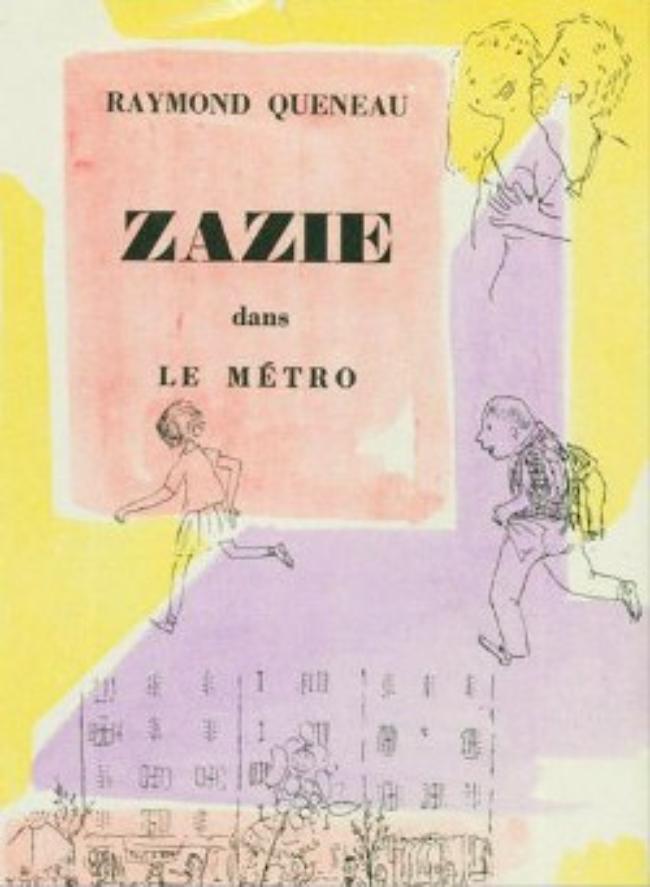
Zazie dans le Métro, first English version. Wikimedia commons
For two years – 1936-38 – Raymond Queneau used his big brain and wrote a playfully pedantic column of urban trivia titled “Connaissez-vous Paris?” (Do you Know Paris?) in the L’Intransigeant newspaper. Every day the paper’s readers were asked three questions about Paris. The answers could be found in the classified ads page in the same edition. Queneau relished his stint of roaming and research; his wandering throughout the Paris streets led to questions where historical knowledge mingled with witty anecdotes.
“Do You Know Paris?” focused on the unusual and mundane aspects of Paris rather than facts tourists would readily know. For example: where is Napoleon’s throne? What or who is the Samaritaine that the department store is named after? Where does the name of the Quartier des Enfants Rouges come from?
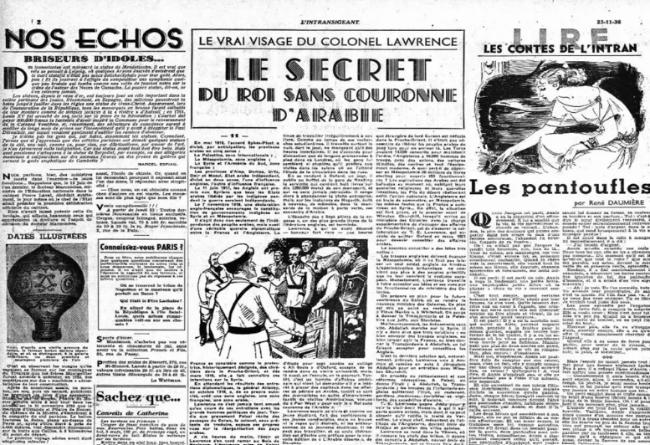
Example of page with Queneau’s questions. Image credit: Gallica
Here are some sample questions, though surely 90 years later some of the answers may have been improved upon.
- What is the deepest point in the Metro?
According to Raymond Queneau, the deepest point in the Paris Metro is located between the Abbesses and Lamarck stations on Line 12. This specific, profound spot is found 62 meters below the level of the rue Norvins. Today according to RATP, it is still the Abbesses metro station.
- Is there a connection between bleach (javel) and the quay of the same name?
According to Queneau, the answer is Yes. The name “Javel” for bleach originated from the town of Javel (now a district in the 15th arrondissement of Paris) where a chemical factory was established in 1777 near the “Moulin de Javelle,” to produce this compound.
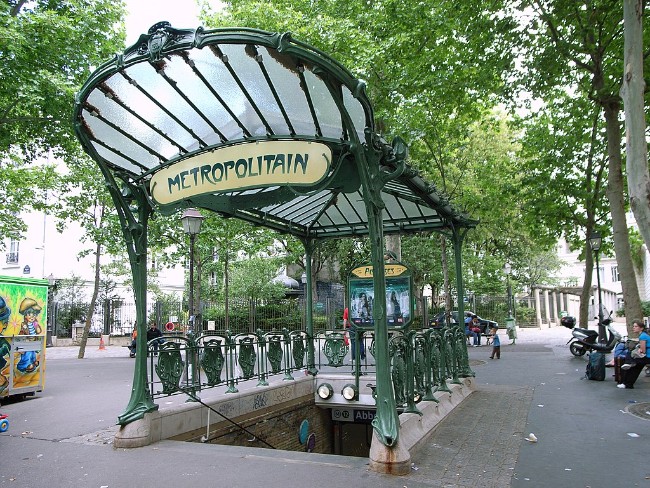
The Abbesses metro station. Photo: Steve Cadman/ Wikimedia commons
- How many triumphal arches are there in Paris?
Queneau said there are two main triumphal arches in Paris. He referenced the famous Arc de Triomphe de l’Étoile, at the western end of the Champs-Élysées, and contrasted it with the smaller Arc de Triomphe du Carrousel near the Louvre. Today the grand arch at La Defense is also counted.
- What pleasant dental memory is associated with the Place des États-Unis?
According to Raymond Queneau the pleasant dental memory associated with the Place des États-Unis is the monument to Horace Wells, who pioneered the use of nitrous oxide (laughing gas) in dentistry. A monument to the American Wells is situated there, in the Square Thomas-Jefferson, in Paris’s 16th arrondissement.
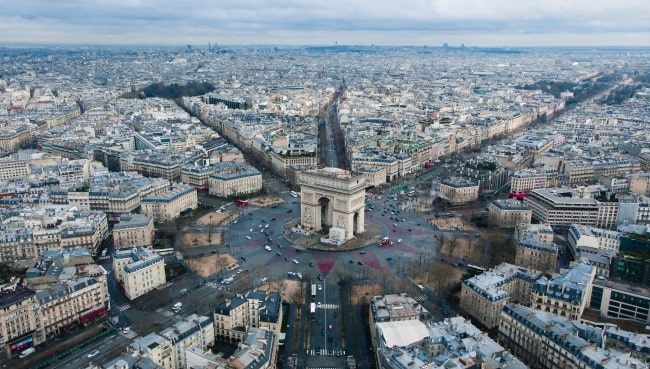
Arc de Triomphe aerial view. Photo credit: Rodrigo Kugnharski / Unsplash
- Where are the fighters of the July Revolution of 1830 buried?
The 504 Parisians who fell during the July Days of 1830 (the 27th, 28th, and 29th) are buried beneath the column in the Place de la Bastille. (Their names are engraved on the shaft.)
- How many religious buildings were there in Paris in 1789?
At the start of the French Revolution, there were 160 churches and chapels, 11 abbeys and 123 convents, totaling nearly 300 religious buildings, of which more than three-quarters have been demolished. (But about 100 churches were constructed during the 19th and 20th centuries.)
- Who is Père-Lachaise?
The Jesuit priest was the personal confessor of Louis XIV. The famous Paris cemetery is named after him because it was built on the site of his house.
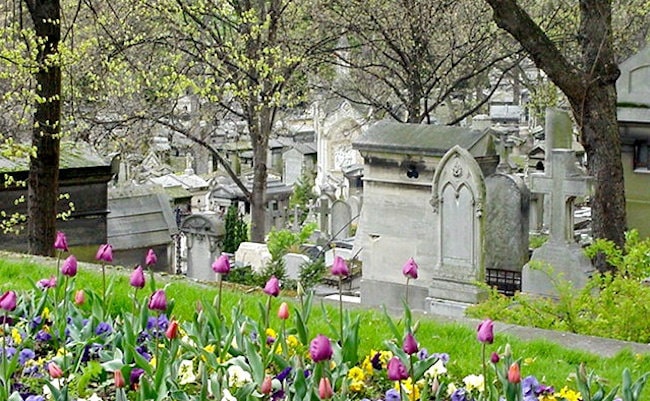
Looking down the hill at Père Lachaise. Photo: Näkymä Père-Lachaiseen/ Public Domain
- When was the Paris telephone network inaugurated?
The telephone network in Paris was inaugurated in September of 1879. The first telephone exchange was at 27 Avenue de l’Opera.
- Where is the Chateau des Ternes?
The remains of the former Chateau des Ternes are located on 17 and 19 rue Demours, built in 1548 and entirely rebuilt in 1715. In 1781, it was opened up in the middle to make way for rue Bayen, known today as rue de l’Arcade.
- When were the old-fashioned street names (many of which can still be seen in the old quarters of Paris) carved?
According to Queneau, it was in 1780 that street names were carved into the actual facades of buildings, for instance 2, rue Chausse d’Antin, 38 rue Chapons, 5 rue Caron, and 20 rue Tournefort, revealing the ages of the buildings to be much older. However, I’m sure Queneau would be interested to know that an ordinance in 1729 directed that the name of the street be chiseled in a stone set into the wall itself.
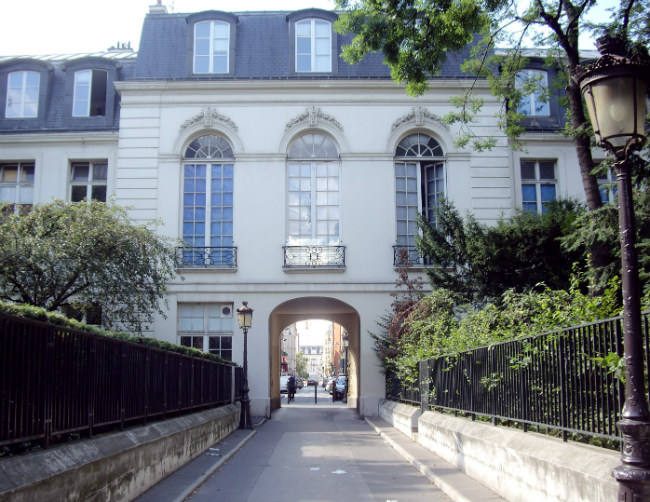
Château des Ternes/ Wikimedia Commons
Apart from the 2,100 questions the savant Raymond Queneau posed, he was consistently more famous for his other endeavours.
Queneau co-founded the Oulipo group in 1960 with a group of writers and/or mathematicians including François Le Lionnais, Georges Perec and Italo Calvino. An acronym for Ouvroir de Littérature Potentielle (Workshop for Potential Literature), the group emphasized systematic, self-restricting ways to write. For example, one gimmick they used replaced every noun in an existing text with the noun that follows seven entries after it in the dictionary thus creating new and often surreal, meanings.
Queneau came up with a “sonnet machine” which he called Cent Mille Milliards de Poèmes (One Hundred Thousand Billion Poems). Ten sonnets written on separate pages were each cut into 14 horizontal strips (one per line). Any strip could be paired with any other strip from the other sonnets, allowing a reader to generate distinct, and probably inane, poems.
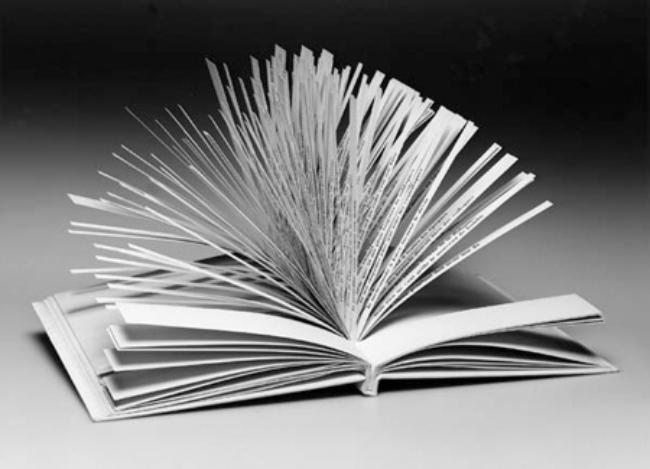
Cent Mille Milliards de Poèmes de Raymond Queneau. Wikimedia commons
Raymond Queneau achieved his first popular success with this novel, Zazie dans le Metro, published in 1959. A metro strike sends the country girl Zazie on a crazy adventure in what has developed into a comic cult classic. The impish but foul-mouthed Zazie arrives in Paris to stay with her uncle Gabriel, a female impersonator. All she really wants to do is ride the metro, but finding it shut, Zazie looks for other forms of amusement and is soon caught up in adventures with a gang of colorful characters. For an author that likes to play with words, what’s the catch?
Queneau used heavily stylized slang, and a phonetical spelling of childhood speech. Queneau’s Zazie invents words, and defies grammar, resulting in a short story, not at all directly translatable. Hats off to the French to English translator Barbara Wright.
Louis Malle adapted it to the screen, When the film came out in November 1960, its wacky humor and creative cinematography gained it a cult following (a Paris cinema showed it one day a week for more than 20 years). Charlie Chaplin was “impressed” with the films attempts at slapstick.
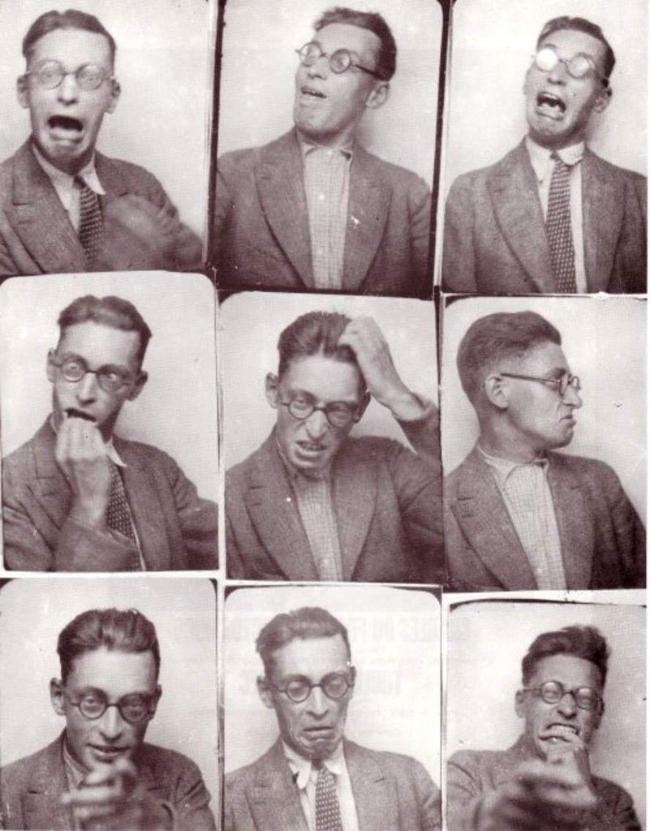
Raymond Queneau, Collage de photomaton, (photo booth pictures), ca. 1929 [© Adagp, Paris]
To sum up Queneau – French novelist, poet, and co-founder of the Oulipo group, renowned for treating the city with playful, trivia-filled expertise – is worth getting to know.
In closing, here’s a 1967 poem he wrote. Again, the wordplay is deftly handled by Barbara Wright.
Courir Les Rues
There are street that are tubes
There are street that are arches
There are boulevards dowdy
And others all crowdy
With cars, vans and coaches
There are squares dodecagonal
Some simply infernal
There are sausage-shaped avenues
Where the beetles are ravenous
Canals quite Venetian
And islands West Frisian
Bridges and alleys and dead-ends and quays
Highways and courtyards and foot paths, all these
For a multiple motley mosaic of modes
You cannot beat Paris’s system of roads
Raymond Queneau
Published by Gallimard, 1967
Lead photo credit : Raymond Queneau. author unknown. Wikimedia commons.
Related Articles
REPLY