Interview with Author Janet Skeslien Charles
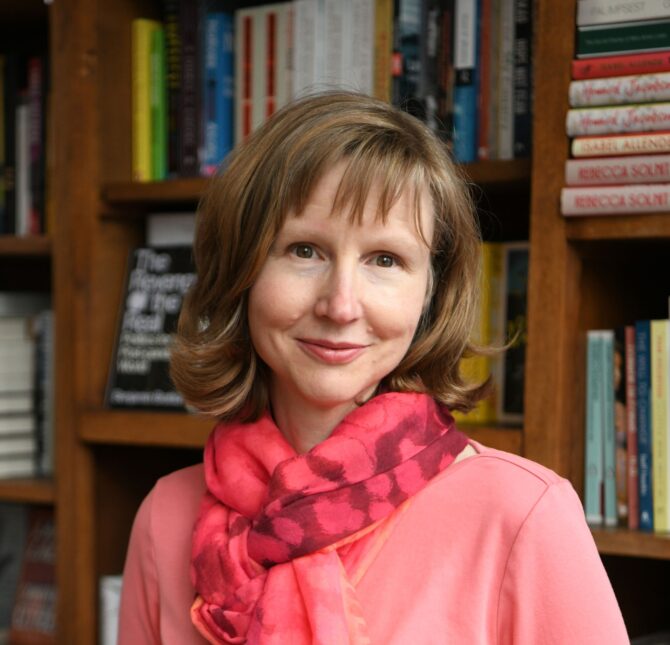
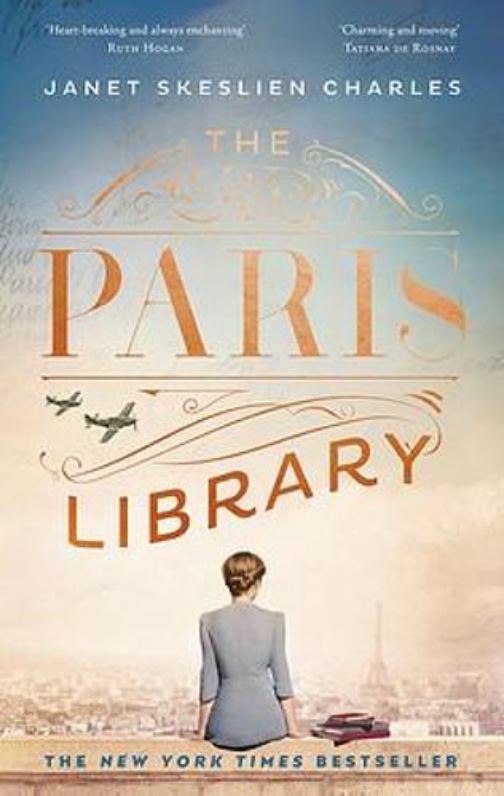
Janet Skeslien Charles is an internationally best-selling novelist who grew up in Shelby, Montana. She has lived in Odessa(Ukraine) and Mulhouse (Alsace), and she now lives in Paris, where she has been for the past 25 years. Fans of her previous two books — The Paris Library, and Mrs. Morgan’s Book Brigade — will be pleased to find some of the characters from those novels making brief appearances once again in her fourth and most recent novel, The Parisian Chapter. Janet recently took the time to answer Janet Hulstrand’s questions about her life and work in this exclusive interview for Bonjour Paris.
First of all, what is the path that took you out of Montana, where you grew up? And what were some of the stops along the way from there, to Paris?
I grew up in a small town near the Canadian border. Glimpses of the outside world came from my neighbor, a war bride from France, as well from my grandmother’s jigsaw puzzles with their images of French castles. Each week, my mother drove my grandmother, who’d never learned to drive, to the grocery store and the library. From these treks, I understood that books were as nourishing as food, and that the library was a window to the world. These influences inspired me to study French in high school and college, then apply for a teaching job in France. I first worked in Odessa, Ukraine, and then in Mulhouse, a city in Alsace. I enjoyed it so much that I return to that region every year. I then moved to Paris and taught English in the western suburbs.
Your last three books have all been focused in one way or another on libraries — the American Library in Paris, and the New York Public Library especially. But I know your feeling about the importance of libraries is not limited to those two. Why are libraries important? And what do you think libraries today need — from the public, from government, perhaps from associations as well?
In some ways, my hometown library hasn’t changed since I was a child. The same arrowheads are on display. I find the same wonderful bookish smell. When I visit, the librarian gives me a hug. There are the same magazine racks and tables. But this library continues to evolve. Recently, it took on the role of gallery, featuring art from incarcerated people in the nearby prison. The library made it possible for these amateur artists to take part in the community. These exchanges and openness are the heart of libraries.
I love libraries and know how important reading is to people of all ages. I hope that my readers enjoy learning about women’s war efforts that sadly have been left out of history books. Miss Morgan’s Book Brigade is partially set in the NYPL where Jessie Carson worked as a children’s librarian before she set sail for Europe and changed the literary landscape of France by creating libraries with open stacks and children’s sections. She also paved the way for a library school to train the first French female librarians. Yet both in France and the US, she is unknown. I hope that my readers and I will change that.
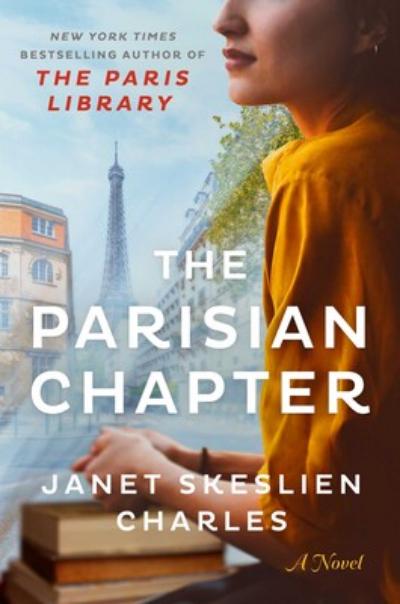
The Parisian Chapter starts with the sentence, “I’m on the front line.” In America, some libraries have become a battleground. Watching my home country from a distance, it appears now more than ever, to be a nation of conflicting values. On the one hand, we often cite the First Amendment right to express ourselves; on the other, we’ve seen a vertiginous rise in book bans that in essence control what people can read. In 2025, the American Library Association’s Office for Intellectual Freedom tracked 4,235 unique titles challenged. Of the unique titles challenged, 1,671 (39%) represent the lived experiences of LGBTQIA+ people and people of color. (Source: https://www.ala.org/bbooks/book-ban-data)
Online, we find everything from porn to misogynists spewing hate on their YouTube channels. The nebulous internet feels impossible to legislate; so instead, book banners turned their attention to libraries and books – concrete symbols of learning. Studies confirm that literature creates empathy by allowing readers to see life through the eyes of others. Instead of open discourse on the power of books, a small minority has organized to pressure librarians, booksellers, teachers, and school board members to remove books they personally find offensive. We should have conversations rather than book bans. We should look for solutions and celebrate difference rather than blindly slamming the door on topics that make us uncomfortable. We can support our local libraries by getting our library cards, showing up at meetings, or donating money or time.
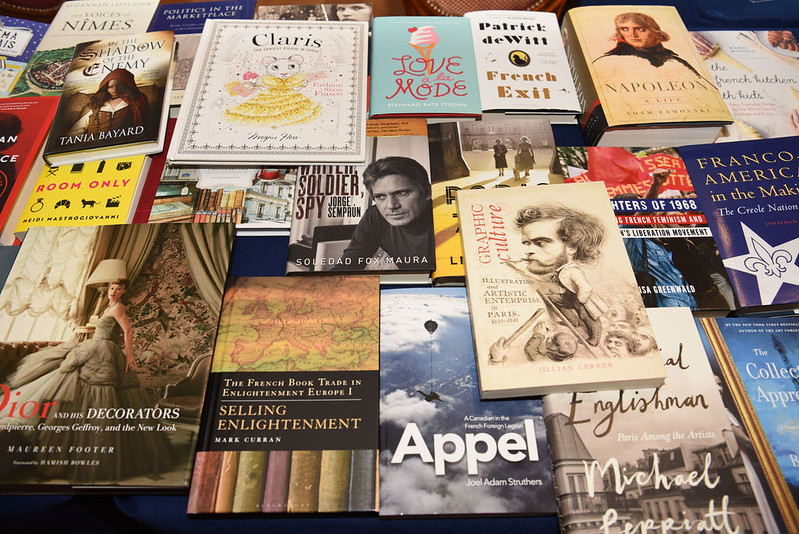
Ceremony for the American Library in Paris book award 2019. Photo: Krystal Kenney
This is the second novel you’ve written in which the American Library in Paris is both the main setting, and nearly a character in the story. In both of these novels, there is a very important character named Odile who lives in Montana. Is/was there a real-life Odile?
If I have a specialty in writing, it is taking poorly paid jobs and turning them into novels. I first learned about the real-life librarians featured in my novels while working as the events coordinator at the ALP. To me, the library is one of the stars of The Parisian Chapter!
As a child, I was fascinated by my neighbor Claudine Mainard, a war bride from Normandy. I didn’t know her very well, but I loved listening to her speak. With her lilting French accent, everything she said in English sounded special. She made me want to learn French. Even back then, I understood she was incredibly brave to leave behind her friends, family, and language for a new life with a G.I. in a tiny town on the prairie.
My many interests inspired this book, from Claudine, to my time at the library, to my love of French, to my appreciation for intergenerational friendships, to losing someone I thought was my best friend, to the solace taken from reading.
When I learned about the ALP history of the librarians during World War II, I knew it was a novel and sat down to write The Paris Library. I wanted the world to know about Dorothy Reeder and her belief in books as bridges. Growing up, I loved the library. While working as the events coordinator at ALP, that passion was rekindled. I share this appreciation of libraries with readers.
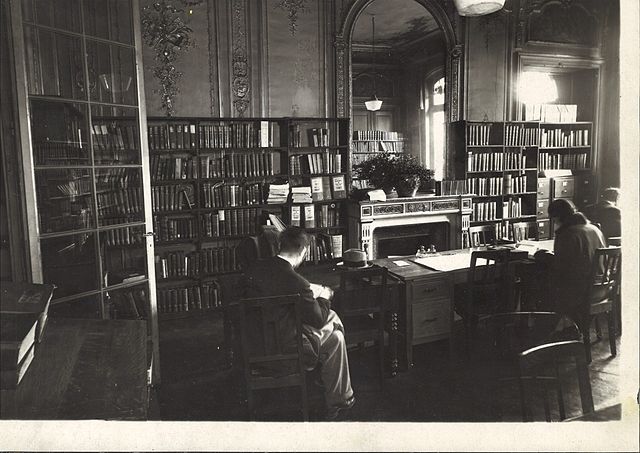
A reading room at the American Library in Paris at the former location of 10 rue de l’Élysée, circa 1927. Photo credit: Plemasson/ Wikimedia Commons
Are the people mentioned in The Parisian Chapter, in connection with the history of the American Library in Paris actual historical figures? And where could readers who would like to know more about them learn about them, and about the history of the library?
Yes, they are real characters. The history is fascinating, and we all have a role to play in keeping this history alive.
During World War II, two courageous women, Dorothy Reeder and Countess Clara de Chambrun, were the directors of the American Library in Paris. They kept it open and hand-delivered books to Jewish readers. Clara was a character in The Paris Library and has a cameo in The Parisian Chapter. You can visit her grave at the Picpus Cemetery in Paris.
Likewise, the women who participated in the American Committee for Devastated France came from most of the 48 states, the UK, and France. Jessie Carson, the real-life librarian who introduced the concept of children’s libraries to France during the Great War, was the main character of Miss Morgan’s Book Brigade and mentioned in The Parisian Chapter.
The Parisian Chapter also underlines the birth of the American Library in Paris in 1920 with the touching story of one of its founders, Charles Seeger, the father of poet Alan Seeger, who was killed in the Great War. His poem “I Have a Rendezvous with Death” was a favorite of John F. Kennedy. Some of the ALP funding came from the royalties of Alan Seeger’s book, which was published posthumously. In a way, the library is a living monument from a father to his son.
I hope that my library trilogy will encourage readers to look into the stories from their own families and regions.
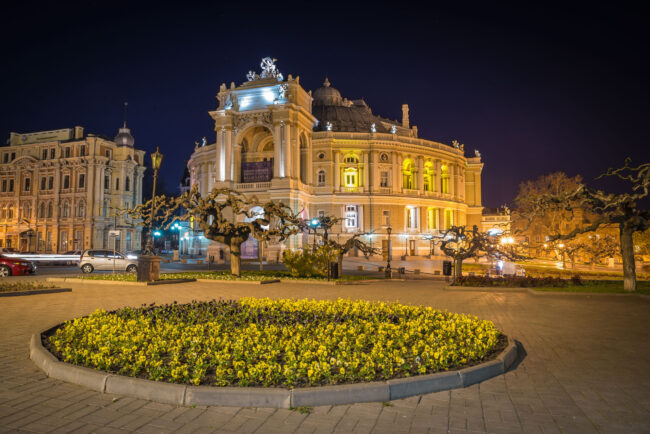
Odessa Opera and Ballet Theater. Photo: Konstantin Brizhnichenko / Wikimedia commons
I would love to know something about the time you spent living in Odessa and how it influenced you. How does it feel now, to see what the Ukrainian people are suffering through in recent years? Are you still in touch with people there?
All of my books were born of traveling and living abroad. At heart, I am interested in journeys and the ways that we must reinvent ourselves through changes in circumstances, whether it is a new job, getting fired, marriage, divorce, retirement, having children, or travel. As a foreigner, first in Ukraine and now in France, I have been an outsider. Though this makes daily life difficult, being an outsider is good when you are novelist because you observe people and have distance from situations. I am very interested in language. I come from Montana, a place where many people, myself included, have trouble expressing our feelings. There are a lot of silences.
I loved my time in Ukraine and feel lucky to have met so many incredible people. I worked at a local high school for two years. It was just after perestroika, and people were really struggling. As an example, I worked as a full-time teacher and my salary was $25 per month. All of my colleagues had second and third jobs. Several generations of families lived with each other. I returned to Ukraine until my beloved elderly Odessan neighbor passed away.
It is terrible to see the war, and incredible to see the courage of Ukrainians.
What do you think is the biggest adjustment about living in a big city as opposed to in a small town? I know you love Paris, but do you ever miss small-town life?
I do miss small-town life! Luckily, I go back to Montana every summer. For me, the price of everything was the biggest culture shock from growing up in Shelby, Montana to Paris — from the price of rent to the price of a cup of coffee. On the other hand, I have Ukrainian friends who moved to Oslo and London, and when they visit Paris, they find everything here very inexpensive – so it all comes down to perspective!
Do you want to tell us what your next book will be about? Or is it too soon to ask that question?
I am working on a psychological thriller set in New York. A huge change for me!
Pick up The Parisian Chapter at your favorite local independent bookstore, like the Red Wheelbarrow and Shakespeare & Company in Paris.
Lead photo credit : Janet Skeslien Charles by Krystal Kenney
Related Articles