
Poetry from Paris With Love

- SUBSCRIBE
- ALREADY SUBSCRIBED?
BECOME A BONJOUR PARIS MEMBER
Gain full access to our collection of over 5,000 articles and bring the City of Light into your life. Just 80 USD per year.
Find out why you should become a member here.
Sign in
Fill in your credentials below.
Will you send your Valentine a poem this year? French poets, many of whom are remembered by statues in the parks and squares of Paris, can provide some inspiration. Here are five love poems, along with hints on where to “find” their authors in Paris and very brief biographical notes on each to set their work in context.
The charming bronze statue of Jean de La Fontaine (1621-95) is one of the highlights of the Jardin du Ranelagh in the 16th arrondissement. It illustrates a moment from one of his best-known fables, “The Crow and the Fox.” The crow, eating his tasty morsel of cheese, is shown at La Fontaine’s feet, while the wily fox who is going to flatter the bird until he opens his mouth and drops the cheese is advancing up some steps towards him.
La Fontaine, was a prominent figure in the 17th century-literary scene in Paris, mixing with many of the day’s other famous writers, including Molière and Madame de Sevigné. Today he is best remembered for his 12 books of fables, published over nearly three decades from 1668, but he also wrote sketches and poetry. His Éloge de l’amour (In Praise of Love) is a lovely romantic poem on the age-old theme of love being the most important thing of all.
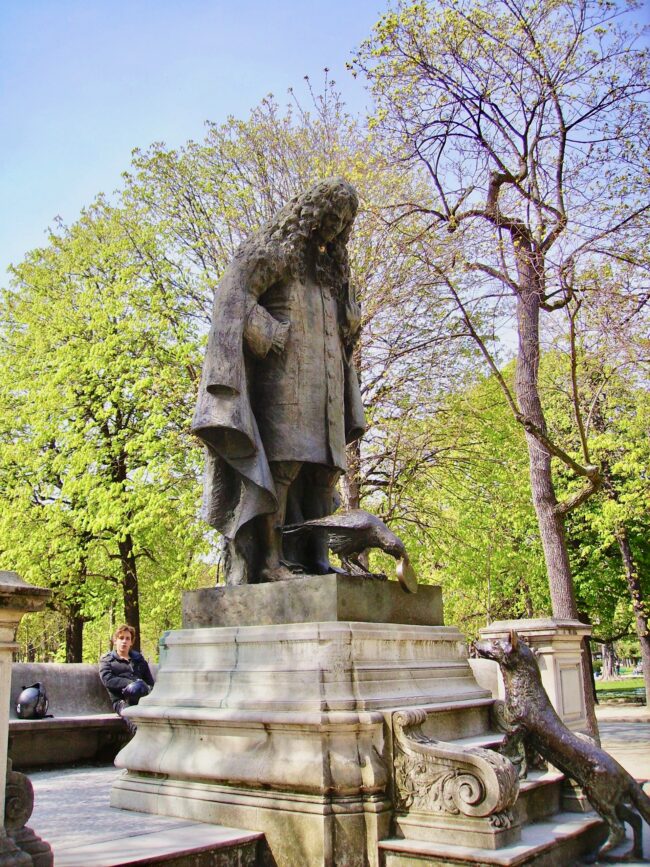
Monument to Jean de la Fontaine by Jean-Alphonse-Edme-Achille Dumilâtre at Jardin du Ranelagh. Photo: Yair Haklai / Wikimedia commons
It’s short, only 12 lines in all. The first verse opens with the thought that “the entire universe obeys love,” and describes love as more powerful than any of the gods, the ultimate goal of all hearts, especially the young. The second verse, given here, says that without love, other pleasures are merely “languishing charms.” Neither lambris dorés (gilded panels) nor bois, jardins, et fontaines (woods, gardens, fountains) can give the same joy as love. The last two lines of each verse are the same, repeating the key message that love is all-important and that “all the rest is nothing”: tout le reste n’est rien.
Sans cet Amour, tant d’objets ravissants,
Lambris dorés, bois, jardins, et fontaines,
N’ont point d’appâts qui ne soient languissants,
Et leurs plaisirs sont moins doux que ses peines.
Des jeunes coeurs c’est le suprême bien
Aimez, aimez ; tout le reste n’est rien.
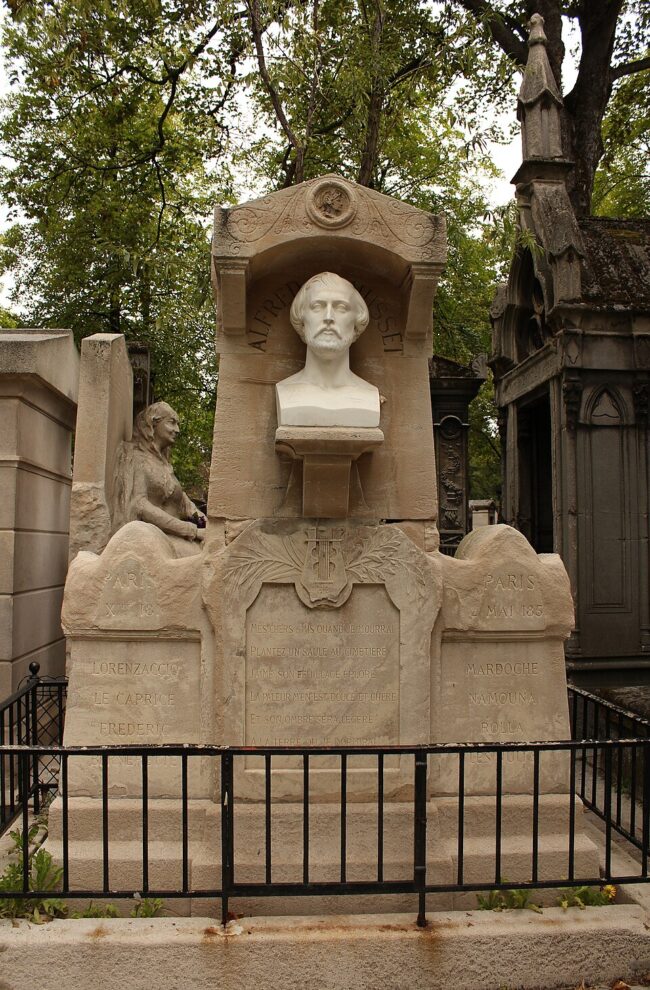
Alfred de Musset tombe in Père-Lachaise. Photo: Pierre-Yves Beaudouin/ Wikimedia commons
Statues honoring Alfred de Musset (1810-1857) in Paris include a bust at his grave in the Père Lachaise cemetery and a larger work, Le rêve du poète (The Poet’s Dream), in a little park in the 8th arrondissement, just where Avenue Franklin Roosevelt meets the Cours de la Reine. It’s a large sculpture, featuring romantic ruins and symbols designed to reflect the themes of his work.
De Musset led a colorful life as a Paris dandy, famed for his drunken exploits and sexual adventures as well as for his writing. The title of one of his many plays, On ne badine pas avec l’amour (You shouldn’t trifle with love), is still a much-quoted phrase today and he was elected to the distinguished Académie Francaise in 1852. He is remembered too for his love affair with the novelist Georges Sand which he said himself inspired some of his best poetry.
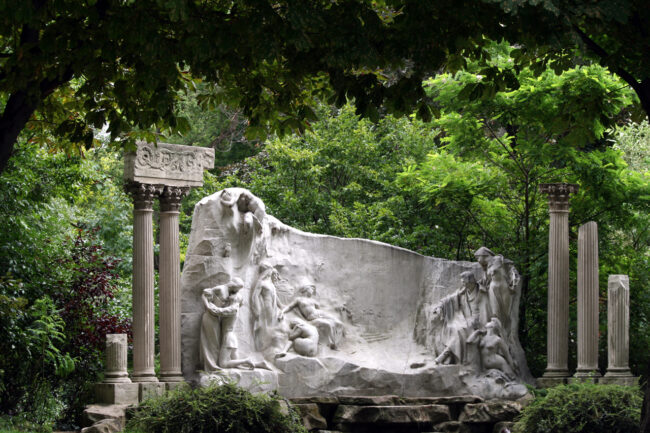
Le Rêve du poète. Jardin de la Nouvelle France. Photo: Remi Jouan / Wikimedia commons
His poem Chanson de Fortunio (Fortunio’s Song) tells of a mystery love, opening by saying he would not reveal her identity even “for an empire.” All he will say is that her hair is as blonde as wheat (elle est blonde comme les blés) and that his heart is torn. The last four lines, printed below, sum up his anguish: I love her too much to tell you / who it is that I love / and I will die for my sweetheart / without naming her.
Mais j’aime trop pour que je die
Qui j’ose aimer,
Et je veux mourir pour ma mie
Sans la nommer.
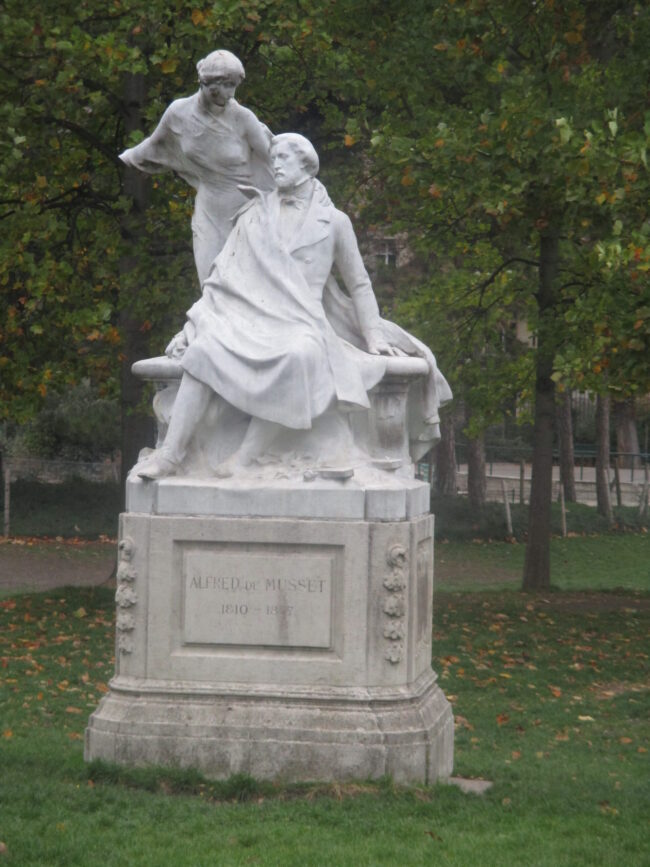
Statue of Alfred de Musset and his muse at Parc Monceau. Photo: Thomon / Wikimedia commons
There’s a bust of Pierre de Ronsard (1524-85) in Place Marcellin Berthelot in the 5th arrondissement, near the Collège de France and the Sorbonne. Often referred to as the “Prince of Poets,” he was a leading figure in the group of Renaissance poets, La Pléiade, whose work was heavily influenced by classical Greek and Latin authors. Ronsard’s poems included a collection of Odes as well as nature poems and love poems including one collection titled “Sonnets to Hélène” and another dedicated to a country girl, Marie.
The theme of this “Sonnet to Marie” is the transience of love. In the first verse, the poet tells Marie he is sending her a bouquet of flowers which he has picked himself, but the second verse compares her beauty, “now in flower,” to the blooms which will soon wither away. “Time runs away” (Le temps s’en va) and we should seize the moment. The fourth and final verse underlines this message: “The loves of which we talk / will be no longer new when we are dead / so love me while you are beautiful.” Here are those last three lines in the original French.
Et des amours desquelles nous parlons,
Quand serons morts, n’en sera plus nouvelle:
Pour ce aimez-moi, cependant qu’etes belle.
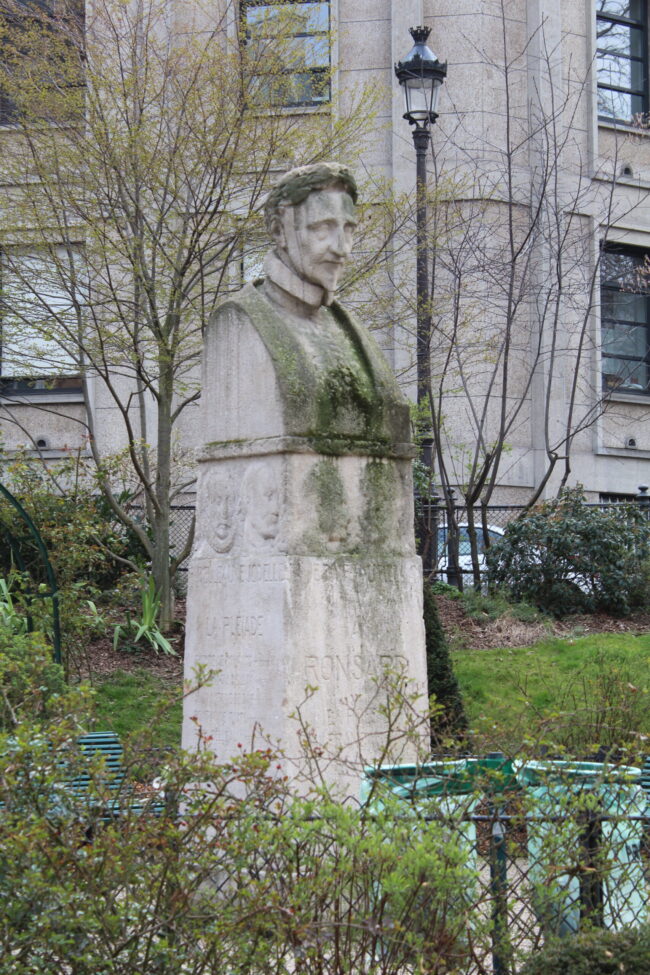
Sculpture of Ronsard in the 5th. Photo: Chabe01 / Wikimedia Commons
There is no statue of Madeleine de Scudéry (1607-1701) in Paris, but in 2019 the French artist Christian Guémy painted a mural of her in the Marais on the corner of Rue de Temple and Rue de Rivoli. She is best known as a novelist and social commentator whose views on such topics as the education of women attracted attention. She was also a leading light of intellectual life in 17th-century Paris and established a literary salon, the Société du Samedi (The Saturday Club), where people gathered to discuss literature and philosophy.
Her beautiful poem, Les amoureux, is an ode to love itself, just eight lines in length. It opens with images evoking the pleasures of love: water caressing the shore, a rose opening in a breeze, the wind laughing through the leaves. Its final four lines explain that love doubles pleasure, for those who love do not have just one soul, they have two. Here is the poem in full.
L’eau qui caresse le rivage,
La rose qui s’ouvre au zéphir,
Le vent qui rit sous le feuillage,
Tout dit qu’aimer est un plaisir.
De deux amants l’égale flamme
Sait doublement les rendre heureux.
Les indifférents n’ont qu’une âme ;
Mais lorsqu’on aime, on en a deux.
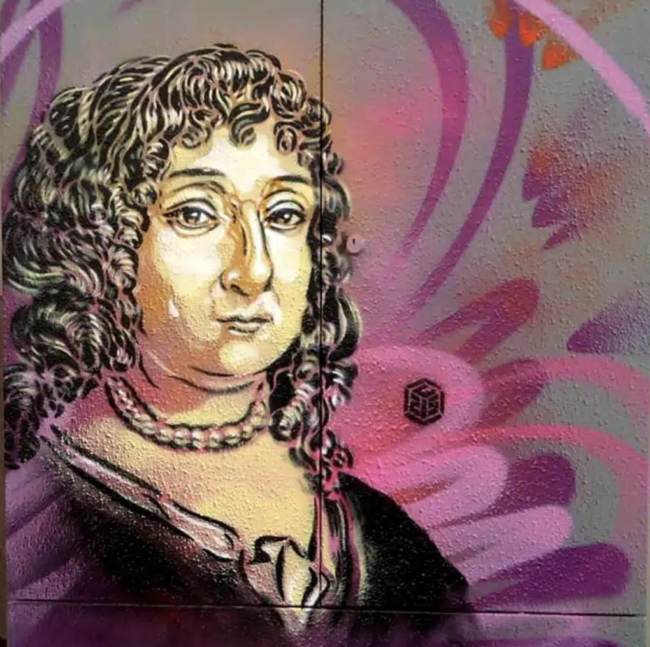
Mural of Madeleine de Scudéry by Christian GUEMY, alias C215, as part of the Le Grand Siècle du Marais series.
There is a marble bust of Paul Verlaine (1844-96) in the Luxembourg Gardens. He was a leading 19th-century poet and remains one of France’s best-known writers, the author of evocative poems on grand themes such as love and loss. Some of his pieces are known to every French schoolchild and frequently feature in anthologies. Examples include Chanson d’automne (Autumn Song) and Clair de lune (Moonlight).
La Lune blanche (The White Moon) is addressed to his well-beloved (O, bien-aimée) and captures a moment of perfection, described in the last line as l’heure exquise (the exquisite hour). Each verse presents a different image, the white moon shining through the trees, the branches of a willow tree reflected in a pond as still as a mirror, a “vast and tender calm” descending from the heavens, colored purple in the starlight. It is the hour to dream (Rêvons, c’est l’heure), it is the exquisite hour (C’est l’heure exquise). Here is the text in full.
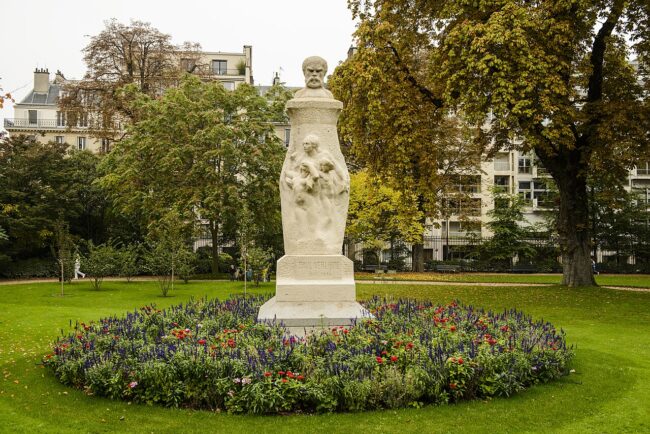
Sculpture of Paul Verlaine in the Jardin du Luxembourg. Photo: Son of Groucho/ Wikimedia commons
La lune blanche
Luit dans les bois;
De chaque branche
Part une voix
Sous la ramée…
Ô bien-aimée.
L’étang reflète,
Profond miroir,
La silhouette
Du saule noir
Où le vent pleure…
Rêvons, c’est l’heure.
Un vaste et tendre
Apaisement
Semble descendre
Du firmament
Que l’astre irise…
C’est l’heure exquise.
And so, with these exquisite words and images, a Happy Valentine’s Day from Paris and her poets.
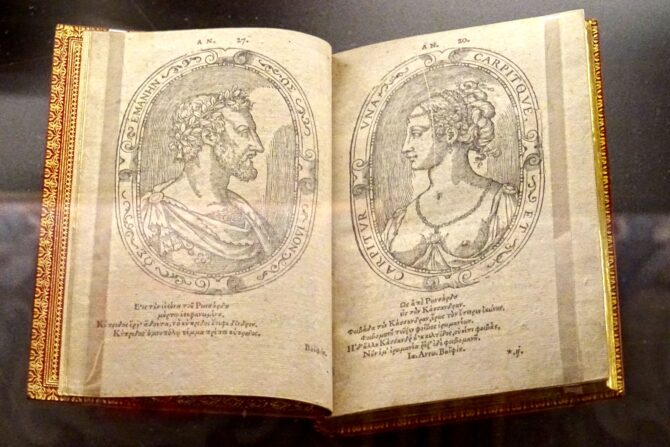
Lead photo credit : Extract from Pierre de Ronsard's "Les Amours... nouvellement augmentées par lui," 1553. Bibliothèque Condé, Chantilly. Photo: Pierre Poschadel / Wikimedia commons
More in Jean de la Fontaine, Love, poetry, Valentines Day
Related Articles


By Marian Jones
REPLY
REPLY