
The Essential Guide to the 4th Arrondissement

- SUBSCRIBE
- ALREADY SUBSCRIBED?
BECOME A BONJOUR PARIS MEMBER
Gain full access to our collection of over 5,000 articles and bring the City of Light into your life. Just 80 USD per year.
Find out why you should become a member here.
Sign in
Fill in your credentials below.
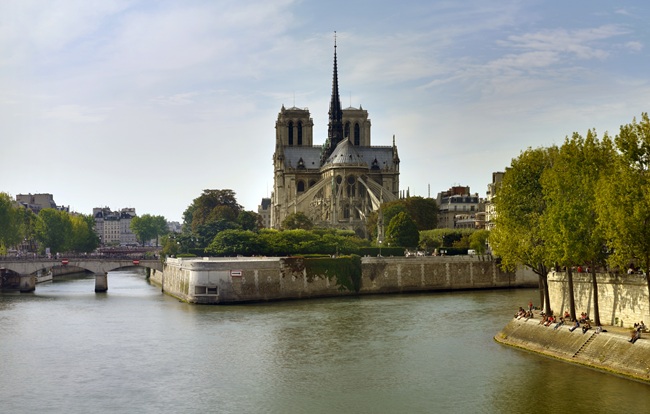
The 4th arrondissement broadly covers the lower Marais and the Îles de la Cité and Saint-Louis and packs a huge amount of history in a relatively small surface area. Notre Dame is in the 4th; there’s a clutch of museums and the Jewish Quarter. You’re surrounded by magnificent, 17th-century hôtels particuliers that have been restored and repurposed. It’s also full of cafés, bars and bistrots so you’ll never be far from refreshment, and it is a shopper’s paradise. Above all, the 4th is for strolling on foot – “flâneur–ing.” The best time to visit is a weekday morning when it is relatively quiet. At all costs try to avoid Saturday when it seems the whole of Paris has descended as well as thousands of weekend tourists.
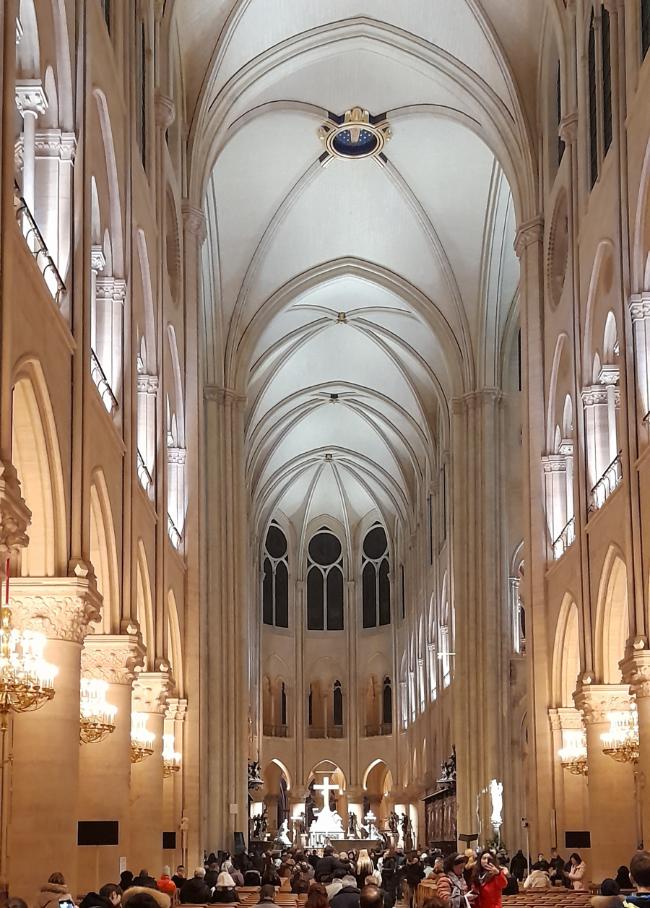
Notre Dame interior. Photo: Pat Hallam
Sights
Let’s start with the biggest must-see attraction of them all: Notre Dame. Like a phoenix, the cathedral did rise from the ashes of the 2019 fire and since reopening in December 2024 has welcomed visitors in even greater numbers than before. Be warned, therefore: if you rock up without a reservation, the entry line will be long, even in the depths of winter. Although it moves quite quickly, you are advised to book a timed slot in advance.
Either way, a visit is unmissable: the interior is bright now that the cleaned stonework is its original buttery hue, the repainted side chapels glow and on sunny days, the cleaned stained glass windows spill multi-colored patterns on the floor. New additions include a contemporary sculpture of the Crown of Thorns and a homage to the Paris firefighters who battled valiantly to save the cathedral, and the thousands of artisans who worked on its restoration. If you have memories of Notre Dame pre-fire, this will be a revelation.
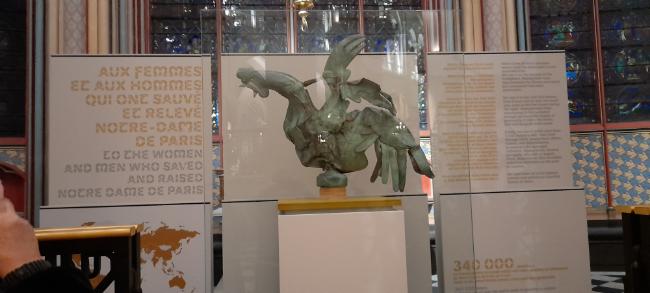
Notre Dame homage to the firefighters. Photo: Pat Hallam
Other perennial sights include the Conciergerie, originally a royal palace dating back to the 10th century but better known as Marie-Antoinette’s last prison before her execution (you can see a reproduction of her cell), and the Sainte-Chapelle, another vestige of the Palais de la Cité, built by (Saint) Louis IX and a glory of medieval stained glass.
Over on the Île Saint-Louis, the elegant, 17th-century houses were once home to the cream of Paris society. Even now, it is an enclave of “old money.” Every other building seems to bear a plaque commemorating someone who once lived there. Take your pick from Marie Curie, sculptor Camille Claudel, Charles Baudelaire and numerous others.
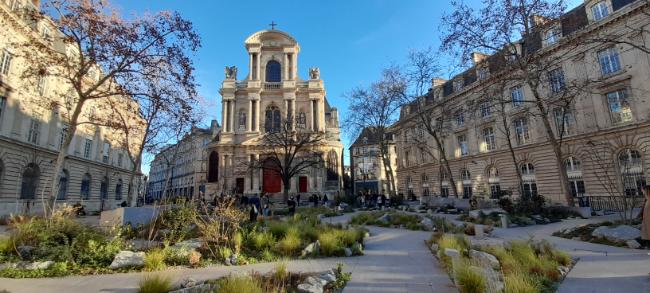
Eglise St Gervais and 13th November 2015 Memorial Garden. Photo: Pat Hallam
Crossing the Pont Louis-Philippe to the Right Bank, you enter a quartier of remembrance. In front of the Église St Gervais is a memorial garden dedicated to the victims of the terrorist attacks of 13th November 2015. Granite blocks commemorate each location of an attack, engraved with the names of the victims who died there.
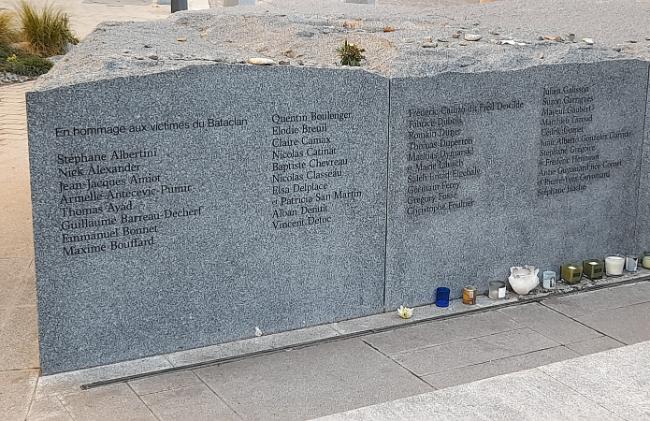
Memorial to the victims of the Bataclan attack 13th November 2015. Photo: Pat Hallam
Then, in the Rue Geoffrey l’Asnier is the Memorial to the Shoah, a museum, exhibition space and research center devoted to the Holocaust in France. It is an extremely moving place whose exhibitions extend to other instances of genocide and ethnic cleansing in modern history. It should be visited alongside the Mémorial des Martyrs de la Déportation on the tip of the Île de la Cité.
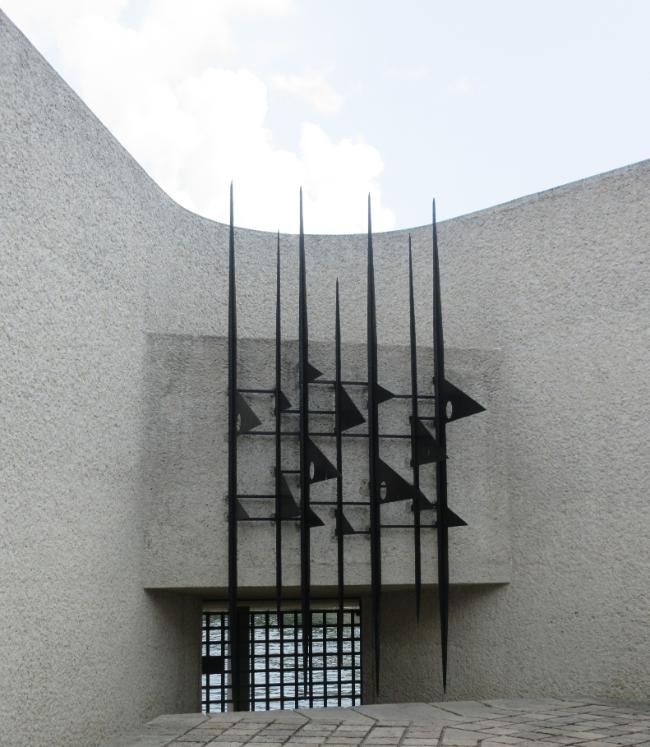


Away from the river, the treasures of the lower Marais continue to reveal themselves. Two old houses stand at nos. 11 and 13 Rue François Miron. They were thought to be medieval but they may only date from the 17th century and were extensively restored in the 1960s when the half-timbering was uncovered. The ground floor of no. 13 has a racy history of being a sex club. The Rue Cloche-Perce alongside is undoubtedly medieval. Further up, the Maison d’Ourscamps, or Paris Historique, the organization responsible for protecting Paris’s built heritage, hides a genuine medieval fragment: an 800-year-old cellar. Volunteers will give a guided tour for 5€ that goes towards the cost of its restoration.
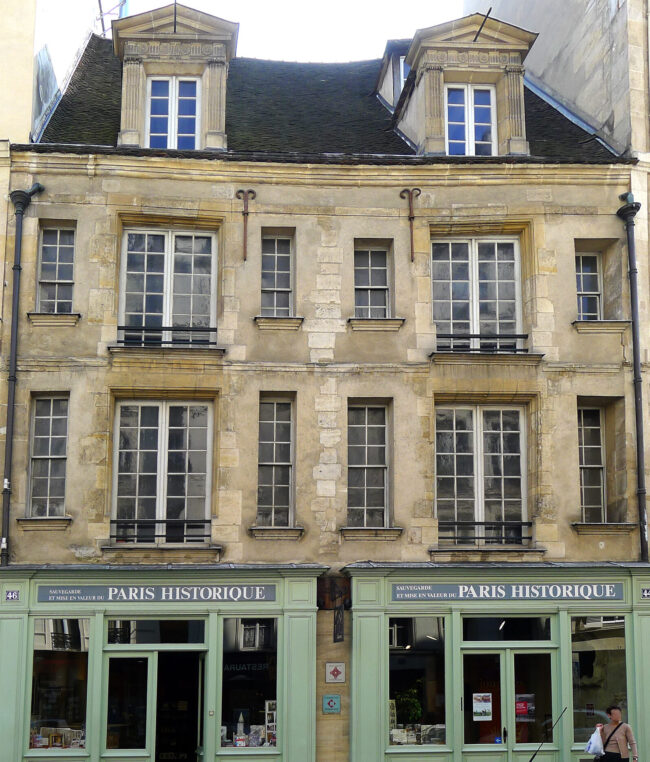
Maison d’Ourscamps on rue François-Miron. Photo: Mbzt / Wikimedia commons
Walking eastwards you come to the Hôtel de Sens, the former Paris home of the Archbishops of Sens. It now houses the city’s main fine art library, the Bibliothèque Forney, and holds regular exhibitions. The garden at the rear is a quiet, sunny place to rest.
At this point you can continue along the quai to the Hôtel de Ville. Guided tours are available and it stages a continual program of exhibitions, so you can get a glimpse of the interior.
Or, you can walk away from the river to the Village Saint Paul, now noted for its pleasant labyrinth of independent boutiques, but once one of the most insalubrious neighborhoods in Paris. A wall exhibits photographs and plans of the village as it was, and its 1970s’ restoration when it narrowly escaped complete demolition.
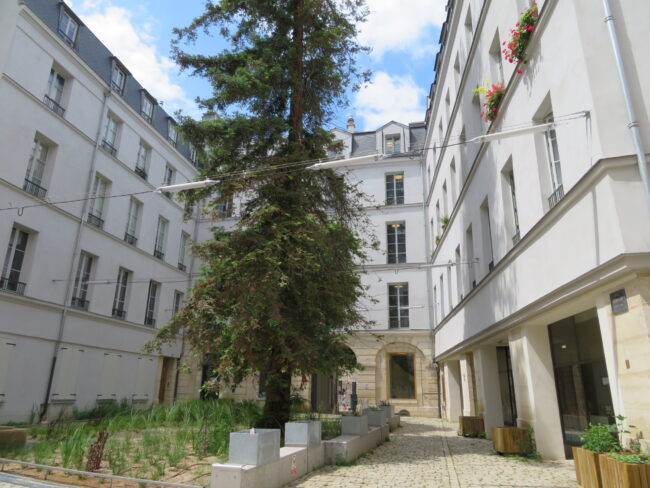
The Cours Rabelais in the Village Saint Paul in 2021. Photo credit: VVVCFFrance / Wikimedia commons
Opposite the Village and beside Rue Charlemagne is the longest extant section of the Philippe Auguste Wall. It was built between around 1190-1215 to protect Paris from invasion while the king went on Crusade and this is the largest segment still standing.
The 17th-century Église Saint Louis et Saint Paul is worth a look, and crossing over the Rue Saint Antoine you enter the Hôtel Sully, dating from 1625-1634, the start of the Marais’ most fashionable era. The courtyard is a peaceful haven to sit for a few minutes, before leaving by the rear exit into …
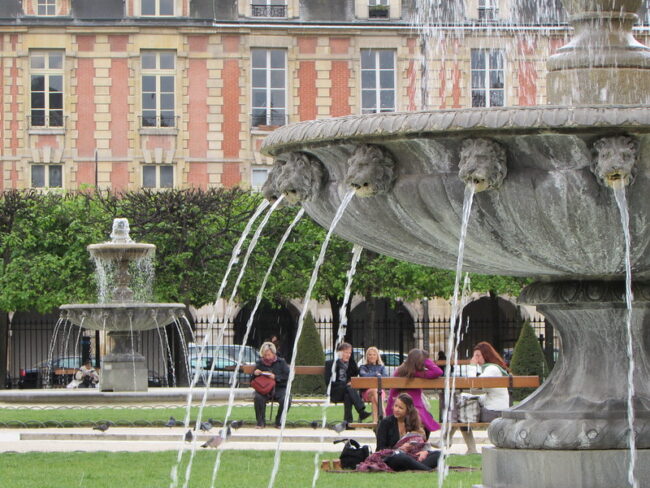
Place des Vosges. Photo credit: Marko Maras/ Flickr
The Place des Vosges, arguably the most beautiful square in Paris. Conceived by Henri IV but completed by his son Louis XIII, this perfectly symmetrical square with its colonnaded arcades has always been a desirable place to live. Nowadays people throng the lawns as well as the benches on a fine day, browse the art galleries that line the arcades, or lunch at the several renowned cafés and restaurants.
Leaving the Place, the Rue des Francs-Bourgeois plunges us into the heart of the Lower Marais. The area is now dominated by international shop chains, much to the dissatisfaction of local residents, but architecturally, fragments of the past linger. Note the corbelled tower on the corner of Rue Payenne. Several streets still sport their original stone-carved street names and their pre-1860 arrondissement. One of the earliest hôtels particuliers is the Hôtel Lamoignan which now houses the Bibliothèque de Paris, with an original square turret overhanging the corner of Rue Pavee. The Rue Pavée leads to what is left of the Jewish quarter, known as the Pletzel. Several bakeries still exist and a couple of bookshops; the synagogue at the end of Rue Pavée still conducts services. Grab some lunch and sit in the Jardin Joseph-Migneret, a hidden garden with an extremely moving memorial to the youngest children who were deported and perished.
Or walk to the Jardin du Clos des Blancs Manteaux – another quiet spot hidden from the street which has been laid out like a medieval physic garden.
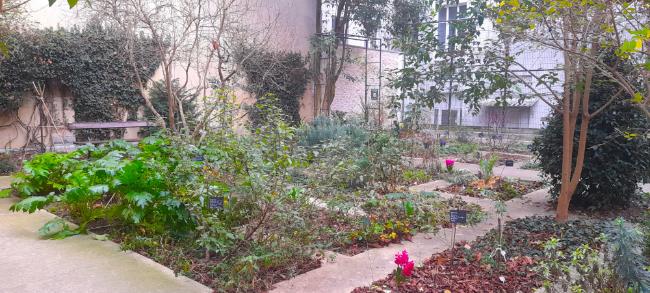
Jardin du Clos des Blancs Manteaux. Photo: Pat Hallam
Museums
The 4th arrondissement is home to a number of museums. Let’s start with the Maison de Victor Hugo at No.6 Place des Vosges. It was the great writer’s home between 1832-1848 and it has been redecorated and refurnished as accurately as possible. The rooms also trace the different periods of Hugo’s life from his early years in Paris, to exile on Guernsey, and back to Paris after 1870. And it’s free to enter.
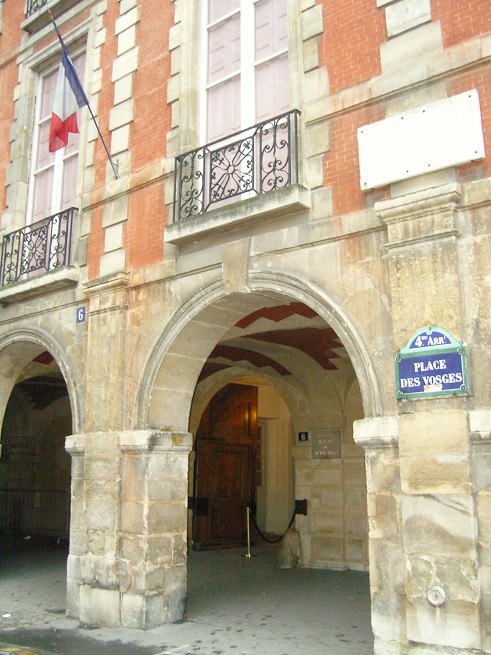
Maison de Victor Hugo, Photo: fredpanassac/ Wikimedia commons
After visiting Notre Dame, head for the Crypte Archéologique de Notre Dame, a museum under the Parvis which houses the earliest built remains of Paris, excavated in the late 1960s. You’ll see vestiges of the Roman port and public baths of Lutetia and the 4th-century city wall, and the medieval streets that crowded what is now the Parvis.
The Maison Européene de la Photographie, also known as MEP, houses a large collection covering the history of international photography from the 1950s to the present day.
View this post on Instagram
You probably wouldn’t think of visiting the Polish Library on the Île Saint-Louis, but in fact it houses not one but three small museums dedicated to notable Poles, including Chopin, reflecting the close historical ties between France and Poland.
And finally, only in France – a museum dedicated to all things cheesy (the dairy product). The Musée du Fromage is possibly unique. As well as tracing the history and heritage of cheesemaking in France, there is an onsite dairy and traditional crèmerie and fromagerie shops.
Eating and Drinking
There is no shortage of places for either in the 4th arrondissement. Below is a small selection but on almost every street corner you will find a café or bistrot.
For excellent hot chocolate head to Carette in the Place des Vosges, while the Café Hugo on the corner of the Place is popular with locals as well as tourists. Coffee connoisseurs might prefer Le Peloton or La Caféotheque. The latter was a pioneer “third wave” coffee shop, opening in 2005, while Le Peloton (as you might tell from the name) combines coffee with bike hire and guided bicycle tours around Paris.
View this post on Instagram
Street food is easy to find in the arrondissement. The Rue des Rosiers is famed for its Jewish bakeries and falafel cafés. You can’t miss the bright yellow façade of Sacha Finkelstein, a family-run bakery since 1946, and with Korçarz and Florence Kahn, all three sell traditional channah bread, bagels, strudels and poppyseed cake. As for felafels, skip the line at L’As du Falafel and go to King Falafel a few doors down. Just be aware that several places around here do observe the Sabbath and are not open on Saturdays.
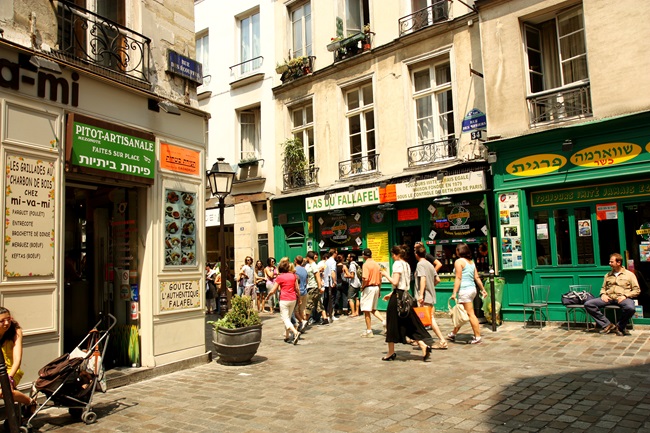
L’As du Falafel, Rue des Rosiers in the Marais , Photo: A S/Flickr
On the western edge of the 4th, Rue Rambuteau has become a bit of a gourmet haven. Homer Lobster reputedly sells the best lobster rolls in Paris. Janet by Homer a few doors down is a kosher deli under the same umbrella. Other places to visit include François Pralus, a bakery specializing in praline and choc chip brioche loaves, Manteigaria and its pastels de nata, and a branch of the artisanal boulangerie The French Bastards.
On the other side of the arrondissement, the boulangerie Au Petit Versailles in the Rue François Miron has the most amazing original ceiling as well as decent bread, viennoiseries and sandwiches. Then indulge yourself with a meringue and whipped cream confection at Aux Merveilleux de Fred on the corner of Rue du Pont Louis-Philippe.
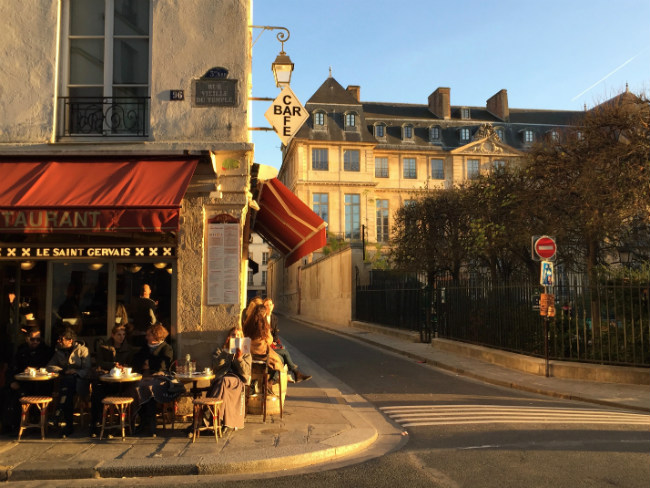
The rue Vieille-du-Temple and the Picasso Museum. Photo: Kasia Dietz
If you are looking for a restaurant, Chez Hanna in the Rue des Rosiers offers inexpensive, Levantine cuisine in cheerful, bustling surroundings. A bit further on, Miznon in Rue des Écouffes has carved out a name for its whole roasted cauliflower and boeuf bourguignon in pitta bread, but it also does a good range of vegetarian/vegan dishes. It’s a place for lunch rather than dinner.
If you want traditional French cuisine there is plenty of choice as well, Au Fer du Cheval in Rue Vieille du Temple is a stalwart of the Marais, offering delicious home-made classics such as steak, confit de canard, andouillette (for the adventurous), and tarte tatin. It’s very small so be sure to book ahead. Further up the street, Le Colimaçon is another popular traditional bistrot.
For a view over the Place des Vosges, Ma Bourgogne is the place to go for traditional Burgundian cuisine, including blanquette de veau, calves’ liver in mustard sauce and boeuf bourguignon. Finish with a choice from a selection of traditional French desserts.
View this post on Instagram
Or, for somewhere quieter, it’s hard to beat Chez Janou, on the corner of Rue des Tourelles and Rue Roger Verlomme. In winter it’s cozy with its walls gaily decorated with posters advertising holiday destinations in Provence while in warmer weather, the terrasse overlooking the tiny tree-planted square will make you almost think you’ve been transplanted to a Provençal village. The very reasonably-priced menu continues the theme with a focus on fish and seafood à la provençale.
If you want an apéritif or cocktail one of the hottest spots is Griffon on Rue des Francs Bourgeois. Hidden from the street, it has a lovely shady terrace for summer as well as a cosy lounge furnished with books and vintage deco.
La Belle Hortense, across the road and sister establishment to Au Fer du Cheval, is another book-lined wine bar where you can browse the shelves or take in a photographic exhibition whilst sipping a glass of organic Chablis.
Speakeasies are still popular in Paris and one of the most opulent is 1905 in Rue Beautreillis. From the street it is a normal wine bar – the Vins des Pyrenées, perfectly nice itself – but climb the stairs behind the side door and upstairs is a lounge with damask and velvet chairs and chaises-longues and a covered outdoor terrace. An atmosphere evocative of the Jazz Age.
Even more hidden from view is 404 Not Found within the German-French restaurant Prost, Boulevard Beaumarchais. There is a conventional bar on the ground floor but climb the stairs and beside a drinks fridge is a discreet door leading to more stairs and 404. As the name suggests, the bar plays with the digital world and computer coding with cocktails named Blue Screen of Death and ALT+CTL+DEL.
Of course, towards the end of the 20th century the Marais, including the 4th arrondissement, became the heart of Paris’s LGBTQ scene. For clubs and bars specifically aimed at the community, check a website such as www.parislgbt.com/category/bars/
View this post on Instagram
Shopping
The 4th arrondissement – like all of the Marais – is a shopper’s paradise. Beyond the international designer chains are dozens of independent boutiques where you can find some beautiful and unusual souvenirs.
The area around Rue du Pont Louis-Philippe and Village Saint Paul is full of shops like these. Check out Kimonoya, No.11 Rue du Pont Louis-Philippe for everything Japanese: teasets, chopsticks, calligraphy equipment and the eponymous kimonos. Across the road at No.10 (Mélodies Graphiques) and further up at No.20 (Maison Boursier) are specialists in writing materials: pens, notebooks, pretty wrapping paper, even repro 18th-century cutout models and model theaters.
La Mouette Rieuse, 17b Rue Pavée, stocks notebooks, posters, gifts and a wide range of books on Paris, as well as an English section towards the back. There is a pretty café on the rear terrace. Next door, Altermundi is a chain specializing in sustainable homewares, clothing and toiletries.
View this post on Instagram
Jewelry shops abound. Gavilane on Rue Malher specializes in bold statement jewelry. Fabien Ajzenberg at 11 Rue Rambuteau is a Paris-based artisan jeweler, but to be honest the whole arrondissement has several handmade jewelers selling at reasonable prices.
Loveramics at No.30 Rue des Blancs Manteaux sells colorful stoneware and quirky pots, while Johanna Braitbart at No. 26 creates amazing feather confections in her on-site workshop.
Just north of the Place des Vosges, the Rue du Pas de la Mule is an ancient street full of quirky little shops. Chocolatière Joséphine Vannier creates wonderful chocolate sculptures: shoes, perfume bottles, violins and pianos – too beautiful to eat. Bohemia at No.5 sells an eclectic selection of colored and engraved glassware, porcelain and table lamps with shades made from historical paintings. And if you want a classic, last-for-a-lifetime knife, Laguiole is your shop at No.6. As well as its own brand, it sells top-notch Japanese kitchen knives and that French picnic staple, the folding Opinel knife.
These lists barely scratch the surface of what you can find in the 4th arrondissement. Steeped in history, thriving in the 21st century, but like most Parisian neighborhoods, it’s easy to escape the swarming tourists if you explore the narrow side streets and take your time to wander.
Lead photo credit : Notre Dame. Photo: Yves Tennevin - Flickr/ Wikimedia Commons
Related Articles

By Pat Hallam
REPLY