
From Les Halles to Rungis: The World’s Largest Fresh Produce Market

- SUBSCRIBE
- ALREADY SUBSCRIBED?
BECOME A BONJOUR PARIS MEMBER
Gain full access to our collection of over 5,000 articles and bring the City of Light into your life. Just 80 USD per year.
Find out why you should become a member here.
Sign in
Fill in your credentials below.
Then
On both sides of the street stood gigantic pavilions, whose overlaying roofs seemed to grow, expand, disappear into a haze of light . . . conjured up images of a series of enormous, perfectly aligned palaces . . . their facades ablaze with a thousand rays of flame . . . Between the slender edges of the pillars, these thin yellow bars formed ladders of light, rising to the dark line of the lowest roofs, then climbing to the top of the upper ones. Beneath the yellow gaslight, within the great openwork frames of immense halls, lay a jumble of gray, faded, and dormant forms.
Extract from Emile Zola’s novel, Le Ventre de Paris/The Belly of Paris
When Zola wrote Le Ventre de Paris in 1873, Les Halles (literal translation, the market halls), the glass and iron structure he describes, was only a couple of decades old, though there had already been various other markets in the vicinity during the preceding centuries.
By 1969 only one of the original pavilions remained, and the Council of Paris ordered its demolition and the subsequent relocation of the entire market operation to Rungis in the Paris suburbs, quite close to Orly Airport. Since that time it has expanded to become the largest wholesale market for fresh produce in the world.
The new precincts are a far cry from the classic landmark in Zola’s book, but the move has indisputably turned out to be a good thing. Just imagine a Paris where multi-ton freight trucks stream into the 2nd arrondissement, unload their cargo, and then depart in the opposite direction 25,000 times a day at all hours, six days a week.
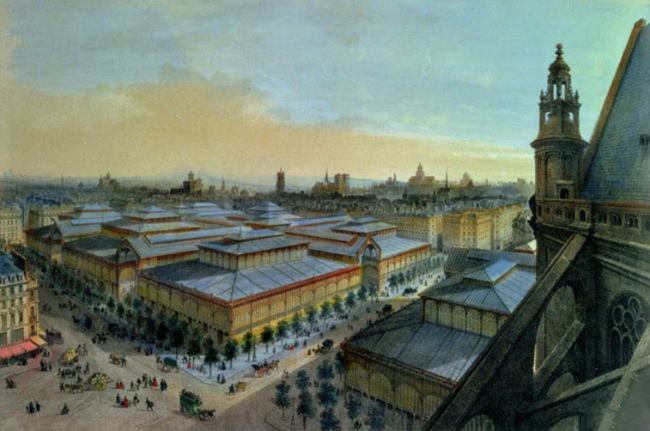
View of Les Halles from Saint-Eustache in 1870. Painting by Felix Benoist. Public Domain
Now
The taxi pulled up outside my door at 5:15 am on the dot, well before sunrise. Downstairs, my friend Rafael was waiting. I thought he’d be the ideal travel companion to explore the Marché International de Rungis, since he’s both a microbiologist and a former chef.
The roads to Rungis were not as empty as I’d assumed they would be at that hour, but we still arrived well in advance of our 6 am appointment with Adeline, the market’s liaison officer for media relations. I had opted out of meeting her at 5 am, which meant we missed seeing the seafood pavilion, but that still left more than enough time to get a good overview of the rest of the facilities.
In order to enter the main precincts of the market, you need a pass, and she had sent me one in advance. It turned out our driver also had a pass and, once through the gates had no difficulty zeroing in on our meeting point at one of the five Meat pavilions.
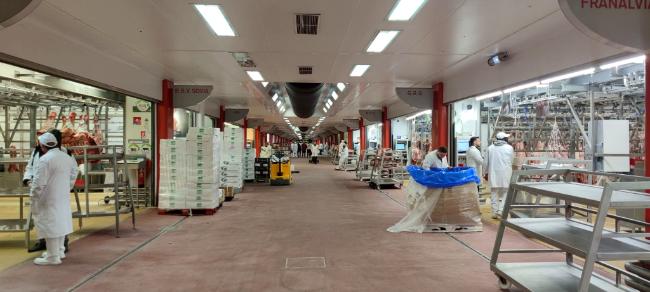
Meat pavilion at Rungis. Photo: Rafael Martins
Almost the first thing Adeline told us after she arrived was that the Rungis market was larger in area than the Principality of Monaco. (Of course I later fact checked, and it’s true: Rungis is 234 hectares/0.90 sq mi; Monaco is 202 hectares/0.78 sq mi). Before entering the pavilion, we were handed white coverall jackets made of some recyclable material and wore them throughout the remainder of our visit for reasons of hygiene. Rafael later remarked how struck he was by the level of sanitation and cleanliness everywhere.
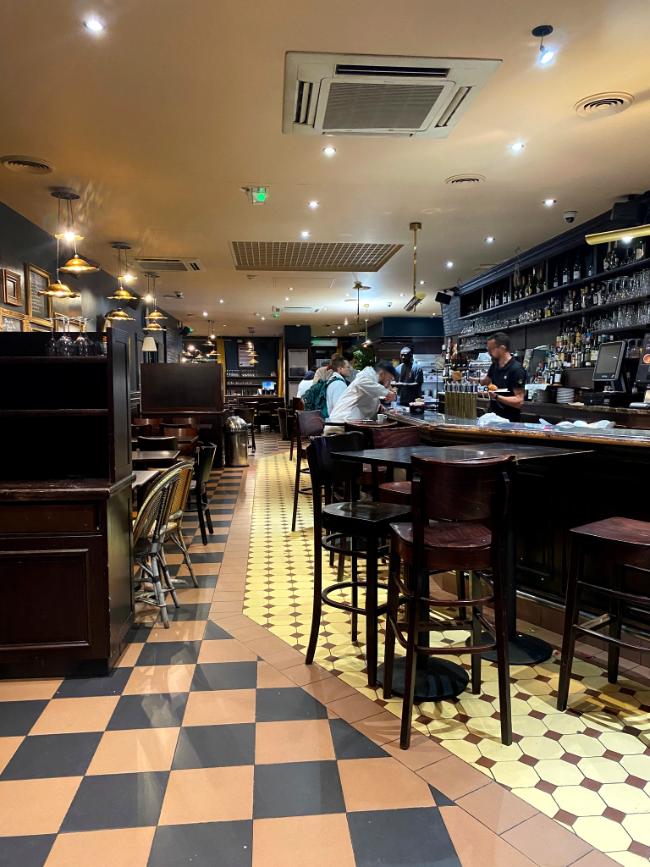
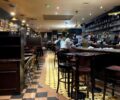
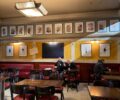
Once inside, I tried not to focus on the beef carcasses dangling on either side of the center aisle, and later declined the opportunity to visit the Poultry + Game and the Tripe pavilions. One pleasant surprise was spotting a door marked l’Aloyau, which led into the kind of traditional restaurant you might find anywhere in mid-to-northern France. A number of workers were eating and drinking at the wooden bar and Rafael noticed one was devouring a steak tartare.
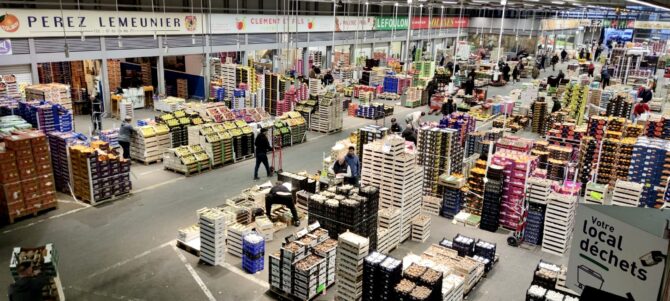
It was barely 6:45 am when we left the pavilion and in the sky, a rosy dawn was breaking. We headed out to our next destination (in Adeline’s car, of course) to the Carreau des Producteurs, a LARGE warehouse where fruits and vegetables are sold directly by their producers to retail merchants.
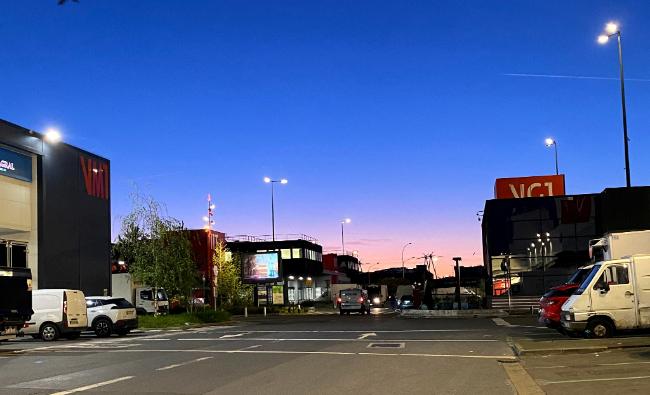
A rosy dawn at Rungis. Photo: Joy Anderson
A pavilion tour
Over the course of the morning we made six more stops. We got to wander around one of the nine spacious Fruit and Vegetable pavilions. A bit later we dropped by the dedicated Organic Food pavilion, which was initially disappointing since it was so much smaller than I’d expected, but Adeline pointed out that organic produce is widely available throughout the other pavilions.
To reach the Dairy and Gastronomy sector, we drove along the avenue de la Gastronomie, and Gastronomy was where we started. The pavilions there cater to high-end épiceries fines and caterers. The shelves and fridges were stocked with foie gras, caviar, exotic condiments, and similar luxury indulgences — exactly what one would expect to find. In Paris, G. Detou is a well-known purveyor of these products and has two adjacent shops widely frequented by food professionals (as well as yours truly).
I really wanted to learn about the availability of sweets at Rungis so, at my insistence, we stopped at Dupleix, the newest building in the market, opened in February 2026. Designed by architect Christian de Portzamparc in the shape of an inverted pyramid, it was definitely the most architecturally noteworthy building we saw that day. Inside, however, it was a bit of a letdown. Although we spotted a fair number of elegant chocolate boxes and decorative biscuit tins, it felt as though the majority of the merchandise consisted of the kind of candies that kids favor: gummies, lollipops, and the like. According to their catalogue, all the bestsellers are in this category.
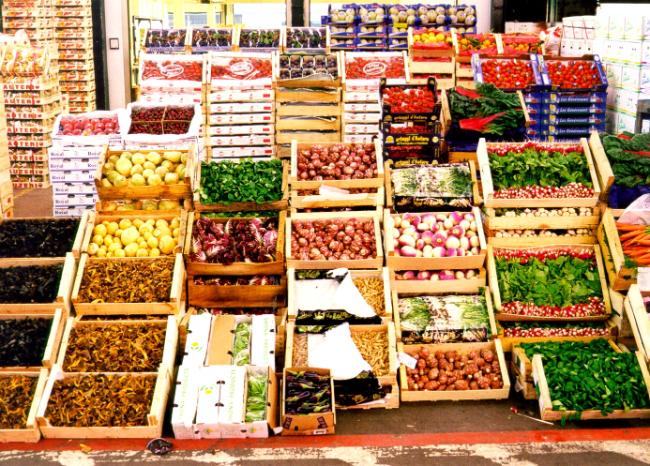
Fruit & vegetable pavilion at Rungis market. Photo credit: Nick Saltmarsh/ Wikimedia commons
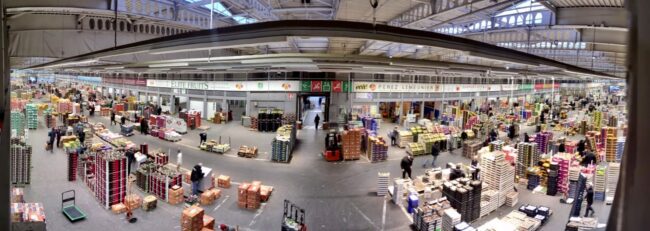
Carreau des Producteurs at Rungis. Photo: Rafael Martins
Flowers everywhere
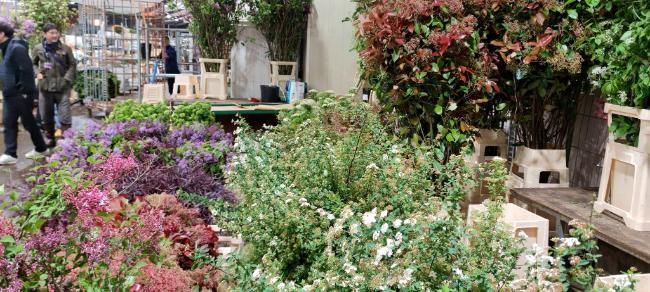
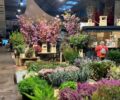
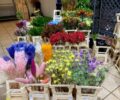
The Horticulture and Decoration pavilions provided a refreshing change of scenery. Everywhere we looked there were flowers — cut, dried, growing in pots, and hanging overhead — along with many varieties of outdoor plants, live trees, and shrubs. The lanes through the market had names like Allée des Glaïeuls (gladiolas), Allée des Oeillets (carnations) and Allée des Orchidées (orchids). There were stalls with gardeners’ tools and others with decorative goods for florists and party planners. I did wonder what happened to those cut flowers at the end of the morning and was reassured to hear that the few bunches that remained were recycled as biomass.
We could smell the cheese the moment we got out of the car before even entering the Cheese pavilion. It was odd because, once inside, the odor vanished and we were confronted primarily with massive wheels and cartons of cheeses stacked on wooden pallets, all very well sealed. A substantial majority were French (apparently 95%).
Further on we came upon a small table where a guy in an apron was slicing bits of hard Italian sheep’s milk cheese to sample. It was our first and only tasting of the day and of course every bite was delicious. As part of what I suspect was his standard spiel, he told us, “French cheese is full of character; Italian cheese reveals the dish.” I thought that was a pretty fair assessment, which is probably why I remember it.
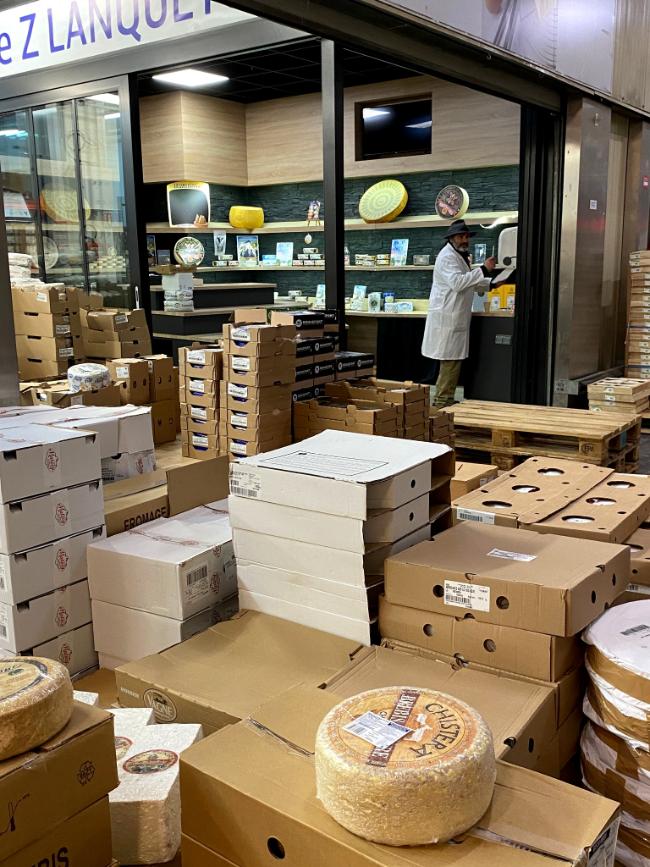
Cheese pavilion at Rungis. Photo: Joy Anderson
Refuel at Chef Nicolas Sale’s restaurants
The Cheese pavilion was the last stop on our official itinerary, but since we were all a bit hungry and thirsty, where better to go than A la Source, a still-in-progress trio of restaurants from Nicolas Sale, the former Michelin-starred chef at the Ritz Paris? So far only Au Coeur du Marché, the cantine conviviale, has opened. The two yet to come will comprise a small gastronomic restaurant, discretely tucked out of sight and, at the other end of the scale, a food truck housed in a recycled shipping container. The menu trends light and healthy, reflected in our breakfast slices of not-too-rich chocolate and lemon cakes. I also enjoyed the détox du jour, an original concoction of apple, pear, asparagus and ginger juices.
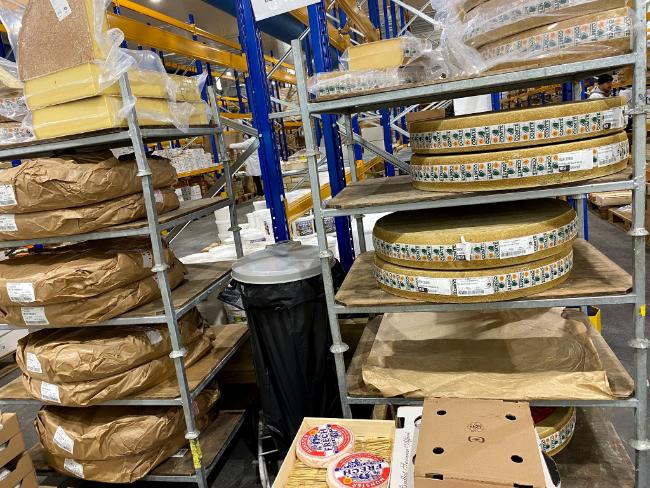
Cheese pavilion at Rungis. Photo: Joy Anderson
When breakfast was over Adeline obligingly drove us the short distance from the market’s gates to Métro Chevilly-Larue, where we caught a train on line 14 and were soon back in central Paris.
Both of us came away overwhelmed by the sheer size and diversity of the entire Rungis enterprise. I asked Rafael what his biggest takeaway was and he said he was moved by the thought of all those thousands of workers, toiling out of sight throughout the night while we slept, making it possible for us to consume whatever we fancied at any time we liked, with minor effort on our collective parts. Food for thought.
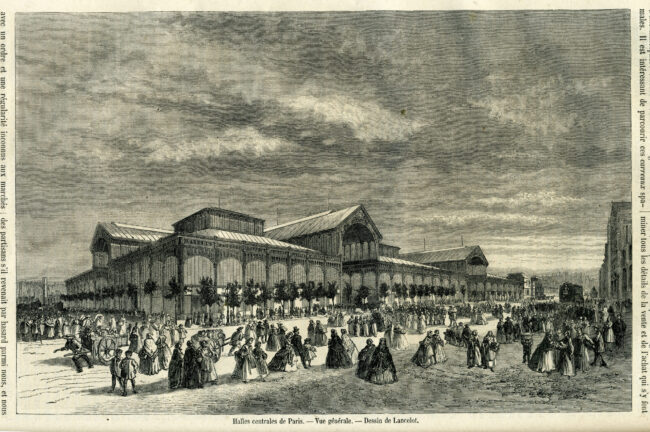
Les Halles de Paris. Dessin de Lancelot reproduit dans Magasin Pittoresque, t. XXX, janvier 1862. Public domain
More food for thought
“In the face of climate and geopolitical challenges, our agriculture is our greatest strategic asset. The future of France lies in its fields, its vines and its livestock farms. We are now building a market that is more supportive, more sustainable, and resolutely rooted in French agricultural roots.
“The Rungis Market makes the fight against food loss an absolute priority. In collaboration with reference partners such as ANDES – Le Potager de Marianne [located at Rungis], the market facilitates the recovery of unsold products to redistribute them to the most disadvantaged. This system makes it possible to recycle fresh products throughout the chain, transforming surpluses into a precious resource for food aid networks.”
From A unique ecosystem at the service of food sovereignty, February 2026 press release
A few fun facts
We learned that Rungis market is a city within a city. It includes a crèche, a post office, and a medical facility.
The market feeds 18 million people daily.
3 million tons of produce pass through it each year, including 60% of what is consumed in Ile-de-France.
61% of the products are of French origin.
On the human side, there are 25,000 buyers daily and 13,000 workers employed by more than 1,200 companies.
What visiting choices exist for the public?
Unless you or someone you know is an authorized buyer at Rungis, frankly, there are not too many options. If you are in that category, it is possible to purchase a Coffret Rungis Prestige/Rungis Prestige Box, where you’ll enlist the services of a professional guide to escort you around the market. Other food professionals, culinary students, and certain small business groups can book similar tours.
A partial workaround does exist. It turns out there are 21 restaurants at Rungis that welcome outside diners. Culinary categories include Traditional French, Gastronomic, Mediterranean, Seafood, Carnivorous, and a few wild cards. Each restaurant will send you an entry pass when you make your reservation and once inside you are obliged to park only in the white spaces. If you don’t see a straightforward way to reserve when looking on an individual establishment’s website, you can contact them by email and sometimes by phone.
Lead photo credit : Carreau des Producteurs at Rungis. Photo: Rafael Martins
More in Marché International de Rungis, Paris markets, Rungis
Related Articles


By Joy Anderson