
Matisse in his 70s: The Creativity of a ‘Second Life’
- SUBSCRIBE
- ALREADY SUBSCRIBED?
BECOME A BONJOUR PARIS MEMBER
Gain full access to our collection of over 5,000 articles and bring the City of Light into your life. Just 80 USD per year.
Find out why you should become a member here.
Sign in
Fill in your credentials below.
The ever-popular Henri Matisse draws crowds at any exhibition in Paris, elsewhere in France or abroad. That’s a given. Currently, there are two new ways to explore a little-known aspect of his life and work, namely the burst of creativity he enjoyed in his last decade, during and after World War II.
At the blockbuster exhibition, Matisse 1941-1954, showing at the Grand Palais until July 26th, you can see many examples of his work from this period. And the story of his life during and after the war is told in Christopher C Gorham’s book, Matisse at War, subtitled Art and Resistance in Nazi Occupied France, published in 2025.
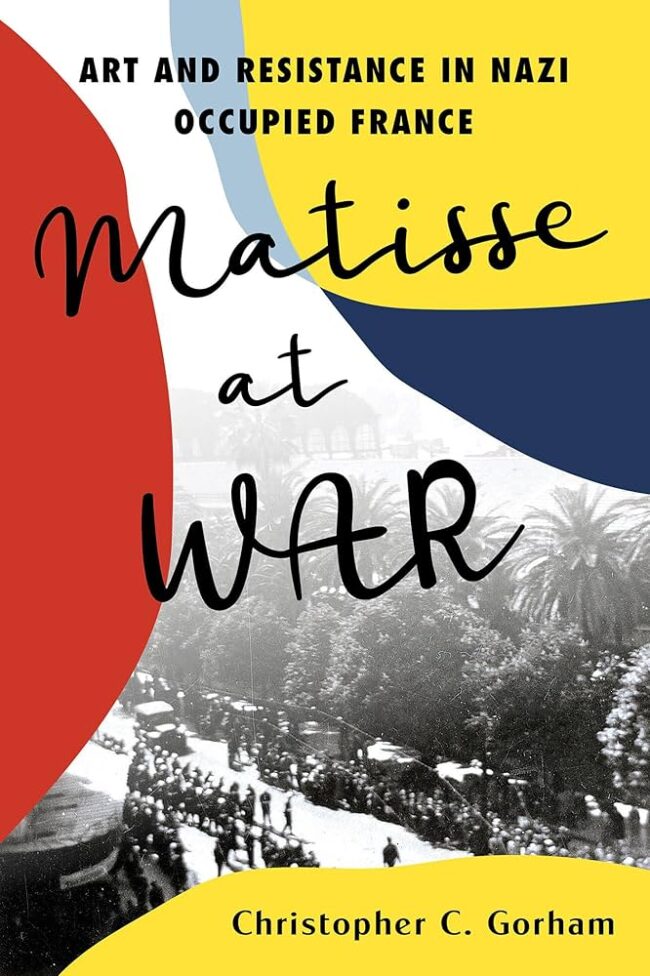
“Matisse at War” book jacket
Matisse was 70 when war broke out, left frail by surgery and declared a degenerate artist by the occupying forces. Many of his works were removed from galleries and hidden away, some were stolen by the Nazis. Both his estranged wife Amélie and his daughter Marguerite were arrested by the Gestapo, and his son Pierre left for New York, helping émigré artists to follow him, then organizing an exhibition of their work there.
Through it all, Matisse opted to stay in France, declaring that to leave would be “a betrayal’ and he lived mainly in Provence with his companion and muse Lydia Delectorskaya. Their story is told here by Marilyn Brouwer.
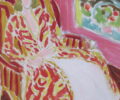
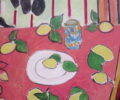
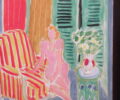
All of this makes the explosion of work he produced in his final decade especially striking. Despite everything, Matisse continued to work, extending his painting and drawing techniques and experimenting with gouache cut-outs, textile work and stained glass.
The color, light, and new forms of expression which sprang out of this period exude joy and hope, despite the darkness of what was happening around him. He said himself that he felt he simply had to grab the opportunities which had so nearly been snatched from him: “I had so completely prepared for my exit from life that it seems to me that I am in a second life.”
Matisse 1941-54 at the Grand Palais
This extensive exhibition comprises more than 300 works, many on loan from the Pompidou Centre and others from major international galleries, curated by Claudine Grammont to show the stunning variety of Matisse’s work from this period and to reveal insights into his way of working.
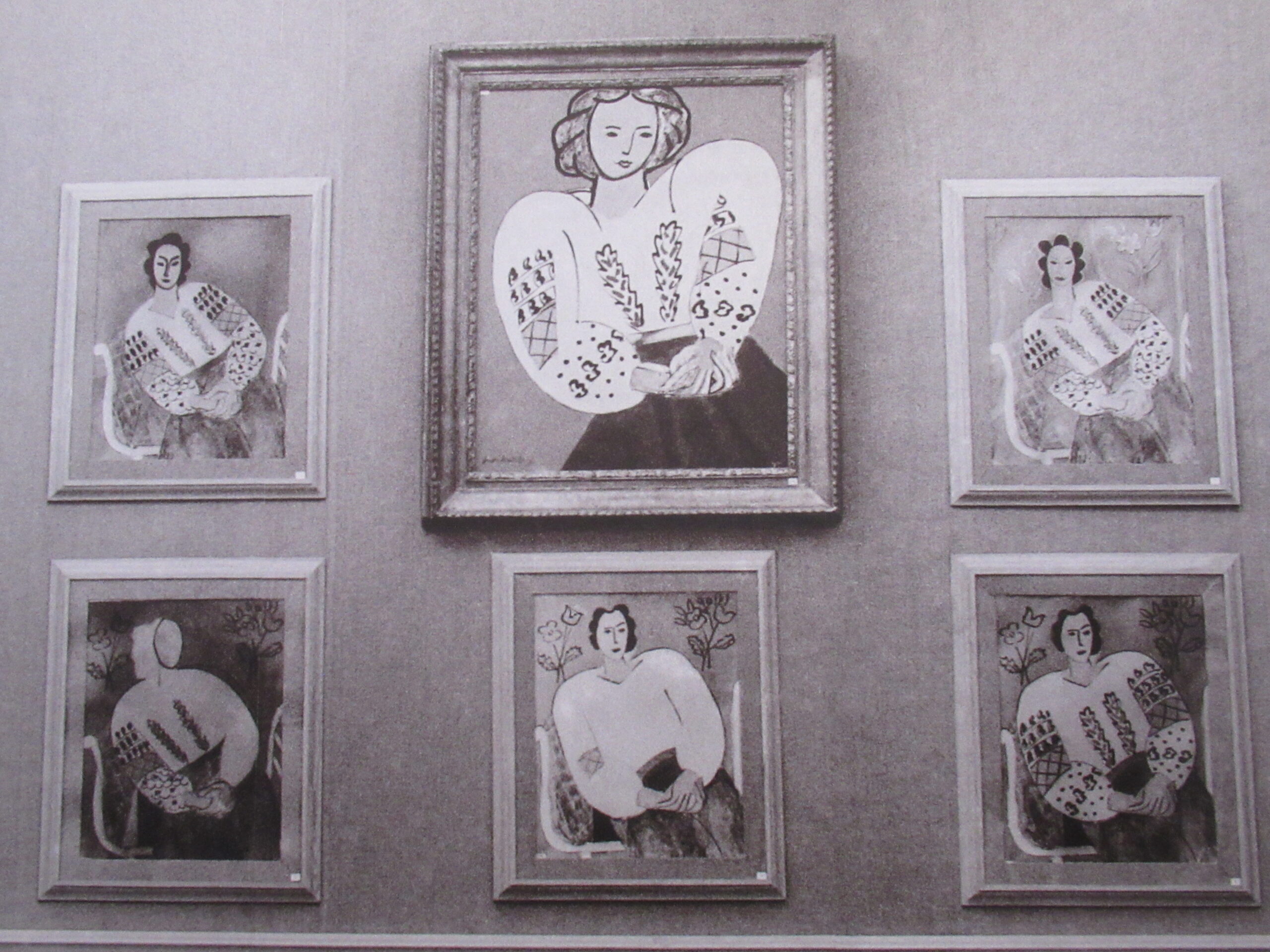
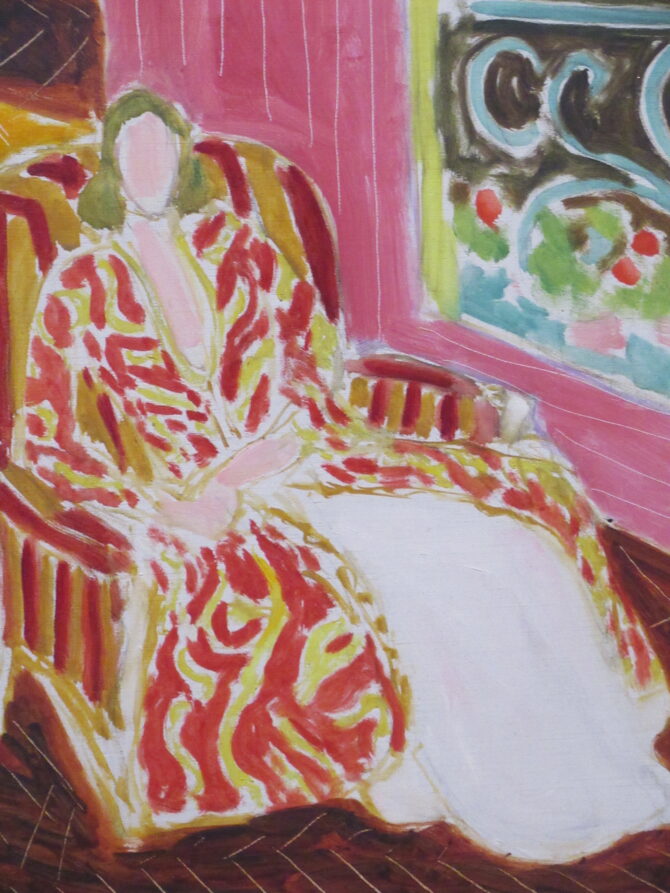
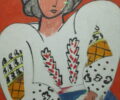
The Romanian Blouse, Matisse exhibit at the Grand Palais. Photo: Marian Jones
For example, it illustrates how his gouache cut-outs from the early 1940s inspired the ground-breaking prints of his book Jazz, published in 1947 and, later, the Blue Nudes series from the early 1950s. Another insight into his method of working comes in La Blouse romaine, where the final painting, The Romanian Blouse, is shown alongside 10 photographs taken at different stages in its creation.
Early in the exhibition are examples of Matisse’s interest in variation, in painting the same subject matter many times over, each in slightly different ways. For example, in 1941 he used a single motif, a girl sitting in an armchair in front of a window, to create a series of images with titles like “Girl in a white dress, black door” and “Young girl in pink in an interior.” A few years later he embarked on a similar project, depicting “Two young girls” in a series of seven paintings, varying the colors and light effects each time.
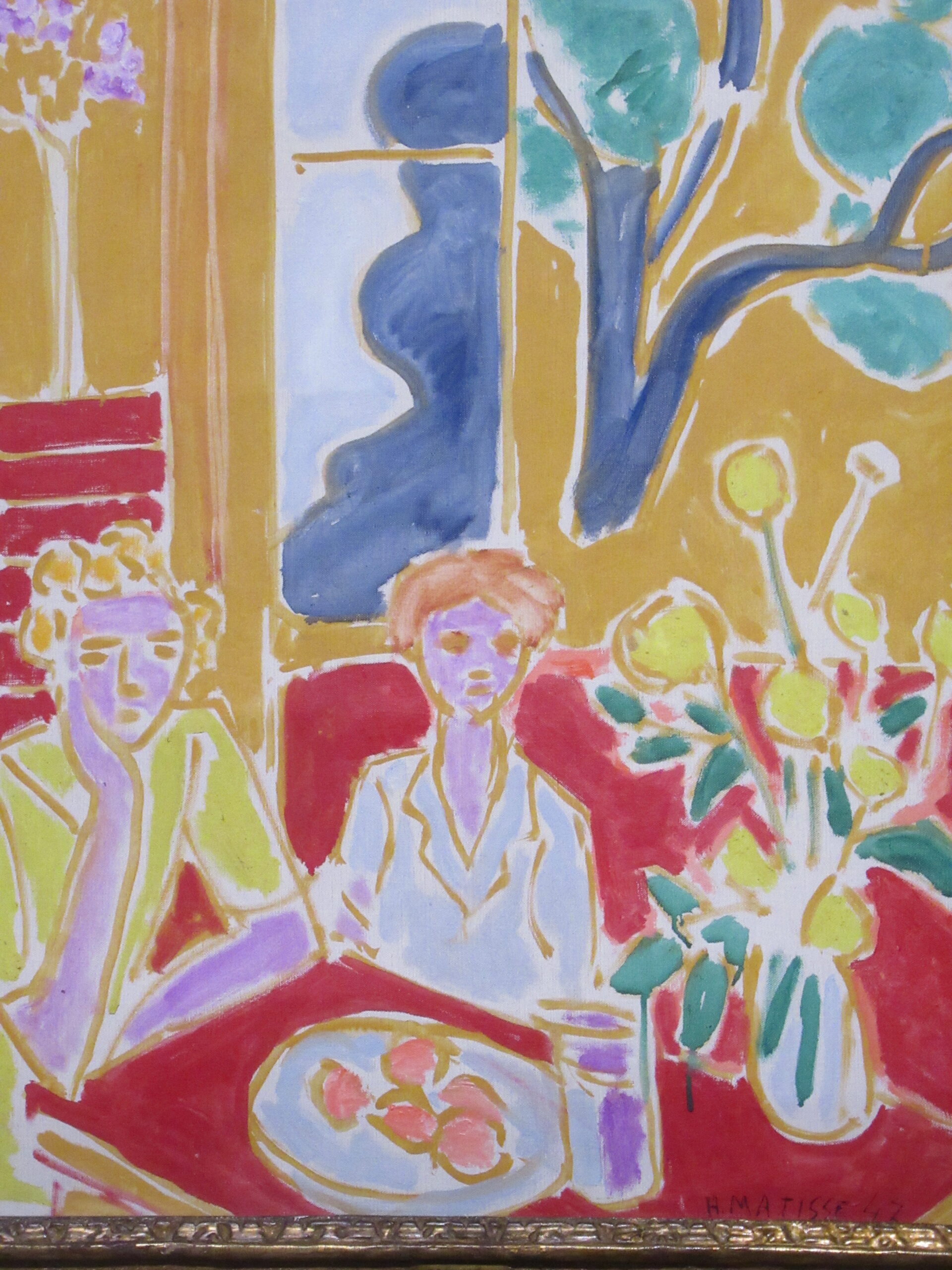
Two Young Girtls in a Red and Yellow Interior, Matisse exhibit at the Grand Palais. Photo: Marian Jones
Another aspect highlighted is his move towards minimalism, reducing everything down to what he called “a form filtered to its essentials.” He did not approach portrait painting conventionally, remarking that “If I wanted something that captured reality, I’d take a photograph.” His aim was rather to convey the essence of a person and some of the most striking images in the exhibition capture a face or a body in just a few lines, yet convey a heightened sense personality. Examples include his Head, three-quarter view from 1947, the sketches included in the “Faces” section of the exhibition and his Acrobat series.
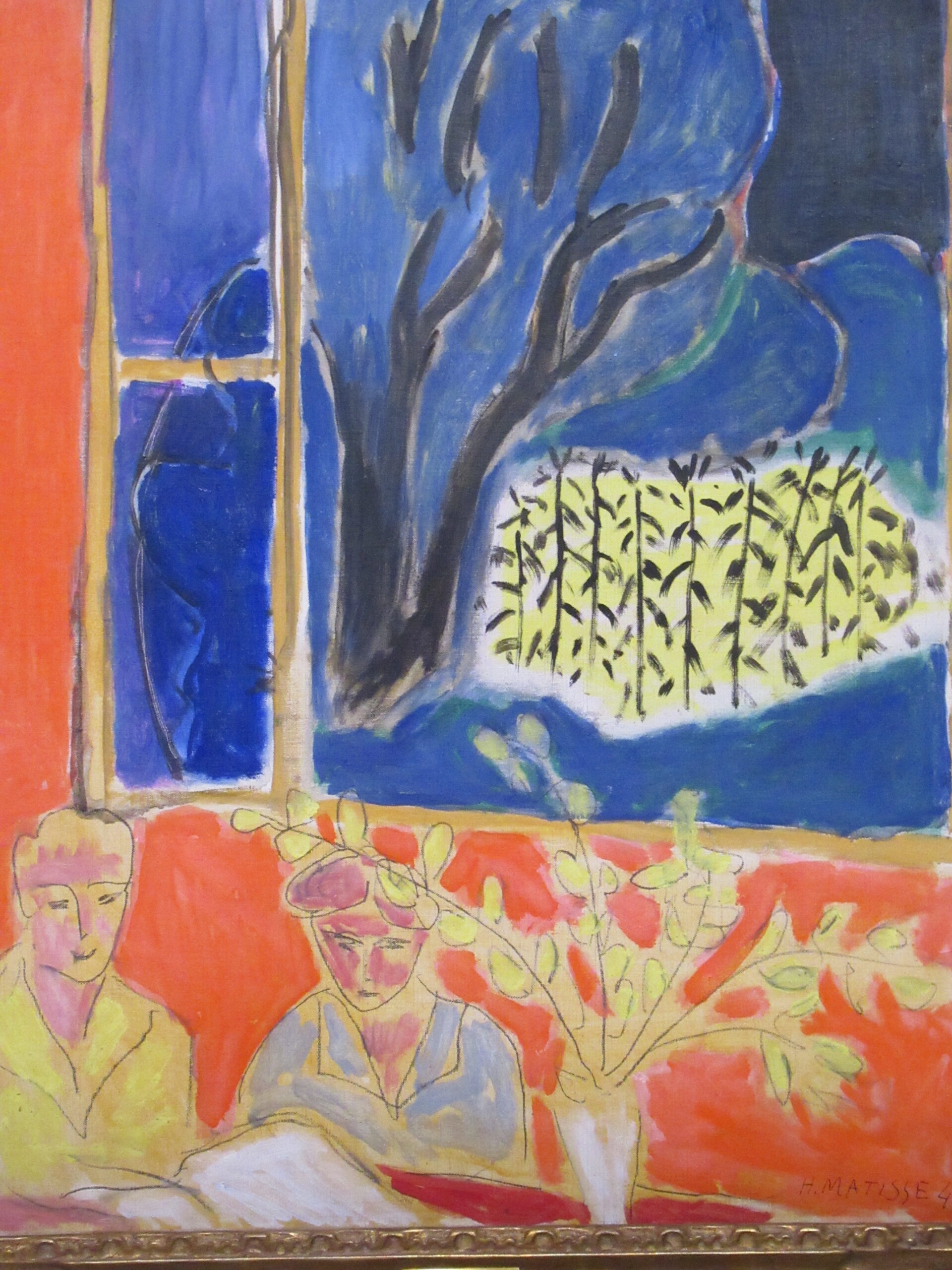
Two Young Girls in a Coral Interior, Blue Garden, Matisse exhibit at the Grand Palais. Photo: Marian Jones
It was in this period that Matisse discovered the joys of cut-outs, another way to experiment with basic shapes, yet with, as he put it, “greater completeness and abstraction.” There are many examples here, the most arresting being the models for his book, Jazz, where bold shapes in eye-popping colors represent the circus, folk tales and other images associated with childhood. They are displayed in a darkened room and backlit so that the bright colors – blue, red, yellow, purple – spring out. The images of elephants, Icarus in a shower of stars, dancing bodies and swirling abstract shapes certainly fulfill the brief, to create “a book on color.”
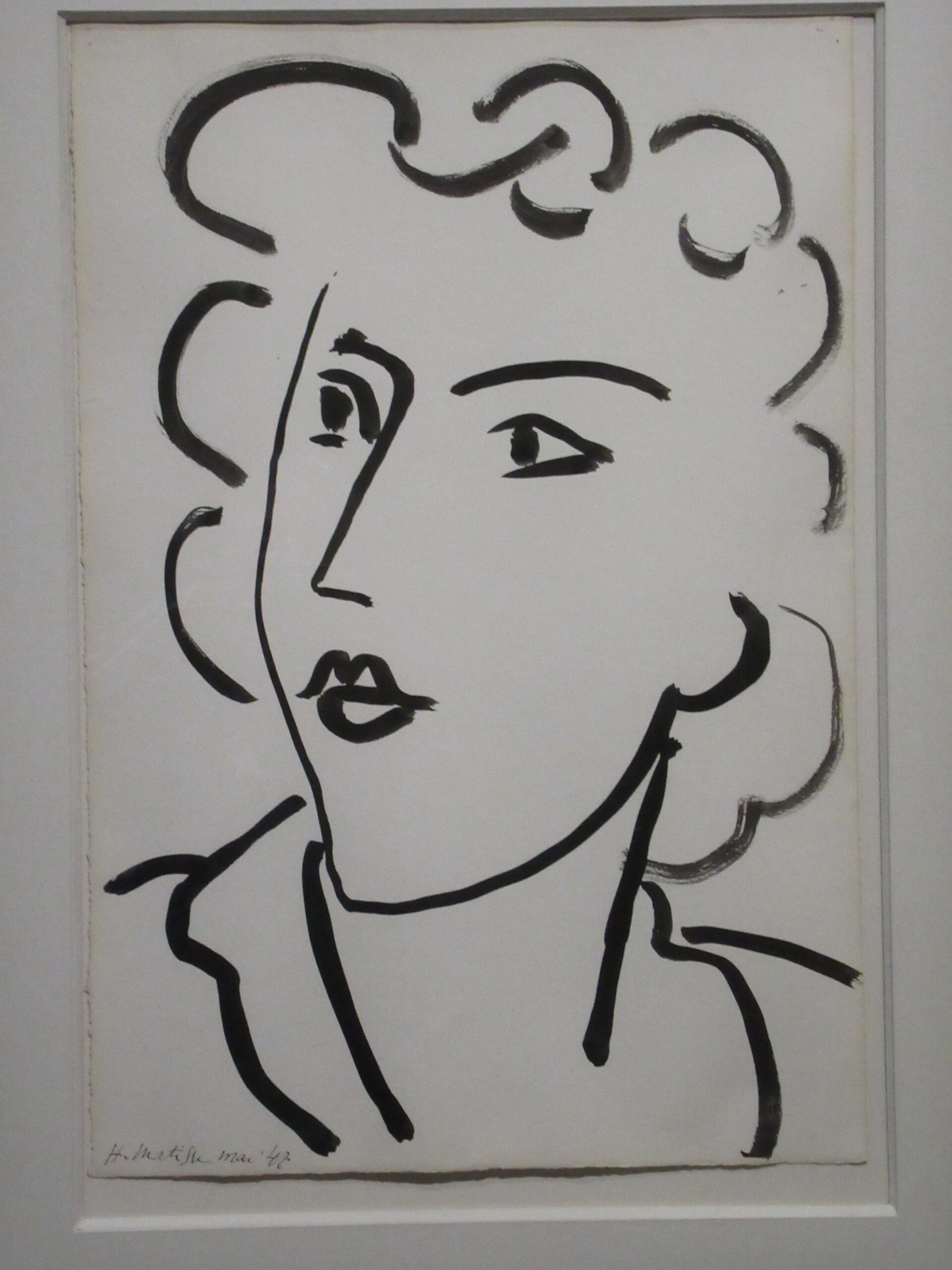
Head, Three quarter view, Matisse exhibit at the Grand Palais. Photo: Marian Jones
Another section focuses on Matisse’s designs for architectural projects, for example a chapel for the Dominican Sisters of the Rosary in Vence where his designs for the stained-glass windows reflect the bright colours and bold shapes of his paper cut-outs.
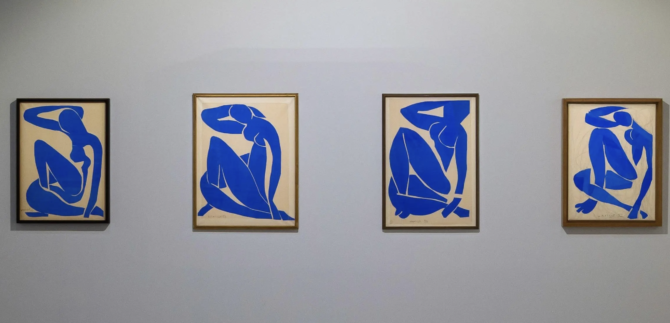
The show’s final exhibits are some of his best-known, the Four Blue Nudes, displayed together here for the very first time. Such is the quantity and quality of exhibits that it’s hard to accept that they all date from the last few years of an artist in his eighth decade. Eddy Frankel, reviewing the exhibition in The Guardian, summed up the excitement he felt at the scope and pure exuberance of this exhibition as “a dizzying, joyous celebration of color, form, line, light and then a whole bunch more color.” Do go if you can.
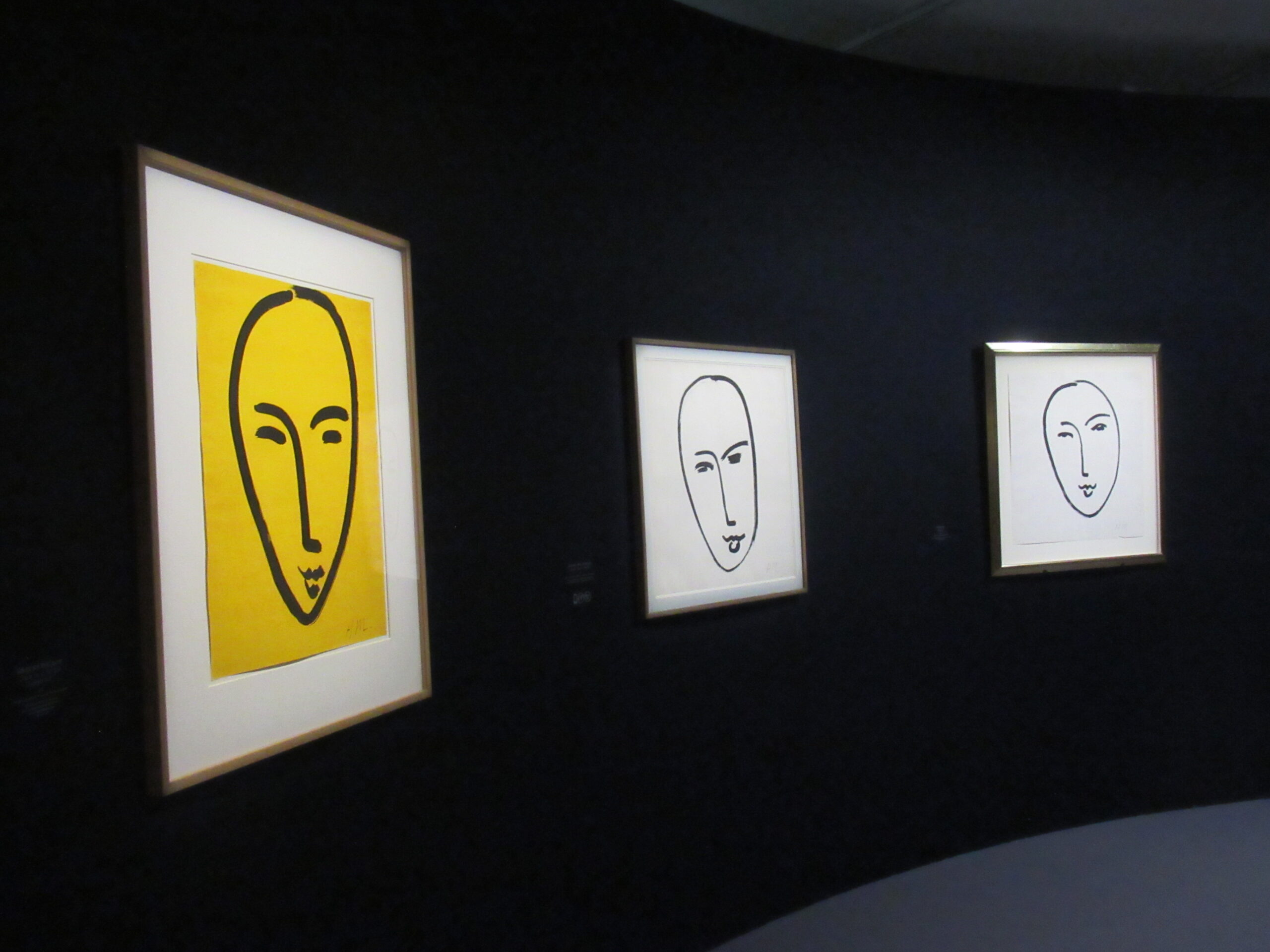
From the “Faces” series, Matisse exhibit at the Grand Palais. Photo: Marian Jones
Matisse at War: Art and Resistance in Nazi Occupied France
If you can’t make the Grand Palais exhibition, then reading Christopher C Gorham’s book, Matisse at War, will let you discover the riveting story of how the artist spent his last decade living through and a few years beyond the Second World War.
It tells the story of Matisse’s life in Nice, where he retreated to paint, in contrast to many other artists who fled occupied France and took refuge abroad. Readers will also learn what happened to Matisse’s family members – his estranged wife, his sons, daughter and grandson – during the occupation and gain a vivid sense of frightening atmosphere in which they all lived.
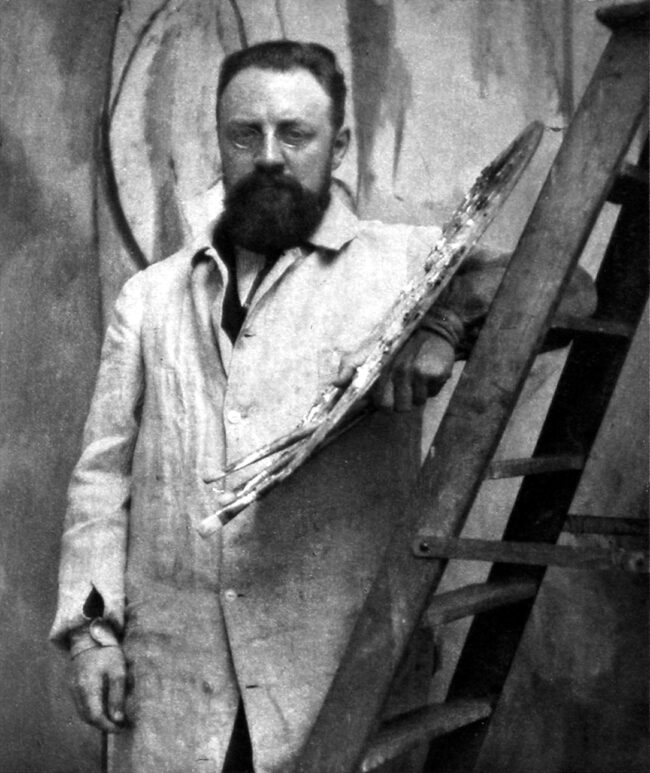
Henri Matisse, Paris, May 13th, 1913. Photo by Alvi Langdon Coburn. Public domain
For example, when German troops arrived unexpectedly at Matisse’s villa in Nice one morning, his companion Lydia was naturally terrified. In fact, they had come to commandeer the cellar to use as a canteen for the troops, but the author’s description of Lydia’s thoughts at that moment convey the fear in which they all lived.
She wondered, he writes “Was it the great artist they wanted? Some kind of war prize? Was it her, a Russian with whom to indulge their vengeance? Did they want information on Jean Matisse? Had Jean been arrested? Did they want to loot the artwork?”
Much of the narrative concerns the work Matisse was doing during this period, so the book will interest anyone who wants to learn the background to the works in the Grand Palais exhibition.
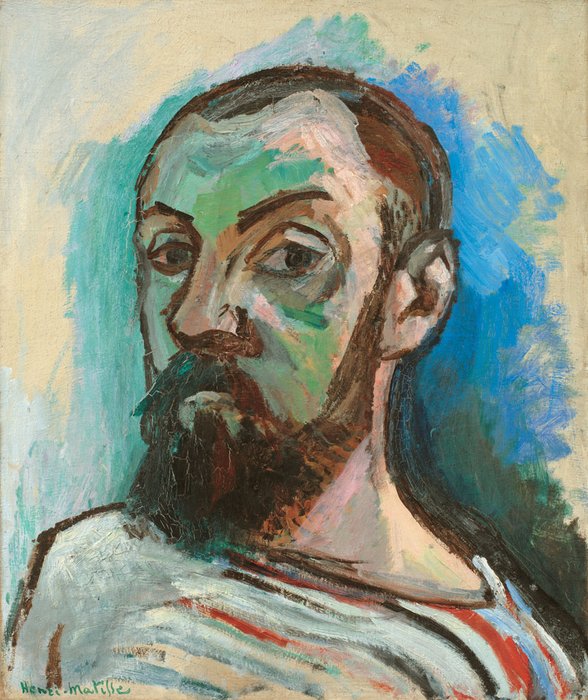
Henri Matisse, Self portrait in striped T-shirt, 1906. Statens Museum for Kunst, Copenhagen, Denmark. Public domain.
There are detailed descriptions of particular projects, analysis of what Matisse was trying to achieve and an assessment of why the artist’s work from this period was so ground-breaking. The author, Christopher Gorham, explains: “I aim to reveal the humanity of the man who could seem conventional in his habits, but whose art broke so free of convention it flickers halfway between the imagined and the seen.”
A New York Times review described Matisse as “one of the young rebels who lived long enough to be regarded as an old master,” and this exhibition explains why while also highlighting the youthful joie de vivre which spills out of the works he created in his 70s.
A Matisse quotation, displayed at the end of the exhibition, sums up his desire never to lose his zest for life: “I hope that however old we live to be, we die young.” Both the book and the exhibition show a side of Matisse which you may not have considered before. Both are more than worth a look.
DETAILS
Matisse, 1941-1954
Grand Palais until July 26th, 2026
Opening hours Tuesday to Sunday, 10 am to 7:30 pm
Late-night opening on Wednesdays and Fridays until 10 pm
Entry €19, concessions €16
Matisse at War by Christopher C Gorham
Art and Resistance in Nazi Occupied France
Citadel Press 2025
Three more articles on Matisse:
Matisse, Marguerite and Münter at the Musée d’Art Moderne by Meredith Mullins
Henri Matisse at 150 by Beth Gersch-Nesic
Seeing Red by Beth Gersch-Nesic
Lead photo credit : Matisse, 1945-1954 exhibition, series of Nus Bleus. Photo: Luc Castel
Related Articles


By Marian Jones
REPLY
REPLY
REPLY