
The Renaissance of the Grand Palais

- SUBSCRIBE
- ALREADY SUBSCRIBED?
BECOME A BONJOUR PARIS MEMBER
Gain full access to our collection of over 5,000 articles and bring the City of Light into your life. Just 80 USD per year.
Find out why you should become a member here.
Sign in
Fill in your credentials below.
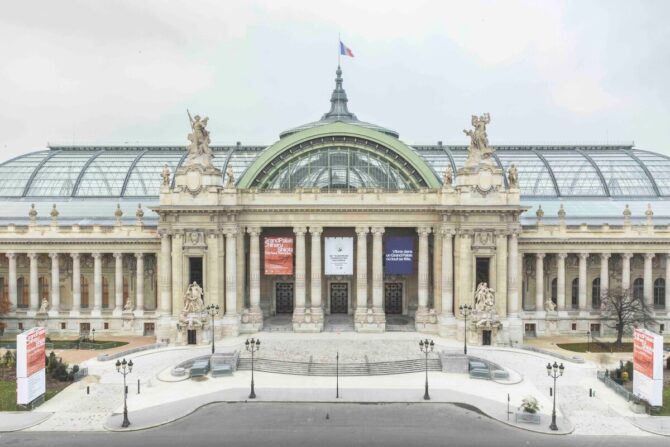
One of the biggest events in Paris this year has been the gradual reopening of the Grand Palais, the magnificent Belle Époque building whose 125-year history represents key moments in the city’s artistic and cultural history. Its president, Didier Fusillier, is surely employing understatement when he writes that it is “no ordinary palace.” So many things make it special: its vast size (did you know it’s larger than the palace of Versailles?) along with its magnificent riverside setting, its iconic architectural mix of classical and Art Nouveau, and its role as the showcase for new developments in fields as varied as art, technology, sport and fashion. It’s a cultural and heritage site second to none.
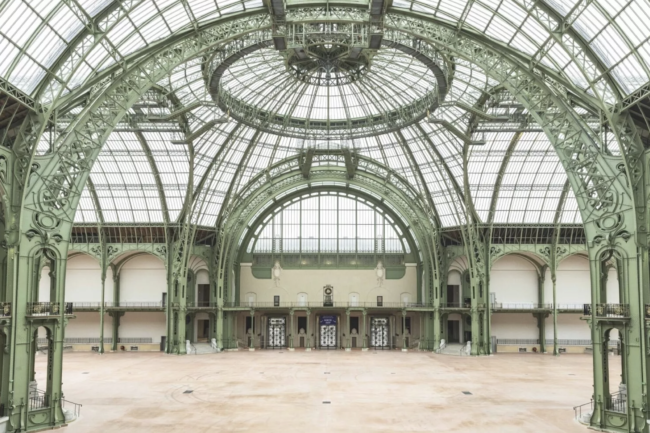
View of the nave from the Escalier d’Honneur. Photo: © Simon Lerat pour le GrandPalaisRmn, Paris 2024
The Grand Palais closed in March 2021 for a major renovation of the whole site, scheduled to last at least four years. It was used as the setting for fencing and taekwondo events during the Paris Olympics in the summer of 2024, but only now is it preparing to open fully to the public. The project, costing 466 million euros, has covered everything from a refurbishment of the whole site to a major rethink about how the space inside is used. A total of 57 different companies and over 600 specialist workers were tasked with creating an exhibition center fit for the 21st century, while remaining true to the Belle Époque design Parisians have admired for well over a century.
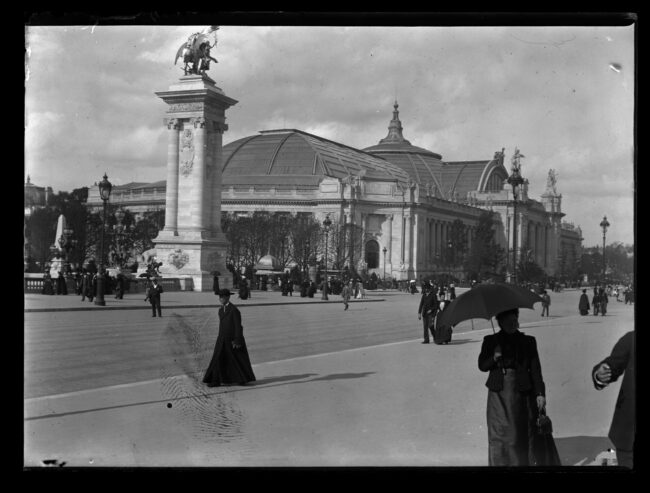
Grand Palais, 1900, Eugène Trutat. Public domain
Built to wow visitors to the Universal Exhibition of 1900, the Grand Palais made an immediate impact. The mix of its classical façades and exuberant decorative statues and mosaics was striking and the enormous glass domed roof, still the largest canopy in Europe, was the talk of the new century. Art Nouveau in style, it relied on the newest technological developments of 1900 to make it possible. For example, 6000 tons of steel were used to build the structure which would hold it aloft. The Grand Palais played a role in some of the 20th century’s major events, being requisitioned as a military hospital during World War I and used by the Germans occupying the city during World War II as a convenient base to park their lorries. In the 1960s it was taken over by the Ministry of Culture and enlarged with the addition of the Galéries Nationales to make it more suitable for international exhibitions.
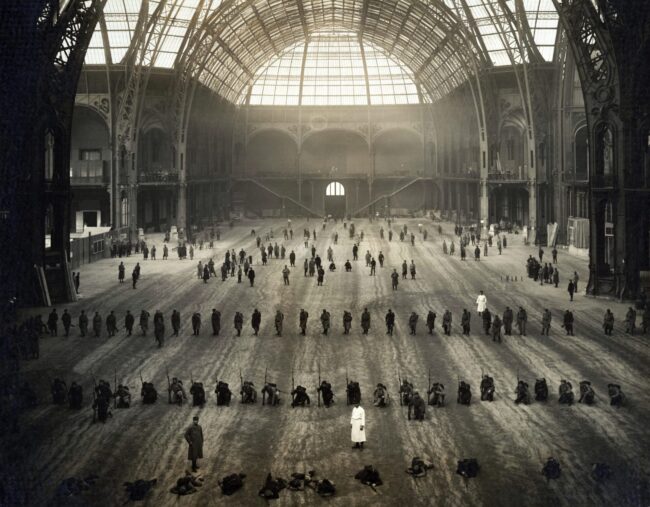
The Grand Palais during the First World War. Unknown author. The Metropolitan Museum of Art. Public domain
From the outset it played a major role in the artistic life of the city. The very first exhibitions, curated for the Universal Exhibition of 1900, were on French Art, 1800 – 1889 and Fine Arts 1889-1900. Soon, organizations like the Société des Artistes Français were exhibiting there, and in 1905 came one of the first of many controversial moments. The art critic, Louis Vauxcelles, outraged by the bright colors exploding onto the canvases of artists including Derain and Matisse, denounced one exhibition as a cage aux fauves (a “cage of wild animals”), giving the new movement, fauvism, its name.
There have been many memorable exhibitions over the years, including the innovative Art Nègre (Black Art) staged in 1966 and the Monumenta series which ran every year from 2006 to 2017, each time inviting a contemporary artist to design a large-scale installation. Who can forget Anish Kapoor’s Leviathan from 2011, a giant four-chamber balloon, representing “the belly of the beast” which the public could explore from the inside? Art Basel Paris, one of the world’s most prestigious art fairs, is held here every October.
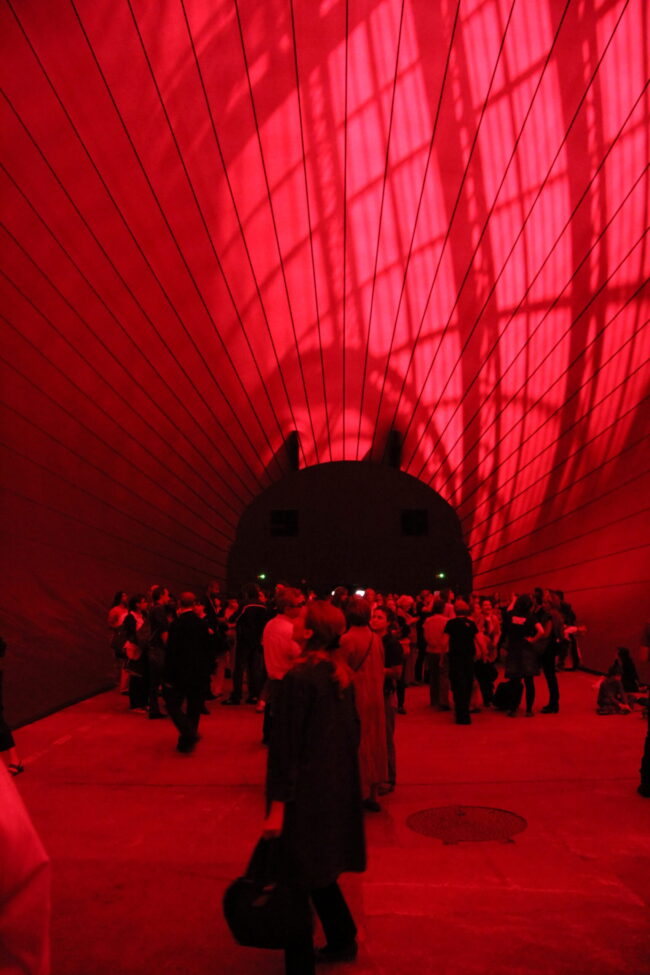
Leviathan, Anish Kapoor, 2011. Photo: Mbop / Wikipedia commons
However not all the different exhibitions, trade fairs and shows at the Grand Palais focus on art. Technical innovation has also been to the forefront, starting with the Paris Motor Show of 1901, staged when horse-drawn carriages were still a familiar sight on Parisian streets. By 1909 it had expanded to include early aeroplanes, creating what is thought to be the world’s first aviation show. An annual Salon des Arts Ménagers (Salon of Domestic Arts) was held from 1926, showcasing the very latest in household appliances. A sentence in the Connaissance des Arts book on the Grand Palais sums up this varied mix: “The mechanical potato masher, Manet’s Le Déjeuner sur l’herbe, the Blériot type XI monoplane … were all unveiled here.”
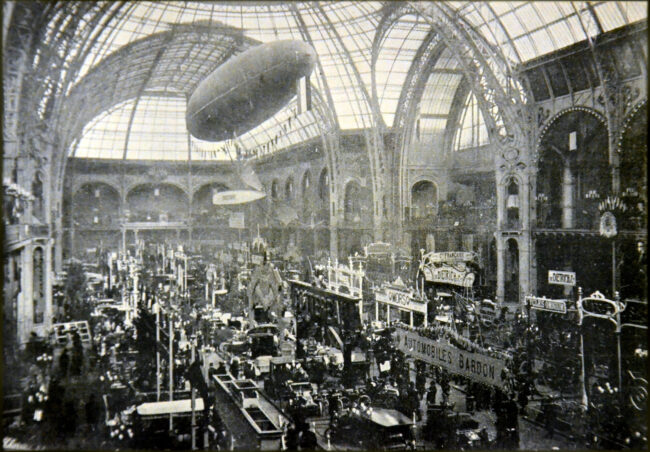
Salon de l’Automobile, at the Grand Palais de Paris, early 20th century. Photo: Valerian Gribayedoff — “Revue illustrée”/ Public domain
From the 1901 Concours Hippique (Horse Show), sport also played a role and the Grand Palais has seen everything from showjumping to boxing, as well as hosting events for both the 1924 and 2024 Olympic Games. A generation of post-war children will recall the Salon de l’Enfance, held for a decade from 1949, a paradise of toys and attractions for little ones. Bibliophiles can still enjoy the annual Salon du Livre, and fashion fans have been well served during this century when memorable Chanel shows include one in 2010, when Karl Lagerfeld installed a 265–ton iceberg in order to highlight global warming. A good motto for attending anything at the Grand Palais might well be “expect the unexpected.”
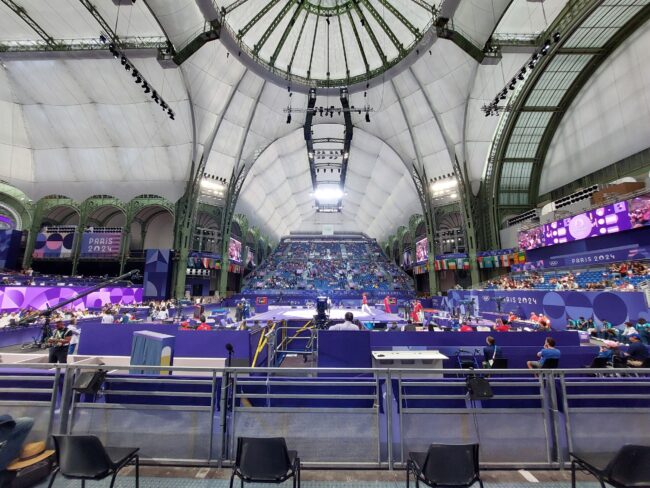
The Grand Palais during the taekwondo competitions at the Summer Olympics 2024. Photo: Nicolas22g / Wikimedia commons
The refurbishment has been thorough in the extreme, all in keeping with the aim of updating the Grand Palais while retaining its heritage. The fabric of the building has been cleaned inside and out. On the exterior, fungicidal moss has been removed from 1000 statues, reliefs and capitals which have also been repointed or, in cases of severe damage, re-sculptured. The inside of the building has been opened up, creating vastly more public space, especially the new central area between the nave and the Palais de la Découverte. The attention to detail includes analysis of small fragments of original paint in order to recreate the exact pale green color first used for the nave. On a grander scale, 42 km of pipes have been installed which will regulate the temperature using hot water in winter and cold in summer.
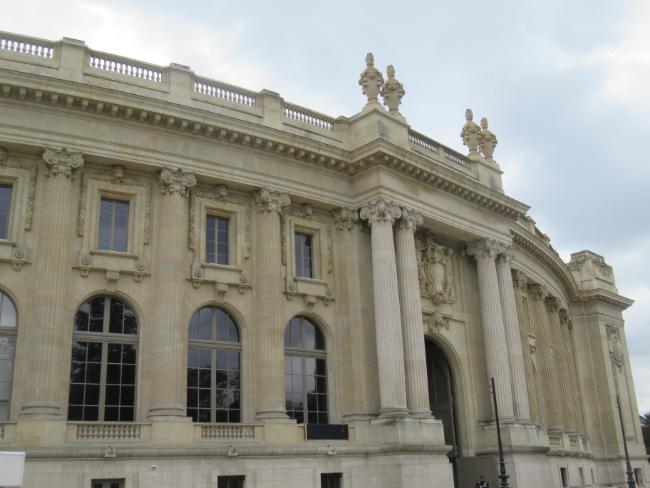




You can enjoy a first appreciation of what has been achieved just by walking around the outside of the building, a journey of an almost unbelievable one kilometer! Admire the neoclassical style, with its many pillars and columns and notice the tricolore flag flying above the dome – it’s the largest anywhere in Paris and measures 24 square meters. See if you can spot the inscription dating from the building’s opening in May 1900 which states its original purpose, namely to celebrate French art: Ce bâtiment est consacré par la République Française à la gloire de l’art français.
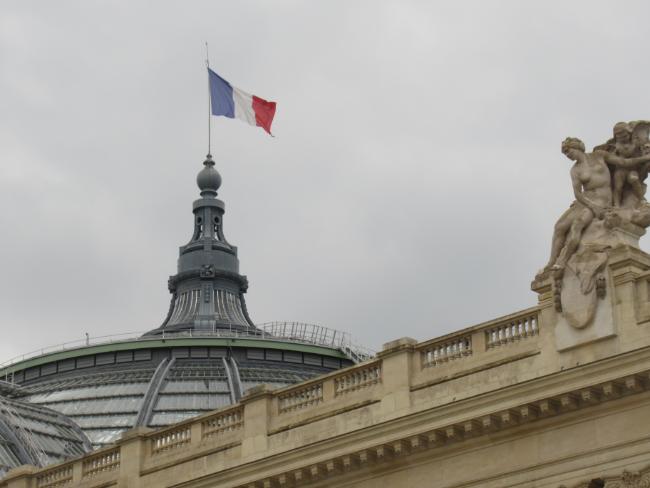
The tricolore flying above the Grand Palais. Photo: Marian Jones
Pay attention to the many sculptures, which accounted for half the cost of the original building and include two magnificent chariots, each pulled by four horses – quadrigas to give them their technical name – plus sculpted odes to Minerva, protector of the arts and Apollo, god of music and poetry. Don’t miss the two giant friezes, the only examples of color on the building. On the Petit Palais side you’ll find a 10 paneled mosaic frieze celebrating the arts of ancient civilizations – Egyptian, Roman, Byzantine – and of France from medieval times to the end of the 19th century. Along Avenue Franklin R Roosevelt, ceramic tiles depict key moments in France’s history.
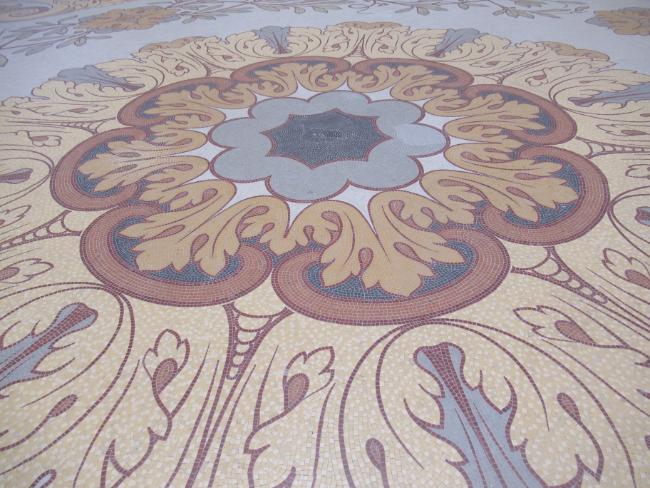




Inside, there is much more to admire and there is free public access to a number of areas, including the huge new reception hall, the central square and the Rotonde which leads off to the Palais de la Découverte and where the carefully refurbished mosaïc floor is a highlight. Guided tours are available, but only in French. Buying a ticket to an event in the main nave will mean you get a close-up view of its magnificent design. The vast space – 13,500 square meters in total! – is crowned by the famous dome, an Art Nouveau masterpiece of steel, iron and glass which was installed not just for artistic reasons, but as a very practical way to light such a large space before the widespread use of electricity. Another highlight is the Escalier d’honneur, a stunning Belle Époque staircase whose balconies and wrought-iron balustrades have been fully restored to their 1900 grandeur.
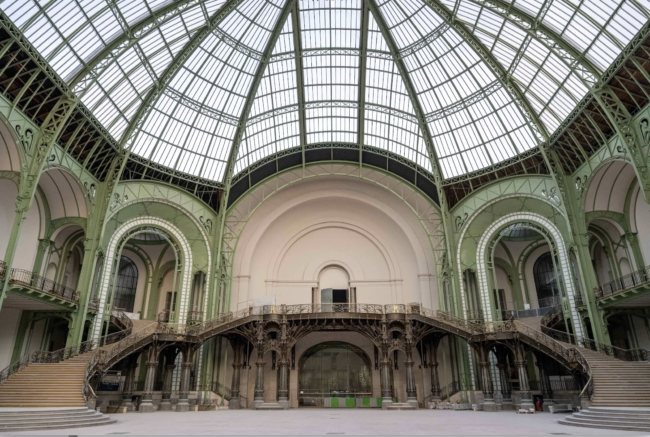
The nave and the grand staircase of the Grand Palais. Photo: Maxime Chermat pour RMN Grand Palais
The reopening of the Grand Palais is being phased in and more details on exhibitions available now and from January 2026 are available here. A fun way to celebrate being able to get back inside would be to go and enjoy the Grand Palais des Glaces event, when, from December 13th until January 7th, the nave will become a giant ice rink with skating sessions running morning, afternoon and evening. The latter run until 2 am and give you the chance to skate under Europe’s largest glass roof, lit up from nightfall, to tracks chosen by resident DJs.
When the Grand Palais opened in 1900 it was the talk of Paris. And now it’s back, its heritage features all spruced up and its facilities updated for the coming decades. Always innovative, never stuffy, its reopening is a major event on the city’s calendar. Its program is hard to define, except to say that there’s something for everyone and so a regular check on what’s coming up there should really be on everyone’s to-do list.
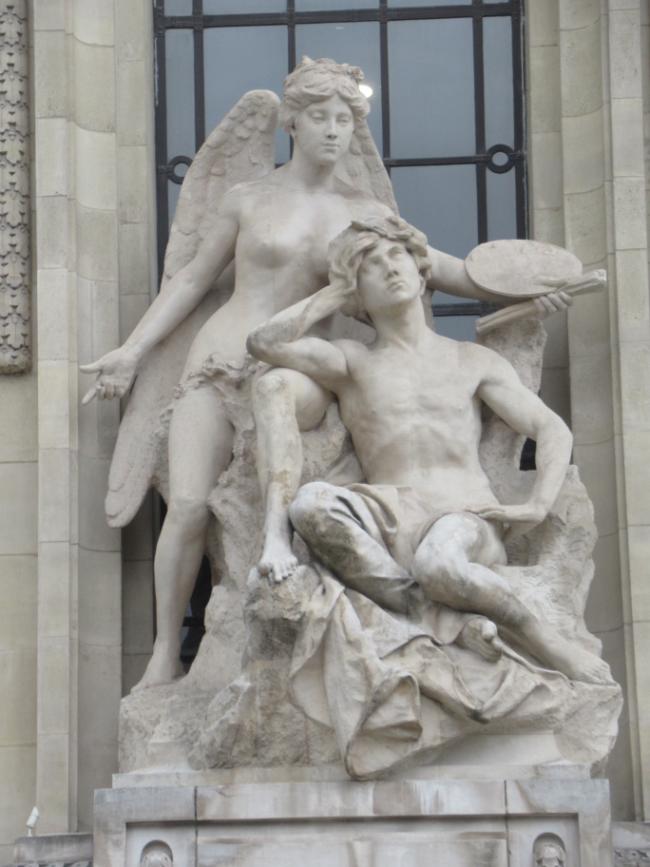
Statues at the Grand Palais. Photo: Marian Jones
Lead photo credit : Façade du Grand Palais, avenue Winston Churchill. Photo: ©SIMON LERAT pour le GrandPalaisRmn, Paris 2024
More in Grand Palais
Related Articles


By Marian Jones
REPLY