A Beginner’s Guide to Sculpture in Paris
As any self-respecting city should, Paris abounds with sculpture. Bridgeside bronzes depict former kings on horseback. Grieving female figures supine on tombs in Père Lachaise. A ghostly Grim Reaper haunts the University of Medicine’s courtyards as a giant silver apple on Place de Clichy derides capitalism. At times, it can seem as though every last museum forecourt, river island, gardens and gallery contains a statue, bust or bas relief.
Defining Paris’s best sculptures is, effectively, impossible; such classifications depend on personal taste as much as anything else, and I’m certainly no expert. What I can do is list some of its most famous, eye-catching, popular or puzzling examples.
Why do so now? Because the capital is going a bit sculpture-mad, that’s why. Not only has Île Seguin recently debuted Paris’s latest sculpture park, but a large Giacometti museum (and school) just been announced for 2028. Let’s start with that, followed by other relevant museums…
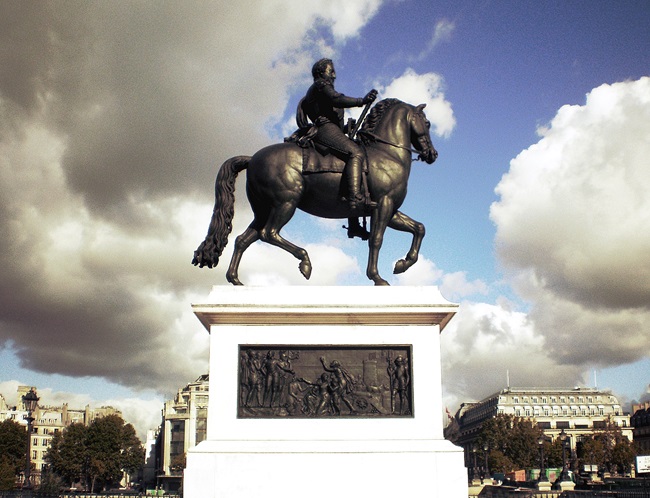
Statue of Henry IV on the Pont Neuf (1618, destroyed 1792, replaced 1818). Photo credit: Mbzt/ Wikimedia Commons
MUSEUMS
Institut Giacometti / Giacometti Museum & School
In 2018, the Fondation Alberto et Annette Giacometti opened Institut Giacometti, a diminutive center devoted to the Swiss master, in the 14th next to Montparnasse Cemetery. But that was only ever meant to be a stopgap, and now a proper museum — the first to be dedicated to Giacometti — and accompanying art school is to open amid the posher 7th sometime in 2028. And not in any ordinary building either, but in the former Invalides train station by Quai d’Orsay. That’s 17 times bigger than their current base, which is just as well given the foundation’s collection encompasses thousands of drawings, 100 paintings and, yes, more than 400 sculptures. For now, you can see a portion of those in the interim Institut.
5 Rue Victor Schoelcher, 14th
View this post on Instagram
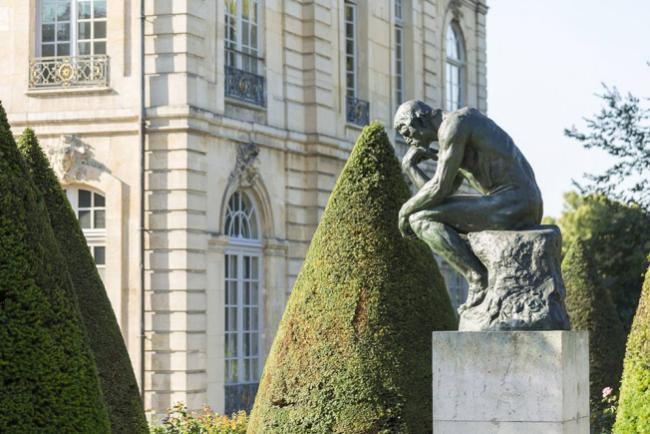
The Invalides area is already home to the world’s largest collection of work by Auguste Rodin, a big-bearded rebel known as the father of modern sculpture. His former mansion home, a two-storey beauty called the Hôtel Biron, workshop and seven-acre garden today form a delightful museum. Especially delightful are those gardens, where bronzes such as The Thinker — a seated man deep in thought, with energy and agony detectable in every sinew — sit easily among trees, ponds, lawns and flower beds. It all feels as simple as Rodin once made sculpture sound. “I choose a block of marble,” he explained, “and chop off whatever I don’t need.” Et voila!
77 Rue de Varenne, 7th
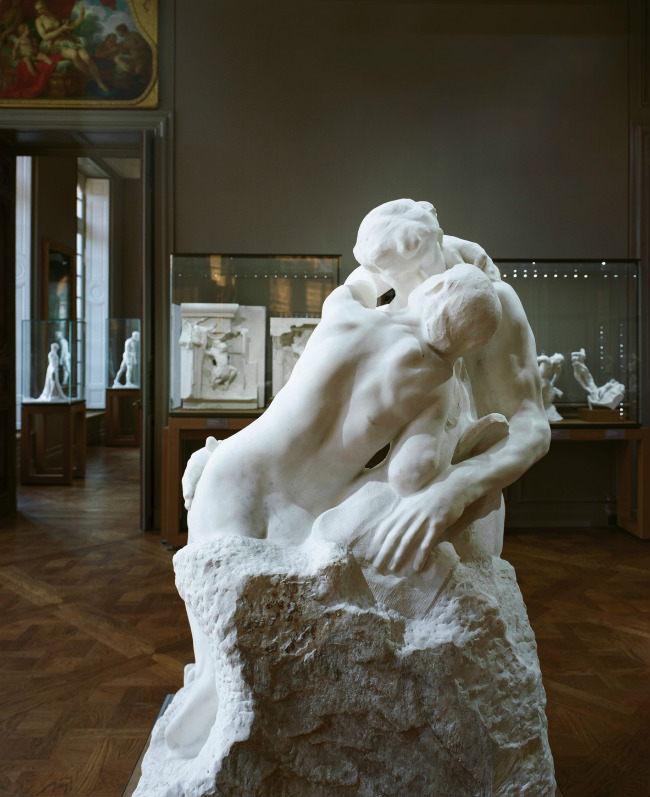
Rodin’s The Kiss. Credit: Auguste Rodin (1840 -1917, LE BAISER, Vers 1882, Crédit agence photographique du musée Rodin/ J Manoukian)
Less famous than his teacher, Antoine Bourdelle was a protégé of Rodin who went on to craft immense works for such famous French buildings as the Théâtre des Champs-Élysées. Here, in his capacious former digs near Jardin Atlantique, devotees can admire plaster, clay and sandstone works, plus big bronzes in a beautiful courtyard garden. Appealingly, it’s laid out like a working studio to give an informal sense of how Bourdelle worked.
18 Rue Antoine Bourdelle, 15th
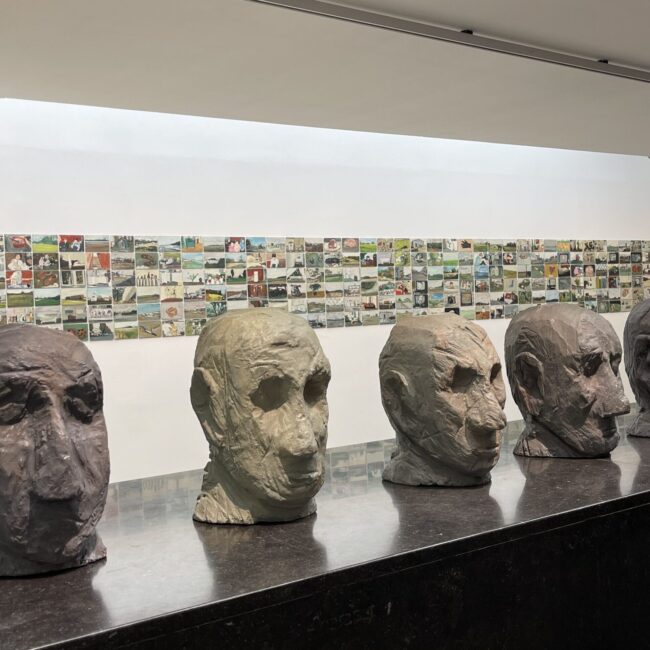
Musée Bourdelle. Photo credit: Poppy Pearce
There’s a similar formula at this shrine to Ossip Zadkine, known for his evolution from primitivism to Cubist works. Repurposing the 20th-century Russian sculptor’s home slash workshop, it’s an intimate venue close to Jardin du Luxembourg (see below) which is mostly centered on its own delightful garden. Temporary exhibits accompany drawings, photographs, tapestries, and roughly 300 sculptures; the permanent collection is free to enter.
100 bis Rue d’Assas, 6th

Musée Zadkine. The interior court, facing the exterior of the studio. Wikipedia/ Public Domain
More museums
The Louvre’s immense collection of classical antiquities extends to anonymous, ancient Greek sculptures of Venus de Milo and a Moai figure from Easter Island. Here too are works by Michelangelo, including The Slaves, and Antonio Canovo, arguably headlined by his ardent Psyche Revived by Cupid’s Kiss. Over in the high-ceilinged Musée d’Orsay, Impressionist paintings neighbor a troupe of 19th-century sculpture such as Rodin’s The Gates of Hell and The Mature Age by Camille Claudel.
There’s a similar focus within the free-entry Petit Palais, whose Beaux Arts galleries and gardens showcase experimental Jean-Joseph Marie Carriès pieces and Jules Dalou’s realist works. Sculptures also await, somewhat under the radar, in Dalí Paris and Musée Picasso Paris; both Spanish mavericks relished the odd three-dimensional work.
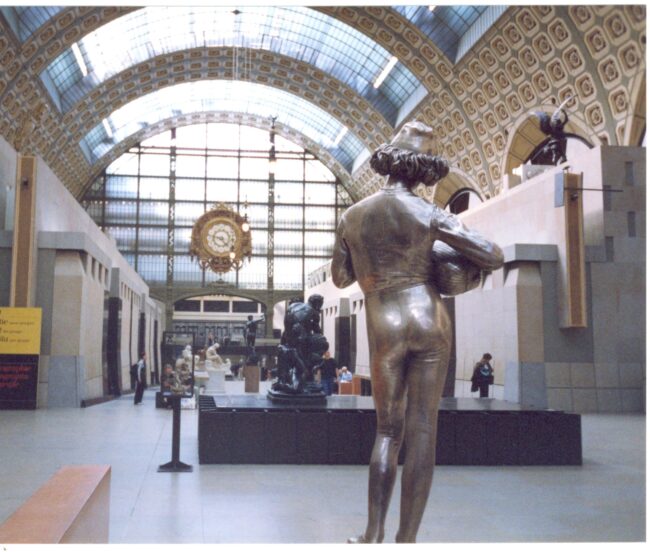
Musee d’Orsay. Photo: Hazel Smith
GARDENS & TRAILS
Musée de la Sculpture en Plein Air
Hugging the Left Bank between Pont de Sully and Pont d’Austerlitz, beside a Sorbonne campus and the Jardin de Plantes, Musée de la Sculpture en Plein Air lives up to its name by occupying the Jardin Tino Rossi’s green, fresh-aired heart. Visitors can walk around 50 modern sculptures, ranging from Cuban artist Agustín Cárdenas’s sugar-white Great Window to César Baldaccini’s sail-like Marseille.
11 bis Quai Saint-Bernard, 5th
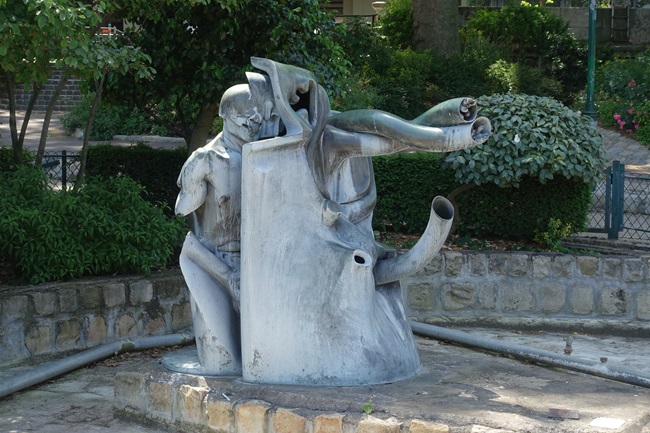
Musée de la Sculpture en plein air @ Jardin Tino Rossi @ Paris, Photo: Guilhem Vellut/Flickr
Gauthier-Mougin Departmental Park
Inaugurated on January 31 this year, the Gauthier-Mougin Departmental Park and its new sculpture trail stretch along the Île Seguin in western Paris. Due to be joined later in 2026 by an enormous Pointe des Arts cultural center, its two footpaths connect river-facing sculptures by the contemporary likes of Didier Marcel and Jacques Villeglé — combining yen, euro and dollar’s symbols for sociopolitical purposes — with installation works.
Île Seguin, Boulogne-Billancourt
Amongst cherry trees or sisal shrubs, the city’s botanical gardens hides several rather ominous statues. Over there, a lion gruesomely devours a child; ahead, a bear and a hunter do grizzly (sorry) battle. These are by, and rather typical of, Emmanuel Frémiet, a Parisian sculptor whose best-known work we’ll come to shortly… There’s also a lovely bronze depiction of Frémiet himself at work, done in tribute by his student Henri-Léon Gréber.
57 Rue Cuvier, 5th
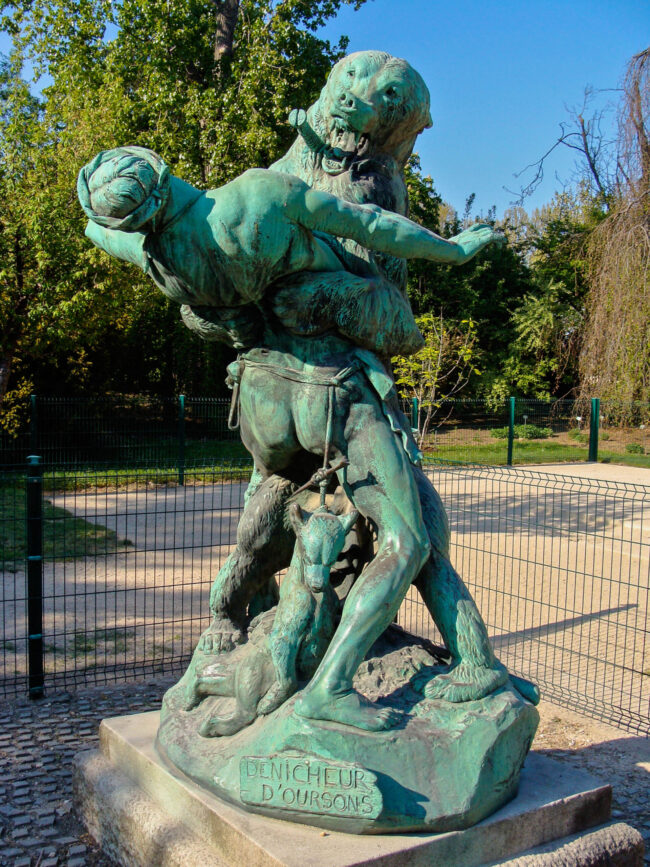
Emmanuel Frémiet, Le Dénicheur d’oursons (1884). Photo: Jebulon / Wikimedia commons
Beside its namesake museum — once Paris’s main art gallery, but now used solely for temporary exhibitions — the capital’s best-known garden hosts a bronze, 1/16-scale replica August Bartholdi’s initial Statue of Liberty model (Bartholdi’s original moved to the Musée d’Orsay’s entrance hall in 2011). Flâneurs may also find one of Antoine Bourdelle’s 80-odd busts of Beethoven — according to legend, Bourdelle was struck by their resemblance — and Jules Blanchard’s marble Mouth of Truth, a play on his original, eponymous piece in Rome. That one presents only a face which, supposedly, won’t release the hand of anyone who has ever lied; the Paris version also features a woman with her paw stuck inside the jaw.
2 Rue Auguste Comte, 6th

jardin du luxembourg. Photo credit: William O’Such
OTHER STATUES
Flame of Liberty
Talking of the Statue of Liberty, here’s a life-sized, gold-leaf reproduction of that icon’s eternal flame. Erected in 1989, it was donated by the International Herald Tribune to both commemorate the newspaper’s centennial and celebrate the bon accord between France and the USA (well, pre-Trump at least). Alas the site has since taken on a grimmer association; it was in a tunnel below here that Diana, Princess of Wales tragically perished in 1997; ever since, and still today, the Flame has become better known as a de-facto memorial to Princess Di.
Place de l’Alma, 8th
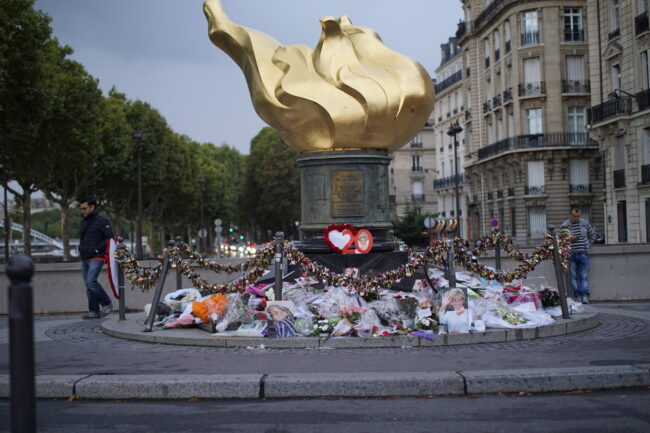
The Flame of Liberty, the unofficial Diana memorial in Paris, France, the day after the 20th anniversary of her death. Photo credit: Keimzelle / Wikimedia commons
Statue of Liberty
There’s no mistaking the reference point of a quarter-scale Liberty replica near the Eiffel Tower, however. Garlanding the artificial Île aux Cygnes’s southern end, and best ogled from Pont de Grenelle’s western pavement, this statue was gifted to Paris in 1889 by the city’s American community in Paris to mark 100 years since the French Revolution — although, ahem, it was still officially debuted on the Fourth of July, rather than on Bastille Day just over a week later.
Allée des Cygnes, 15th
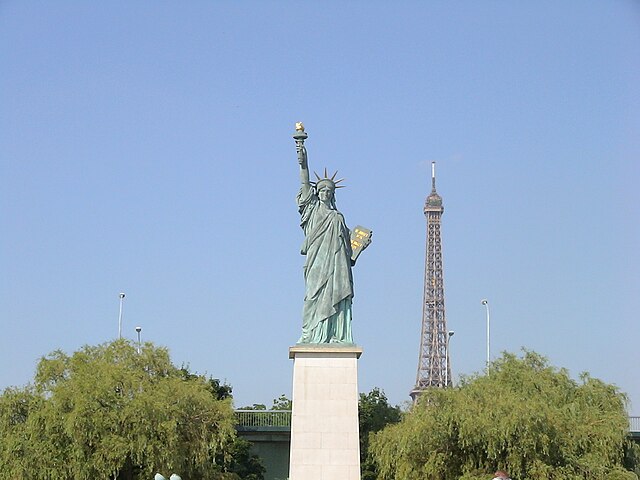
The Statue of Liberty on the l’île aux Cygnes. Photo credit: V. Gubina / Wikimedia Commons
Le Passe-Muraille
As much trompe-l’œil as sculpture, Jean Marais’s tribute to the writer Marcel Aymé portrays M. Dutilleul, the character of Aymé’s short story, Le Passe-Muraille, doing his star turn: walking through a wall. Though not the reason most people come to Montmartre, it ends up in many a fun photo.
Place Marcel Aymé, 18th
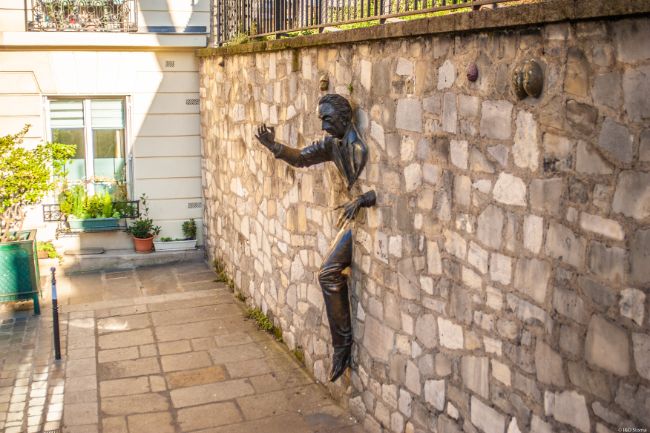
Passe Muraille in Montmartre. Photo credit: I&D Sioma / Wikimedia Commons
Elephant caught in a trap
While animals tend to triumph over humans in Emmanuel Frémiet’s Jardin des Plantes works, things are very different in the Musée d’Orsay’s forecourt. Originally assembled for 1878’s World Fair, Frémiet’s emotional piece here shows an elephant calf rearing in alarm and pain as a trap captures its foot; a guinea baboon behind appears similarly distressed. Rather than a broadside against poaching or environmental crimes, the bronze is reckoned to symbolically criticize European colonialism in Africa.
Esplanade Valéry Giscard d’Estaing, 7th
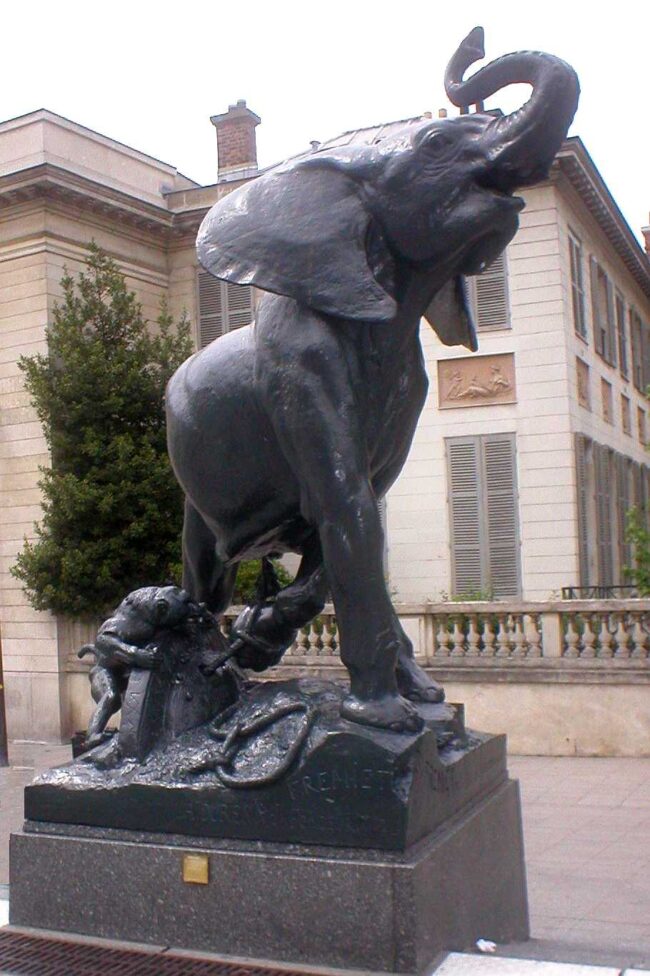
Jeune éléphant pris au piège, Emmanuel Frémiet, 1878. Photo: Siren-Com / Wikimedia commons
Joan of Arc
Frémiet’s highest-profile concoction was this gilded impression of Joan of Arc on horseback in the center of Place des Pyramides — close to where France’s original heroine was wounded during a failed bid to take Paris as the Hundred Years’ War raged on. Boldly, proudly brandishing her standard and gleaming in gold leaf, the teenage Maid of Orléans looks irresistibly fierce. Frémiet used as his model Aimée Girod, a lookalike peasant woman from the same Lorraine village as Joan; Girod followed Frémiet to Paris but later sank into poverty and eventually died in a fire — burned alive just like Joan — in 1900.
4 Place des Pyramides, 1st
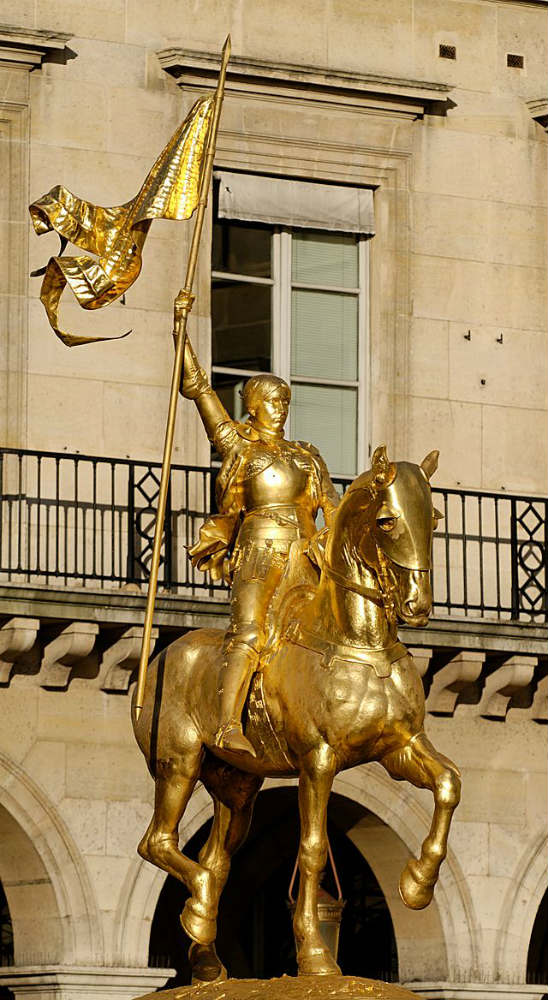
Joan of Arc statue on the Rue de Rivoli by Jastrow/Wikipedia
Victories
Let’s finish back at Les Invalides with some more bling. When it comes to Napoleon Bonaparte’s sarcophagus, the glorious gold-plated dome above tends to get most flowers — and a dozen toga-draped figures surrounding his tomb can easily be missed. Big mistake: wrongly assumed to be angels or guides into the afterlife (they in fact symbolize the Little Corporal’s military achievements), these white marble women are beautiful efforts by Jean Jacques Pradier, whose neoclassical efforts also decorate the Arc de Triomphe and Louvre.
129 Rue de Grenelle, 7th
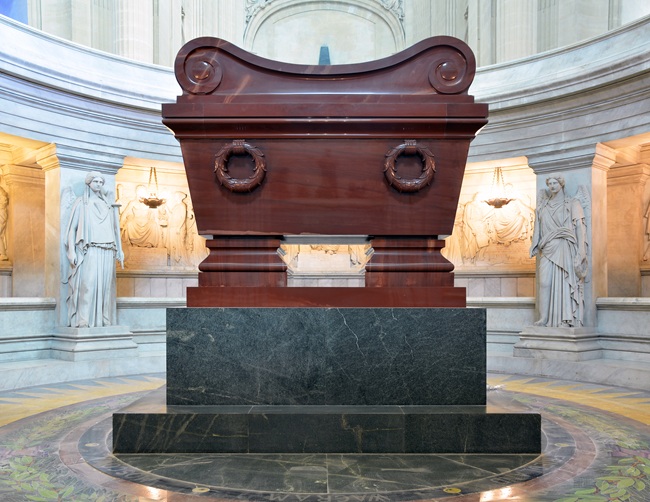
Napoleon Bonaparte’s tom at Invalides. Photo: Livioandronico2013 / Wikimedia commons
Lead photo credit : Auguste Rodin, The Thinker or The Poet, 1880, outside of the Musee Rodin Paris. courtesy of Musée Rodin
Related Articles