Interview with Jane Bertch: Author, Entrepreneur, Inspiring Woman
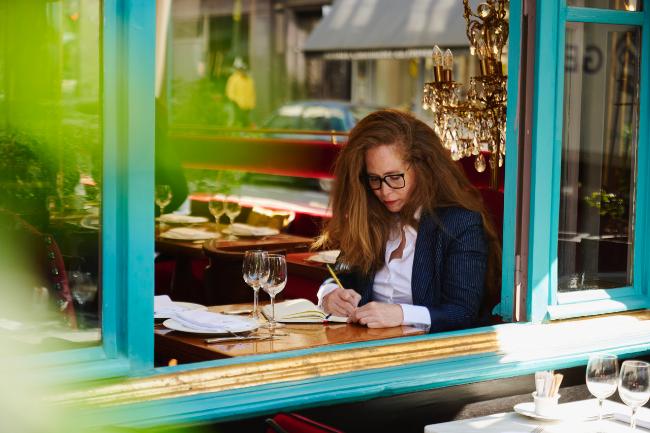
Jane Bertch is a Midwestern American — a proud Chicagoan — who has lived in Europe for more than 25 years and in Paris for more than 20 years. She is the founder of the La Cuisine cooking school; author of The French Ingredient: Making a Life in Paris One Lesson at a Time, a memoir which tells the story of how she achieved a somewhat unlikely success in opening that school; host of the podcast GenerateHer; and creator of Paris-based workshops and retreats designed to help women make transformative changes in their personal and/or professional lives. She recently took the time to answer Janet Hulstrand’s questions about her life and work in this exclusive interview for Bonjour Paris. Watch Jane’s online event “The Evolution of French Cuisine” in the Bonjour Paris Live video hub.
Jane, the path you have taken through life — so far! — is a really interesting one. You grew up in Chicago in a very close family, and you were especially close to your grandmother, who did not understand at all your desire to live abroad. Yet at the age of 24 you accepted a job in London, and five years later, you moved on to Paris. How did you manage to find a balance between honoring, and maintaining, the closeness of your family ties, and following the path that led you into a life in Europe?
That balance is something I still navigate every single day — it’s never fully resolved, and I think that’s actually okay. My grandmother couldn’t understand why I’d want to leave, and honestly, part of me understood her confusion. Family was everything to us. But I think what my family ultimately taught me — even when they didn’t realize they were teaching it — was that “family” is about the values that are instilled in you, not proximity.
I also think being so rooted in my family is precisely what gave me the courage to leave. I had this very solid foundation, and I knew it would hold no matter how far I went.
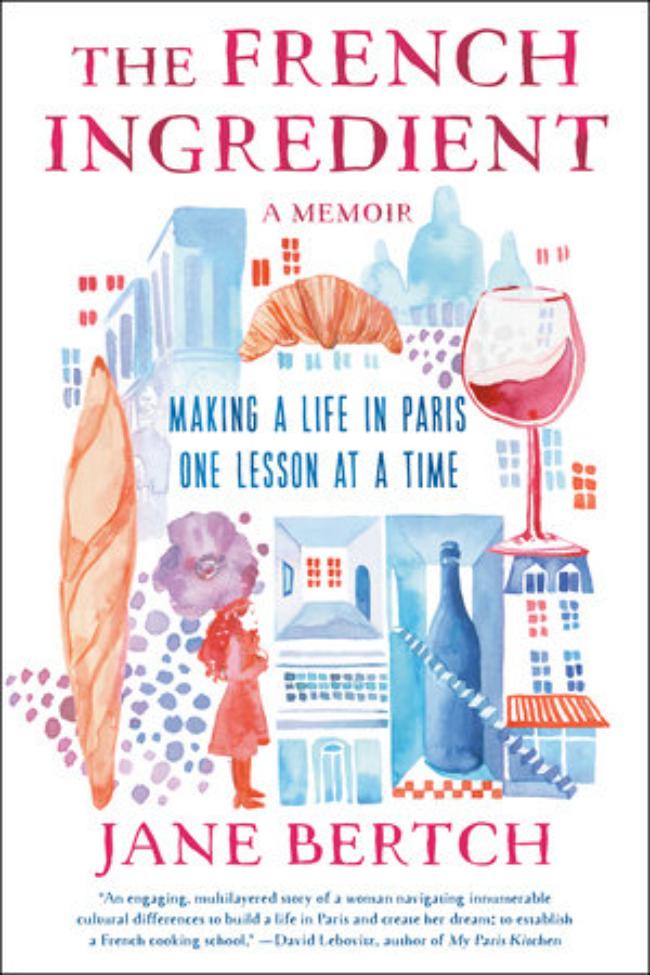
I love your memoir — The French Ingredient — for many reasons. One of them is the candor with which you share quite a few times when you felt, let’s just say extremely discouraged — and were at a point where many people would have reasonably given up on whatever it was they were trying to do. And yet, you didn’t give up. In that sense, your story is the story of how to persist in the face of daunting obstacles, and not be overwhelmed by them. Part of this is due to your own personal strength and determination, but you also make it very clear that getting through these times wasn’t all your own doing; and you give a lot of credit to the people who helped you along the way. What are the lessons here for the rest of us?
I think the honest answer is that I didn’t always know I was persisting. Sometimes I was just putting one foot in front of the other because I couldn’t see any other option. There’s a difference between determination and stubbornness, and I’m not always sure which one was carrying me on any given day.
But the part about other people — that’s essential. I would not be here without the people who believed in me when I wasn’t sure I believed in myself.
The lesson, if there is one, is that asking for help isn’t weakness — it’s a strategy. And surrounding yourself with people who see your potential (and your future), even when you can’t, is one of the most important things you can do. That’s actually something I carry into my work now – I like to call it the “soil” you plant yourself in.
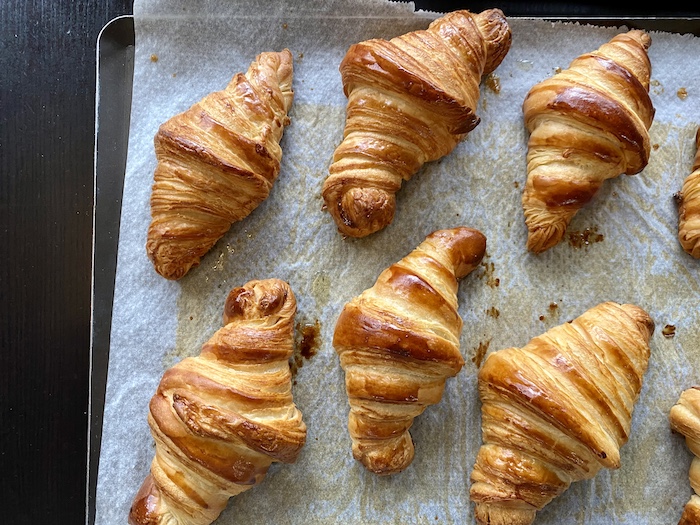
Croissant Class at La Cuisine Paris
I also love the wealth of astute tips about French etiquette, French ways, and just overall French psychology that are included in the pages of your book. I think there is so much of value for Americans to learn about life in France by reading your book. You’ve pulled some of these tips out into handy sidebars that end each chapter. But even more valuable I think is what readers can gain by reading your book slowly, and appreciating the depth and the subtlety of the many ways you have learned to appreciate and understand French people and their ways — which can be so fundamentally different than American ways — and which often require a measure of patience that many Americans tend not to possess. What do you think is the most important thing for Americans to understand about the French, and the French way of life? Or maybe the most difficult thing for them?
Oh, this is a big question. I think the most important thing — and also the most difficult — is learning to be comfortable with time. Time and relationships are completely intertwined in France, and they rely on each other. Time in all senses is important here. The time you take and dedicate to yourself and to others. The relationships that eventually develop through that investment. And then the time you use to cherish and build on what you’ve created. Whether it be a cup of coffee savoured alone, or a long stroll with a friend — the French understand that none of this can be rushed.
And then, the “non.” But here’s what I’ve learned after 20-plus years: the French “non” is almost never the end of the conversation. It’s the beginning. It’s an invitation to come back with a better argument, to show that you’re serious, to demonstrate that you’ve thought things through. But it can feel like a constraint.
I actually think there’s something deeply creative about constraint, and Paris is a city built on it. The rules, the formality, the “non” — these aren’t obstacles. They’re the structure within which something beautiful can emerge.
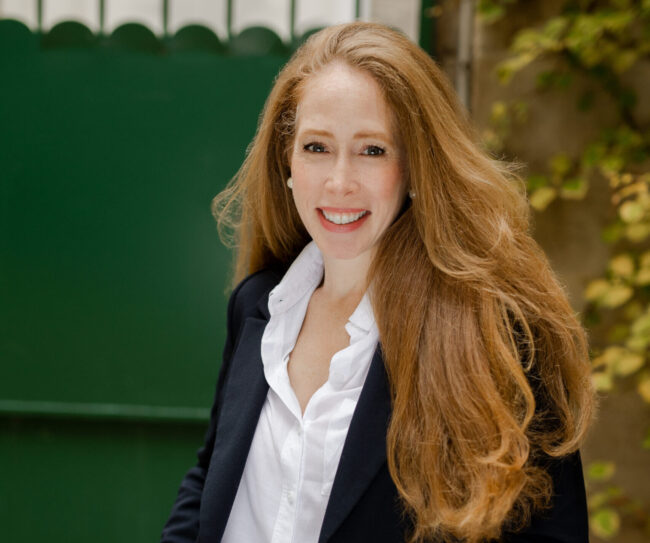
Jane Bertch. Photo credit: Katie Donnelly Photography
Perhaps because I am also a Midwesterner, another thing I appreciated about your book is the strength you attribute to having grown up in Chicago — you credit not only the strength of your family, but your Midwestern roots. I love hearing this so clearly articulated because the Midwest is so often unfairly — and ignorantly! —dismissed by people from other places, and sometimes even by Midwesterners themselves. What are some of the qualities of being a Midwesterner that you think have helped to sustain you in meeting the challenges of life?
Thank you for asking this — and yes, I think Midwesterners understand each other in a particular way. There’s a practicality, a groundedness, a refusal to take yourself too seriously that I carry with me everywhere. In Paris, where things can be very polished and very formal, my Midwestern directness has actually served me well. The French respect someone who means what they say.
There’s also something about growing up in a place that isn’t the center of attention. You learn to work hard without needing applause. You learn resourcefulness. And you learn to connect with people genuinely — not because of what they can do for you, but because you’re actually interested in them. That last one, honestly, is what opened more doors for me in France than anything else.
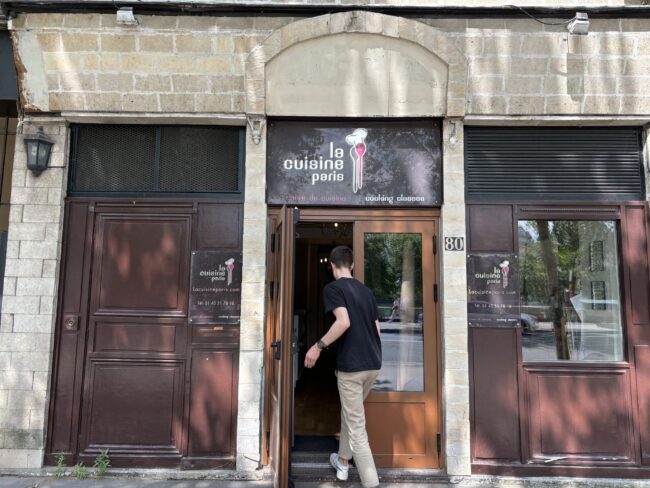
courtesy of La Cuisine Paris
After surviving a series of major challenges — from the terrorist attacks in Paris in 2015, to the pandemic a few years later, and even some relatively minor crises having to do with the availability of butter (!) and mustard (!) — your cooking school, La Cuisine, is still going strong. But you’ve also got a new enterprise going, offering workshops and retreats for women. What made you decide to do this, and what kinds of workshops and retreats do you offer?
This grew very organically, especially after publishing my book. I started to see women who enjoyed the Paris story — but really connected with the “reinvention” and the spirit that we have the right to reinvent at any point — no matter our past experiences, no matter our age, no matter our background. So I started intentionally building a business to support that.
So now I offer several things. Les Saisons are intimate seasonal retreats here in Paris — small groups, deeply curated experiences that use the city itself as a catalyst. The Paris Pirouette is a six-month virtual mastermind for women entrepreneurs that culminates with the group coming together in Paris — the next cohort celebrates together in November for Beaujolais Nouveau, which feels very right.
And I’ve just started developing something new called The Paris IncubatHER. We all have a different definition of an entrepreneur –f or me, it is a spirit, not necessarily a business. I am designing something for women 40 and older who are ready to start something new — a business, a project, a new chapter — who need the space and the support to figure out what it is. We begin with inspiration in Paris because I genuinely believe this city has a way of shaking things loose.
Building these elements has been incredibly rewarding, and I am looking forward to seeing how they develop in the future.
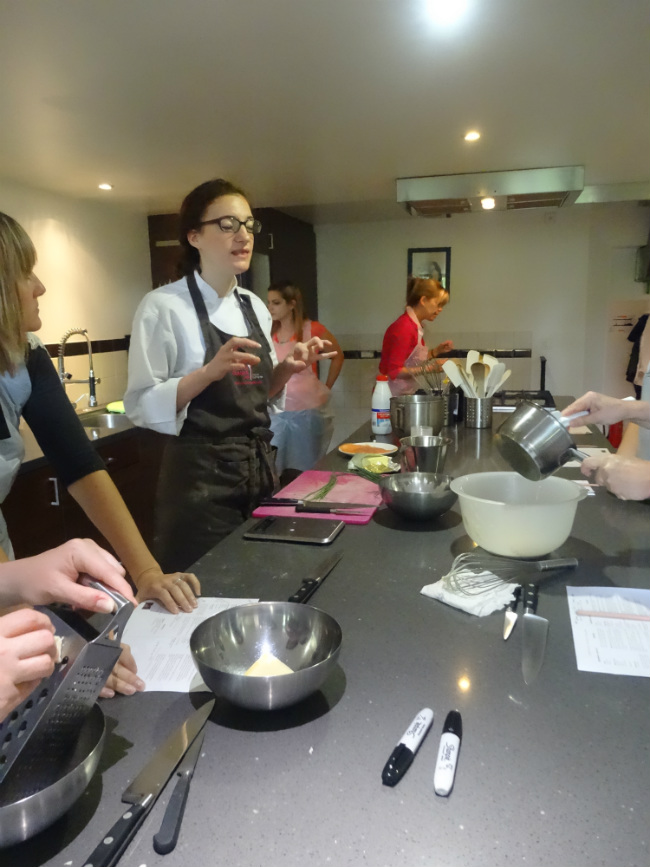
Chef Emelie leading the cooking class at La Cuisine Paris/ Nicole Corriel
I understand that you also host a podcast, called GenerateHER. What can you tell us about that?
GenerateHER is something I’m incredibly proud of. It’s a podcast about women who generate — who create, who build, who reinvent. I have solo episodes, but I also interview women who are doing remarkable things, often after a major pivot or at a point in life when the world might have expected them to slow down. We’re in our third season now, and the conversations just keep getting richer.
I must confess this last question seems like a silly one, given all you are already doing — but I will ask it anyway. What’s next for Jane Bertch? Or are you going to be content to just continue leading the very busy, very successful life you are living?
It’s not a silly question at all — it’s actually the question I ask myself constantly. I’m not someone who will ever be “content” in the sense of standing still, though I’m getting better at appreciating what’s right in front of me. The French have helped with that.
What’s next is deepening the work I’ve already started. Growing The Paris IncubatHER into something with real impact — I believe this idea of supporting women in midlife is so important because they have so much rich potential and so much experience.
So, Janet, I’ll continue to keep myself busy and growing, like we all should!
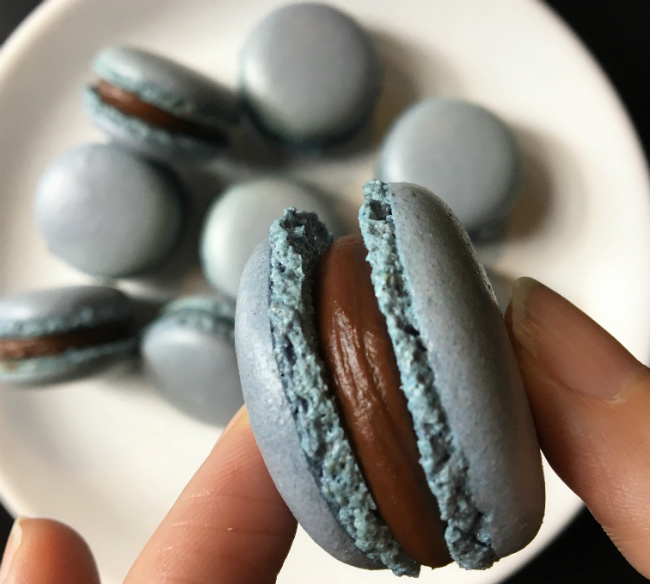
courtesy of La Cuisine Paris
Lead photo credit : Jane Bertch
Related Articles