Paris in Superlatives: Fascinating Facts about the City of Light
- SUBSCRIBE
- ALREADY SUBSCRIBED?
BECOME A BONJOUR PARIS MEMBER
Gain full access to our collection of over 5,000 articles and bring the City of Light into your life. Just 80 USD per year.
Find out why you should become a member here.
Sign in
Fill in your credentials below.
What is the capital’s longest street? Where is its highest point? And which metro lines are fastest and slowest?
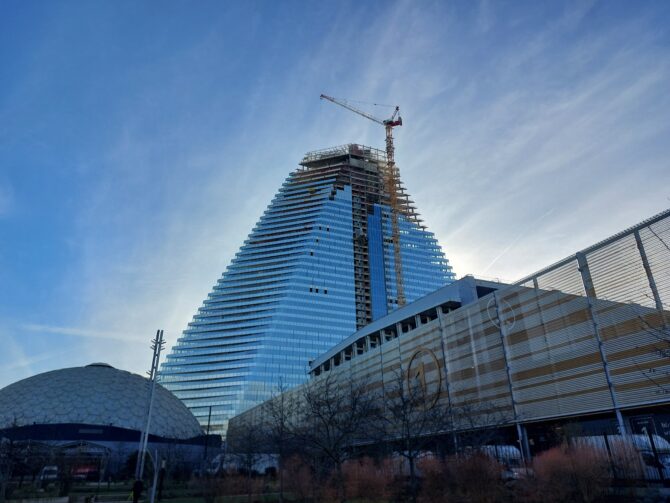
With Porte de Versailles’ newly-completed, 42-storey Tour Triangle ranking as the city’s third tallest building — or is that structure? — we were inspired to seek out other Parisian record breakers, and to go slightly superlative-mad.
Do you know, for instance, which is the capital’s longest street? How about its longest-running restaurant? Or fastest and slowest Metro lines? Whether you’re bored on a lunch break or prepping for tonight’s Paris-themed pub quiz, here are some useless but hopefully fascinating facts about the City of Light.
Paris’s tallest…
BUILDING: At 180 meters, Tour Triangle comes in joint-third — tied with Jean Nouvel’s Tour Duo n°1 near Bercy — only if we a) limit the chart to Paris proper (within the Périphérique, effectively), and b) include all man-made structures. That’s because first place goes to a certain Eiffel Tower, at a whopping 330m. If you don’t strictly consider that a building, however, or want to limit the list to theoretically habitable edifices then it becomes Tour Montparnasse, which extends 210m upwards. In the entire Paris region, it’s La Défense’s recently-completed, 242m-high The Link skyscraper.
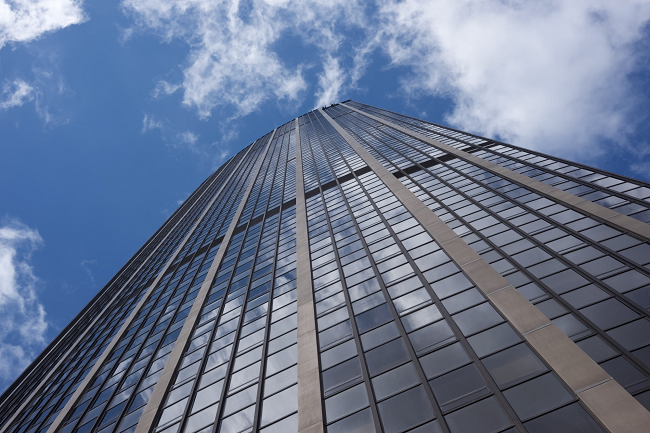
Tour Montparnasse. Photo credit: William O’Such
Paris’s smallest…
HOUSE: As far as anyone knows, this is 39 Rue du Château-d’Eau, just off Place de la République. A piffling 1.1m wide and 5m high, this Lilliputian dwelling was built to seal a dispute linked to the former opening here between Rue du Château-d’Eau and Faubourg Saint-Martin. Its 4m² ground floor has lately served as a petite clothing boutique, having previously hosted 19th-century shoemakers.
ARRONDISSEMENT: Just slightly smaller than the 3rd is Paris’s eclectic deuxieme. Despite being slightly less than a kilometer squared, it still packs in Galerie Vivienne’s glass arcade, restaurant-lined Rue Sainte-Anne’s miniature Tokyo and the Bourse de Commerce modern-art museum.
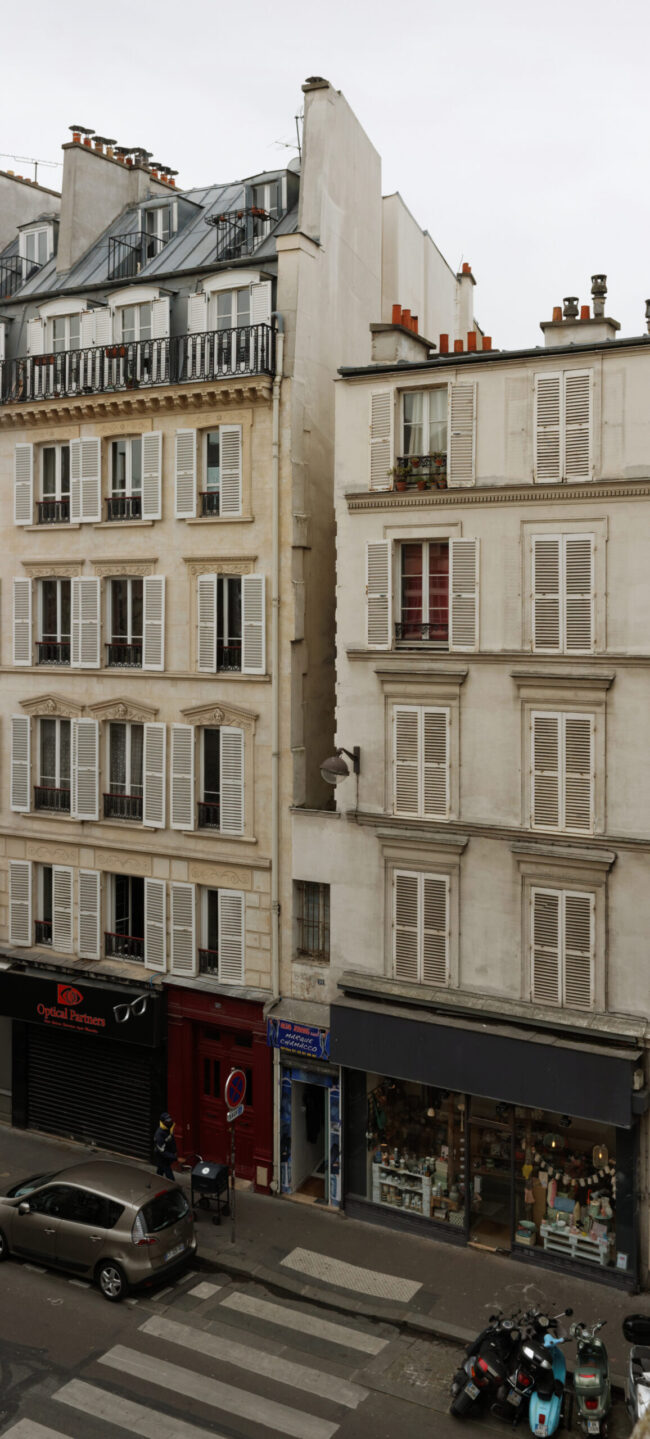
39 rue du Château-d’Eau in Paris. Photo credit: Coyau/ Wikimedia commons
Paris’s biggest…
PARK: At 2,500 acres, the easterly Bois de Vincennes is around 200 football pitches bigger than its westerly rival, the Bois de Boulogne, and more than twice as large as New York’s Central Park. Having four lakes rather helps. In terms of parks entirely contained by the Périphérique, and assuming we disqualify Père Lachaise (110 acres) for being a cemetery, none come bigger than the 63-acre Jardin du Luxembourg.
MUSEUM: Paris’s biggest museum? Pah. The Louvre is the world’s biggest museum if you measure it by floor space — and more than three times as large as the runner-up, St Petersburg’s State Hermitage. In all, the institution boasts 750,000m² of floor size, which explains why it displays around 35,000 works at any one time. That’s a lot of art.
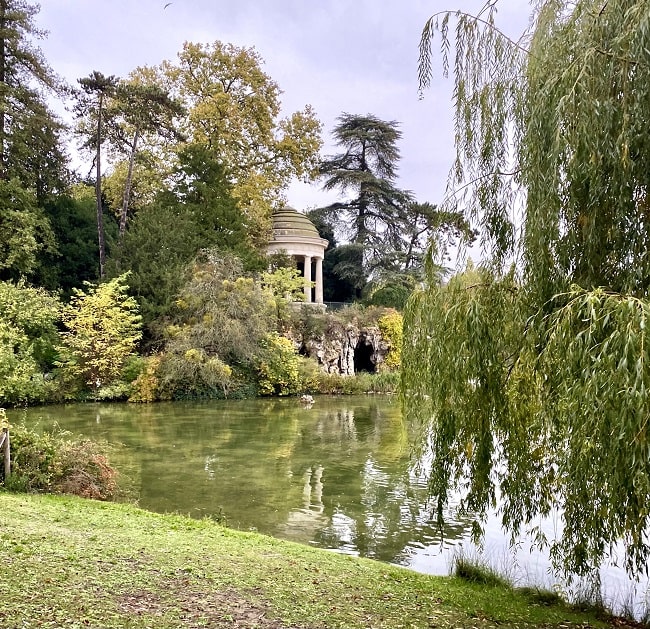
Bois de Vincennes / île de Bercy & île de Reuilly. @ Amy Kupec Larue
TRAIN STATION: The city’s biggest metro station? Its biggest overall train station? Earth’s largest underground station? In all cases, the answer is Châtelet–Les Halles. Three stations in one, this is a point of convergence for five metro and three RER lines. Hence the 19 entrances and, at least in 2023, up to 750,000 travelers passing through each day and 120 trains stopping every minute during rush hour. In terms of its size, consider this: the most distant of Châtelet–Les Halles’ platforms are some 800 meters apart — a fact which seems wholly believable whenever one is trekking wearily between them.
SHOP: That’ll be Galeries Lafayette’s Haussmann branch, by Place Diaghilev in the 9th. Its three buildings collectively span 70,000m2, with one chunk of that given over to Europe’s largest shoe department.
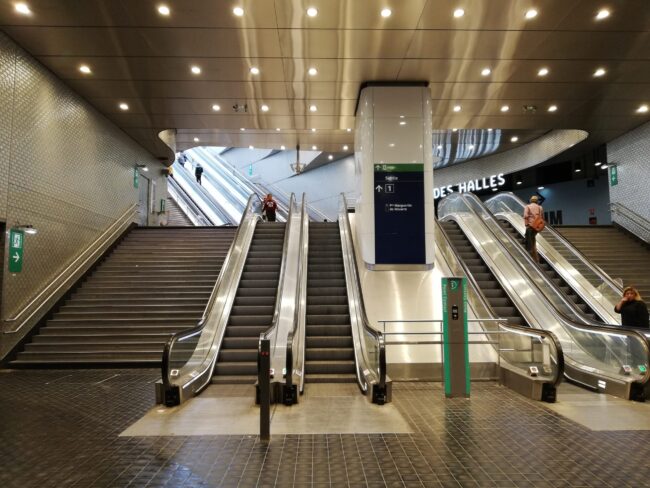
Châtelet Les Halles station. Photo credit: Idris2000/ Wikimedia commons
Paris’s oldest…
HOUSE: People used to give this award to the timber-framed charmer found at 3 Rue Volta — until historical records exposed it as a 17th-century replica. Now the consensus vote is 51 Rue de Montmorency, aka the Maison de Nicolas Flamel. Thanks to its eponymous manuscript seller (and alleged alchemist), this was erected in 1407 as a house for the poor. Now it’s rather the opposite, hosting Auberge Nicolas Flamel, whose French fine dining has earned a listing in the Michelin Guide.
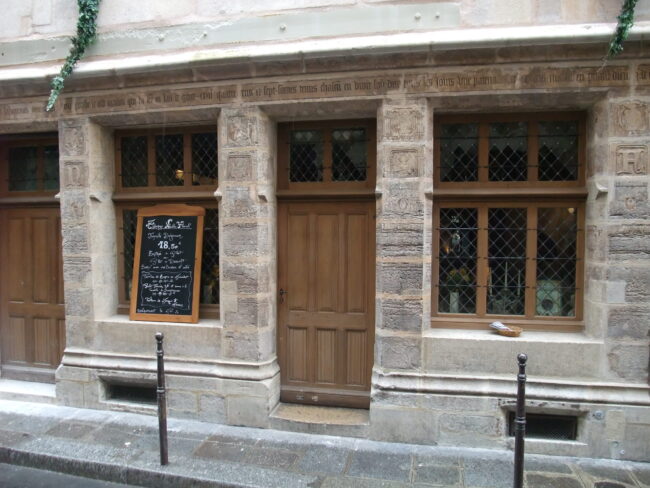
House of Nicolas Flamel. Photo credit: Thiebes / Wikimedia commons
RESTAURANT: Saint-Germain-des-Prés’s traditional Le Procope claims this title, saying that it has been serving “intellectuals, artists and lovers” including Voltaire and Rousseau since 1686. Alas that’s not true: first of all, the original cafe closed in 1872, with today’s restaurant not opening until 1957. Even if it was true, traditional La Petite Chaise, on Saint-Germain-des-Prés’ fringes, is older, having launched as an inn back in 1680. Atop a six-floor building on Quai de la Tournelle, the Michelin-starred La Tour d’Argent claims to date back still further, to 1582, but historians have poured scorn on that.
BRIDGE: It might translate as “New Bridge,” yet the now-padlock-free Pont Neuf is actually Paris’s longest-standing river crossing. Recently turned into a giant grotto by JR to mark the 40th anniversary of Christo and Jeanne-Claude’ssimilar installation, it was completed back in 1607.
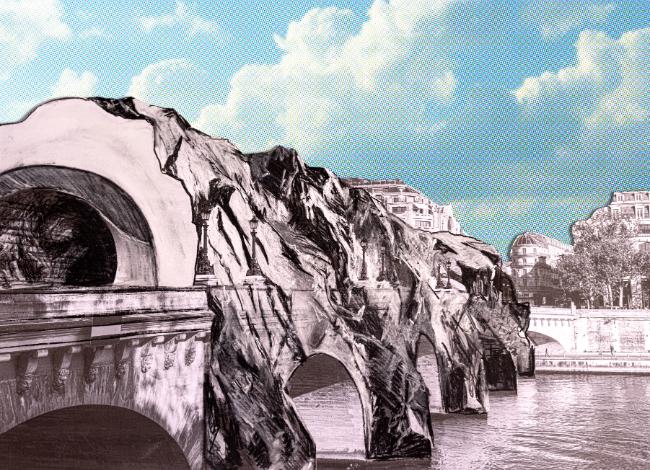
Caverne du Pont Neuf. Photo: Courtesy Atelier JR. © 2026 Atelier JR
Paris’s widest…
STREET: No Parisian thoroughfare can rival the girth of Avenue Foch, which extends to a width of 120m as it grandly connects the Arc de Triomphe and Bois de Boulogne. Side lanes, lawns and gardens all help to plump out the main road here.
Paris’s longest…
STREET: Surely that’s Boulevard Périphérique? Well, yes, given that the ring road stretches for more than 35 kilometers. Except: is it really a street? That same question could also be leveled at the right bank’s 13km-long Voie Georges Pompidou expressway. Veto both and the winner becomes Rue de Vaugirard, which extends for 4.3km between Place de la Sorbonne and Porte de Versailles. It does so while largely remaining ramrod-straight; no surprise, then, that this was originally a Roman road.
METRO LINE: That’ll be the 24.3-km Line 8.
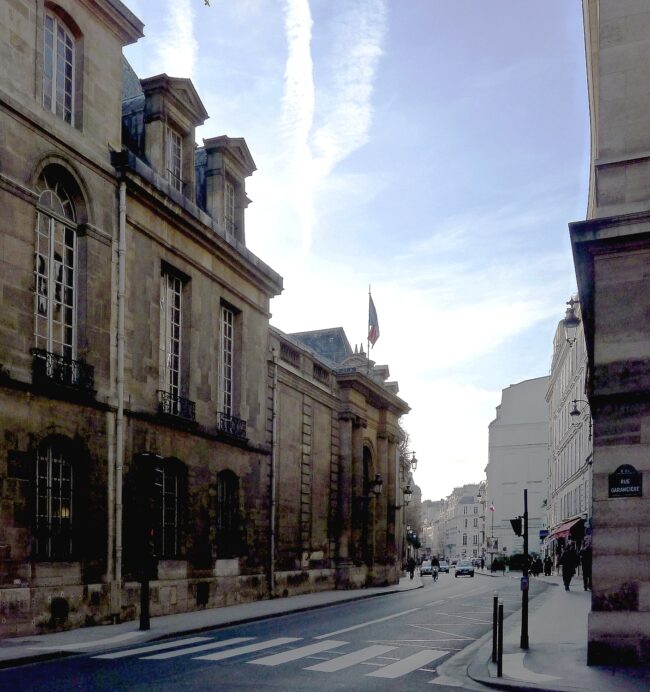
The rue de Vaugirard in front of the Palais du Luxembourg which houses the Senate. Photo: Mbzt / Wikimedia commons
Paris’s shortest…
METRO LINE: At the other end of the scale is tiddly Line 7bis, whose route is just 1.3 kilometers in length.
GAP BETWEEN METRO STATIONS: We think this occurs on Line 10, with Mirabeau and Église d’Auteuil stations only 268 meters apart.
Paris’s fastest…
METRO LINE: Staying with the metro theme, Paris’s speediest line is number 14. The average speed here is a respectable 40 kph, while some trains attain 80 kph. Having unusually large intervals between stations helps, of course, as does comparatively new technology.
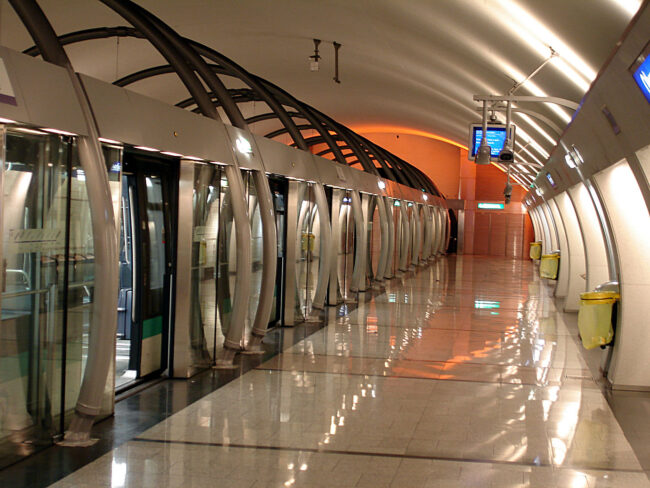
Olympiades station on the Paris metro line 14. Photo: Clicsouris / Wikimedia commons
Paris’s fastest…
METRO LINE: Most cynical Parisians would bet their maison that this is the aforementioned, notoriously-sluggish Line 10. Apparently not: with an average speed of 21.6 km/h, the winding, get-there-when-we-get-there Line 4 takes the dubious accolade.
Paris’s deepest…
METRO STATION: One last metro fact: the city’s deepest station is Abbesses at 36 meters underground. For a work-out, consider leaving via its 176-step pair of fresco-lined spiral staircases.
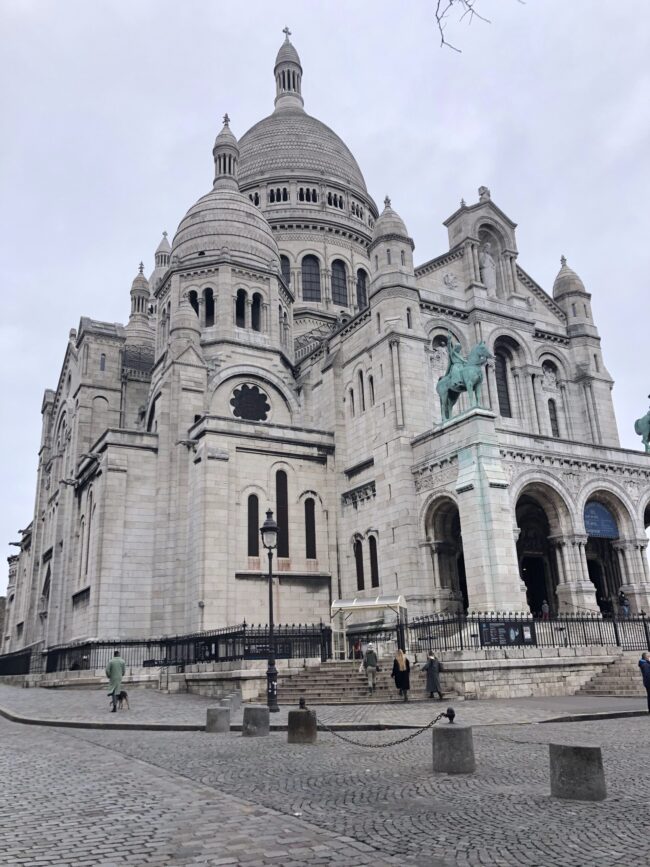
Sacré-Cœur. Photo: Jill Amari
Paris’s highest…
POINT: Paris’s premier butte? It’s the Calvaire cemetery beside Montmartre’s Saint-Pierre church, some 130.5 meters above sea level. That said, this spot is closed to the public except on All Saints’ Day. At any other time of year, the highest point you can reach is on Belleville’s Rue du Télégraphe — look for a plaque outside No.40, marking the spot where Claude Chappe demonstrated the first telegraph system in 1793. Opposite another cemetery, Belleville’s own, you’re currently 128.5m above sea level.
Paris’s steepest…
STREET: Again, there are two available answers here. Steepest of all is Rue Foyatier, back in Montmartre, with a vertigo-inducing gradient of 36 per cent. However, climbing towards the Sacré-Cœur, this is really a massive staircase — with 222 steps in total — so you may want to disqualify it. If so, first place goes to Rue Gasnier-Guy, over in the 20th near Père Lachaise, whose incline is a still-thigh-testing 17.4 per cent.
Have we overlooked anything? Have we got anything wrong? Please do put us right, or make suggestions for what we could add here.
Lead photo credit : The Tour Triangle under construction in January 2026. Photo credit: Nicolas22g/ Wikimedia Commons
More in Auberge Nicolas Flamel, Tour Triangle
Related Articles