In Search of a French Cookbook
Touring Paris’s bookstores and bouquinistes in search of a gastronomic gift
She might be retired as a cookery teacher, yet my dear mother still loves few things more than making magic happen in the kitchen or rooting through her many recipe books for inspo. Among the latter, none of Mum’s 100-plus collection is more dog-eared and better-thumbed than 1961’s inaugural English-language edition of Larousse Gastronomique – aka the French culinary encyclopaedia.
With a significant birthday imminent, I decide to try and see if I can source another such cookbook for her collection in Paris. The parameters are simple: it must be written in English but focused on French fare; it must be of a decent, pleasing size – less velouté, more coq au vin; and it must have alluring photography.
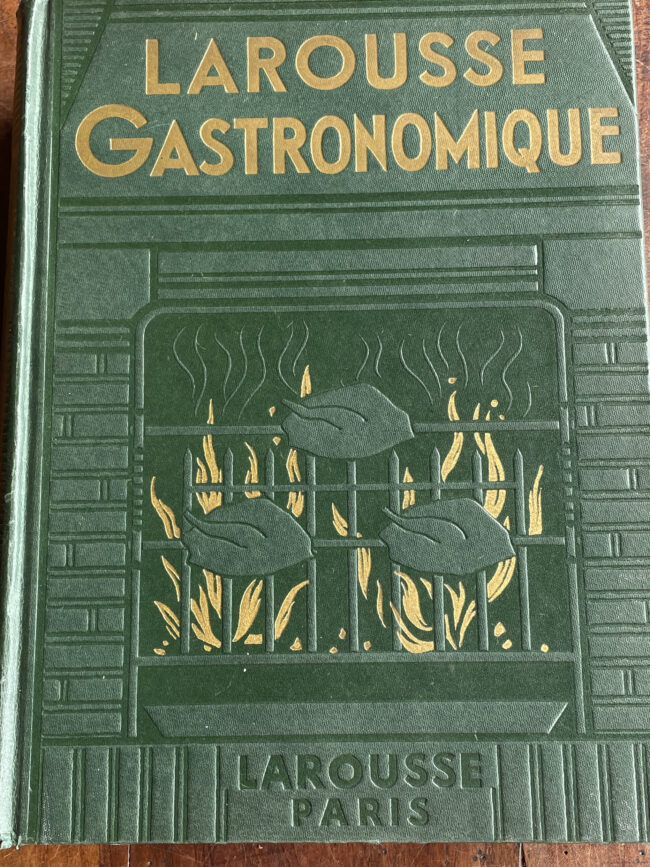
Larousse Gastronomique, 1938 edition. Credit: wikimedia commons
Librairies near the Louvre
The obvious recourse here is to visit Librairie Gourmande at their newish digs near Montparnasse on Rue Vavin. Yet, for some deep-seated reason, I feel inclined to resist this, at least initially — perhaps in the name of unearthing a rarer gem, or perhaps because I’m childishly resentful that LG has forsaken its convenient shop on Rue Montmartre.
So where else to find a cookbook in Paris? Finding myself near the Tuileries, I begin, without a great deal of hope, at Smith & Son, the WH Smith relation present near Concorde since 1870. For all that history, this English-specialist shop always feels quite glossy, touristy and inauthentic to me, and so it proves again.
The cookbook selection is more handsome but equally meager, too nouvelle focused and mostly in French some 300m down Rue de Rivoli in posher, plaint-lined Librairie Galignani. As this also immediately seems like a dangerous place – the kind where I could easily splurge €40 on a pretty art book straight out of some faux-Emily in Paris life I’ll never actually lead – I scarper sharpish.
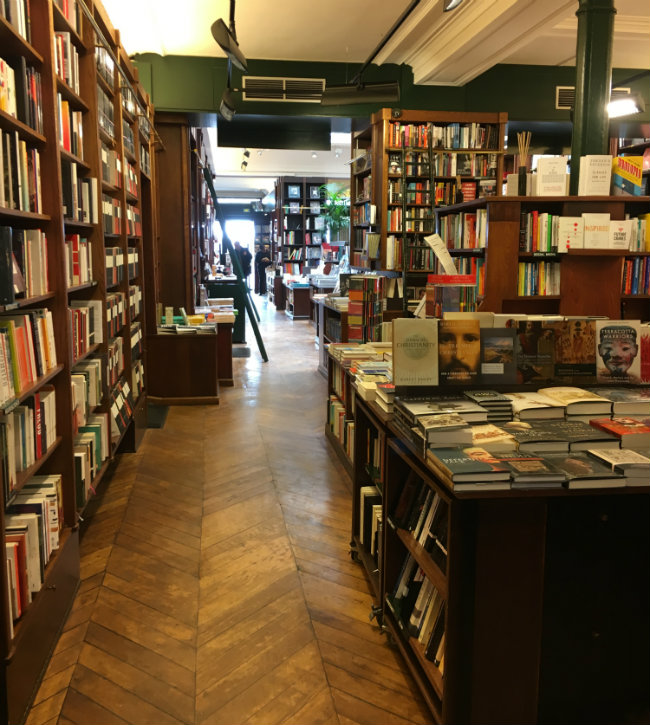
Librairie Galignani. Photo: Ulrike Lemmin-Woolfrey
Queues and bouquinistes
Paris book basics: if in doubt, make for the Left Bank. So that’s exactly what I do, crossing the padlock-cleansed Pont Neuf, zig-zagging across Île de la Cité and promptly abandoning any idea of trying Shakespeare & Company upon sighting its ever-lengthy line. The bulk of people waiting to enter here always resemble box-ticking tourists rather than bookworms; are any books actually sold there now? It’s almost become a bookshop concept store. A bookshop concept store with bouncers, no less.
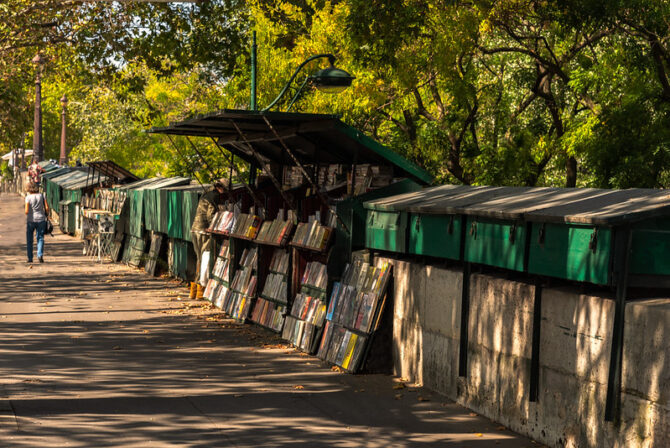
The man I instead seek out, via a 10-minute stroll along the Seine, has also been a local stalwart. Back in place after the Olympics – “I’ll chain myself to my boxes,” he threatened, when told to vacate for the 2024 summer opening ceremony – Alain Huchet is one of Paris’s iconic bouquinistes, those al-fresco riverside booksellers as integral to city life as gridlocked streets and pointless strikes. Found most afternoons at 7-9 Quai de Conti opposite the Paris mint for more than a quarter of a century now, Huchet specializes in vintage cookbooks and gravures (fine art books) related to food and wine. French gastronomy is a heavy focus.
Belatedly, I realize an all-too-foreseeable problem. Not the fact that his books are plastic-wrapped – M. Huchet will open them if requested – but rather that they’re not cheap. Subconsciously, I’ve lumped bouquinistes in with Les Puces stalls and second-hand shops; in fact, their wares are at the sought-after, antiquarian end of the used market. Most volumes here cost well north of €50, and while I love my mother dearly, I’m not that rich. Luckily, M. Huchet is distracted by a wealthier customer as I shamefully sneak off to Monoprix in search of a meal deal.
Eau de bookshop
What now? Ducking into the Latin Quarter, I treat myself to a rummage in the charming Abbey Bookshop. Not only does this treasure trove primarily focus on English-language titles, but it dispenses complimentary coffee and tea from a self-serve machine. Win, win! My caffeine rush is briefly enhanced by some adrenaline as I unearth some tempting cookbooks, including a baking option by Julia Child, but nothing quite lands right.
Over in Gibert Joseph there’s no need to brave the narrow escalators as livres des cuisine are found on the ground floor. Alas the exceedingly French selection underwhelms. Gibert’s English offerings are, I deduce, mostly limited to fiction. Fair dinkum.
This pocket of Paris, around the Sorbonne, is bibliophile heaven. Heading vaguely, resignedly for Librairie Gourmande, I dip next into San Francisco Books and Librairie Reiffel, mainly because both are enchanting dens replete with ladders, steep shelves and eau de paperback, that particular, pleasing scent. No dice on the cookbook front, and nor opposite Jardin du Luxembourg in the two-part “anglophone” (so its awning proudly declares) Red Wheelbarrow, which is a bit more spacious but just as liable to appear in a Woody Allen movie.
Gourmande for gourmands
Libraire Gourmande’s new premises can’t be resisted any longer. A bit stiff-legged, I weave across the garden, admiring its retro carousel afresh, and enter the new, perky space. This is actually something of a homecoming for the brand, with Geneviève and Marcel Baudon’s original Librairie Gourmande opening near here on the Left Bank in 1985.
Today’s well-ordered shelves contain vegetarian sections, gourmet literature and even a kids’ section. There are books about ice cream, sourdough and sauces; then books about gratins, mocktails and mushrooms. Most are in French but a good smattering of options in English also await. One of them, in the used section, is Patricia Wells’ The French Kitchen Cookbook, a collection of recipes inspired by bistros across the land. It’s plump, passionate and resolutely unhealthy, just like its temporary new owner. “That’ll do,” I say.
Though I could have saved lots of time by simply coming here first, it was heaps of fun roaming bookshops as I crossed the city on a quest. Better yet, I might soon end up eating some yummy pommes a l’huile as a result.

Lead photo credit : Bouquinistes. Photo credit: Claude Attard/ Flickr
Related Articles