
Revolution and Resistance: A Walk around the Faubourg Saint Antoine

- SUBSCRIBE
- ALREADY SUBSCRIBED?
BECOME A BONJOUR PARIS MEMBER
Gain full access to our collection of over 5,000 articles and bring the City of Light into your life. Just 80 USD per year.
Find out why you should become a member here.
Sign in
Fill in your credentials below.
Bookended at its western end by the Place de la Bastille and at the eastern end by the Place de la Nation where the 11th, 12th and 20th arrondissements intersect, the Faubourg Saint Antoine was once known for its radicalism. Originally it was a center for cabinetmaking and furniture manufacture, manual trades which engendered a fierce sense of political injustice. Nowadays, the old workshops are home to architecture and graphic design agencies, but gentrification has not entirely taken over and traces of the area’s working class past remain. A stroll around the area is well-rewarded.
We start at the Marché d’Aligre. Named after the wife of one of Louis XIV’s counselors, the original market was established in the open square in 1779. Eighteenth century maps of Paris show clearly the rapid development of this suburb just outside the city walls: on the famous Turgot map of 1730 the area is still very rural with large expanses of orchard and market gardens, interspersed by the odd country house, or “folie,” and dominated by the aptly-named Abbaye de Saint Antoine des Champs (St Anthony in the Fields).
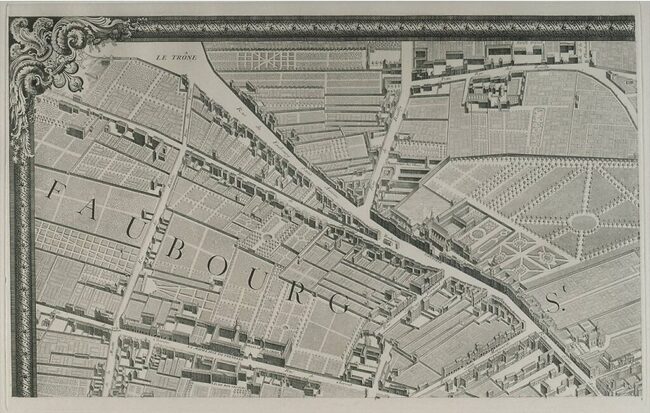
Plan Turgot – Planche n° 1 – depicting faubourg Saint-Antoine
Fast forward 50 years and most of those green spaces had been built over and the Faubourg had become a fully-fledged industrial suburb, to the extent that a local market was established so that people didn’t have to trudge all the way to Les Halles. The clock tower in the center of the Place d’Aligre – known locally as the Mairie d’Aligre – is the last remaining building from that era. The covered market, the Marché Beauvau, named after the last Abbess, dates from 1843.
Today, the Marché d’Aligre is one of Paris’s most popular markets. Fruit and vegetables are attractively laid out on the stalls while the Marché Beauvau specializes in fish, meat and cheese and specialist food stalls. If you are a coffee aficionado, head for Early Bird, a micro-roastery run by a friendly Irishman, Joseph. As well as bags of their own coffee you will find a range of Irish specialities including jams and marmalades, Irish gin and whiskey.
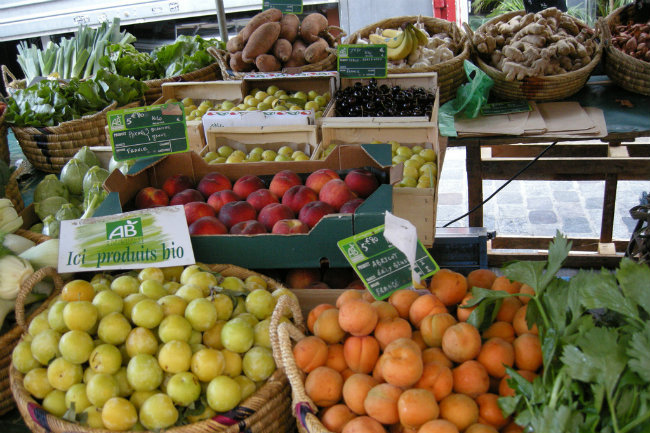
Marché d’Aligre street market in Paris. Photo: Nicolas Toper/Flickr
The area has gained a reputation as a bit of a foodie haven. The Rue d’Aligre houses a number of specialist food stores, including Les Chocolats d’Aligre which sells products from a range of French artisan chocolatiers, and L’Épicier, a treasure trove of artisan grocery products including terrines, conserves, and biscuits. Sabah on the corner tempts the passerby with its large selection of olives next to the window and, inside, everything you need to create an authentic Middle Eastern or North African meal: spices, pulses, couscous and bulgar wheat, pomegranate molasses, rosewater. Near the Square Trousseau the caviste Le Baron Rouge specializes in natural wines and offers a bring-your-own-bottle refill service straight from the vat. If it’s fine weather, pick up a delicious pastry from Le Ble Sucré and sit in the shady park.

Le Baron Rouge. Photo credit: Wikimedia- Gideon
Leaving food behind, the broad Rue du Faubourg Saint Antoine is the main thoroughfare of the district. One of its distinctive features are the narrow passages running at right angles to the street with names like the Passage de la Main d’Or and the Cour du Saint-Esprit. This is where the cabinetmakers had their workshops. Wander down them and be momentarily transported back 200 years, for they retain many buildings from that time, distinguishable by the long windows on the ground floor that let in the maximum amount of light. Furniture making survives as new craftspeople have reclaimed some of the workshops, but the doyen is Rinck in the Passage de la Bonne Graine. Established over 180 years ago, it maintains the tradition of top class handmade cabinetry alongside the modern profession of interior design.
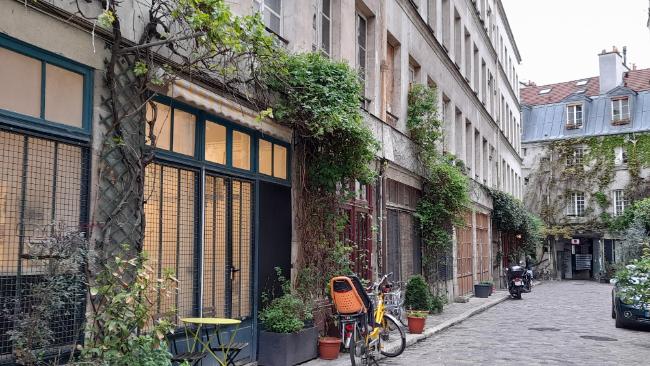
A pretty redevelopment of a traditional woodworkers’ passage. Photo: Pat Hallam
Turning towards the eastern end of the Rue du Faubourg Saint Antoine, the atmosphere becomes less gentrified. Prominent is the Hôpital Saint Antoine – the last vestige of the Abbaye, which was closed during the Revolution. Just across the road stands an isolated stone building. It might be confused with a toll booth but it is actually a regard or water fountain. As the population increased, the lack of clean water became an acute problem but a regard like this ensured a safe supply. It is still in working order and water flows from the (modern) faucets.
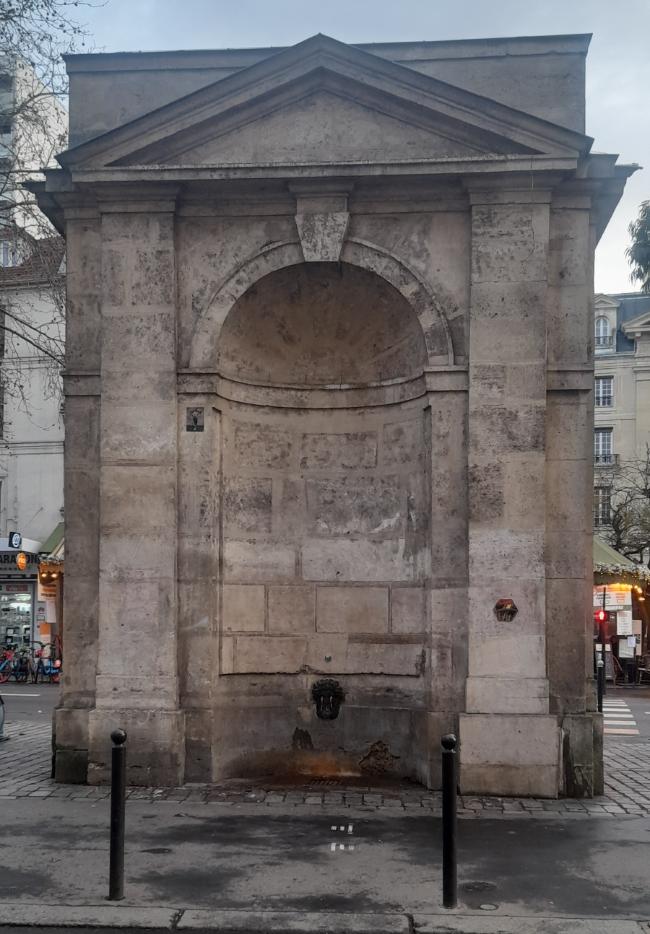
The regard (water fountain) in the Rue du Faubourg St Antoine. Photo: Pat Hallam
A few meters further on, the Rue du Faubourg Saint Antoine meets the Rue de Montreuil, originally one of the country lanes bringing produce from the surrounding villages to the new market. Streets like the Rue de Charonne, Rue de Reuilly, Rue de Charenton belie their similar origins. But the Rue de Montreuil became notorious for a dramatic fire that broke out in the last months before the outbreak of revolution.
Outside number 34 two plaques commemorate the Folie Titon, the original country house which stood here, and the Reveillon wallpaper factory which replaced it. By the 1760s Jean-Baptiste Reveillon had risen to become the royal wallpaper manufacturer to Versailles and by extension, the aristocracy. In the last week of April 1789, tensions were running high in Paris as people were anxious about the imminent opening of the Estates-General, the nearest France had to a parliament. A rumor spread in the Faubourg that Reveillon intended to reduce his workers’ wages.
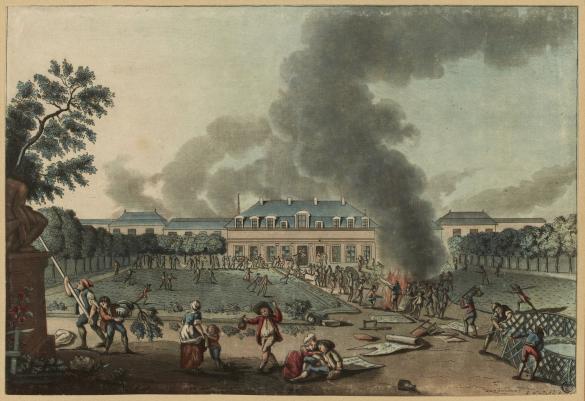
The ransacking of the Folie Titon : looting of the Réveillon house in the Faubourg Saint-Antoine, on April 28, 1789. Musée Carnavalet. Public domain
Although Reveillon immediately refuted the idea, a mob built a life-size effigy of the man and paraded it through Paris, ending up outside the Hôtel de Ville. With night falling, they abandoned the effigy and dispersed home. But the following morning, they congregated again outside the wallpaper factory and set it on fire. Retribution from the authorities was swift and brutal but it was one of the last major events before the Revolution actually broke out. The factory was never rebuilt and in the mid-19th century the site was bought and the ruins demolished to make way for the Cour de l’Industrie a little further down the street.
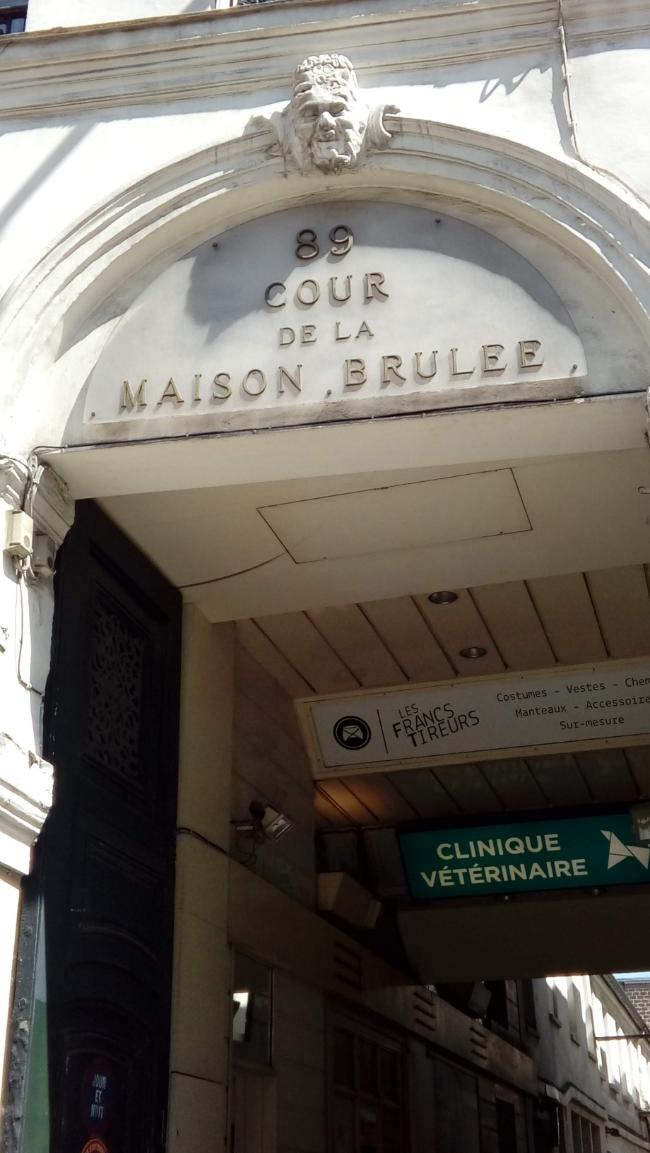
Intriguing name for a passage. Photo: Pat Hallam
It is one of the best-preserved and largest courtyards in the area. It was laid out in 1853 on the site of the old Reveillon factory to combine artisan workshops and lodgings for the workers. There are actually three courtyards in a Z-shape and the buildings are in that attractive half-timbered style that the French call colombage. In 1908 it was ravaged by fire but it managed to survive through the 20th century.
From the 1970s, as the traditional artisans retired or died, the buildings were taken over by artists looking for cheap studios, but the buildings themselves became more and more dilapidated. By the 1990s, as the area started to be gentrified, developers began eyeing up the Cour for demolition. A rescue association was formed, however – Les Ateliers Cour de l’Industrie – and in 1994 it succeeded in getting the facades added to the appendix of the list of France’s historic monuments.
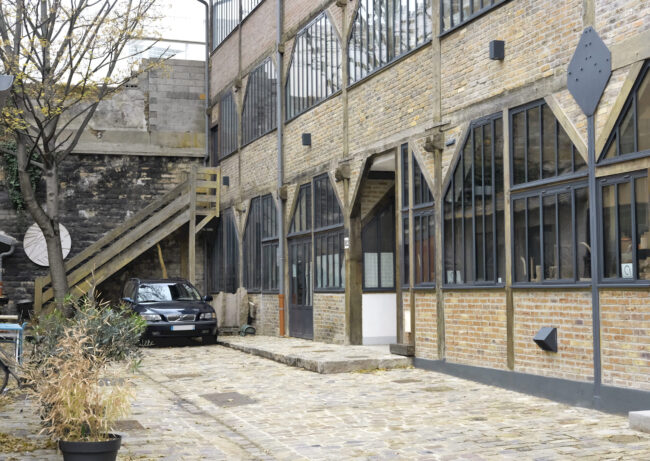
A courtyard in the Cour de l’Industrie. Photo credit: Mbzt / Wikimedia commons
In 2003, the courtyards were bought by the Ville de Paris and between 2011-2017 the buildings were restored, but with a light touch to preserve their character. Together, they are a fine example of the industrial architecture of this area of the mid-19th century. They now house around 50 artisans and artists, some of whom still carry on the traditional crafts of furniture making and restoration, tapestry weaving, and wood-gilding, plus printing and engraving, and cutlery-making. Others are painters, sculptors, ceramicists, jewellery-makers, a guitar-maker, and even a wigmaker and someone who makes archery longbows!
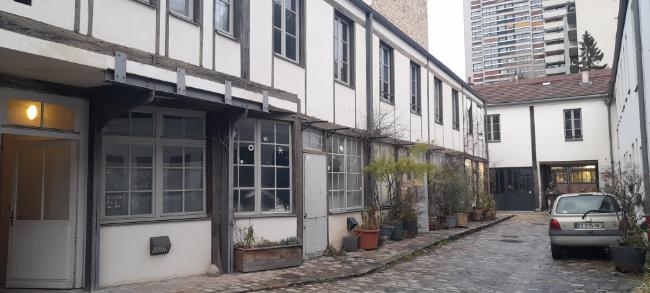
In the Cour de l’Industrie. Photo: Pat Hallam
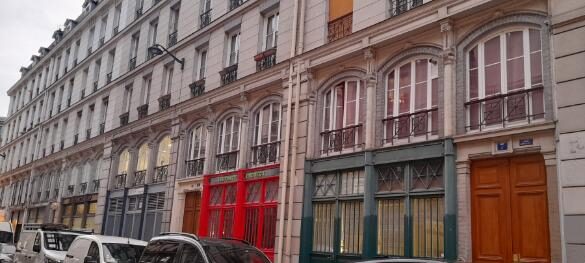
From here, continue to the end of Rue de Montreuil where it meets Boulevard Voltaire, and turn down into the Rue des Immeubles Industriels. As you walk down the street you’ll notice an unusual uniformity about the buildings, even by Parisian standards. The fact is that these buildings were put up in the 1870s to provide healthy homes and workshops for working people. At the time of their construction, this area was a very insalubrious district with lots of small courtyards linked by narrow, unsanitary streets. There are 19 buildings in all, deliberately designed to house workshops on the ground floor and the entresol, or mezzanine, while the floors above contained apartments to house the workers.
The architect, Émile Leménil, was heavily influenced by the ideas of the utopian socialists which were popular at the time, where workers lived in pleasant, healthy homes centered around active community engagement. This street reflects his attempt to put that into practice. The construction materials that he used were quite innovative as well: colored brick as well as stone, and cast iron, which was a bit of a wonder material at the time, for the pillars. The properties were collectively heated by an immense furnace in the basement of the central building, built by one of France’s most enlightened industrialists of the time, Jean-François Cail. His machine provided hot water and gas lighting to every apartment – almost unheard-of for working class homes at the time.
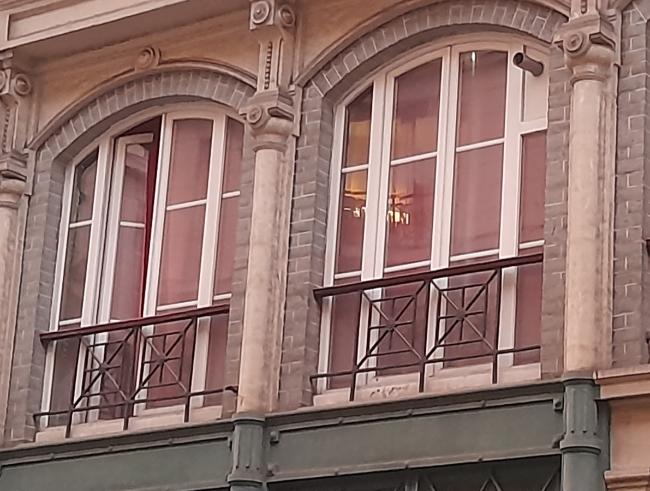
Polychrome brick and cast iron pillars on the entresol in the Rue des Immeubles Industriels. Photo: Pat Hallam
From the early 20th century onwards the street saw an influx of foreign immigrants, notably Polish Jews. They settled and made the street a micro Jewish quarter where Yiddish became the most-spoken language. The furniture workshops were turned over to garment-making. Several of these Jewish residents fought for France when war broke out in 1939. As they were not French-born they couldn’t join the regular armed forces but they fought in the French Foreign Legion, or became Resistance fighters.
One of the best-known was a young man called Marcel Rajman, who joined a separate wing of the Resistance for non-French fighters called the FTP-MOI. Rajman is best remembered for his part in the killing of Julius Ritter in September 1943. Ritter was a doctor who was in charge of the STO, or Service du Travail Obligatoire. This so-called service was responsible for rounding up people to send into forced labour to support the German war effort. For his role in Ritter’s killing, Rajman was arrested and shot in February 1944 with his fellow conspirators. He was 21. He featured on a Nazi propaganda poster to warn the populace of the fate of terrorists and resistants. Almost all of the other Jewish residents in the street were rounded up and deported to the death camps.
And this marks the end of our stroll around the Faubourg Saint Antoine. From here it is a short walk to the Place de la Nation where you can pick up the RER A as well as the métro and numerous bus services.
Lead photo credit : Rue des Immeubles Industriels. Photo: Pat Hallam
More in Faubourg Saint Antoine, Marché d’Aligre
Related Articles

By Pat Hallam