
Flâneries in Versailles: Explore the St Louis District

- SUBSCRIBE
- ALREADY SUBSCRIBED?
BECOME A BONJOUR PARIS MEMBER
Gain full access to our collection of over 5,000 articles and bring the City of Light into your life. Just 80 USD per year.
Find out why you should become a member here.
Sign in
Fill in your credentials below.
This is the 47th in a series of walking tours highlighting the sites and stories of diverse districts of the Paris region
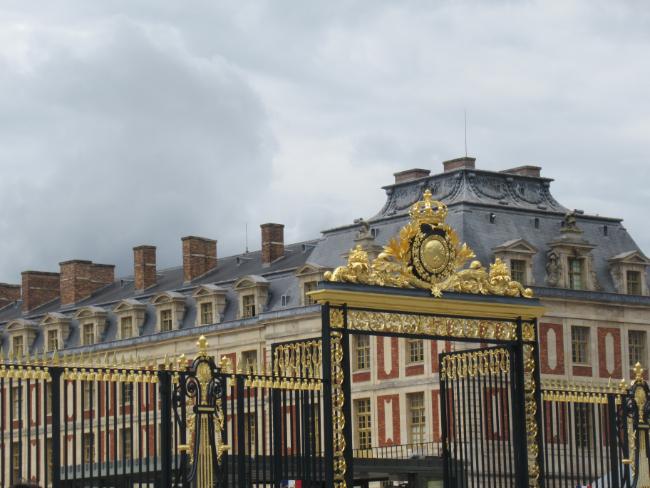
The gates of the Palace of Versailles are enticing, shiny black and glistening gold with the exquisite façade of le château as a backdrop, but this time I walked straight past them. My plan for the afternoon was a wander around the historic St Louis district of Versailles, the area of town southwest of the palace which promised a number of intriguing sights. A bright yellow sign pointed to the quartier historique St Louis, promising that my first goal, the Salle du Jeu de Paume, was just a 2-minute walk away.
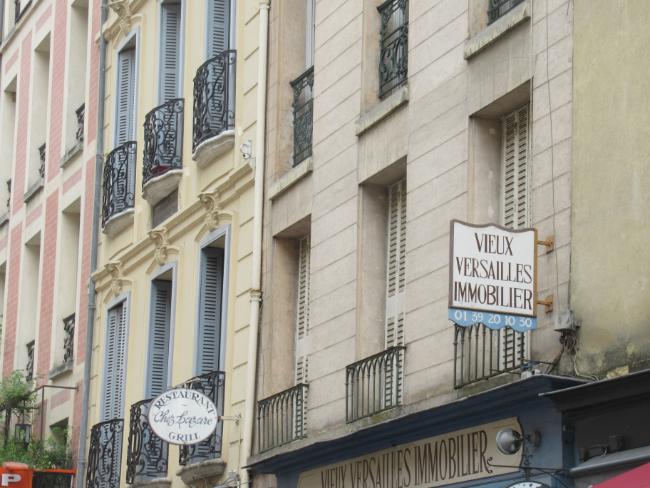
In the bustling Rue de Satory, the lampposts were topped with golden crowns and the elegant, 18th-century houses were painted in pastel shades, many of them restaurants at ground level. A right turn into the narrow Rue du Vieux Versailles was a reminder that this is very much old Versailles, a historic district which grew up around Louis XIV’s shiny new palace and was home to the kitchens and vegetable gardens which kept him and his court fed. But today it has its innovative side, exemplified in the punning title of the personali’thé librairie where books in the window included Sophie Kinsella’s Le Burn-Out and you can enjoy free tea and cake while browsing the selection.

My goal was the Rue du Jeu de Paume, home to a little building which has long intrigued me, namely the indoor court built alongside the Palace of Versailles to host the early form of tennis known as jeu de paume. It’s called that because it was played by batting a ball back and forth with one’s paume, ie palm. Louis XIV had been advised to play the game as a healthy form of exercise and among his courtiers was Nicolas Creté, his official jeu de paume player, so it makes perfect sense that the court was built in 1686, just four years after Louis moved his court to Versailles.
Inside I found a small exhibition, explaining how the game evolved in the Middle Ages, first played bare handed or perhaps wearing a leather glove and then with racquets – there was an example on display – in the early 16th century. By the Sun King’s era there was also a net and a more precise set of rules, all of which showed how it was becoming the forerunner of modern tennis. Only one bounce of the ball was allowed, the scoring system was based around 0, 15, 30 and 40 points. Louis XIV was, say the history books, an enthusiastic and skilled player of jeu de paume and I tried to picture him here, running and sweating, perhaps insisting that his opponents let him win.
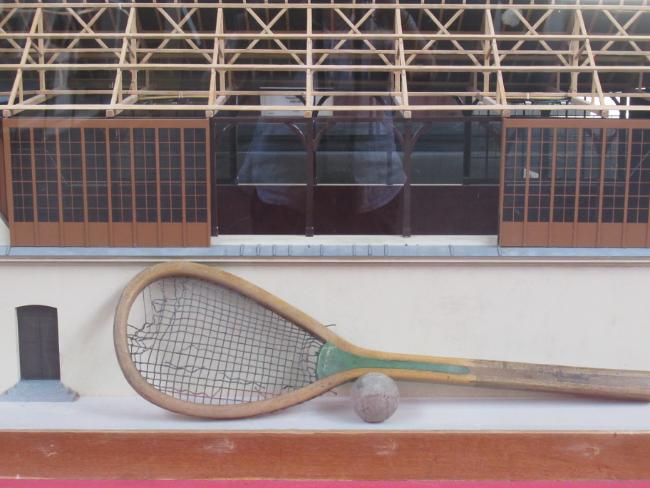
Jeu de Paume. Photo: Marian Jones
Fascinating though this was, it was not the main reason for my visit. I wanted to see the site of the “Tennis Court Oath,” where a key speech, made there in June 1789, is still known today as the foundation of French democracy. It all began with a financial crisis which forced the king, Louis XVI, to call the Estates General together, three groups representing the clergy, the nobility and, the group known as the Third Estate, everybody else. The last group didn’t like what was proposed and set up a separate meeting, here in the Real Tennis Hall where eventually all but one of the 577 members in attendance signed an oath which eventually led to the French Revolution.
So, high drama had played out here. Busts of the key figures lined the walls and a life-size statue of Jean-Sylvain Bailly, arm raised, faced into the room. He had addressed the crowd here that day and persuaded them to risk an act of defiance against the king, to sign an oath promising that they would stick together until a written constitution was established. Their solidarity forced the king to sanction a new group, the assemblée nationale, which became the forerunner of today’s French parliament.
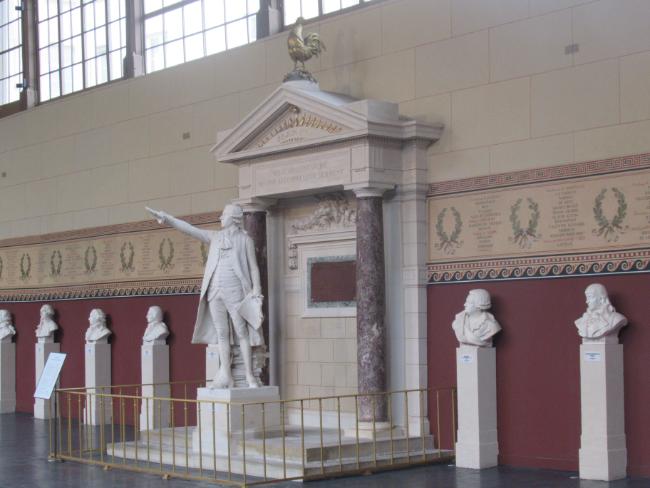
Jeu de Paume. Photo: Marian Jones
The Jeu de Paume is now a museum, basically a plain room just a little bigger than a modern tennis court, where Bailly’s statue stands in front of a model portico. Gazing down at him from a pediment above sits the golden cockerel which became a popular symbol of the people during the revolution. Nearby on the wall is an engraving of the famous text, beginning “Nous jurons de ne jamais nous séparer …” (“We swear never to separate…”) and at one end is a reproduction of Jacques-Louis David’s unfinished fresco which captured the momentous event, The Tennis Court Oath.
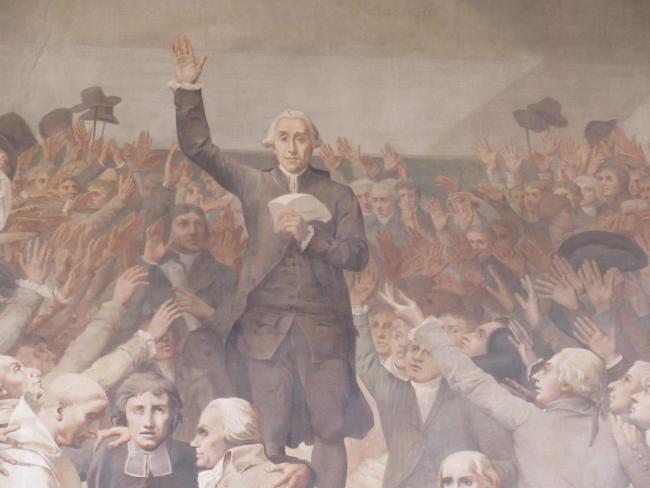
Jeu de Paume. Photo: Marian Jones
Louis XIV may be all over this quartier, Louis XVI’s undoing began here with the Tennis Court Oath, but it was Louis XV who instigated its most spectacular building, the Cathédrale Saint-Louis. It sits proudly in a fine square, where palm trees in large planters and a statue or two set the tone. A bronze monument is dedicated to l’Abbé de l’Épée, a clergyman born in the Palace of Versailles who preached in the slums of 18th-century Paris and, moved by the plight of two deaf children he encountered, devoted his life to helping others like them. He promoted the use of sign language, founded the first public school for the deaf and is remembered as the “Father of the Deaf.”
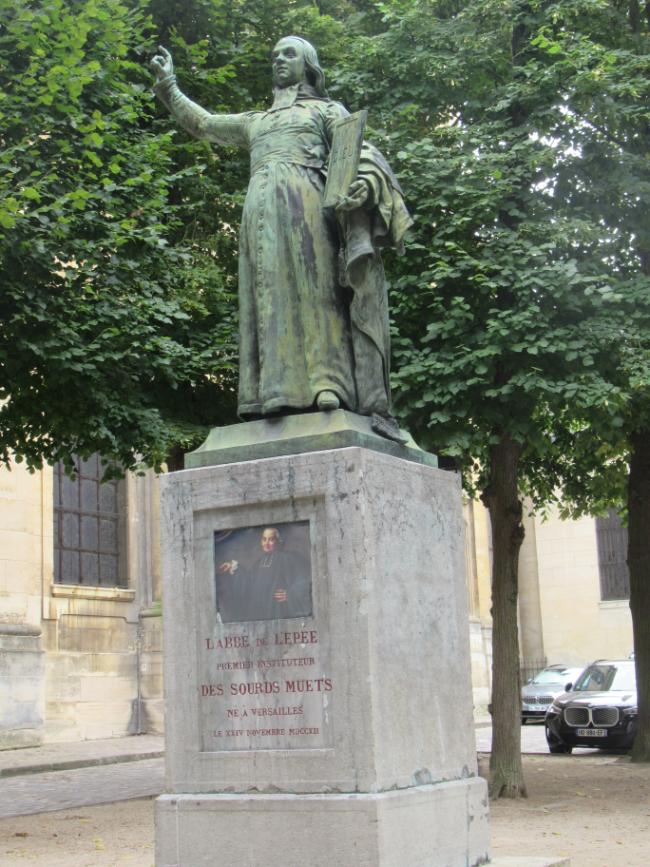
Statue of l’Abbé de l’Épée. Photo: Marian Jones
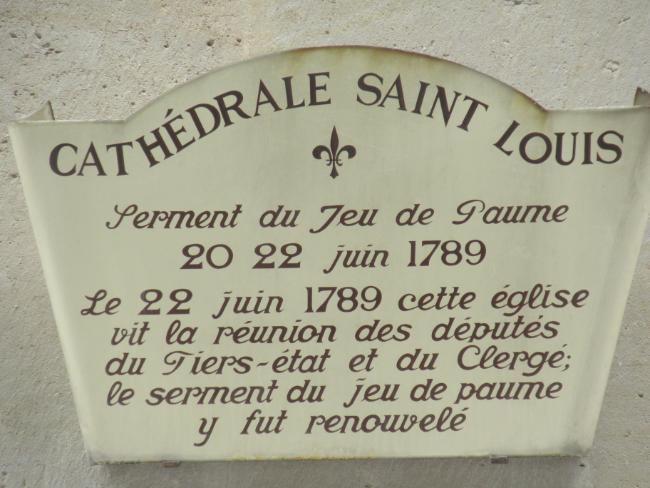
The clean lines of the cathedral’s pillared façade have classical overtones, yet the curved domes of its twin towers are more baroque in style. A plaque explains that it too played a role in the revolution, for two days after signing the oath, many of the Third Estate gathered here, along with some members of the clergy, to renew their pledge. Hearing that the movement was spreading like this would surely have underlined to the king that he was in great danger. As I wandered the side chapels and looked up at the stained-glass windows, organ music played. When it stopped, applause broke out and I realized I’d gate-crashed a little concert, but no one seemed to mind.
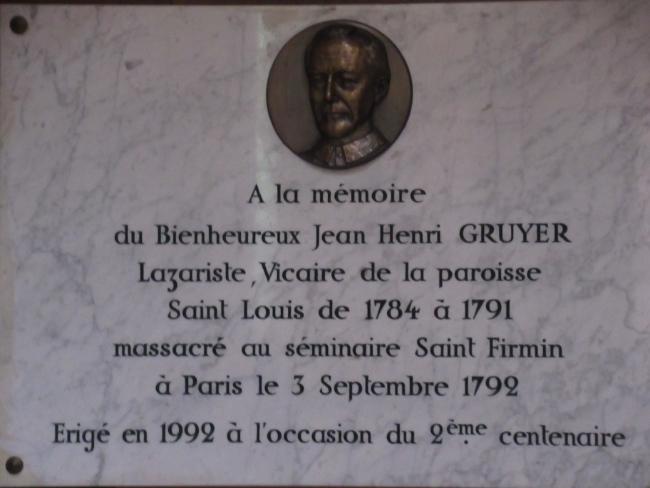
The music made a peaceful backdrop as I read the prayer boards, each illustrated by a biblical quotation. Some were linked to the needs of the sick or of refugees, others referenced the ideals of hope or peace. The very first one was based on the words from the Sermon the Mount which begin Heureux les artisans de paix (“Blessed are the peacemakers”). It contrasted jarringly with a nearby plaque in honor of Jean Henri Guyer, Vicar of this Parish from 1784-91. He, like so many clergy, was a victim of the Revolution and alongside 76 other priests was massacred at the Saint Fermin Seminary in Paris on September 3rd, 1792.
Exactly opposite the cathedral was the Potager du Roi (King’s Vegetable Garden), established by Louis XIV. Immediately inside the garden was a statue of its creator, Jean-Baptiste de La Quintinie, although I thought that, with his smart frock coat and tumbling curls, he didn’t really look like a man of the soil. How wrong can you be? Originally a lawyer, his passion was horticulture and he transformed this damp little area, which sniffier courtiers called ‘the stinking pond’, into a haven of productivity which sent tons of fruit and vegetables to the palace each year. He loved to experiment and it was thanks to him that the royal court could enjoy strawberries in March and asparagus in December. When his master gardener died, Louis apparently lamented that ‘We have suffered a great loss that we can never repair.’
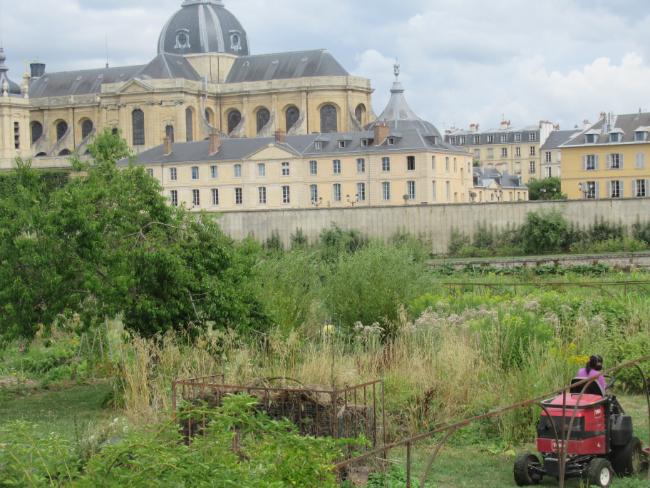
The Versailles cathedral and the Potager du Roi. Photo: Marian Jones
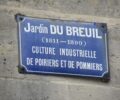
It’s still very much a working garden, now overseen by The National School of Landscaping, a place where some grass has been left to grow long, plants are covered in netting or supported by canes where needed, information boards advise on “the four rules of composting,” and explain the experiment with different types of pear tree underway in the walled-off Jardin du Breuil. I meandered from patch to patch, passing gardeners wheeling barrows or driving mini-tractors, yet also catching glimpses of the cathedral in the background, rising majestically above the greenery. It was a welcome half hour of tranquillity.
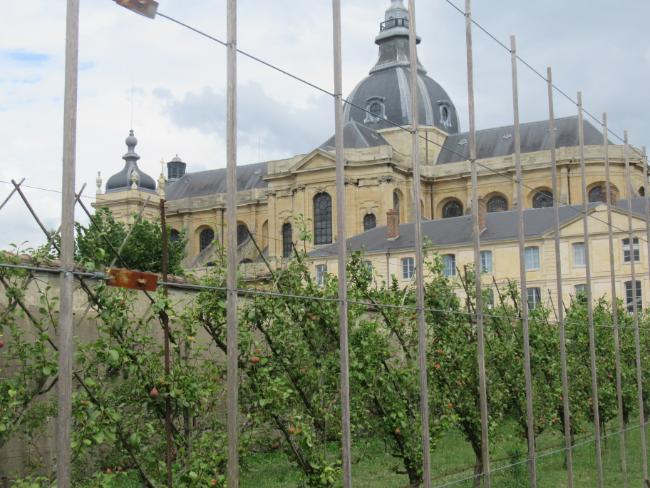
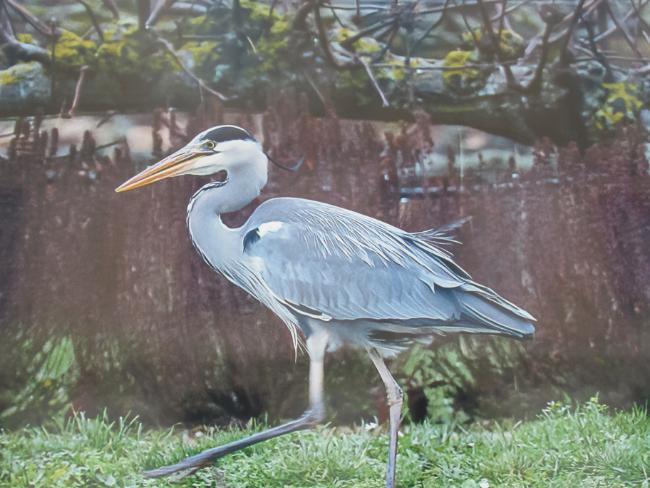
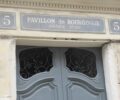
My route further along the outside wall of the Potager du Roi unveiled a large photographic display illustrating the birds found inside and the habits of each. The 20 or so glorious pictures included the hérons cendrés (grey heron) who like to feast on fish from the pond and the rougegorges (robins) who “defend their territory fiercely,” but “sometimes make friends with the gardeners.” Turning into Rue d’Anjou, I was amused to find that just along from number 5, proudly labeled above its fancy door as a Pavillon de Bourgogne dating from 1750, came a shop offering plumbing and heating services, equally grandly titled Dépanneurs du roi (The King’s Repair Shop).


There was one more place I wanted to see on my way back to the station, the Carrés Saint-Louis, a “new build” ordered by Louis XV. Begun in 1737, the little cottage-type buildings were designed as a craft market, a place for artisans to display their wares, but the project was not successful and gradually the buildings were repurposed as homes and shops. I found a whole cluster of them at the point where Rue d’Anjou crosses the Rue Royale, squat little houses with matching dormer windows set into their sloping slate rooves. They seemed out of place, having a rustic charm which was at odds with the surrounding paraphernalia of bollards and car park signs. Perhaps one day, I mused, someone will turn them back into a craft market.
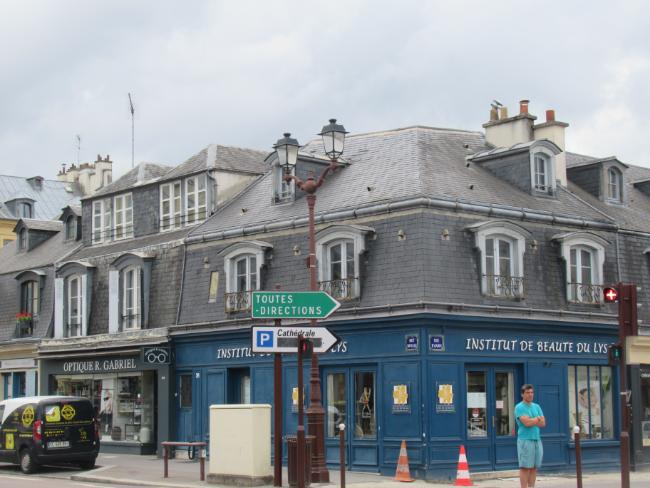
Carrés Saint-Louis in Versailles. Photo: Marian Jones
My stroll through the quartier Saint-Louis revealed a new aspect of Versailles to me. Louis XIV sited his splendid new château in an unlikely corner of the countryside precisely to escape from central Paris and the courtiers who wanted to influence him. But that made it suddenly the place to be and a so a whole town grew up around the new palace. I’d explored only a small part of it, but what a fascinating trio of sites I’d seen in the Salle du Jeu de Paume, the Potager du Roi, and the Cathédrale Saint-Louis. Just as everywhere in the Paris city center, out here too I’d found that history really is all around us.
DETAILS
Open for free self-guided visits from Tuesday to Sunday and public holidays
12:30 pm to 5:30 pm (last entry 4:45 pm).
Open to visitors daily outside services, generally held at least twice each day.
The Potager du Roi
April-October open Tuesday-Sunday 10 am – 6 pm €8, concessions €5
November to March open Tuesday-Friday 10 am -6 pm €5, concessions €3
Lead photo credit : Gates of Versailles. Photo: Marian Jones
More in Flâneries in Paris, jeu de paume, Louis XIV, Versailles
Related Articles
By Marian Jones