
The Paris Region’s Forests Are a Natural Cooling Resource

- SUBSCRIBE
- ALREADY SUBSCRIBED?
BECOME A BONJOUR PARIS MEMBER
Gain full access to our collection of over 5,000 articles and bring the City of Light into your life. Just 80 USD per year.
Find out why you should become a member here.
Sign in
Fill in your credentials below.
At the time of writing, France is undergoing its third heatwave in six weeks; 2026 is shaping up to be another very hot summer with temperature records breaking almost everywhere in France. If you are in a densely built city like Paris the accumulated heat can be unbearable. Unfortunately, it is nowhere near the coast where sea breezes and the ocean can cool you off. But Paris is blessed with a natural cooling resource that is often overlooked: its neighboring forests.
Paris is ringed by woodland and forests that are easy to reach by public transport and, if you have a five-zone Navigo, free. On the outskirts of the city there are the Bois de Vincennes and de Boulogne. Slightly further afield but still close to the city are the Parc de Saint Cloud and the Forêts de Meudon and Saint-Germain-en-Laye, and in the Île de France proper are the truly huge forests of Fontainebleau and Rambouillet. Miles of trees in full leaf casting shade and lowering the ambient temperature.
Not only do they provide welcome relief from the heat, they are incredibly peaceful. Even in the most popular forests you can wander for hours and rarely see anyone apart from a few fellow walkers or cyclists, the silence only broken by the swish of a breeze through the trees, and birdsong. And if you needed more proof of the difference a forest can make, temperatures in the Forêt de Fontainebleau can be up to 10°C lower than along the Seine in central Paris.
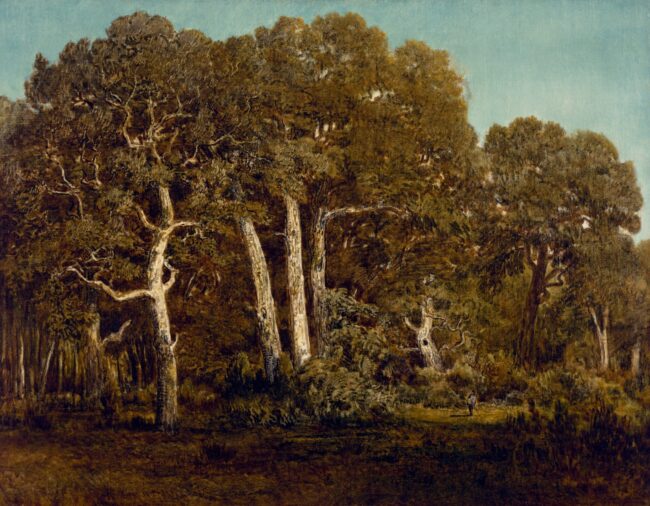
Théodore Rousseau – The Great Oaks of Old Bas-Bréau, 1864. Museum of Fine Arts, Houston. Public domain
Let’s start with the biggies. Fontainebleau is best-known for its château of course, but it is surrounded by over 21,000 hectares of forest. Archeological remains have been found that attest to human activity going back 40,000 years and the forest shelters the most extensive collection of prehistoric rock art in Europe. But it was in the middle of the 11th century that the forest became a royal hunting ground, a status which lasted until the Revolution. In the 19th century, it became a favorite subject for painters who stayed in the western village of Barbizon and hence became known as the Barbizon School – artists such as Camille Corot who prefigured Impressionism.
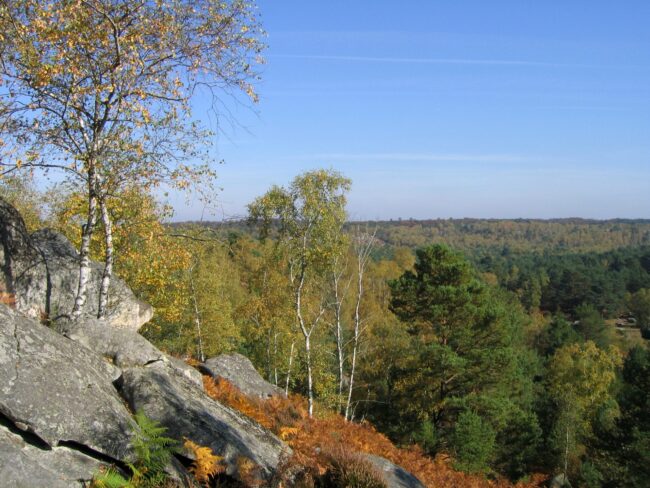
Rocks in the Forêt de Fontainebleau. Photo: Thesupermat/ Wikimedia commons
Nowadays, the forest is a sprawling expanse of green offering diverse trails from gentle rambles to more strenuous hikes. It is also a firm favorite with Paris’s rock climbing fraternity owing to its easy access from the capital and its internationally renowned escalades. The forest is criss-crossed by a network of paths, each one with a name that is signposted on a plaque fixed to tree trunks. Two national grandes randonnées (GR) footpaths also traverse the forest, signposted in red and white on tree trunks. Inside the forest you will find lookout spots with crosses and towers such as the Tour de Denencourt, the remains of a priory and a hermitage, and the Crystal Grotto (Grotte aux Cristaux).
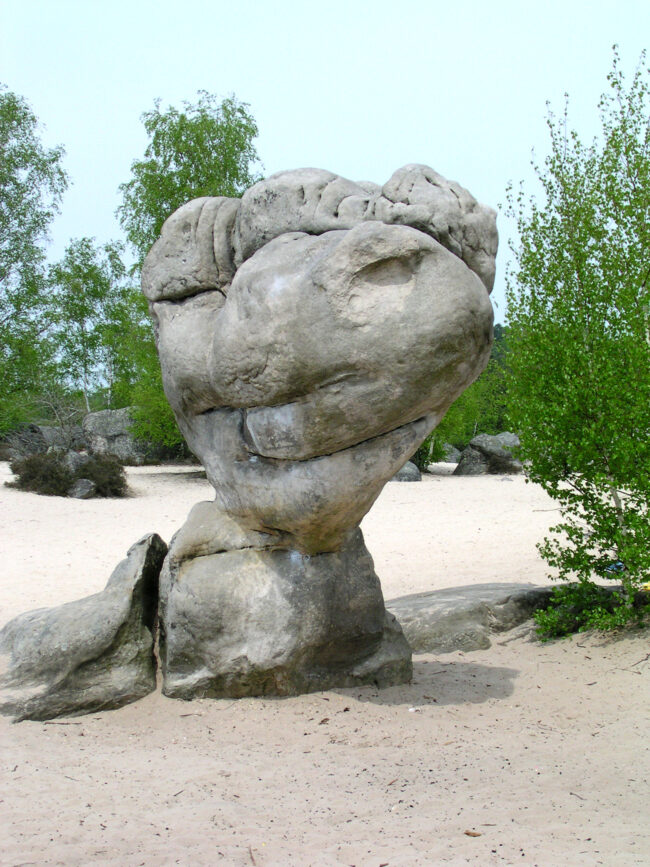
The famous Biloboquet block of the Fontainebleau forest. Photo: Romary/ Wikimedia commons
To get there take the Transilien railway line R from Gare de Lyon to Bois-le-Roi or Fontainebleau-Avon on the forest’s northern edge; both are a 10-15 minute walk out of town to the edge of the forest. Alternatively, there is a halt in-between these stations that drops you off in the middle of nowhere, right on the forest edge. Only one train stops there on Saturday and Sunday mornings and public holidays, in summer. It leaves the Gare de Lyon at 9:16 am but the stop is not advertised. It does not appear on the official timetables or maps; sometimes it will show on the departures board as “arrêt en forêt.” Your best bet is to go to the Gare de Lyon to catch the 9:16 and if, for some reason, the train does not stop, get off at Fontainebleau-Avon and adjust your route. You can only disembark at the halt; for the return journey you have to go to one of the official stations.
If you have a car you have more options. In particular, you can drive to Barbizon and explore the village and the houses once lived in by the Barbizon painters. A car will allow you to explore the western side of the forest which is not served by trains from Paris.
Note: A major wildfire broke out in the forest on July 12th and 13th, covering up to a fifth of its surface. Consequently, it’s likely some footpaths and access routes will be closed for some time. For up to date information, go to the Office National de Forêts website.
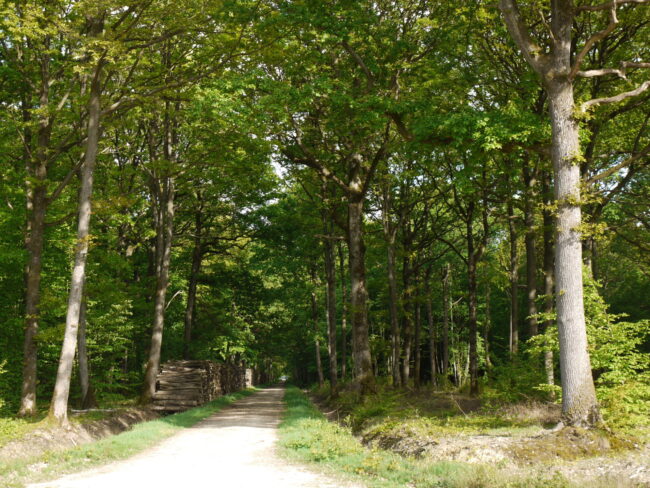
Rambouillet Forest. Photo: Pline/ Wikimedia commons
The Forêt de Rambouillet is a relic of an ancient forest that encircled Paris from St Germain-en-Laye round to Fontainebleau. From the Middle Ages onwards, it was progressively felled until only the current separate forests of St Germain-en-Laye, Meudon, and Rambouillet itself remained. In the 16th century, it became King François I’s favorite hunting park. Today it extends over 22,000 hectares, although nearly half of that is broken up on the eastern side into small, privately owned woods. The motorway A10 cuts the forest in half and it is the western side that is publicly owned.
Footpaths are arranged in a rectilinear pattern centered on a series of star shapes, a throwback to hunting days. It is less wild than Fontainebleau and is well-provided with picnic areas and information panels for visitors. As well as footpaths there is a network of broad cycle paths, and horses can be ridden along certain paths that have been created for forest management. Just be aware that hunting is still practiced in the forest depending on the season.
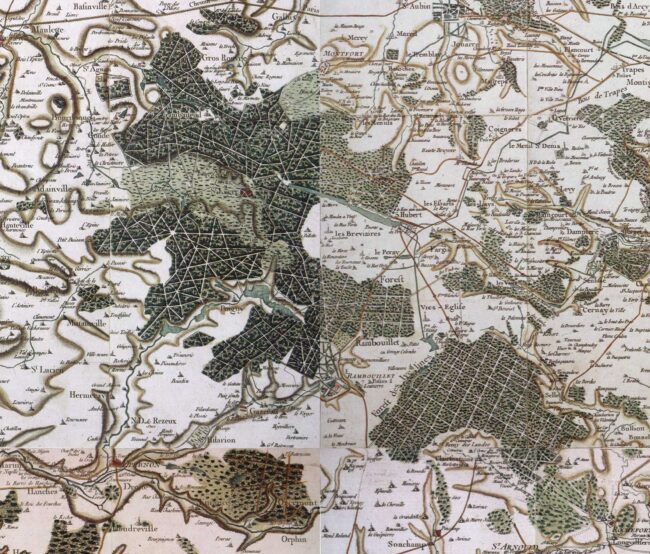
The Rambouillet Forest as seen on the Cassini map, 1780
The forest also includes the Parc de Rambouillet and if you prefer a less strenuous walk you can enjoy a stroll around the lakes and visit the Bergerie Nationale – a national farm devoted to sheep rearing – and the Laiterie de la Reine, or Marie-Antoinette’s private creamery.
Rambouillet is the second-last stop on Transilien Line N from Gare Montparnasse. Walk into town and head for the château. The park is free to enter and from there you can walk deeper into the forest itself. Alternatively, the bus 5301 from the town towards Groussay will drop you off at Groussay terminus a short walk from the forest edge further away from the château.
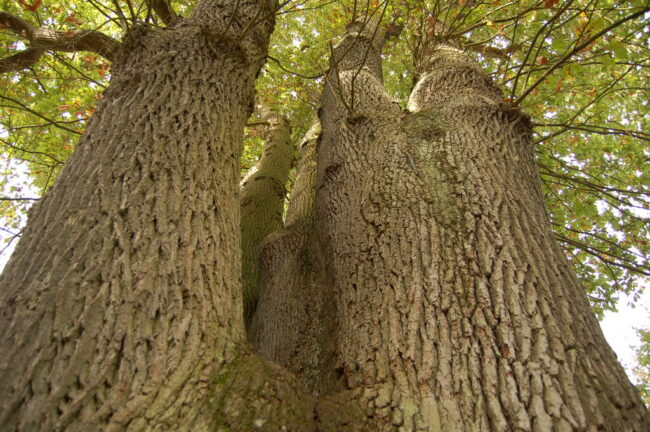
Le chêne des Six Frères, Forêt de Dourdan. Photo: Cryptic91/ Wikimedia commons
The Forêt de Dourdan has to be one of the easiest forests to get to on public transport – the terminus of RER C stops literally on the edge of the forest. Not far away are the Boiling Fountains which, despite the name, are neither fountains nor hot water but are a haven for birds. Oak trees predominate in the forest and there are several that are more than a hundred years old. Outdating them all is the Chêne des Six Frères, a 500-year-old oak tree whose trunk has divided at its base into six separate trunks, a very rare occurrence. Once you’ve finished your ramble, a five-minute train ride will take you back into the little town of Dourdan with its medieval fortress and remains of the town walls.
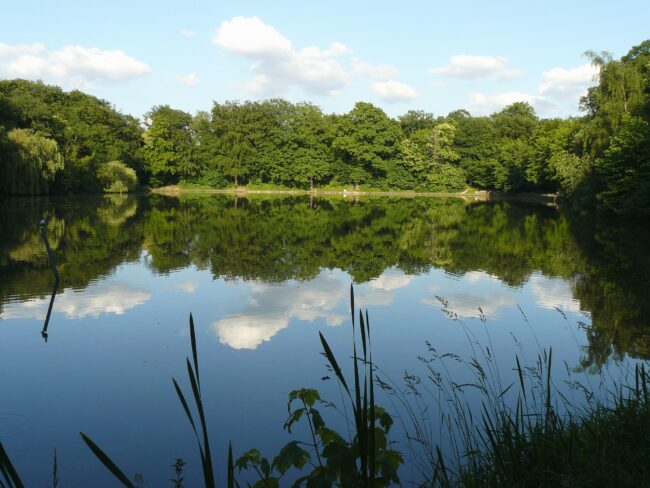
L’étang de Villebon, dans la forêt de Meudon. Photo: Félix Potuit/ Wikimedia commons
The Forêt de Meudon is much closer to Paris and much smaller (1,100ha) but is still a proper forest with numerous ponds known as étangs, and the Hertz telecommunications tower, the tallest structure in the Île de France after the Eiffel Tower and visible from Montmartre. The Pavé des Gardes which cuts across the northwestern corner is an old military road between Paris and Versailles. It includes a steep hill so proper walking shoes are recommended. The national footpath GR2 traverses the forest and the numerous footpaths, cyclepaths and bridleways (for horse riders) are signposted.
The forest is accessible on Transilien Line N from Gare Montparnasse. The stop nearest to the forest is Chaville Rive Gauche. Alternatively you can take Métro Line 13 to its terminus at Chatillon, transfer to Tramway Line 6, and disembark at Georges Pompidou or Louvois for a short walk through town to the forest’s southern edge.
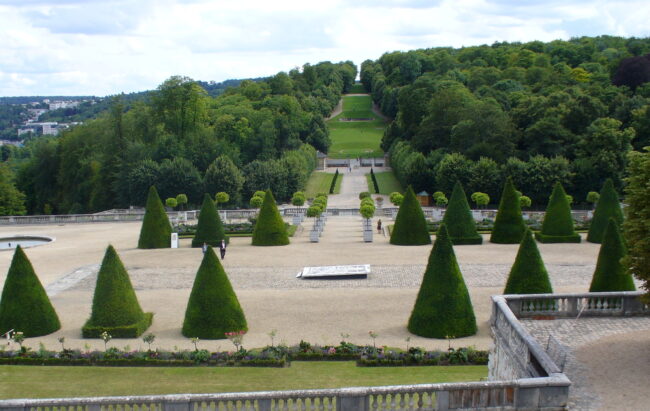
Parc de Saint-Cloud. Photo credit: Parisette/ Wikimedia commons
The Forêt de Saint Germain en Laye and Parc de Saint Cloud are more or less situated in the Paris suburbs and both are easily accessible by RER (Line A for Saint Germain) or the Métro (Line 10 for Saint Cloud). At Saint Germain, cross the road from the RER station and enter the Parc du Château, walk to the terrasse and enjoy the spectacular view, then start walking away from the town. Within minutes you are on a woodland path enveloped by trees, mostly oak and beech; there is a waymarked route pointing out the different species. The paths will take you across the forest where you can pick up the RER A at Achères Grand Cormier or Poissy, or double back into Saint Germain itself.
Saint Cloud is the venue for Paris’s foremost rock concert, the annual Rock en Seine, but for the rest of the year the park offers easy rambles. Start in the Bas Parc where the paths are lined with shady lime trees, then turn up the hill (there is a bit of road walking) and enter the wood. The path will gradually take you back down the hill to the Bassin du Grand Jet and Grande Cascade, remnants of the original Château du Saint Cloud. Both Saint Germain and Saint Cloud are close to built-up areas so the sounds of the city are not far away but in the middle of the woods the noise is distant and a peaceful quiet descends.
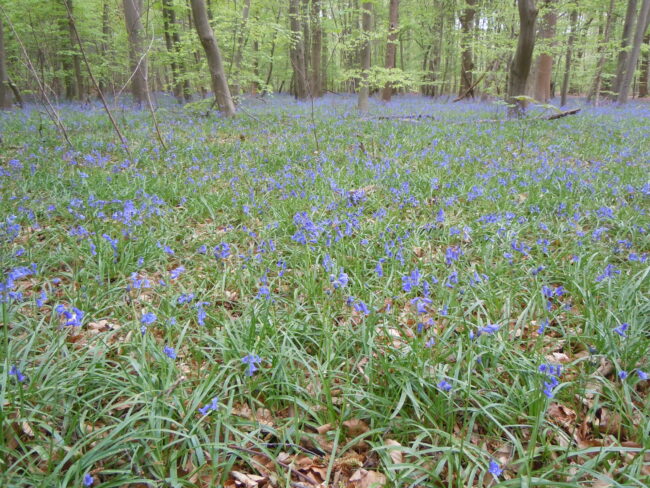
Blue hyacinths in the Forêt de Saint-Germain-en-Laye. Photo: Patrice78500/ Wikipedia commons
Both of these are great getaways for an afternoon, but if you just want to escape for a couple of hours, the Bois de Vincennes and Bois de Boulogne should not be forgotten. On the doorstep of Paris and easily accessible by Métro (Line 1 Château de Vincennes and Line 2 Porte Dauphine respectively), at first glance they appear to be simply large parks. But get away from the manicured lawns, the lakes and the gravel paths and you enter a semi-wild woodland where background noise is muffled and you can wander in the cool shade. You can also pick up a Vélib or other hire bike for a gentle cycle ride. You are never far from a road, several of which crisscross both woods, so you can’t really get lost, but for a little while you can escape the city’s heat and bustle.
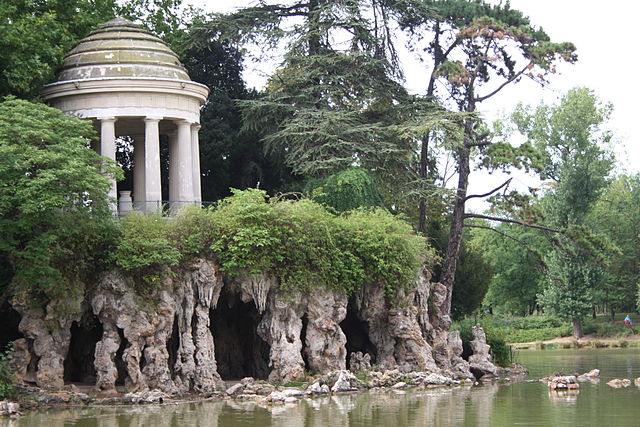
The Temple of Love on Lac Daumesnil in the Bois de Vincennes. Photo: Georges Seguin, Wikimedia commons
Practical Tips
Getting there – the travel notes in this article are for guidance only. For up to date information go to www.iledefrance-mobilites.fr.
Footwear – sneakers will suffice for the gentle rambles in the woods around Paris. For more strenuous hikes in Fontainebleau and Rambouillet a lightweight pair of proper hiking shoes or boots is recommended.
Orientation - while Google Maps on your phone is fine for smaller woods and zooming in on small areas, you will find the appropriate IGN map, either downloaded or in old fashioned paper format, more useful for general orientation and finding your way over a larger area. IGN maps come in different scales and cover the whole country; they are indispensable for exploring off-road and the more obscure parts of France.
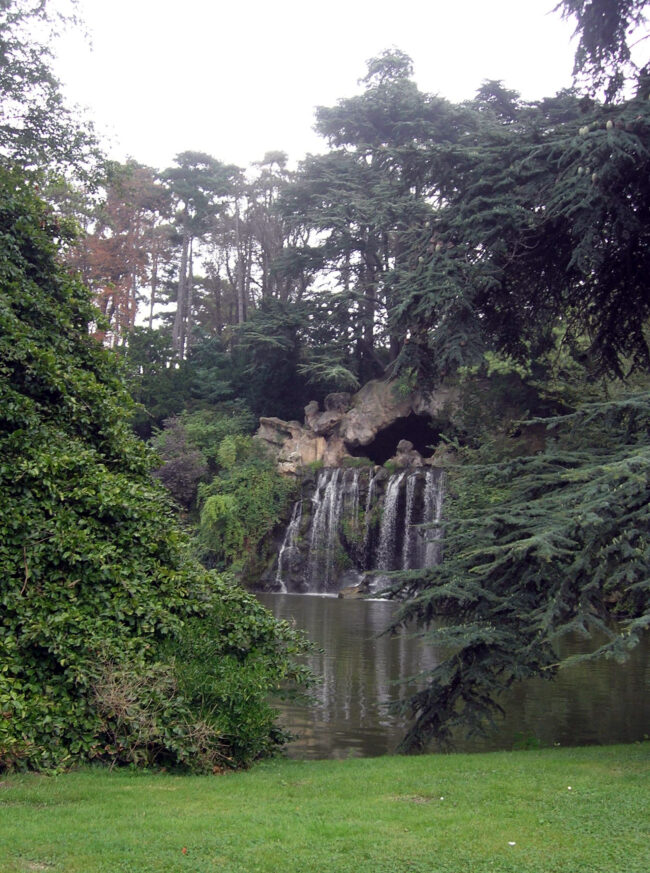
Grande cascade in the Bois de Boulogne. Photo credit: Remi Jouan/ Wikimedia commons
Sun protection and a hat – suncream with a good SPF is recommended even if most of the walking takes place in the shade. Lookout towers and open views will expose you to the sun at its hottest.
Water – make sure you take plenty of water and keep yourself hydrated. Especially in the bigger forests – in the middle of the forest there are no water taps or cafés!
Camping – wild camping is not allowed. There are official bivouac spots in Fontainebleau that allow a single overnight stay in a bivvy bag/shelter. You will see homeless people in makeshift camps in the Bois de Boulogne, in particular, but don’t be tempted to emulate them for a night in the woods.
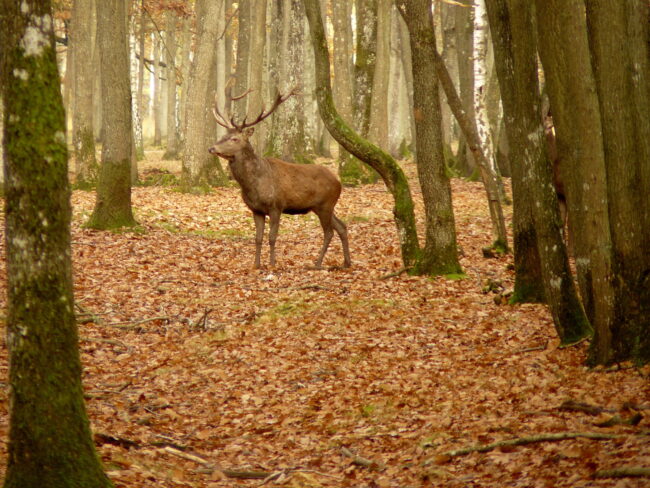
A deer in the Rambouillet Forest. Photo: Félix Potuit/ Wikipedia commons
Bicycles – the Transilien train network, which operates in the Île de France by SNCF, allows bikes on its trains outside rush hour, up to the capacity of each train. It’s best to buy a ticket online and check that you can take your bike on that train. Only folding bikes (folded up) are allowed on the RER or Métro.
Keep to the signposted footpaths and refer regularly to your map. Especially in Fontainebleau and Rambouillet, the trees go on forever and it is easy to get lost. You start to appreciate why these places were known as the Wild Wood and why so many scary fairytales are set in them.
Finally – it should go without saying that no naked flames – cigarettes or lighted matches – should be lit inside any woods or forest. No camping stoves or portable barbecues either. Most wildfires are caused by human idiocy such as throwing a cigarette end on to a motorway verge.
So, beat the canicule and pull on those shoes to head to the woods for peace, quiet and some respite from the suffocating heat.
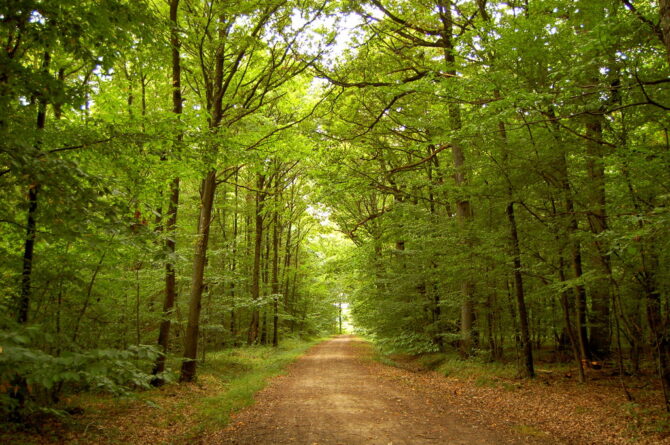
Lead photo credit : The "Route des Soupirs" (the path of sighs) in the Dourdan forest. Photo: Cryptic91/ Wikimedia commons
More in Fontainebleau forest, forest walks near Paris, Meudon
Related Articles


By Pat Hallam