Paris in Winter: How Belle Epoque Artists Depicted Snow
- SUBSCRIBE
- ALREADY SUBSCRIBED?
BECOME A BONJOUR PARIS MEMBER
Gain full access to our collection of over 5,000 articles and bring the City of Light into your life. Just 80 USD per year.
Find out why you should become a member here.
Sign in
Fill in your credentials below.
Paris in wintertime has a unique beauty. Under the grip of cold, its historic architecture glowers under heavy skies of violet and gray, but under a blanket of snow, Paris becomes a different town. Parisians can’t help but be thrilled by this rare event. Hushed, the first snowfall leaves everything crisp and clean. The refreshed cityscape reflects new light and colors. Once upon a time, when snow rendered the Paris streets with a white brush, the painters from the Belle Époque tried to capture the fleeting phenomenon on their canvases.
In the 21st century, snow is just as magical, but infrequent. Paris averages seven to eight snow days per year, and accumulating snow is even more uncommon. When it does snow, it often melts quickly due to the city’s mild, oceanic climate, and the snowy layer only stays put for a day or two. Snowfall is most likely from January to March, but not impossible in December.
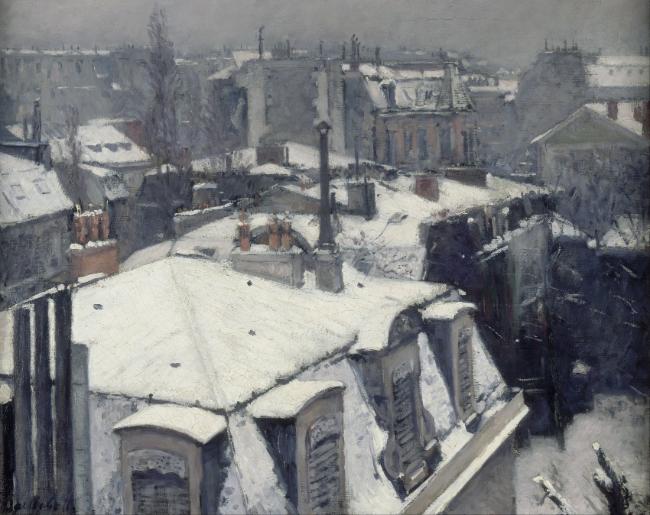
Gustave Caillebotte, Rooftops in the Snow (snow effect)
Gustave Caillebotte’s large painting View of Roofs: Effects of Snow reveals his enthusiasm for this meteorological phenomenon. Inspired by the impressive snowfall of December 1878, viewers sense perfectly the quiet, snowy morning represented in Caillebotte’s blanketed roofs; the houses are still asleep under the low gray sky. The only touch of color is the terracotta pink of the chimney pots. These old buildings may have been painted from the back rooms at Caillebotte’s apartment at 31 Boulevard Haussmann, which overlooked a yet-to-be refurbished area. Caillebotte joined the ranks of the Impressionists in 1876 and became one of the group’s most active members, both as a painter and as a patron, thanks to a considerable personal fortune. In the era in which he was active, Caillebotte’s snowy painting was considered a modern urban landscape.
“…the top floor of the hotel where I worked, in a room that looked across all the roofs and the chimneys of the high hill of the quarter, was a pleasure. The fireplace drew well in the room and it was warm and pleasant to work.” – Ernest Hemingway, A Moveable Feast
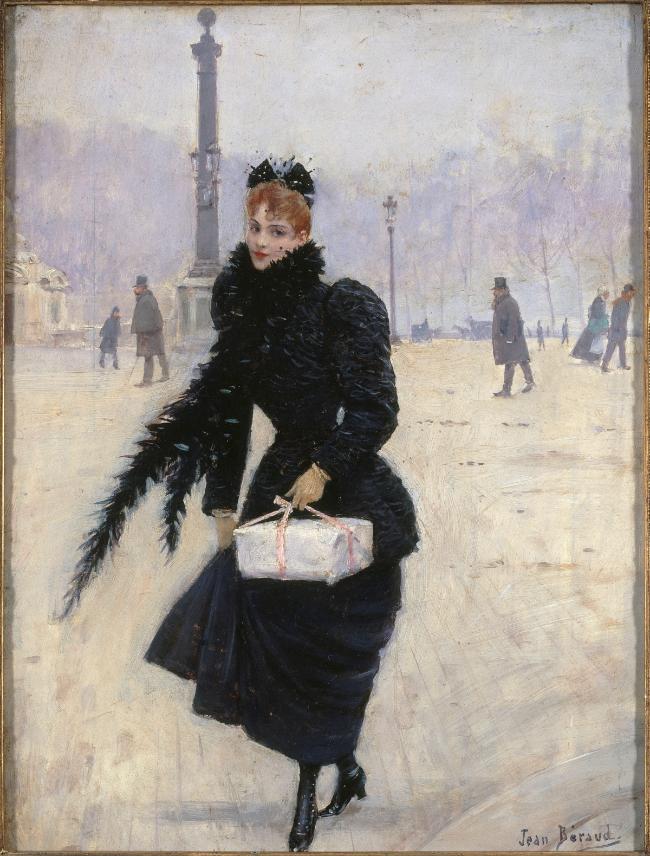
Jean Beraud, Parisienne, place de la Concorde
Jean Béraud is defined as an Impressionist, but his work is more traditional and realistic than many of his contemporaries. Béraud told the story of Paris in his highly anecdotal paintings that depicted the Parisian bourgeoisie and essential stereotypes found on the city’s streets. When the snow fell, Béraud didn’t want the starkness of Caillebotte; he picked a lively boulevard as seen in Parisienne, sur la Place de la Concorde, circa 1890. The subject is a young woman in motion, animated compared to the plodding parade of men in the background. Black, off-white and gray, the only color in this work is the pink ribbon on the woman’s parcel, which we hope contains a cake or another splendid scarf. This and other works by Béraud can be seen at the Musée Carnavalet, a good place to spend a wintery day.
“If you choose not to find joy in the snow, you will have less joy in your life but still the same amount of snow.” – Colette
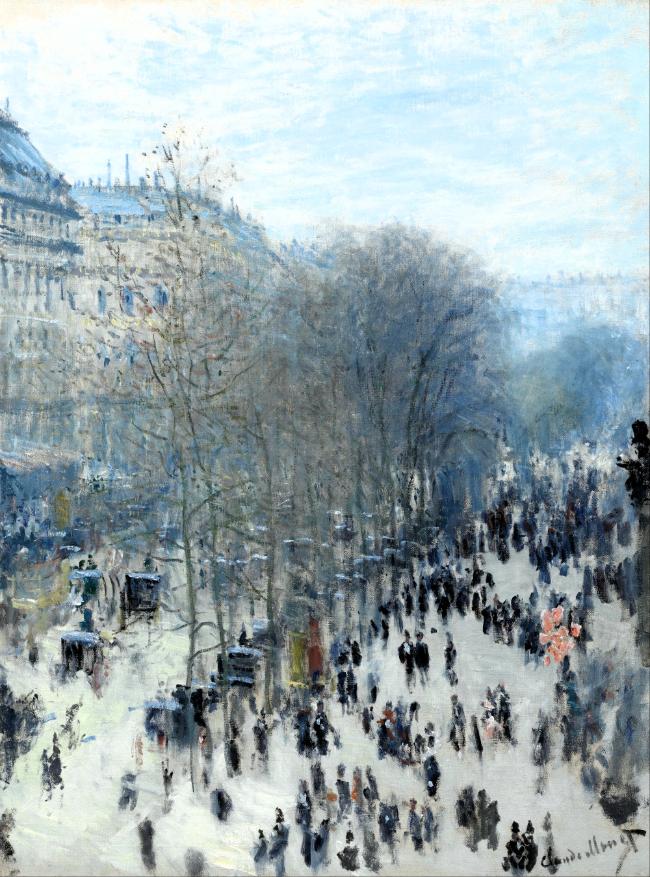
Claude Monet, Boulevard des Capucines, 1873
Claude Monet was fascinated by winter and the colors created by snow and ice. Monet captured over 100 snow scenes. Whenever it snowed in the 1870s and 80s, Monet quickly grabbed his art supplies, and braved the harsh conditions, knowing the snowy makeover was a fleeting one. Monet didn’t use just flat, white strokes, but tiny touches of prismatic color to indicate the shadows and light on the snow. The casual eye may at first fail to recognize that the shades of white, blue, and violet Monet used were accurate – but they are.
Monet’s Boulevard des Capucines painted late December 1873 presented a genuine glimpse of the hustle and bustle of Parisian life on a winter afternoon. Sketched from the studio of Monet’s friend, the photographer Felix Nadar, Monet painted bare trees, the roofs, streets, and facades swept with snow. His quick brushstrokes created the “impression” of people alive with movement.
From December 14 to December 23, 1874, the weather was exceptionally snowy in the Ile-de-France. This heavy snow caused the roof of a market to collapse on December 18, resulting in casualties. Paris and the surrounding area were paralyzed by snow and all transport stopped.
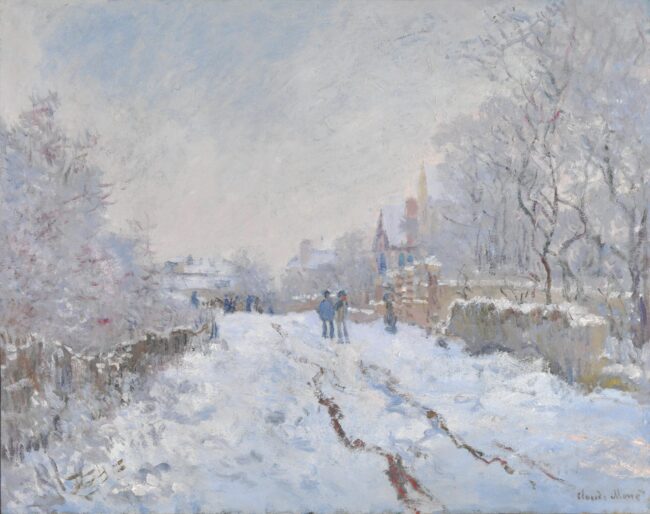
Claude Monet, Snow at Argenteuil, 1875
While stranded in his village of Argenteuil, in the outskirts of Paris, Monet painted the snow-quilted streets. Here in Snow at Argenteuil, areas of this canvas are painted in the expected blues and greys, the application of small strokes of yellow, green, and red wakes up the painting and even creates a little warmth. Most of Monet’s pictures from the winter of 1874–1875 were painted from locations close to his house on the Boulevard Saint-Denis (now number 21 boulevard Karl Marx). The house is now an immersive museum about the painter, open Wednesdays, Saturdays, and Sundays during the winter season.
“One winter he [Manet] wanted to paint a snow scene. I had in my possession just such a piece from Monet. After seeing it, he said, “It is perfect! I would not know how to do better,” whereupon he gave up painting snow.” – Theodore Duret, art dealer, 1879
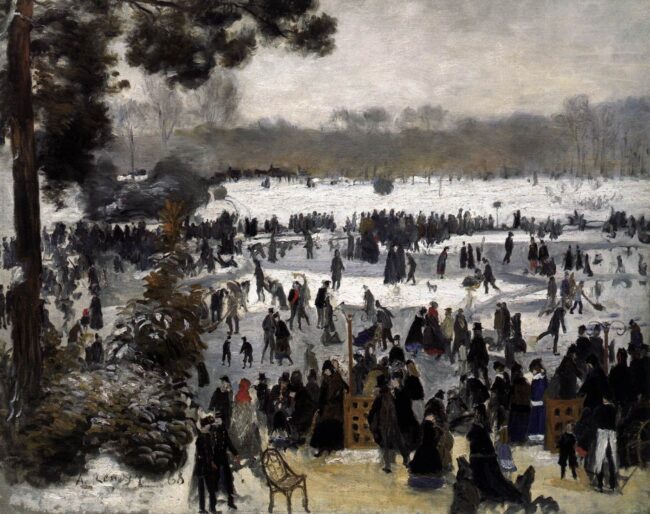
Auguste Renoir, Les Patineurs à Longchamp, 1868
Despite Renoir’s strong dislike of the cold and snow, he braved the winter of 1868 to create Skaters in the Bois de Boulogne – one of Renoir’s few winter works. The painting depicts a snowscape with Parisians spending their precious free time on a frozen lake in the Bois de Boulogne. Newspaper accounts recorded freezing temperatures allowing the curious to walk across the Seine, and skate on rivers and streams. This painting has an unfinished, sketch-like quality to it, which to my eye looks more like the work of Monet above, because of the black licks of paint.
Parisians took advantage of freezing temperatures to skate outdoors, on ponds and on the Seine. After 1894, winter skating took place at the Palais de Glace on the Champs-Élysées. Apart from skating, it was a place to see and be seen. This poster by Jules Cheret is just one of many he made to celebrate the skating palace.

Jules Cheret, Palais de Glace, Champs Elysées
The winter of 1885-86 was an especially snowy one in Paris. In December, there were two snowfalls of more than four inches, and a blizzard hit the city on January 8, 1886. In Snow, Boulevard de Clichy, Paul Signac’s budding pointillist technique is excellent for rendering snow. It positively animates the scene. Art critic Jean Ajalbert colorfully described Signac’s snowy painting thus, “on the Boulevard Clichy the swirling blizzard coats the houses, trees and streetcars with snow. The lilac mauve and violet landscape turns opalescent in the distance.” The painting is housed in the Minneapolis Institute of Art.
“I like snow and roses, calm and storm; I like to love, I like to hate. Every contradiction, every absurdity, every folly—I harbor them all.” –Gustave Flaubert.
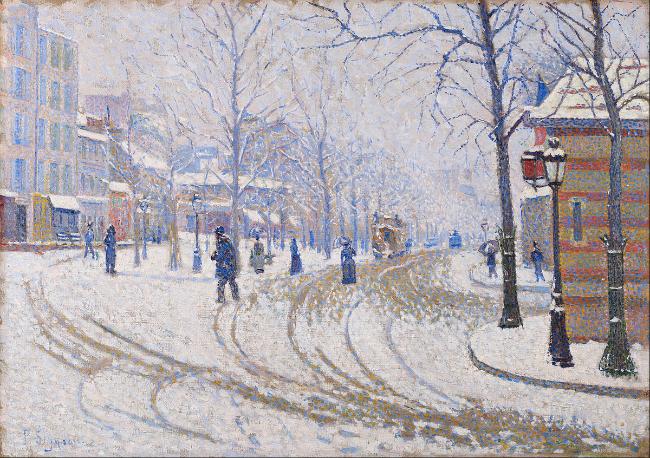
Paul Signac, Snow, Boulevard de Clichy
Early in his career, Paul Gauguin uncharacteristically showed enthusiasm for painting snow scenes, yet his eventual choice to move to the tropics suggests he was tired of the cold and poverty of Europe. Throughout December 1879, Paris was inundated with snow for much of the month. One of the coldest winters for the city, the record for lowest temperature of −23.9 °C (−11.0 °F) on 10 December 1879, still stands. In La Neige à Vaugirard II, is Gauguin representing the tranquility and calm of a winter landscape, or the bleak and bitter mid-winter?
In 1894, after his return from his first Tahitian voyage, Gauguin caught another snowy day. Winter Landscape shows the view from the artist’s window. Gauguin rented rooms on the second floor of a building in the Montparnasse area of Paris. Newspapers reported that it snowed on 24 February 1894, so he probably made the painting around that date. We can see just how much Gauguin’s palette has changed – it’s warmer. The painting was given to Jo Bonger, Theo Van Gogh’s widow and Vincent’s sister-in-law, in May of that year.
“The life of Paris was now found along the boulevards. No longer were residents traveling in a labyrinthine maze of small, medieval streets. Now fashionably dressed men and women spent their afternoons walking through the park, or strolling along the fashionable boulevards.” –Henry Bacon, “Glimpses of Parisian Art,” Scribner’s Monthly, December 1880


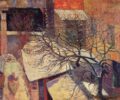
The art of Eugène Galien-Laloue may be considered kitschy, but he certainly was a prolific popularizer of Paris street scenes, garish and sentimental though they might be. Galien-Lalou usually painted in autumn or winter, unusual for a young painter who did not like to work en plein air; in fact he “hated to walk in any mud and even a blade of grass bothered him.”
Galien-Laloue rendered every detail of fin-de-siècle Parisian architecture with absolute precision. One of Galien-Laloue’s favorite subjects was the l’Eglise de la Madeleine, the huge Roman temple of a neo-classical church that Napoleon commissioned. Here in Place de la Madeleine, Marche aux Fleurs, the artist gives us the temple in winter, with Parisians scurrying past the huge Doric columns.

EUGÈNE GALIEN-LALOUE, Place de la Madeleine, marché aux fleurs
The countryside in winter particularly attracted Arthur Sisley who often presented villages and gardens hushed by the snow. Sisley’s Snow a Louveciennes creates a lonely feeling; one small, isolated character walks down a snow-covered disappearing into the background. For the same reasons as Monet, Sisley liked painting snow scenes because it allowed him to study the variations in light and to use different ranges of shades. Dashes of blue and grey create shadows and texture underfoot, in the seemingly impenetrable snow.
“When old Winter puts his blank face to the glass, I shall close all my shutters, pull the curtains tight, and build me stately palaces by candlelight.” -Charles Baudelaire
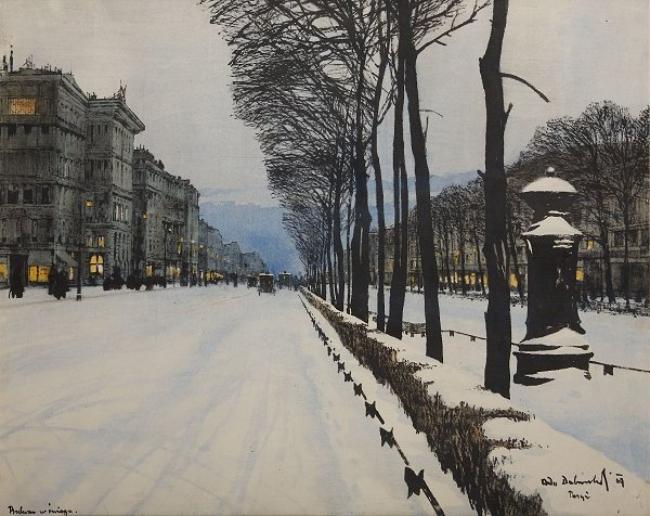
Odo Dobrowolski was a Polish national who lived in Paris in the years before World War 1. Featured at the top of this article, in an almost photo-realistic style, he accurately describes a snowy boulevard in Paris, just as Parisians made their way home to their warm, lighted homes.
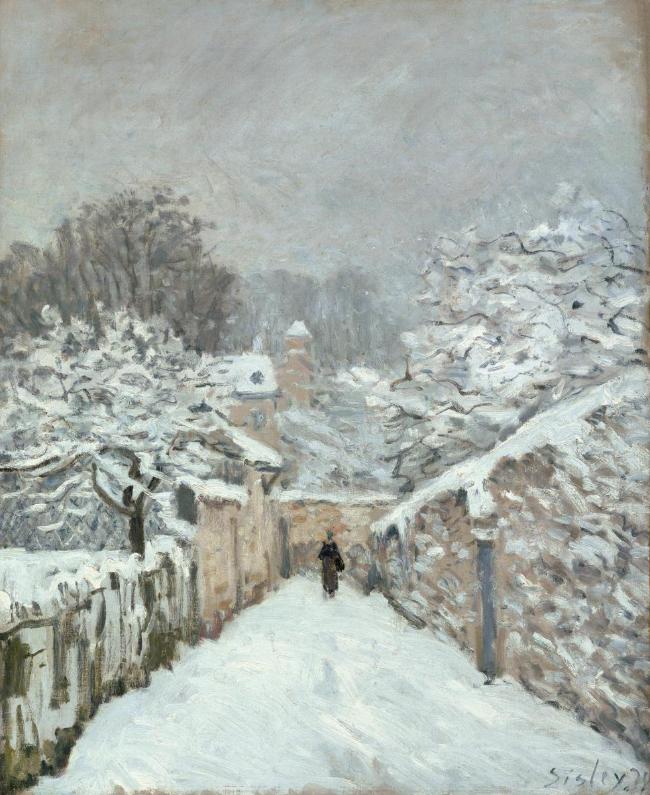
Alfred Sisley, Snow at Louveciennes
The famous author Émile Zola became an avid photographer in the 1890s. Here he has photographed Place de Clichy with the Monument to Marshall Moncey in the background. Unfortunately, the snow has turned into a slurry of slush. As Zola died under suspicious circumstances in September of 1902, this photo would have been taken between 1894 and 1901.
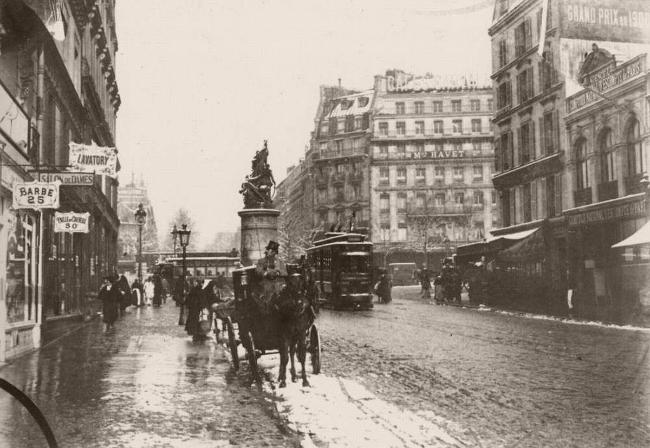
Vintage Paris by Emile Zola
The Seine Viewed from the Pont Neuf, Winter 1902 is a wintery scene created by Camille Pissarro in the early months of 1902. It’s one of a series of views painted from his apartment at 28 Place Dauphine on the Ile-de-la-Cité. Here Pissarro is looking west along the Seine toward the Pont-des-Arts and the Louvre. The railings and steps on the left indicate where the statue of Henri IV stands above the Square du Vert-Galant. The painting shows Pissarro’s fascination with the effect of transient weather, but he has contained these within a carefully structured, accurate view of the Seine.
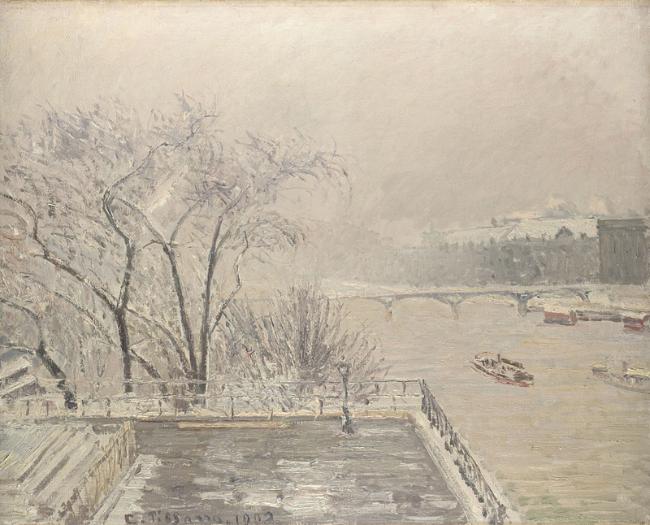
Camille Pissarro, Louvre under snow, 1902. National Gallery London.
When Maurice Utrillo found purpose in his chaotic life he became a more famous and lucrative painter than his mother, the one-time artists’ model Suzanne Valadon. He was able to fashion a comfortable life because his plain, naïve cityscapes of Montmartre were popular with foreign collectors who simply wanted classy souvenirs of Paris. Utrillo went through a white period, when his lavish use of zinc white, sometimes with the addition of plaster, lent itself to snow paintings. His painting of the steep Passage Cottin shows his neighbors dealing with the snow, and steep streets near Sacré–Cœur.
Paris can be challenging in the winter, but always charming. Put on your boots, because even in the winter, Paris is always a good idea.
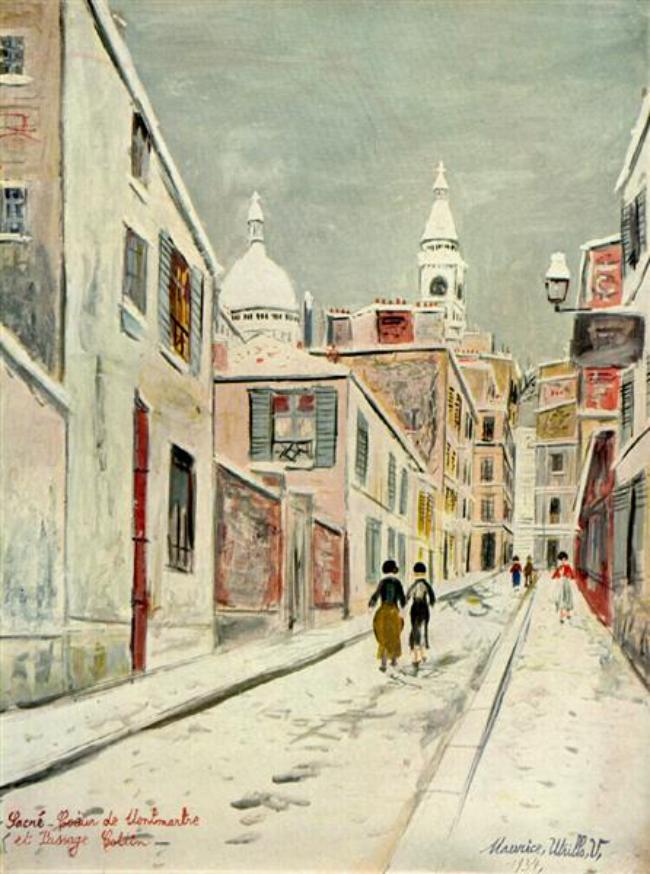
Maurice Utrillo, Sacre-Coeur and Passage Cottin
Lead photo credit : Odo Dobrowolski, Snowy boulevard, 1909
More in Arthur Sisley, Auguste Renoir, belle epoque, Claude Monet, Gustave Caillebotte, Maurice Utrillo, Paul Gauguin, Paul Signac, snow in paris
Related Articles