
Museuming in Paris, Part I: The Paris Museum Pass
- SUBSCRIBE
- ALREADY SUBSCRIBED?
BECOME A BONJOUR PARIS MEMBER
Gain full access to our collection of over 5,000 articles and bring the City of Light into your life. Just 80 USD per year.
Find out why you should become a member here.
Sign in
Fill in your credentials below.
“Let’s go to Paris,” my husband announced, while we watched the final credits for Season 6 of L’Art du Crime cascade quickly down our television screen. “I want to see the Loover.” (Imagine an Eastern European pronunciation with a sly, playful smile, just to annoy me). Separation anxiety had already set in as we contemplated withdrawal from our evening rendezvous with art detectives Madame Chassagne, Captain Verlay, Commander Pardo, and the rest of the hilarious, heartbreaking characters who populate a fictional Parisian Central Office for Combatting the Trafficking of Cultural Property (OCBC). How could we prolong our connection to our favorite sleuths? Why not visit the scenes of the crimes and the artworks featured in each episode? We hatched our plan.
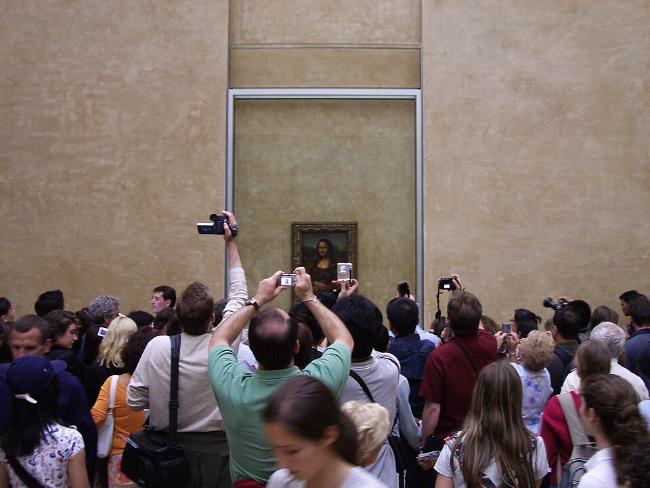
Louvre, in front of the Mona Lisa, July 1, 2005. Photo: Sergey Meniailenko/ Wikimedia commons
First, the dates: mid-January is the least expensive and quietest time of the year for visiting museums. Flight and accommodations were booked during Black Friday sales. We agreed on Icelandair with a stopover in Reykjavik to visit our niece, and then we found an apartment with AirBnYou, booked through a hotel website. Location: Le Marais, my favorite quartier. Next task: museuming. Which style worked best for both of us?
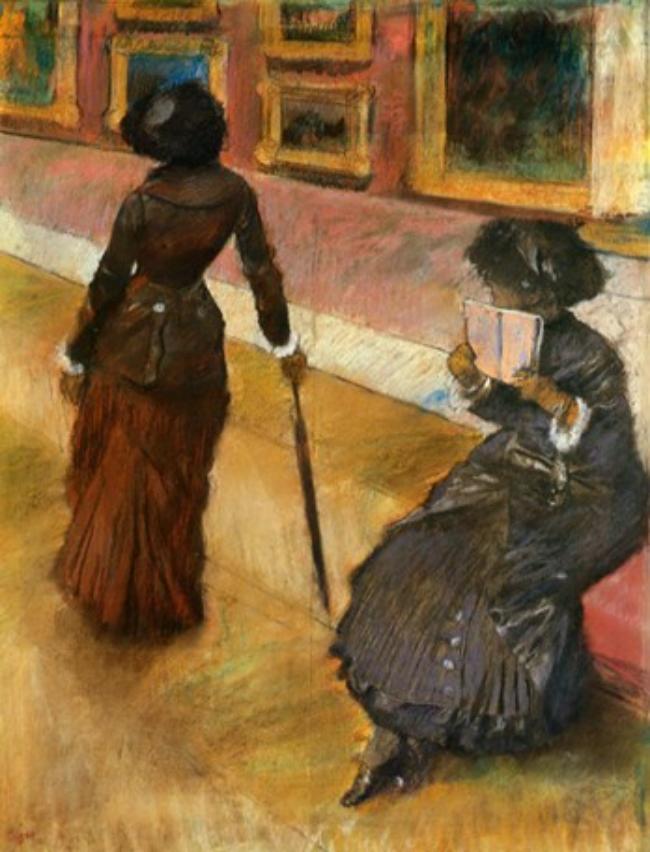
Edgar Degas, Mary Cassatt [and her sister Lydia] at the Louvre, 1878
I like stuffing a whole bunch of exhibitions into one day. Dusan (pronounced Doo-shin), the meticulous text-panel reader, can handle one large exhibition or two small ones per day, at most! Should we buy a pass for numerous museums, or should we go à la carte?
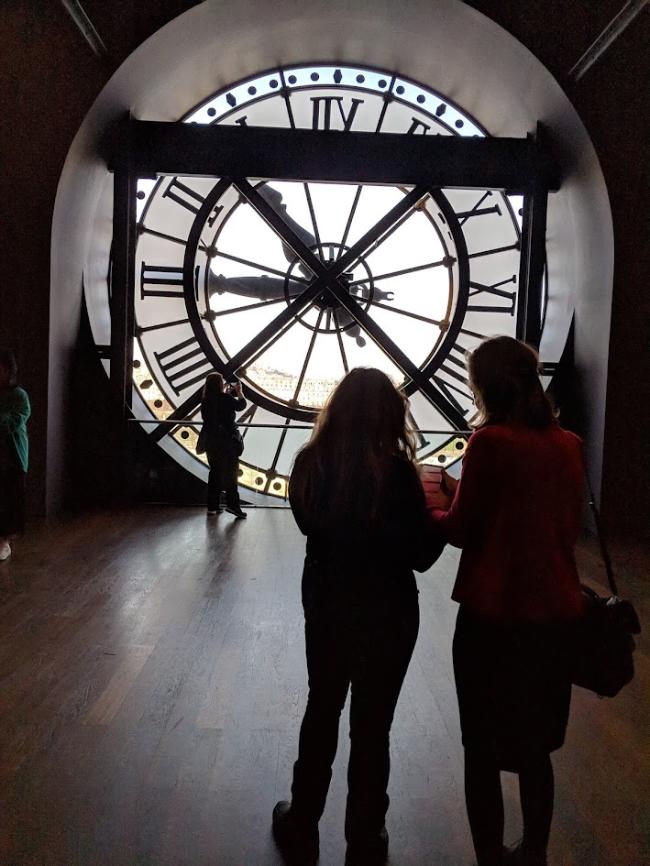
Musée d’Orsay, May 2022. Photo: Beth Gersh-Nesic
I did the research (this guy is a scientist, so facts and figures are essential for productive conversations). First, I listed the pros and cons of each option, and then Dusan presented his alternative. Here’s what we considered and selected, much to our mutual delight.
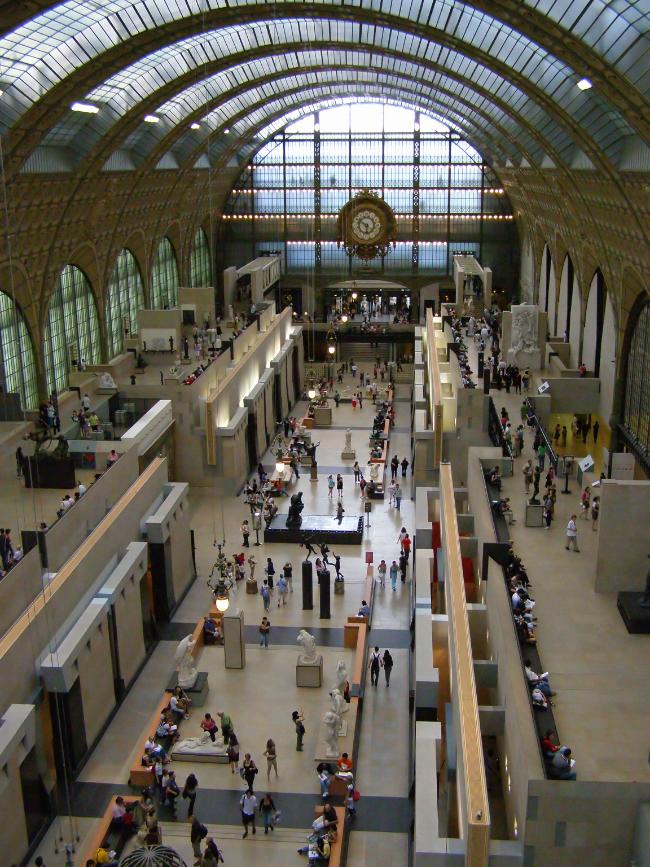
Musée d’Orsay interior. Photo: Krzysztof Mizera/ Wikimedia commons. Public Domain.
Option 1: Paris Museum Pass
For years, I have purchased the Paris Museum Pass (PMP) to organize a working week of art exhibitions and meetings. This is not the Paris Pass, which combines museums and sightseeing attractions, such as the Eiffel Tower and the Bateaux Mouches river boat cruises on the Seine. If you are looking for a complete Paris adventure, the Paris Pass may be just what you need. Check out both passes before you arrive in Paris to see which works best for you.

Musée de l’Orangerie, Claude Monet, Nymphéas. Photo: Brady Brenot/ Wikimedia commons. Public Domain
The Paris Museum Pass offers one visit per museum for a set number of consecutive days. According to the website today (July 2025), the prices are 70 euros for two days (an average of 35 euros per day); 90 euros for four days (about 22 euros per day); and 110 for six days (about 18 euros per day). The best deal is six days if you are ambitious, well-organized, and determined to get your money’s worth.
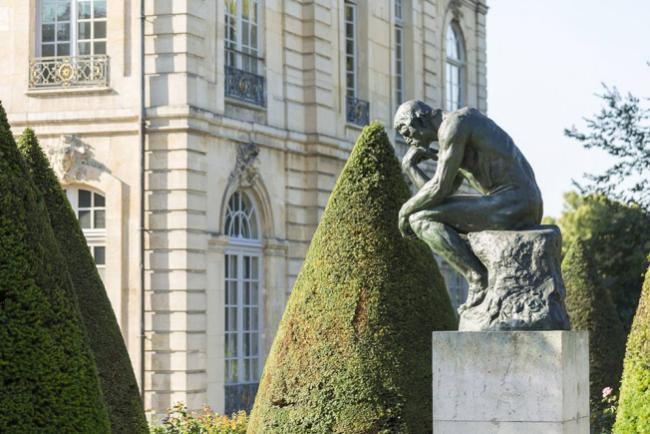
Auguste Rodin, The Thinker or The Poet, 1880, outside of the Musee Rodin Paris. courtesy of Musée Rodin
For example, the enormous Louvre could easily take up a whole day. Reservations are required, even with the PMP. One day at full price for an adult is 22 euros. Children under 18 are free. (Retirees must be eligible through the French government to take advantage of the “senior” discount.) Spending one day at the Louvre and no other museum is well within the PMP’s average daily price if you purchase the four-day or six-day pass.
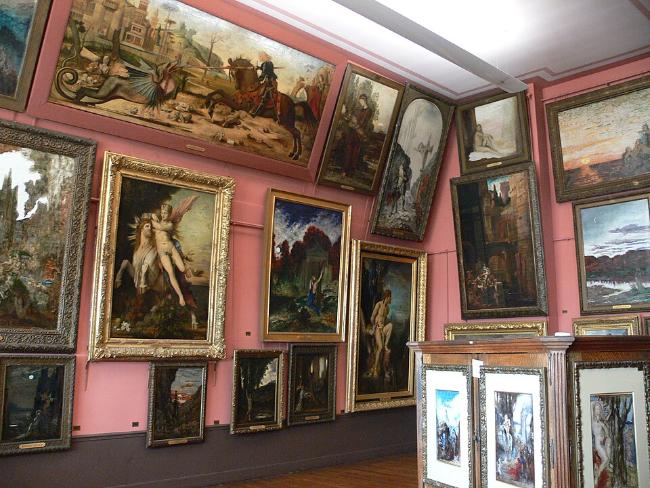
Musée Gustave Moreau, interior of the artist’s home and studio. Public domain
However, compare the Louvre’s price to the Musée d’Orsay: 16 euros for adults without children; 13 euros for adults accompanied by a child; 12 euros on Thursday evenings, 6 pm to 9:45 pm; free on the first Sunday of each month with a reservation. That’s less than the average cost of one day with a PMP. Do you have the stamina to visit the Musée d’Orsay and another museum on the same day? If so, read on.
If you can visit the Louvre during the day on Thursday and cross the Seine on the Pont Royale or the Passerelle Léopold Sédar Senghor to visit the Musée d’Orsay on Thursday evening, when it is open until 9:45 pm, the PMP is your best bet. You can also visit the Musée d’Orsay during the day on Wednesday or Friday and then cross the Passerelle Léopold Sédar Senghor to reach the Louvre, open until 9 pm on those evenings. Or you can visit the Musée d’Orsay and then cross the Passerelle Senghor to walk on the Right Bank toward the Musée de l’Orangerie on Friday evenings when the Orangerie closes at 9 pm. (12.50 euros for adults, 10 euros for parents with children, free for young adults 26 and under from the EU, free for children under 18). These are examples of how PMP veterans visualize clusters of museums within a short distance from each other. On days when museums have evening hours, you can maximize your PMP’s value and your daily dose of art.
One of the best benefits of the PMP is visiting the Musée d’Orsay without a reservation. It’s optional, but not necessary. Not waiting to pay for admission, especially during a blockbuster temporary exhibition, is worth the price of a PMP. You enter quickly and spend your precious time in the museum, not waiting in a long line to enter the museum and again in another line to pay at the Admissions Desk (Bureau d’Entrée).
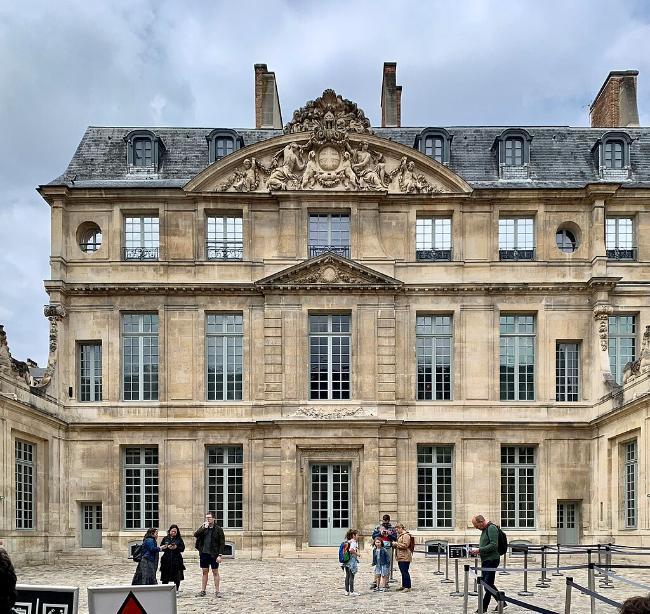
Musée Picasso, inner court, main entrance. Public Domain
Another great combination for the PMP is a day in the Marais. First, the Musée Picasso (16 euros per adult without children; 12 euros per adult accompanied by one or two children; children under 18 years old are free) and then the Musée d’art et d’histoire du Judaïsme (13 euros per adult; 9 euros for non-EU residents 18-25 years old; 5 euros for EU residents 18-25 years old; children under 18 years old are free). Both require a few hours. Break up your art gazing with a delicious lunch at the Swedish Institute’s Café FIKA at 11 rue Payenne near the Musée Picasso, where you will find free exhibitions of Swedish art and design (closed on Mondays, the same day as the Musée Picasso and the MahJ).
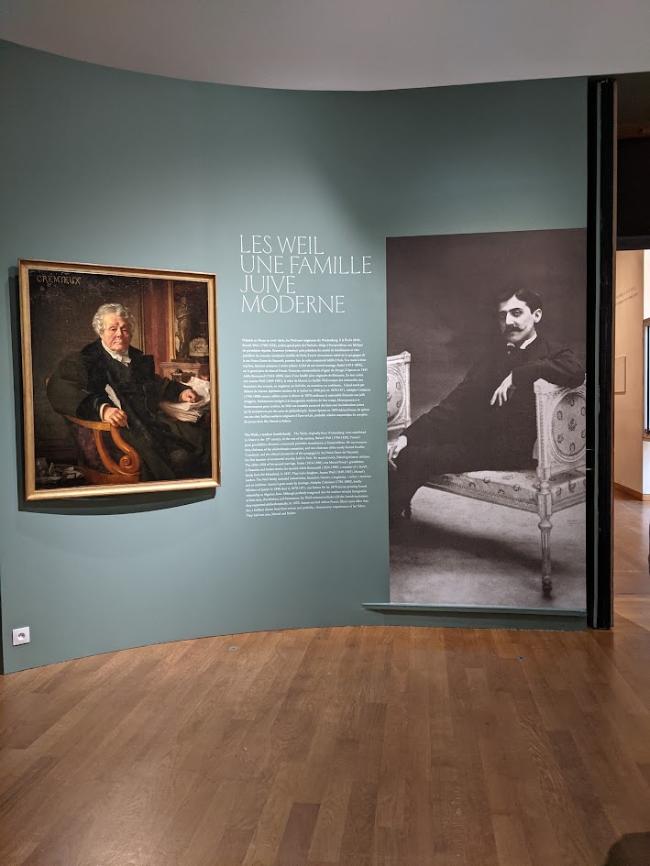
Musée d’Art et d’Histoire du Judaïsme, First Gallery of Proust du Côté de la Mère. Photo : Beth Gersh-Nesic. May 2022.
Is the Musée d’art et d’histoire du Judaïsme open on Saturdays, the Jewish sabbath (aka Shabbat or Shabbos)? Oui! On a Saturday in January 2024, I started at the Musée Picasso to tour the enormous and enigmatic Sophie Calle exhibition installed in a museum almost empty of any Picasso artworks. The experience felt surreal: a homage to death and eternal ever-aftering. Thoroughly exhausted, I decided to walk by the MahJ to read the outside banners for the exhibitions on view, planning to visit another day. To my great surprise, this Jewish museum was open on Shabbat! Unbelievable, but true.
The main temporary exhibition was about the popular graphic artist Joann Sfar, whom I had never heard of. Taking a chance, the experience felt like a shot of oxygen after slogging through Sophie Calle’s meditation on mortality. Sfar’s artworks are bright, extremely imaginative, and full of energy. It was great fun to meander through the MahJ galleries studying his (yes, it’s a guy) characters in each installation, organized in chronological order. This impromptu visit, thanks to the PMP, expanded my knowledge of French popular culture and children’s books in a way I would have never considered without a Paris Museum Pass influencing my choices.
Can an observant Jew use the PMP on Shabbat, when it is forbidden to spend money from Friday sundown to Saturday sundown? It’s debatable. Check with your rabbi first before you purchase a PMP that includes Saturday.
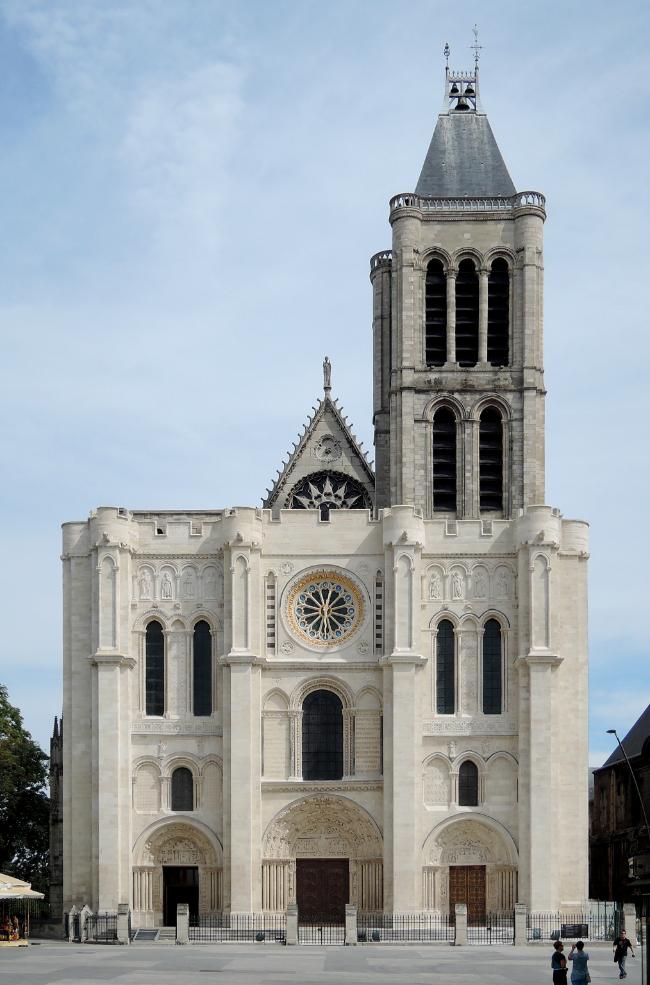
Basilica of Saint Denis, begun 1144. Public domain.
And speaking of religious art, Parisian churches offer exceptional opportunities to enjoy Christian art without charging admission. However, the Basilica of Saint Denis, located 9.4 kilometers (about six miles) outside of central Paris, does charge admission (11 euros for adults; discount prices with transportation, free for children under 18, and EU residents, 18-25). It is included with your PMP. So, you might want to visit this magnificent Gothic royal cathedral during the day and then head for a PMP museum open during the late afternoon and early evening. The time needed to travel between central Paris and Saint Denis is short, but waiting for the RER or train might eat up a bit of time. Don’t forget to check out the website for the days and hours Saint Denis is open. It’s closed during services.

Musée Cluny. The Lady and the Unicorn Gallery. Public Domain
Another thoroughly enchanting immersion in Christian art included in the PMP is the Musée Cluny (12 euros full price; 10 euros for non-EU residents 18-25 years old; free for EU residents 18-25 years old and EU children under 18 years old). The Musée Cluny is dedicated to medieval art and features the famous Lady and the Unicorn tapestries in an unforgettable, mystically somber gallery. The museum is located off the Boulevard Saint Michel, across from the Boulevard St. Germain.
Pair this museum with the Panthéon (13 euros for adults on Wednesdays from June 1 through September 30, 2025, or 16 euros full price all other days; free for EU residents 18-25 years old; free for children under 18 – up to 5 per family). The Panthéon is also located off the Boulevard St. Michel at the end of the rue Soufflot. Once called the Church of St. Geneviève, the Panthéon pays homage to numerous giants who contributed to French culture: Voltaire, Madame Curie, and, most recently, Josephine Baker. It is their final resting place, or, in the case of Josephine Baker, a symbolic tomb with soil from the original burial site in Monaco.
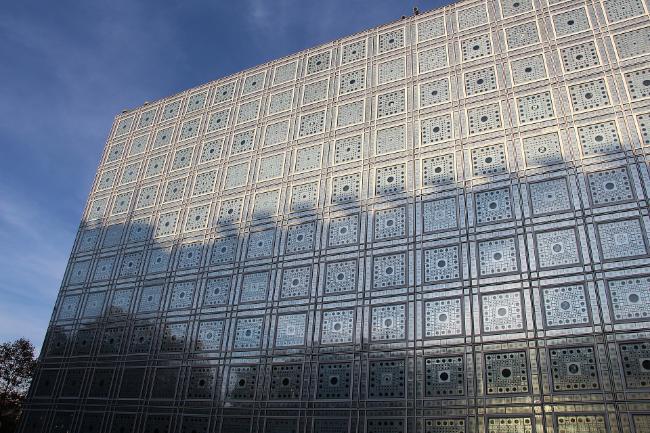
Institut du Monde Arabe. Public Domain
If you add the Institut du Monde Arabe, it’s a comfortable walk from the Musée Cluny to the east end of the Boulevard Saint Germain, where you find the IMA at 1 rue Fossés St. Bernard. On Saturday and Sunday evenings, the museum is open from 10 am to 7 pm. Magnificent inside and out with beautiful historic and contemporary artworks, objects, and images, the IMA, inaugurated on November 30, 1987, unites the efforts of 18 Arabic countries in one building, designed by Jean Nouvel. It features 10 floors of galleries, an auditorium for live events, a bookstore, and a rooftop café that offers spectacular views of Notre Dame. Admission is 10 euros per adult, and free for people 26 years old and younger.
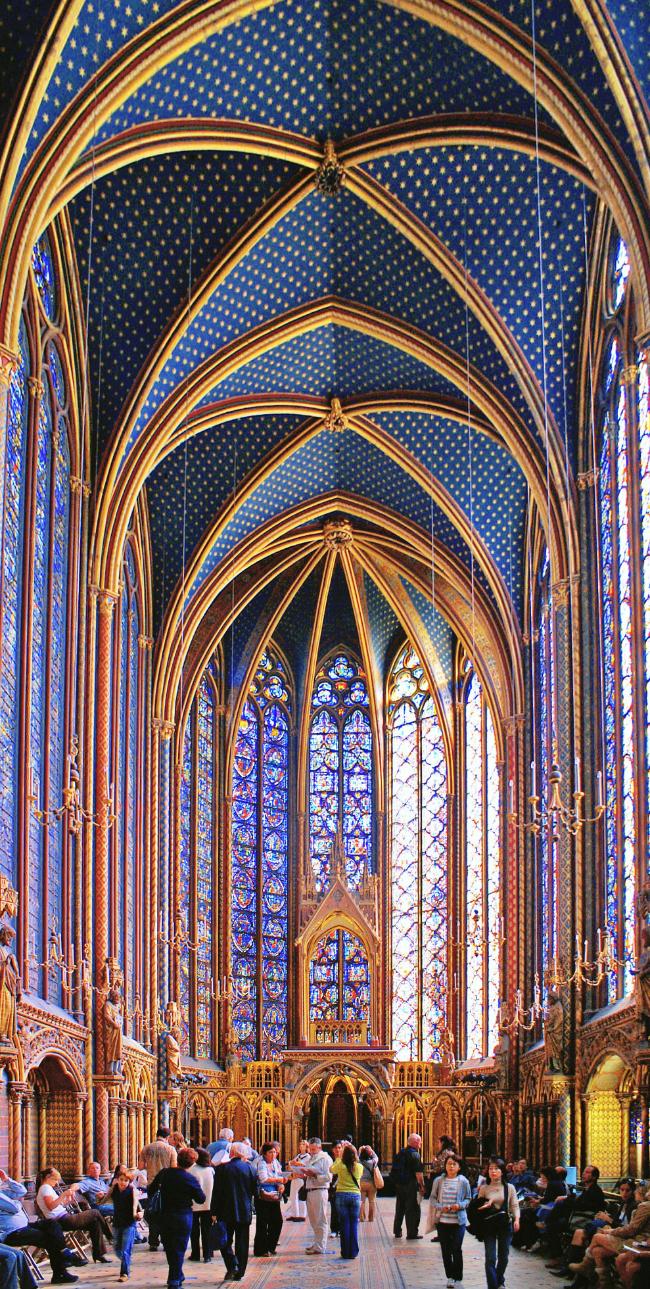
Sainte Chapelle, Upper level. Public Domain
Or you can head to the perfect jewel-box of architectural splendor Sainte-Chapelle on the Ile de la Cité, not far from the Musée Cluny. It is open from 9 am to 7 pm from April 2 – September 30, and 9 am to 5 pm October 1 – March 31. Tickets are 19 euros per adult from June 2 – September 30, 2025; 13 euros from October 1, 2025 – March 31, 2026.
Not far from Sainte Chapelle is the Conciergerie (13 euros for adults and free for people under 26). A combination ticket for Saint-Chapelle and the Conciergerie costs 25 euros from June 2 – September 30, 2025, except on Wednesdays, when this combo costs only 20 euros. From October 1, 2025 – March 31, 2026, Sainte-Chapelle and the Conciergerie cost 20 euros for adults, while children under 18 are free. Young EU adults and non-EU adults residing in France, 18-26 years old, are free.
A day spent at the Musée Cluny, Saint-Chapelle, and the Conciergerie would cost 32 or 35 euros à la carte, or around the average price of the 2-day PMP. With a four-day or six-day Paris Museum Pass, your average daily price is much less. So, you save money and profit from visiting these three important cultural treasures in one day using your PMP – certainly doable if you have the inclination and energy
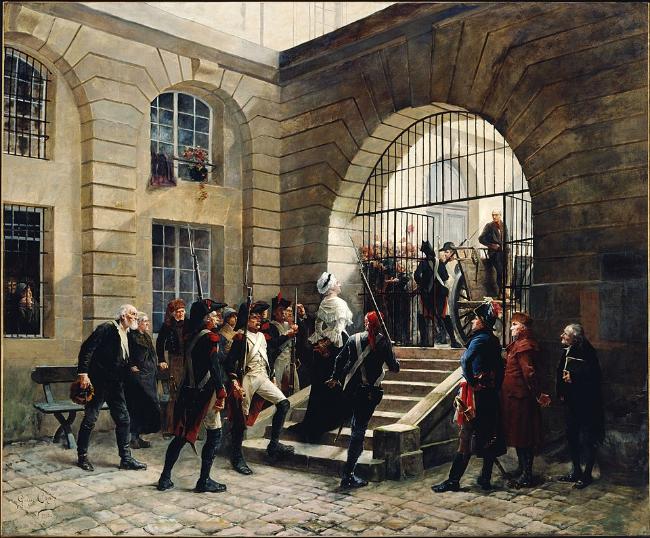
Georges Cain, Marie Antoinette Leaving the Conciergerie on October 16, 1793, 1885. Musée Carnavalet, Paris.
Please note that the Paris Museum Pass promises access to over 50 museums in and around Paris, but you are limited to only one visit per venue. If you want to return to a venue, you will have to pay for that visit separately. Before the Covid lockdown introduced museum reservations, the PMP offered unlimited visits to every venue listed with their pass. It was a better deal then. Nevertheless, it’s still worth the investment if you plan well. Just ask veteran Paris Museum Pass purchaser, and one of my favorite traveling companions, Julie Wolfer.

Jacques-Germain Soufflot, Le Panthéon
Julie used the PMP recently with her young adult grandchildren, a different generation and perspective. Here is her advice: “Know your museum tolerance. Do you think you can spend four days in a row in museums? Once you activate your card, the clock is ticking. The Louvre and other large museums can take two hours or all day, depending on how much you want to see. Always reserve a timed entry well in advance of your visit. If you are visiting several sites in one day, plan to see things that are close to each other. Traveling around the city, while efficient, eats up your museum time. Consider grouping a small museum, a historic residence, and a memorial into one day to vary the type of sites you see and avoid museum burnout. Take breaks. Museum cafés offer decent food and save time. You can’t see all the museums included in the PMP, but that’s a good reason to return to Paris.” Amen.
Other benefits of the PMP: you can buy the PMP online before you go to Paris, which means you can plan your itineraries well in advance of your trip. When you pay online, you can download a pdf and print the pass and/or you can download the app to keep the pass on your phone. Activation of the PMP begins at the first admission stop when your paper pass or phone pass is scanned.
However, if you crave leisure museum experiences, cultivating your sense of spontaneity and following your bliss as you meander aimlessly down the ancient streets of Paris, consider museuming “à la carte.” This style can make your Paris trip extremely fulfilling and memorable.
To satisfy my husband’s curiosity, I presented the “à la carte” option with help from our daughter, who planned our mother-daughter Paris trip in 2012 during her semester abroad in France. Stay tuned for the next installment in this series of articles on Museuming in Paris…
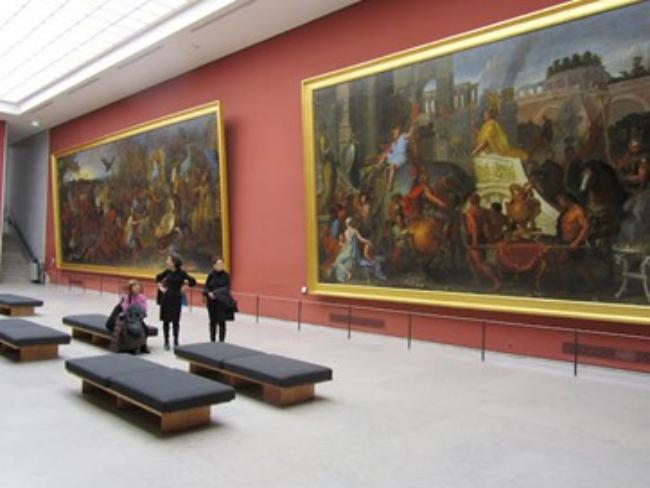
Lead photo credit : New York Arts Exchange group in the Louvre, January 2011. Photo: Beth Gersh-Nesic
More in Louvre, Museuming in Paris, Orsay, Paris Museum Pass
Related Articles


REPLY