
The Pont Neuf Transformed

- SUBSCRIBE
- ALREADY SUBSCRIBED?
BECOME A BONJOUR PARIS MEMBER
Gain full access to our collection of over 5,000 articles and bring the City of Light into your life. Just 80 USD per year.
Find out why you should become a member here.
Sign in
Fill in your credentials below.
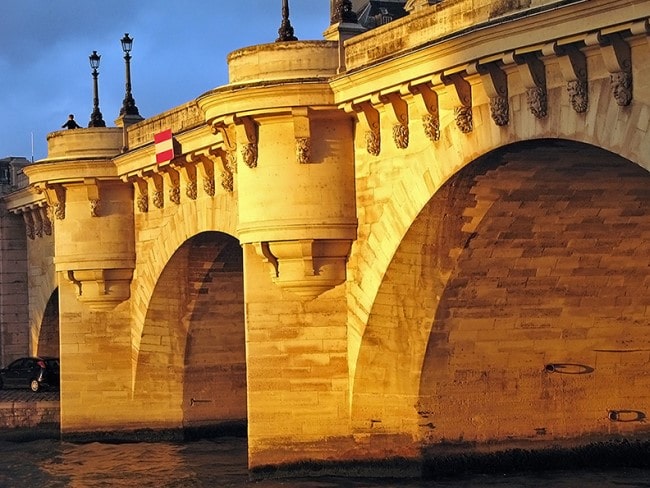
For three weeks this summer, there’s one topic which will be on everyone’s lips in Paris and that’s the Pont Neuf. Yes, it’s the oldest bridge in the city, a monument historique and a favorite snap for tourists, something we take for granted most of the time. It’s just “there” and, it seems at least, always has been. But surely everyone will see it with new eyes in June this year, when it will be turned into an attention-grabbing art installation.
The Caverne du Pont Neuf project, or the Cave of the Pont Neuf in English, will see the artist JR use nearly 20,000 square meters of canvas to turn the bridge into a giant grotto, enhanced by augmented reality and a soundscape. It will be 120 meters long, a giant inflatable with enough space under its rocky peaks for the public to walk right through. Many more will pass by, walking along the banks of the Seine or sailing underneath, and others will view it when crossing one of the nearby bridges. They are sure to be stunned by the bold reimagining planned for the city’s most iconic bridge, first opened in 1607 during the reign of Henri IV.
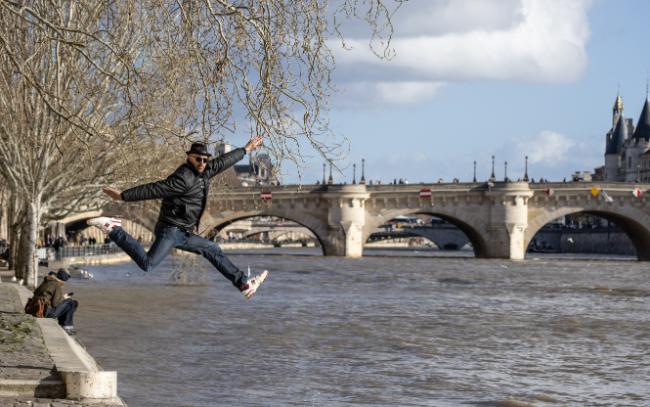
JR and the Pont Neuf. Photo: Emilie Pria / Atelier JR © 2026 Atelier JR
The Pont Neuf crosses the Seine at the western tip of the Île de la Cité, built to connect the right and left banks of the city as it expanded out from its medieval beginnings. It was such an integral part of Paris in the centuries after it first appeared that the author and historian Edouard Fournier published a two-volume history of it in the 19th century. So now, when everyone will be looking at it afresh, is a good moment to recall some of the reasons why every Parisian has cause to think fondly of it.
An innovative design
Originally called the Pont Neuf to highlight its up-to-the-minute – by 17th century standards! – design, this was the first bridge in Paris to be made entirely of stone. It was a triumph of engineering because its deep foundations and raised arches made it particularly resistant to flooding. It was a beauty too, designed as a series of short arched bridges and it was exceptionally wide, with room for pavements on each side so pedestrians could keep out of the way of passing carriages and the mud they spattered.
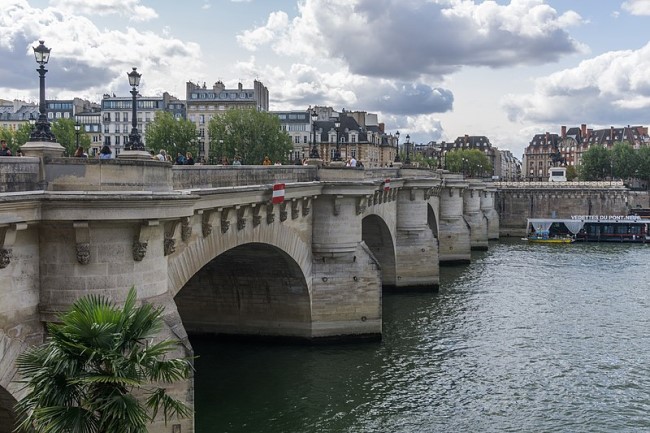
View of the Pont-Neuf bridge in Paris. Photo credit: Sumit Surai/ Wikimedia Commons
Warding off evil spirits
Sculptors chose to carve grotesque faces in stone to adorn the sides of the bridge, creatures from ancient mythology, designed to protect against evil spirits. The original mascarons, as they are known, were replaced during a major renovation in the 19th century, but you can still see some of them in the Musée Carnavalet and at the national Renaissance Museum, the Château d’Écouen. Those decorating the bridge today are copies, installed in the 19th century, but none the less striking for that. If you sail under the Pont Neuf, you will certainly be drawn to their strangely grimacing faces and wild-eyed stares.
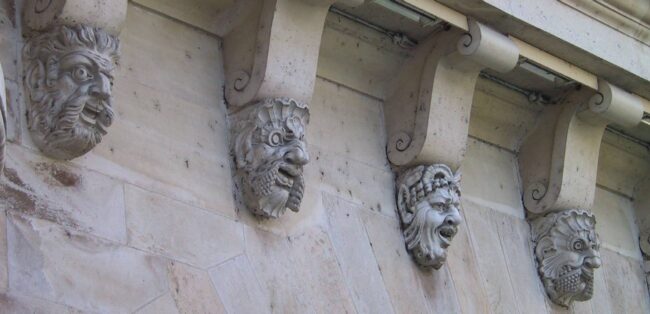
Mascarons on the Pont Neuf. Photo: Wikimedia Commons
Henri IV, splendid in bronze
Henri IV, often said to be France’s favorite king, took a great interest in the building of the Pont Neuf, visiting frequently as it took shape. His wife, Marie de Medici, commissioned the imposing bronze statue of him on horseback which stands on the center of the bridge as a tribute, and it took on extra significance when he was assassinated just three years after it was installed. It was destroyed during the revolution just like so many other royal monuments, but in 1818 when the monarchy was restored, a new one was commissioned and paid for by public donations. A cast of the original statue was used to make an exact copy and inside it are hidden a biography of Henri IV and a list of those who contributed to the new statue.
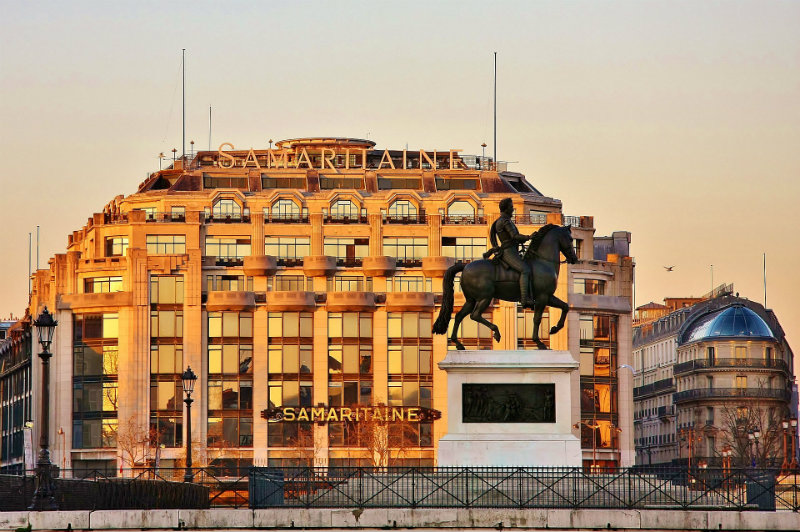
La Samaritaine and the statue of Henri IV. Photo: Adrian Scottow
La Samaritaine
Did you know that the name of La Samaritaine, one of the city’s most exclusive department stores, is connected to a well which once stood on the right bank end of the Pont Neuf? Henri IV had a water pump installed there, close to where the shop stands today and it was decorated with a statue of the Samaritan woman whom Jesus met when she came to a well to draw water. The pump soon became a well-known spot in the city, referred to as simply la Samaritaine, and although the pump itself was no longer there when Ernest Cognacq opened his department store in 1869, he chose to name it after the well.
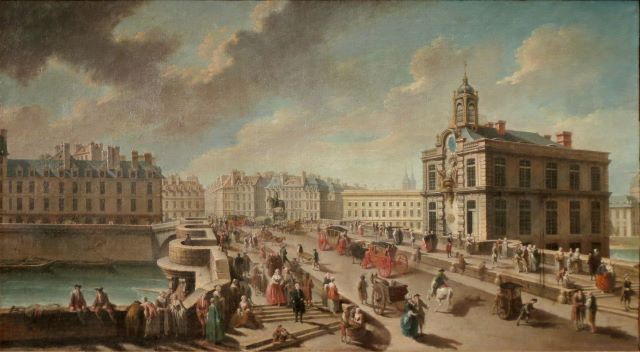
La pompe de La Samaritaine et le pont Neuf, depuis le quai de la Mégisserie en 1777 (painting by Nicolas Raguenet, Musée Carnavalet). © Public domain
A busy crossing point
The Pont Neuf soon became a key crossing point over the river and a busy center of activity in its own right. In the 17th century, it was claimed that there was no time of day when crossing the bridge wouldn’t lead to seeing “a carriage, a white horse, a priest and a prostitute.” It was also commonly thought that if the Paris police were looking for someone, they would keep watch on the bridge. If the person they sought had not crossed it in three days, they assumed he had left Paris!
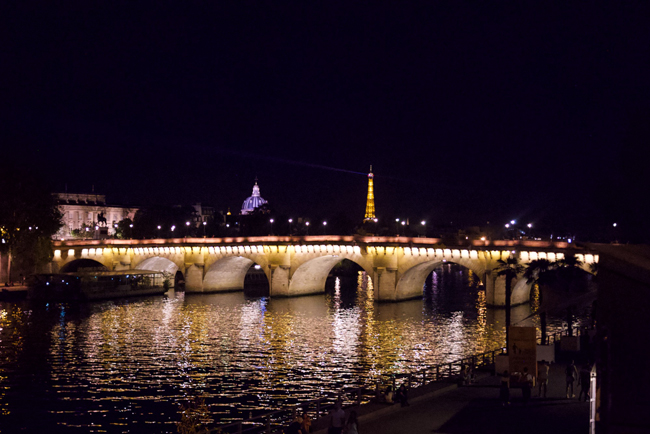
Les reflets de Pont Neuf © William O’Such
A hive of activity
Unlike on earlier Parisian bridges, no houses were built on the Pont Neuf and soon businesses sprang up in the spaces along its length. Art-dealers gathered to display paintings they hoped to sell and jewelry-makers set up their stalls. In fact, the nearby Quai des Orfèvres (Goldsmith’s Key) was named after them. But the trade was certainly not all in luxury goods. It was a lively, noisy place, memorably described by the historian Colin Jones in his book Paris, Biography of a City: “Pedlars jostled against a motley crew of bouquinistes (second-hand booksellers), pamphlet-sellers, pickpockets, acrobats, dog-barbers, street entertainers, flower-sellers, umbrella-hire merchants and recruiting sergeants.”
A letter said to have been written in 1701 by a Sicilian tourist, outlines a thriving trade in medicine and quackery. Among the people he saw offering their services on the bridge were some who “put fallen teeth back in.” There were others who made false eyes or “cured incurable illnesses,” not to mention those offering potions to “whiten and beautify the face.” Teeth-pulling was a particular speciality and one famous practitioner, known as Grand Thomas, is said to have had a stand just below Henri IV’s statue for some 40 years in the first half of the 18th century.
Gradually however, as the fashionable new boulevards opened up in Paris in the 19th century, shoppers flocked there and activity on the Pont Neuf began to fade away.
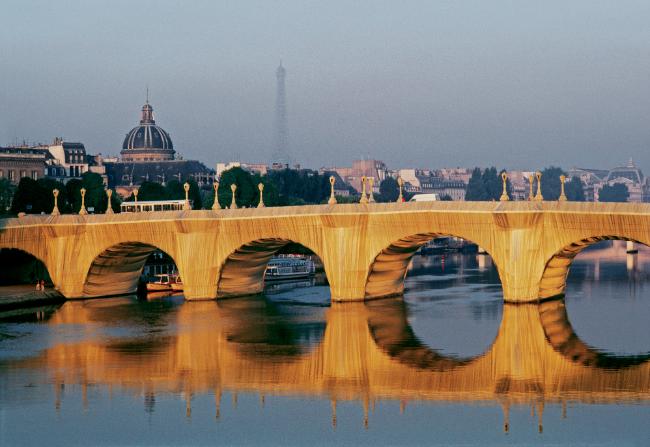
“The Pont Neuf Wrapped.” Photo: Wolfgang Volz. © 1985 Christo and Jeanne-Claude Foundation
A 20th-century showpiece
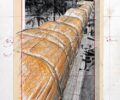
In the summer of 1985, the Pont Neuf became the centre of an art installation known as “The Pont-Neuf Wrapped.” Artists Christo and Jeanne-Claude covered the bridge entirely in 450,000 square feet of material the color of golden sandstone, even wrapping the street-lamps, parapets and pavements. The wrapping was tightly done so that the bridge’s shape was accentuated rather than obscured, and for two weeks, its shimmering image was the talk of Paris. Anne Hidalgo, mayor of Paris until earlier this year, remembers being fascinated by the project, saying “It was an unforgettable moment of poetry and beauty. We were rediscovering the bridge and the majesty of the river of Paris.”
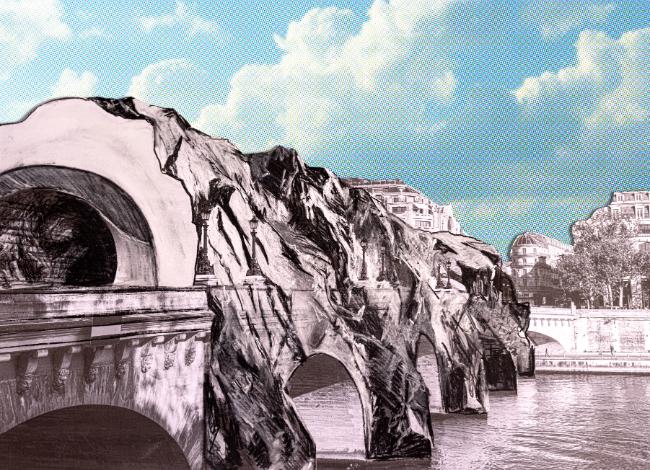
Caverne du Pont Neuf. Photo: Courtesy Atelier JR. © 2026 Atelier JR
2026 A New Tribute
JR, the artist who has designed the Caverne du Pont Neuf installation, has said that it is in part inspired by Christo and Jeanne-Claude’s work, writing that “I share their idea that the mission of art is to make the public think, or rethink, the familiar.” His giant cave is partly a tribute to the limestone quarried locally and used to create many of the most beautiful buildings in Paris. Exploring the cave will be an immersive experience, one the artist hopes will “juxtapose the elegant and the raw,” and encourage people to see the bridge in a new light, creating “a dialogue between the past and the present.”
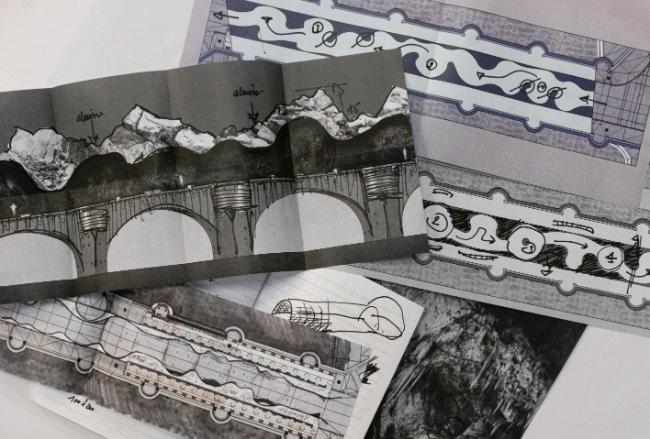
Ironically, practically none of this bridge, said to be the oldest in Paris, is original. Emperor Napoleon III had its foundations completely rebuilt, and both the mascarons and the Henri IV statue are copies, albeit very faithful ones. Nevertheless, the Pont Neuf remains one of the most iconic sights in the city, a repository of tales from history. The Caverne du Pont Neuf will have a futuristic vibe, but as visitors explore it they will surely also be prompted to think back to the many stories from its colorful past.
The Caverne du Pont Neuf will be on display every day from June 6th–28th and will be open to visitors 24/7. Entry is free.
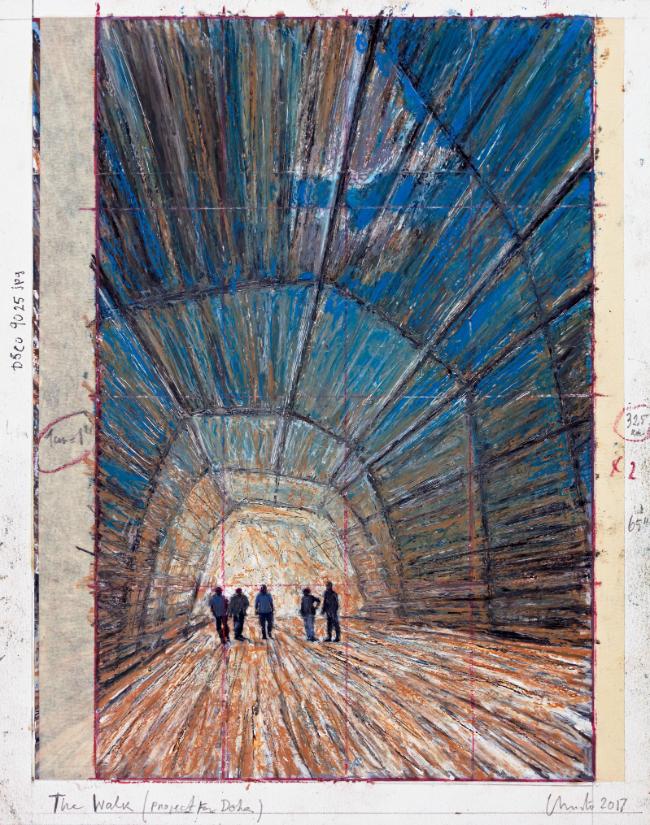
Sketch. Caverne du Pont Neuf. Photo: André Grossmann. © 2017 Christo and Jeanne-Claude Foundation
Lead photo credit : Pont Neuf bridge. Photo credit: Steve/ Wikimedia commons
More in Caverne du Pont Neuf, JR artist, Paris bridges, Pont Neuf
Related Articles

By Marian Jones