Vie Privée, Starring Jodie Foster
- SUBSCRIBE
- ALREADY SUBSCRIBED?
BECOME A BONJOUR PARIS MEMBER
Gain full access to our collection of over 5,000 articles and bring the City of Light into your life. Just 80 USD per year.
Find out why you should become a member here.
Sign in
Fill in your credentials below.
One of the intriguing things about Vie Privée (A Private Life) is trying to figure out all the movie genres it isn’t. It’s sort of a murder mystery … but not quite (we’re never sure if the victim was really murdered, for one thing). A romance … but boy and girl are more than middle-aged, and were already married and divorced. A comedy of manners … but my laughter always got stuck at the point of leaving my throat. It’s an old-school psychological thriller that owes a lot to Hitchcock’s Spellbound, but it has new-school doubts about how substantial reality really is, anyway. The director, Rebecca Zlotowski, who’s explored the complexities of contemporary France in films like Les Enfants des Autres (2022) and the mini-series Les Sauvages (2019), turns this ungraspable quality into something charming as well as exasperating, and even, well, substantial (maybe).
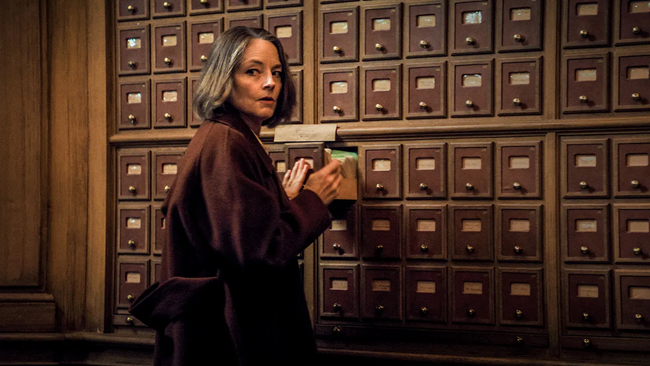
The one sure thing about Vie Privée is that it’s a Jodie Foster movie. I hadn’t seen Ms. Foster in a film in quite a while, and forgot how brilliant she can be. At her best, challenged by a role, she does what even revered actresses like Meryl Streep and Cate Blanchett cannot. She doesn’t construct a character, or “inhabit” her, but seems to just be her. It’s an in-born gift I marveled at as a child when pre-pubescent Jodie played Joey in TV’s Courtship of Eddie’s Father (without knowing what I was marveling at, she was clearly different from other actors on television). This is all the more impressive when the character is an “Other”, very different from what we think of as Ms. Foster’s persona. Here she plays Lilian Steiner, an American psychiatrist practicing in Paris. After one of her patients (played by Virginie Efira, in her second feature directed by Ms. Zlotowsky) dies by suicide, she begins to suspect that it was actually homicide, and the shrink transforms into private eye.
The delicious irony is that the investigation into the death and life of her patient entails an inquiry into Lilian’s relationship with her, her approach to psychiatry, and finally her own psyche. She’d prescribed the meds that killed Paula and her husband (Mathieu Amalric) accuses her of being responsible for her death. Did she accidentally prescribe too much? (Wasn’t it Freud who said there are no accidents?) These doubts lead her to get in touch with her son (Vincent Lacoste), grown up with a baby, from whom she seems quasi-estranged. She also meets her ex (Daniel Auteuil) after a long separation. They call her methods and motives into question, until she begins calling her very self into question. (She’ll even have a session with Paula’s hypnotherapist.) Then Paula’s daughter Valérie (Luàna Bajrami) begins her own inquiry and asks for information that Lilian maintains is confidential.
Ms. Zlotowski balances these various characters and narrative strings adroitly. She brings out a seasoned, nearly mellow, quality in her actors, so that watching veterans like Auteuil and Amalric is like enjoying succulent dried fruit. Noam Morgensztern (a member of the Comédie Française) is particularly good as an embittered, but mordantly funny, ex-patient suing Lilian for malpractice. The director isn’t perfect, however. While she coaxes a wonderful performance out of the great nonagenarian documentary-maker Frederick Wiseman (playing Lilian’s mentor), in terms of plot and character development it’s largely wasted.
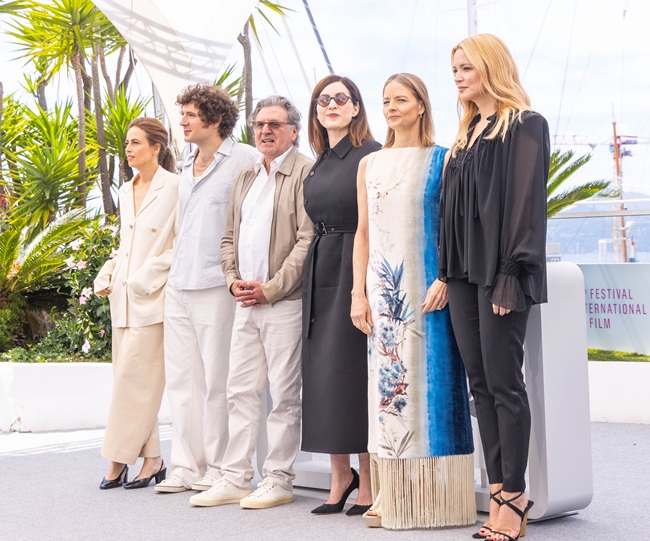
Cast and crew of “A Private Life” at the 2025 Cannes Film Festival. Photo: Harald Krichel/ Wikimedia commons
The director’s filming is also hit-or-miss, trying things that may work or not, and scene transitions are sometimes over-abrupt. Some techniques work in their way, like a dialogue scene in a car between Lilian and her former husband: when one person speaks the other blurs out of focus, and vice versa. This is a bit ham-fisted but expresses how self-centered a spouse can be, letting the supposed “significant other” fade into vague non-entity. The hypnotism-induced dream sequences are also effective, recalling sequences in Spellbound designed by Salvador Dali, and bring in elements seemingly out of nowhere, as in real dreams.
Some of those images derive from the Occupation. The director is Jewish, with forbears from Poland, and she gives the film a strongly Jewish tint. Ms. Foster’s character is Jewish, as is her ex-husband, the deceased patient and her family. But this isn’t developed, so there’s no real point about their Jewishness. We don’t learn about possible links to the Holocaust, or contemporary anti-Semitism, or the situation in the Middle East. There’s nothing about the differences between French and American Jews, or between Ashkenazi and Sephardic Jews (the director’s father was Ashkenazi, her mother Sephardic). Funerary rituals aside, the characters seem thoroughly secular. Perhaps that’s the point lurking underneath the surface?
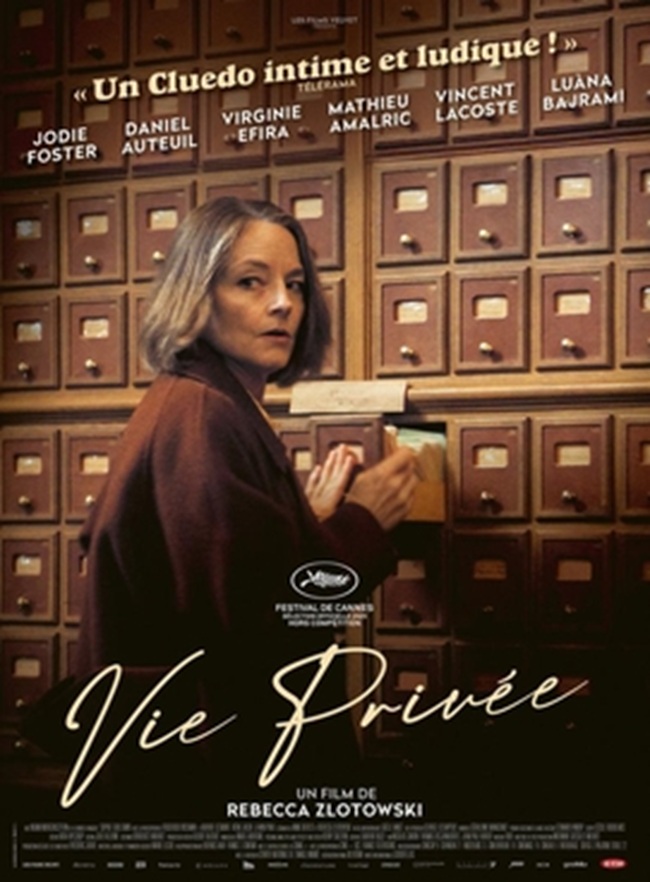
A Private Life film poster
You can’t underestimate Jodie Foster’s performance, yet her character remains obscure in ways. She’s an American, so why did she settle in France? Only because of her marriage to a French doctor? We never learn how this expatriation affected her relationship with him and her son. When (and why) did her relationship with the son go south? How has language affected her life and career in France? (In fact Ms. Foster speaks French impeccably, with the fluency of someone who learned the language at an early age in elite schools, not like the typical expat or immigrant.) The film is also coy about her sexuality. There are hints of same-sex passion, bringing to mind Ms. Foster’s own private history in and out of the closet. But the coyness, instead of leading to a revelation, discreetly fizzles.
Happily, the director and cast revert to plot and action (if not solution). That means real-life break-ins and dream-life confrontations, showdowns with the villains. It reminds us a little of Woody Allen’s mock-mysteries, but Ms. Zlotowsky has her own touch, sometimes deft, sometimes heavy-handed, but always personal. Unlike some psychoanalysts she’s more interested in reconciliation than resolution. There’s enough of the former to make Vie Privée, if not a feel-good movie, at least a feel-not-bad. As for the mystery … what mystery?
Production: Les Films Velvet/Auvergne-Rhône-Alpes Cinéma/Buenos Hair/France 3 Cinéma
Distribution: Ad Vitam
Lead photo credit : Jodie Foster in 'A Private Life' ('Vie Privée'). credit: Georges-Lechaptois
More in French film, Jodie Foster, movies
Related Articles