New Film Shines the Light on De Gaulle in World War II
- SUBSCRIBE
- ALREADY SUBSCRIBED?
BECOME A BONJOUR PARIS MEMBER
Gain full access to our collection of over 5,000 articles and bring the City of Light into your life. Just 80 USD per year.
Find out why you should become a member here.
Sign in
Fill in your credentials below.
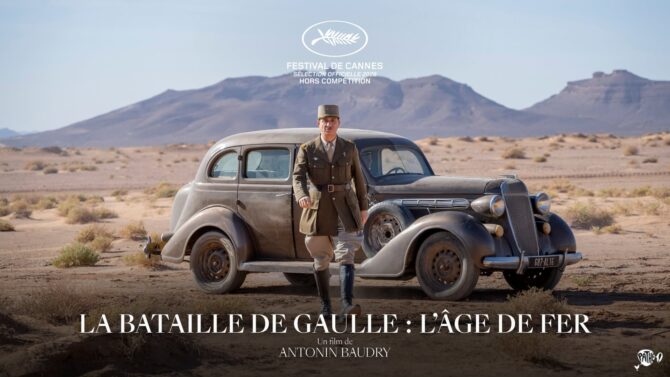
La Bataille De Gaulle isn’t exactly a biopic. It sticks to Charles De Gaulle’s role during WWII. It’s the first installment of a two-part opus (Part II has also been released). The film follows his trajectory from the initial rout of the French army by the Germans until the assassination in 1942 of Admiral François Darlan, a high-ranking Vichy official who’d belatedly switched sides after being captured. The second part will take us to the Liberation. There’s so much more to this monumental figure’s epic life: his leadership during the post-war period; his creation of the Fifth Republic in 1958 and ending of the Algerian war of independence; his handling of the May 1968 revolution; his abrupt resignation from the presidency. Those episodes (if they’re ever made) will have to wait.
The film we do have is excellent, both spectacular and moving. On one level it’s a splendid, old-fashioned WWII extravaganza, recalling The Longest Day as well as guilty pleasures like A Bridge Too Far, Tora! Tora! Tora! and Pearl Harbor. The battle scenes are stirring and gritty, without being gruesome. These scenes round out the depiction of the Free French, and keep the film from being claustrophobically focused on De Gaulle.
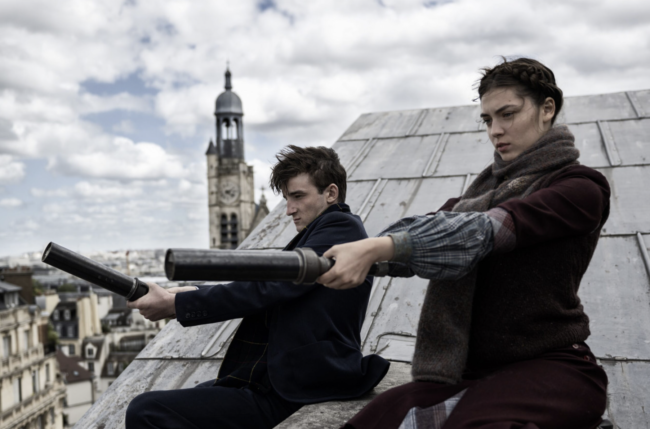
La Bataille De Gaulle, L’Age de Fer. Photo credit: Guy Ferrandis
Still, the film remains decidedly character-driven, similar to Patton or Oppenheimer (on one level also a WWII movie). De Gaulle’s personality is made up of equal parts military bearing, pride, patriotism, hatred of “barbarians.” The superstructure is his identification of himself with the besieged French nation, another version of Joan of Arc (his Catholic faith isn’t stressed but it’s there, like his family-man side). Yet he retains an enigmatic, unpredictable quality.
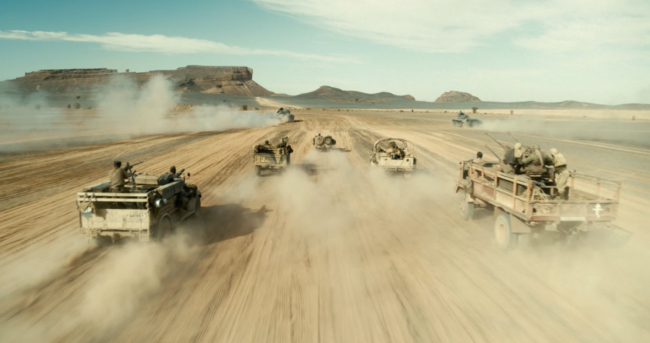
La Bataille De Gaulle, L’Age de Fer. Photo credit: Pathe Films/ TF1 Production
The director, Antonin Baudry, has made a shrewd choice in narrative strategy. Parallel to the De Gaulle bio and large-scale warfare is the story of a young resistant. This story is by turns dramatic and romantic: like a Truffaut movie set during the war. The character’s real-life prototype was a royalist (though anti-fascist), something the film doesn’t explore. The director obviously felt an extra dollop of complexity wasn’t what was needed. Instead the young lead is paired up with a French-Jewish girl who’s not only a résistante but a sloe-eyed ingénue. Whether this strategy brings in young movie-goers remains to be seen, but as a way to further balance the narrative it works.
As the quintessential Frenchman of the 20th century, Simon Abkarian is utterly convincing (the delicious irony is that his family origins are Armenian). He has De Gaulle’s imposing physical presence down to a tee, also his imperious way of speaking (including efforts at English). He’s able to project De Gaulle’s dejection at major setbacks, while remaining locked with iron-clad fidelity to his values. (No wonder the film’s subtitle is “The Age of Iron”.)
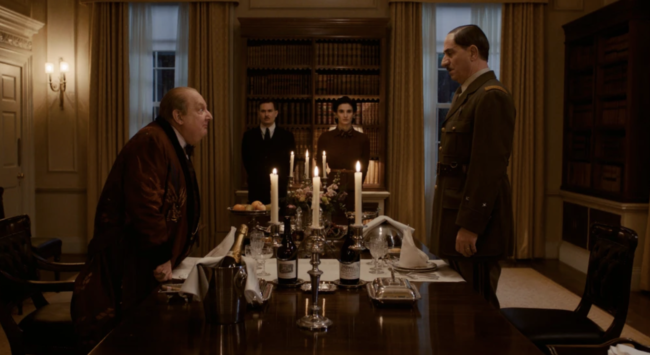
La Bataille De Gaulle, L’Age de Fer. Photo credit: Pathe Films/ TF1 Production/ Belvedere
The supporting cast is outstanding. Simon Russell Beale as Churchill takes getting used to, but grows into his part. Dialogue between Churchill and De Gaulle is often in French, which we also get used to. Campbell Scott plays FDR to haughty perfection, though we don’t get his craftiness or ebullience (or his disability). Florian Lesieur as the young resistant and Anamaria Vartolomei as his comrade-in-arms are engaging and authentic — they don’t seem like contemporary teenyboppers time-traveled into the picture.
The most powerful performance, aside from Abkarian’s, is by Mathieu Kassovitz as the duplicitous Vichy admiral Darlan. After a long career playing myriad characters (and also directing), Kassovitz inhabits his role with creepy ease. With his careworn face he reminded me of Sean Penn as the baddie in One Battle After Another, but lower-key and more believable.
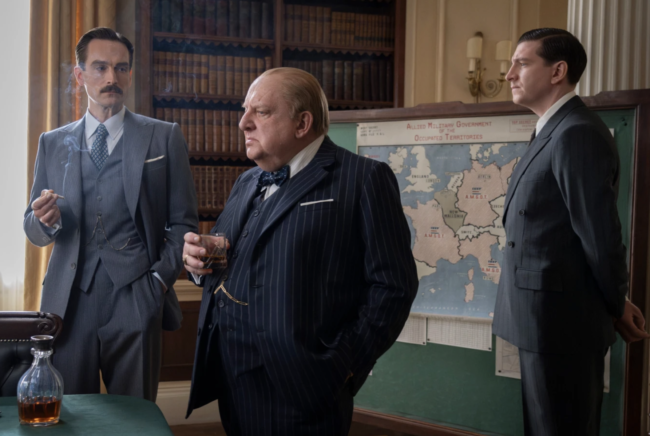
La Bataille De Gaulle, L’Age de Fer. Photo credit: Malgosia Abramowska
Baudry (whose second feature this is) adds a few stylistic flourishes reminiscent of Christopher Nolan and others. These aren’t terribly convincing, but remind us that the film, traditional as it might be, was made in the 21st century. There are sprinklings of political correctness: female, Black, Arab, and Jewish characters parachuted into the action. In fact, there were people from these groups who played an important part in the struggle against the Nazis. It would seem less formulaic if they were more than just walk-ons. It’s especially grating that the film doesn’t deal more thoroughly with Félix Eboué, the Black colonial governor of Chad, whose decision to rally to the Free French came at a crucial moment.
The movie doesn’t give history lessons, but they’re on offer if we want them. First, the basic fact that France wasn’t just continental France (i.e. “the Hexagon”). It was the French Empire, which stretched from the Western Hemisphere to North, West and Central Africa to Indochina and Polynesia. We usually think of De Gaulle and the Free French hunkered down in London, but in reality decisive engagements took place all over the African continent. That French and British imperialism was relied on to fight German imperialism is another complexity the film doesn’t delve into.
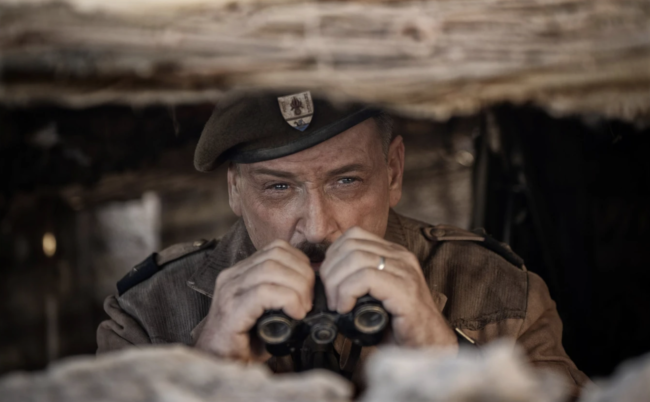
La Bataille De Gaulle, L’Age de Fer. Photo credit: Guy Ferrandis
There’s added room for debate. Admiral Darlan seems to have been less of a movie villain as depicted in this, well, movie. He played a double-game, pro- and anti-Vichy, but others did, as well. He was conniving about his own ambitions, but also obsessed about the integrity of the fleet he’d built up. He was perhaps genuinely concerned about France’s destiny, but saw the geopolitical configuration in obsolete national terms, rather than as a new dichotomy between democracy and totalitarianism. If he hadn’t been assassinated (sorry, with this kind of historical picture spoilers come with the territory) the war effort might have been eased — but post-war France would have been deprived of the redemption De Gaulle achieved.
Darlan also figured in the personal drama played out between De Gaulle and Roosevelt. It might make Americans squirm to see how the president denigrated his French ally. Why? Perhaps a matter of perspective: Roosevelt was responsible for a worldwide situation, both European and Pacific theaters of the war. De Gaulle remained Franco-centric, prioritizing the honor of his homeland. I’m sure it’s more complicated than that. In historical terms — and for moviegoers in narrative terms — the Darlan question is an engrossing “what if?” hinge moment. Its resolution is an almost viscerally satisfying way to end the first part.
Stay tuned for Part II.
Production: Pathé Films/Auverne-Rhône-Alpes Cinéma/TF1 Films Production
Distribution: Pathé
More in Charles de Gaulle, World War II, WWII
Related Articles