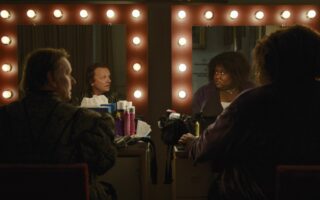
‘La Venue de l’Avenir’ by Cedric Klapisch, France’s Great Comic Director
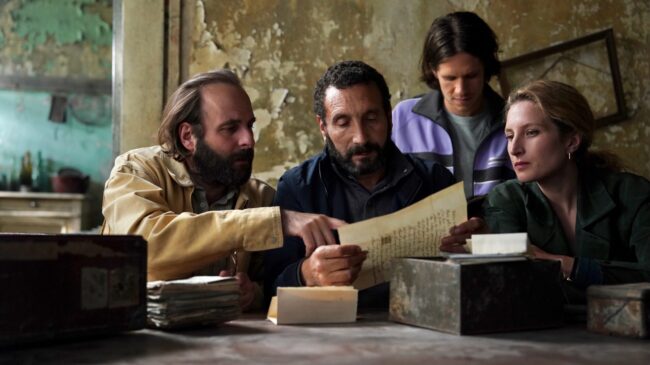
Cedric Klapisch is France’s great comic director. I’ve described his work as “Human Comedy comedy”. He tends to depict groups or individuals thrown together by circumstance. In La Venue de l’Avenir his premise is both deliciously funny and deliciously contemporary: He portrays a large family who didn’t know they were a family, the descendants of a woman named Adele. These descendents are brought together by genealogical researchers, and aside from a live meeting at the start of the film, most of them interact virtually. This clan is not only genealogical (like all those people — including in my own family — connected by outfits like Ancestry.com) and virtual, but pecuniary: they find themselves the owners of an ancestral house in Normandy coveted by developers. A group of descendants go to investigate before deciding whether or not to sell the homestead they never knew about. There they discover a trove of memories in the form of photos and paintings.
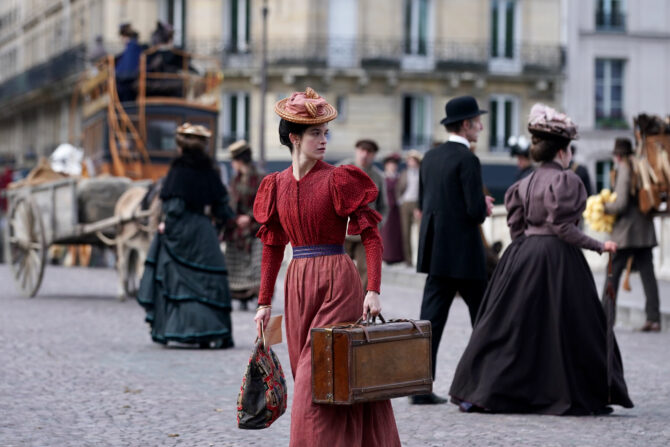
We also go back in time to follow the adventures of the common ancestor when she was a 21-year-old woman who left the provinces to go to the Paris of the 19th century. She wants to discover the wide world but also has a more intimate mission: to discover the mother who’d also gone to Paris, leaving her daughter with family, regularly sending money but otherwise having no contact with her. Adele quickly meets two young men, also provincials, out to make their mark, one a painter, the other a photographer. (Although the best of friends, the painter doesn’t think much of photography as an art, while the photographer thinks painting will soon be extinct.)
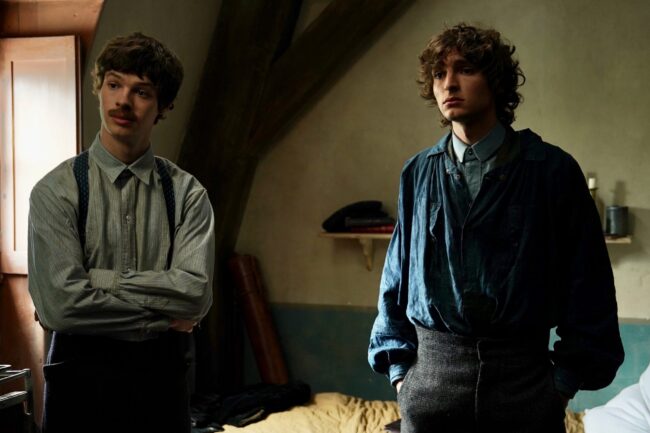
La Venue de l’avenir. Photo credit: emmanuelle jacobson roques/ Cineart
Adele is played by Suzanne Lindon, an accomplished, affecting actress (and daughter of actors Vincent Lindon and Sandrine Kiberlain). Her character is an anti-Amélie, anti-Emily, and anti-Bella (of Poor Things). She’s a 19th-century Everywoman, wide-eyed like Candide, but clear-eyed and sensitive as well. She’s shocked but tolerant after discovering her mother isn’t the ideal figure she’d dreamed about. Nor is it a problem for her to get involved with the young painter while keeping in touch with the boy she left behind (ironically thanks to the painter — he writes her letters since she’s illiterate).
Seb (Abraham Wepler) is Adele’s modern-day counterpart. Like Adele, he didn’t grow up with his parents, but for a more tragic reason — they died in a car accident, so he was raised by his grandfather. He’s a content-provider for Internet sites, but seems to be more or less a photographer. He’s also torn between two (possible) lovers, a vain, air-headed model and a soulful singer (who somehow evokes old Paris). Like Ms. Lindon, Wepler is affecting, but he’s also funny, which she, alas is not.
Klapisch is at his best in the modern-day narrative. He catches the rhythms and foibles of contemporary French life with exactitude and live-wire irony, just acerbic enough to keep us on our toes and laughing. Even his occasional technical gimmicks, the fast-motion sequences and self-conscious segues, tend to work, and if they’re distracting, that’s part of the point. He has a feel for the pulse of different age groups and social classes, which makes the film effortlessly varied.
Still from La Venue de l’avenir. Photo credit: emmanuelle jacobson roques/ cineart
His portrayal of 19th-century Paris, on the other hand, while well staged, and sumptuous- looking, is more conventional. It’s the standard Ye Olde Paris that we get in many historical extravaganzas. He trots out so many celebrities (Victor Hugo, Sarah Bernhardt, Claude Monet, Félix Najar) that we feel like we’re on a guided tour at the Grevin wax museum. What the director doesn’t show is the dirt, grime, and animal energy of the Paris of that time.
Adele’s search for her mother winds up being a kind of McGuffin that stokes our interest on a basic level. More deeply entertaining is how the recently configured family-members get on with their own search, marvel at the ironies of the past, and bond with each other. As the main characters are from different places and walks of life, the family becomes an image of 21st-century France. Veteran actors Vincent Macaigne, Zinedine Soualem, Cécile de France, and Julia Piaton make their characters engaging, and when called on to be funny they manage it with aplomb.
Still from La Venue de l’avenir. Photo credit: emmanuelle jacobson roques/ Cineart
The film eventually turns into a sort of variation on Woody Allen’s Midnight In Paris, where Then meets Now in a surreal fantasy. Klapisch lurches from comedy to ayahuasca-fueled tomfoolery, but fortunately the talented cast is game for what’s basically a lot of silliness. When a painting found at the house seems like it might be worth a lot of money, the descendants debate, quite seriously, doing the noble thing and donating the possible national treasure to the French state. This is humor of the unintentional variety. Cedric Klapisch’s body of work is a national treasure, too. Perhaps he should put it all in the public domain, to spread the word of his contemporary comédie humaine, both human and humane, on Netflix or American public television. Now that would be noble — and funny.
Production: Ce qui me meut/9 SOFICA/France 2 Cinéma/La Compagnie Cinématographique/Panache Productions
Distribution: STUDIOCANAL
Lead photo credit : La Venue de l'avenir. Photo credit: emmanuelle jacobson roques/ cineart
More in 19th century, Cedric Klapisch, genealogy, Normandy
Related Articles