
The Essential Guide to the 19th Arrondissement in Paris
- SUBSCRIBE
- ALREADY SUBSCRIBED?
BECOME A BONJOUR PARIS MEMBER
Gain full access to our collection of over 5,000 articles and bring the City of Light into your life. Just 80 USD per year.
Find out why you should become a member here.
Sign in
Fill in your credentials below.
Mention the 19th arrondissement to Parisians and you may get raised eyebrows. Parts of the 19th do not have a good reputation, which is not entirely deserved. It is one of the poorer areas of Paris with a large ethnic population. While this gives the district a vibrancy and color that is lacking in more bourgeois areas, it is true that the 19th also suffers from a transient population and social problems, including drug use.
However, the arrondissement divides into two halves separated by the Bassin de la Villette and while the 19th is always going to be a bit rough around the edges, a large part of it has been redeveloped over recent decades. Some areas, particularly around the Parc des Buttes Chaumont, are hip, bobo-loved enclaves. It is not overtouristed like central Paris – in fact, foreign tourists are rarely seen – and it is perfectly possible to explore it safely and enjoy the open spaces, fun eateries, and cultural attractions. It is definitely one of the more child-friendly parts of the city in summer. If you have already visited Paris several times and exhausted the most popular attractions, or you are just feeling a bit adventurous, a métro ride to the 19th will more than repay the time and effort and show you another side of the city.
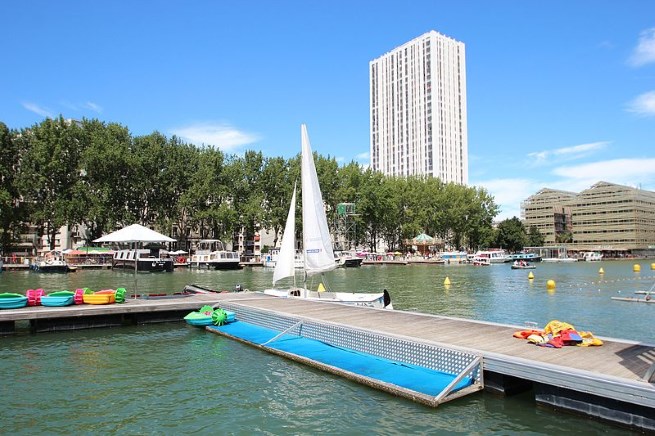
Bassin de la Villette. photo: Lionel Allorge
Things to Do / Places to See
The Bassin de la Villette is the natural starting point for an exploration of the 19th. It is the northern extension of the Canal Saint Martin where it disappears under the intersection of Rue Lafayette, Boulevard de la Villette and the overhead métro and reappears on the other side of Place Stalingrad as the Bassin.
Paris Plages
Since 2007 the Bassin has hosted the second site of Paris Plages, the summertime conversion of waterside Paris into temporary beach resorts. Throughout July and August an area beside the Quai de la Loire is cordoned off providing a safe, temporary swimming pool complete with a shallow children’s pool. The water is monitored continually for cleanliness. Along the quayside deckchairs are set up for sunbathing, quiet reading or meeting friends. There is a regular program of activities, especially for children and families, and outdoor games.
Also – everything is free of charge. It is not usually quite as crowded as the central Paris Plages but it has certainly become more popular over the years.
Canal cruises
If you’ve been to the Bassin de la Villette before you may have noticed the red-canopied boats of Marin d’Eau Douce plying their way up and down the canal. The company is still operating elsewhere in Paris and the Île de France, but at the Bassin the operation has been taken over by a company called Akwa Experience. The boats are now blue but the experience is pretty much the same. You steer the boat yourself and various sizes are available from four-seaters to boats for a large group of friends or family.
A gentle cruise up the Canal de l’Ourcq is a great way to spend a hot afternoon: chug along past the redeveloped Parc de la Villette out to the northeastern suburbs of Pantin and Bobigny. It may not be scenic countryside, but you get a fascinating look at how Paris’s industrial past has been reinvented and a pleasant breeze to cool you off when the temperatures reach 30° or more. Picnics can be provided or take a chilled bottle of champagne.
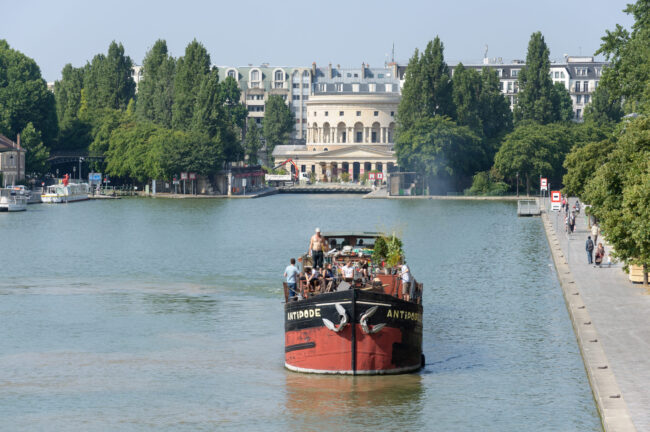
Bassin de la Villette. Photo: Myrabella / Wikimedia Commons
Cycle path
In cooler weather or if you are simply more energetic, the cycle path alongside the Bassin will take you right out into the Île de France. The path takes you through the Parc de la Villette, under the Péripherique and towards Pantin, whose redeveloped Grands Magasins are now a hub of bars and cafés. But you can continue on… and on. The cycle path will eventually take you all the way to Claye-Souilly in the department of Seine-et-Marne, a total of 30km. Hire a Vélib, which is valid anywhere in the Île de France.
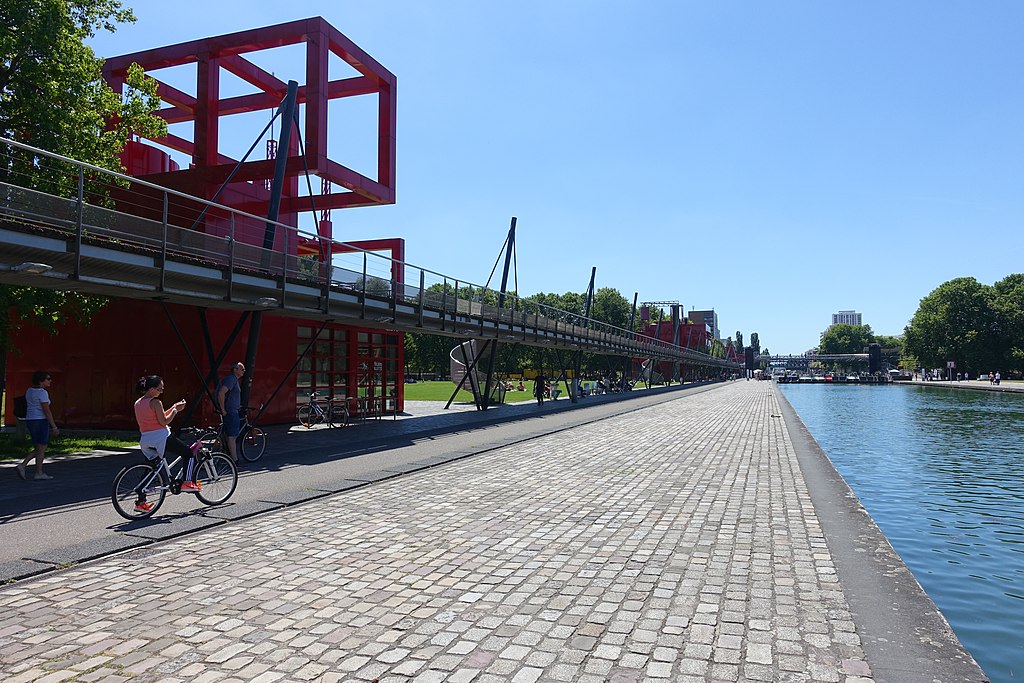
Canal de l’Ourcq/ La Villette. Wikimedia Commons
Péniche L’Eau et les Rêves
This péniche, or converted barge moored alongside the Quai de l’Oise, is an exhibition space, café and gardening bookshop all rolled into one. It has a regular programme of art exhibitions, painting workshops and talks centered on gardening and botany, as well as a café serving snacks and light meals.

Cité des Sciences et de l’Industrie. Photo: Leandro Neumann Ciuffo / Wikimedia commons
Cité des Sciences et de l’Industrie
The flagship of La Villette’s redevelopment in the late 1980s, this is Paris’s science museum. It is huge with permanent exhibitions covering space exploration, the cosmos, the climate crisis, robotics, genetics, the workings of the human brain and other topics, as well as a planetarium. As one of Paris’s most modern museums, from the beginning it was conceived to be child-friendly and is full of interactive exhibits and games, even a dedicated video games lab. Perfect for rainy days and / or children (and adults).
View this post on Instagram
Parc de la Villette
The science museum is in Paris’s third-largest park, 55.5 hectares in area. It’s ideal for letting kids blow off steam, have a picnic or just chill out. There are cafes, play areas and large expanses of grass. Through July-August the park holds a program of open-air cinema screenings. Rent a deck chair, bring food and drink, and enjoy a classic film in the twilight.
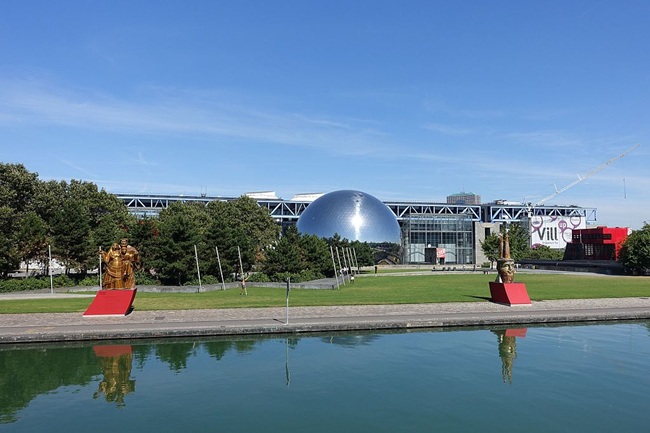
Parc de La Villette. Wikimedia Commons
Cité de la Musique
La Villette has positioned itself as a leading music venue in the city with La Grande Halle de la Villette, the Zénith arena and the Philharmonie de Paris concert hall, opened in 2015. The Philharmonie stages concerts in all genres of music from classical to jazz, to world music, to rock. Architecturally it is a beautiful building and acoustically it is a treat for the ears. The Jazz à la Villette festival is held late August-early September each year at venues in the Parc.
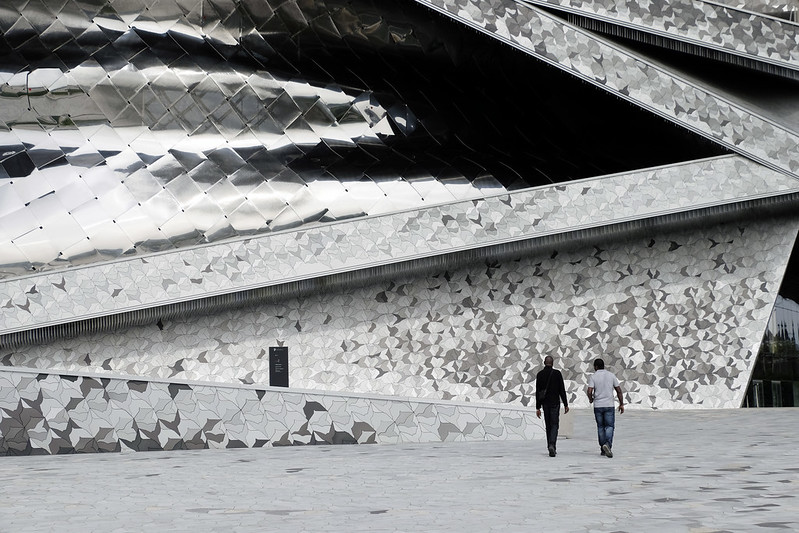
Philharmonie de Paris. Photo credit: Jacqueline ter Haar/ Flickr
Parc des Buttes Chaumont
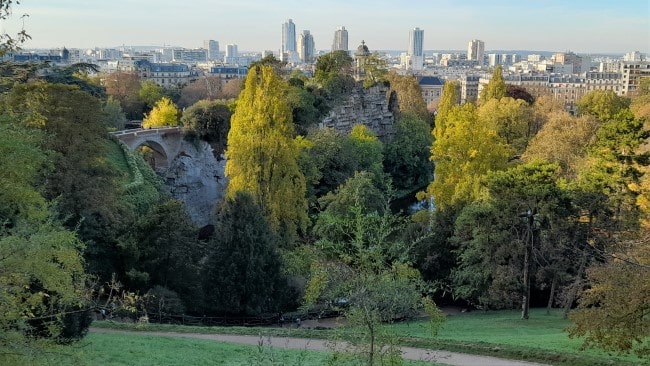
No feature on the 19th arrondissement would be complete with mentioning the Parc des Buttes Chaumont. Created in the 19th century on the site of a disused gypsum quarry, the teardrop-shaped park is a favorite with local people. Landscaped in the English style, it is genuinely hilly with large expanses of rolling grassland, a stream, lake and follies. Unfortunately a major survey is underway to assess the stability of some of the structures so the Temple de la Sibylle, for example, is closed to the public. But the views over the northern suburbs stretch to the forests in the Île de France which uplifts the soul, and there are no irate park-keepers whistling you to get off the grass. Great for children to run around and maybe paddle in the stream. There are also several restaurants in the park.
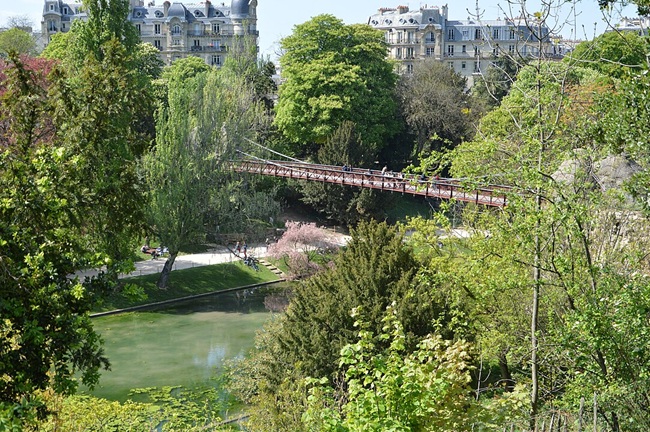
Suspended bridge in the Parc des Buttes Chaumont. Photo: Clem/ Wikimedia commons
Butte Bergeyre
If you are more of a flâneur/euse this small, hidden enclave of paved streets is a gem. You have to climb some steep flights of steps to reach it but at the top there are good views towards Sacré-Cœur and a tiny vineyard that still produces wine. There is also a community garden. The houses were built on the site of a sports stadium named after Robert Bergeyre, a national rugby player who died in World War I. Access is up the steps from Avenue Simon Bolivar to the corner of Rue George Lardennois, or from Avenue Mathurin Moreau to the bottom end of Rue Georges Lardennois – less steep but a longer walk.
If you enjoy exploring hidden lanes you might find the nearby cités of Belleville (mostly in the 19th) interesting, or the villas of La Mouzaïa.
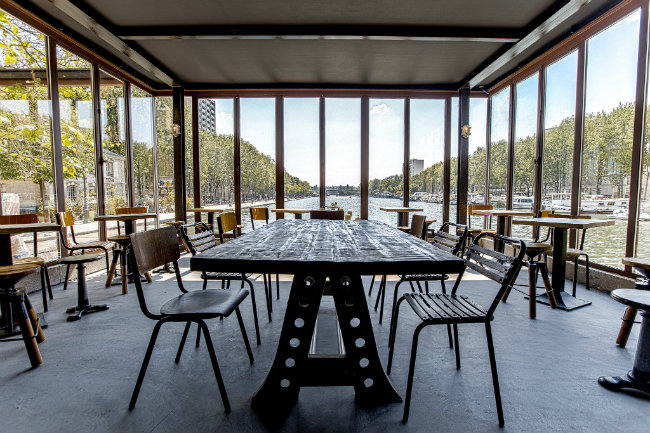
view of the Bassin de la Villette from the Paname Brewing Company. Photo: Paname Brewing Company
Places to Drink / Nightlife
Paname Brewing Company on the Bassin de la Villette has been a favorite since 2015 and has expanded its production and taphouses to other sites in Paris. Located in a former warehouse, it still develops new beers in its onsite microbrewery (you can see the mash tuns from inside the pub) and sells its own craft beer. Outside there is a patio over the water which becomes very popular in good weather.
Le Pavillon des Canaux is a quirky, multi-purpose venue next door to Paname that has become equally popular. Housed in a former canal-keeper’s cottage it is still furnished as a house, even down to being able to read or drink your cocktails in the bathtub! It holds exhibitions, concerts, and workshops, as well as being a place to eat brunch or work.
View this post on Instagram
Péniche Antipode has adopted the popular habit of converting former barges into bars and entertainment venues. Come here for a drink, a light meal, or a low-key concert. Moored on the Quai de la Seine or Quai de l’Oise of the Bassin (check – it moves according to the season), it is one of several péniches that line the Bassin and its junction with the Canal St Denis.
La Rotonde was once a tollhouse on the Farmers-General Wall – the 18th century tax wall that encircled the city’s then-boundary. Nowadays La Rotonde is a multi-use venue combining a restaurant under the luminous atrium with an adjoining bar and, for warm evenings, a large outdoor terrasse overlooking the Bassin de la Villette. An historic location to enjoy your drink. It hosts music nights several times a week.
Combat is on the other side of the 19th and named after the specific quartier of this part of the arrondissement. Under the imaginative rule of its founder, Margot Lecarpentier, in the eight years of its existence it has become one of Paris’s most innovative cocktail bars. You won’t find a classic Negroni or Manhattan here but if you like experimental cocktails using off-the-wall ingredients and unusual combinations this is the place to come.
Kissproof Belleville is a newcomer to the local drinking scene, opening in 2022 and deliberately positioning itself as an oldfashioned dive bar. As well as modern cocktails it has an extensive list of absinthes, these days a very branché drink to sip.
Places to Eat
Au Boeuf Couronné across the road from the Philharmonie dates back to the 1930s and with its menu of prime steak and other beef cuts it provides a last link with La Villette’s past as Paris’s largest slaughterhouse. The décor is modernized Art Deco, all mirrored walls, fluted pillars and red banquettes, and prices are very reasonable.
Another 19th arrondissement institution is Lao Siam in the Rue de Belleville. Celebrating its 40th anniversary in 2025, it is famous for its Thai and Laotian cuisine (no surprise given its name) and has become a fixture in Belleville’s Chinese community.
Voir cette publication sur Instagram
Soces in Rue de la Villette opened in 2021, specializing in seafood. It is a small, unpretentious bistrot; the menu is short but includes interesting dishes such as line-caught red tuna, barbecued stone bass, or white asparagus with sorrel and smoked pike’s eggs.
Further down the street, Le Cheval d’Or has become a bit of an institution serving European-Chinese fusion cuisine such as tofu-stuffed tortellini, croque-madame with prawns instead of ham, and steamed cod with ginger-braised endives.
If you don’t want a sit-down meal, then buy a picnic and sit on the banks of the Bassin de la Villette. Avenue Secrétan offers several boulangeries and greengrocers, plus a cheese shop and a Monoprix for putting together an impromptu meal.
Shopping
To be honest, no-one comes to the 19th for fancy shopping. The stores are functional, catering to the everyday needs of its residents. However, its multicultural population does mean that many of the shops sell unusual or exotic goods. If you are in Paris for an extended stay, like cooking and are open to trying something new, the alimentation générale mini supermarkets around Place Stalingrad sell yams, plantains, okra and other fruits and vegetables familiar to African and Caribbean cuisine, as well as unusual fish like tilapia. Or pick up jars of authentic sauces and condiments to take home. Many women wear traditional West African clothes and you can buy lengths of cloth or readymade dresses and headwear in bright, multicolored prints.
For coffee connoisseurs, Belleville Brûlerie on Rue Lally Tollendal was one of the original third wave coffee roasters / cafés in Paris. They started an artisanal coffee roastery in – no surprise – Belleville before upsizing to their current premises in 2017. Here they sell their signature coffees as well as all the kit to make a perfect cup and hold tastings and workshops.
Rue de la Villette near the Parc des Buttes Chaumont has some interesting independent shops, including Baan at no. 4. The name means “house” in Thai, and the shop sells an eclectic mix of East Asian-inspired homewares, furniture and clothing.
For little ones, Les Folies Douces at no.9 has cute children’s clothing and soft toys, while Le Dragon Savant further up is a fully-fledged toyshop.
Les Roussoeurs has two boutiques, one at no. 7 selling accessories and jewelry and another for clothes a few doors up the street.
Lead photo credit : The view from the Temple de la Sibylle in the Parc des Buttes-Chaumont. © Pat Hallam
More in Bassin de la Villette, Butte Bergeyre, Cité des Sciences, La Mouzaïa, Parc de la Villette, Parc des Buttes Chaumont, Paris Plages
Related Articles


By Pat Hallam
REPLY