
François Ozon Adapts Camus’ ‘The Stranger’ to Film
- SUBSCRIBE
- ALREADY SUBSCRIBED?
BECOME A BONJOUR PARIS MEMBER
Gain full access to our collection of over 5,000 articles and bring the City of Light into your life. Just 80 USD per year.
Find out why you should become a member here.
Sign in
Fill in your credentials below.
Once upon a time, two titans bestrode the intellectual landscape, in France but also in America and elsewhere: the philosopher Jean-Paul Sartre, and the handsome humanist-novelist who won the Nobel Prize at 42 and after a car accident became a martyr, Albert Camus. One was pro-Sartre or pro-Camus in the way you were either a Beatles or Stones fan. Camus is known for the moral uplift of his novel The Plague, his philosophical Myth of Sisyphus, and his agonizing over the independence war in his native Algeria. Yet he first won renown with The Stranger, a novel which like the works of Kafka is “absurd”, located in a spiritual, cosmic realm. Unlike Kafka’s fiction, it’s also “realistic”, at least on the surface.
Now François Ozon, one of France’s most distinguished directors, has adapted the classic to film. Ozon is hugely talented, and the movie is technically impeccable. Many will find it absorbing. Albert Camus it is not. If the director had tried to replicate Camus, the result would have been Classic Comics, like many great-work adaptations. So Ozon must be given credit for putting his own stamp on The Stranger. But even as on its own terms, it’s a very mixed bag.
The story is dead simple: A French-Algerian, Meursault, is informed of his mother’s death. After dealing with the sad event, he kills an Arab on a beach: in existentialist terms an acte gratuit, something done for no conventionally rational reason. He’s tried, but as in other imperial locales, no one cares about the killing of an “indigenous”. His sin is to exhibit no emotion about his mother’s death. He’s convicted not for his legal crime but for calling the basis of human society into question, and is sent to the guillotine.
Much of the novel’s meaning lies in its stripped-down style. It embodies not only the antihero’s anomie, but the harsh North African setting, and the “absurd” situation he’s going through. As in Kafka, or some mystical works, the novel obliterates the distinction between subjective and objective. Yet it’s accessible to “normal” and young readers (I read it, riveted, as a teen). Ozon’s equivalent is to shoot in black-and-white. The cinematography is gorgeous, and one can sit back and enjoy the film on that level. But gorgeous wasn’t Camus’ point.

Benjamin Voisin in The Stranger. Film still: Carole Bethuel/ Foz/ Gaumont/ Macassar Productions/ France 2 Cinema/ Scope Pictures
Ozon captures the look and feel of French Algeria at that time. But which time? When the French think of l’Algérie Française, they reflexively think of the ’50s, the period of the independence war. In fact, Camus’ novel came out in 1942. We can speculate that part of the author’s own anomie came from the colonizer suddenly become colonized — by the Nazis — though the war doesn’t figure in the novel. (Camus did join the Resistance, which contributed to his ambivalence about the Algerian National Liberation Front).
Ozon succeeds in depicting not just the tense co-existence of settlers and natives, but the strange fact of Europeans, their culture and ways, existing in such an alien environment. We see the French wearing ill-adapted clothing even in broiling weather. Meursault, brilliantly played by Benjamin Voisin, is constantly squirming under the effects of prickly, sultry heat. The incongruity feels like a dream. (There’s something similar in the fiction of Paul Bowles, who lived in North Africa for decades). Ozon serves up odd details which underline the dreamlike quality: an Arab woman who wears a fabric strip over her face because her nose has been cut off, insects filmed in close-up so that they look like grotesque creatures, the ruined faces of residents at the geriatric home where Meursault’s mother ended her days, the grief-stricken old man who maintains that he was her late-in-life fiancé.

The Stranger. Film still: Foz/ Gaumont/ Macassar Productions/ France 2 Cinema/ Scope Pictures
The weird colonial vision is the best part of the film. The acting is also mostly superb. Voisin has the impassive handsomeness, part feminine, part reptilian, of the young Christopher Walken. There was a previous adaptation of The Stranger, by the Italian Luchino Visconti. The general consensus is that the only good thing about it is Marcello Mastroianni. It’s possible the newer film will be mostly known for Voisin’s excellent performance, though he receives impressive support.
Ozon’s films often have an expansive scale and ensemble casts. Unsurprisingly, he “opens out” the narrative, with subplots featuring talented actors: Pierre Lottin is a pimp in a violent relationship with a prostitute, who precipitates Meursault’s killing of the Arab. The lovely Rebecca Marder is Meursault’s paramour, who sticks by him when he’s tried for murder. The always great Denis Lavant plays a pathetic old man whose closest companion is his dog. All these actors inhabit their characters vividly. Their subplots bring comic or sentimental relief from the claustrophobic intensity of Meursault’s ordeal. They’re also a distraction, and overshadow the protagonist.
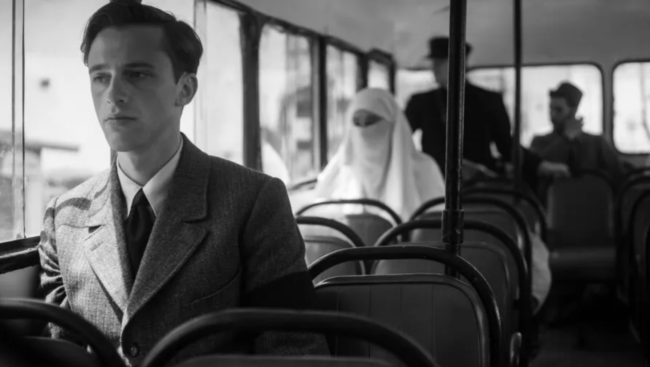
Scene from Ozon’s The Stranger. Film still: Gaumont/ Macassar Productions/ France 2 Cinema/ Scope Pictures
It takes most of the movie to get to the catalyzing event, the murder of the Arab on the beach. Instead of the acte gratuit we’re treated to a melodramatic build-up involving the pimp, his Arab prostitute, a brawl with her family-members. Ozon’s staging of the death-by-shooting makes it seem like self-defense, complicated by sun glare. This might work for viewers who haven’t read the book. For those who have; it feels like a betrayal of Camus’ vision.
Camus’ novel is not only very focused, but quite short (it’s been referred to as a novella). To create a meaty full-length feature, Ozon falls back on conventional filmmaking, chiefly the courtroom spectacle. This is overblown, and derivative as well, inspired by films like Anatomy of a Fall and The Goldman Case. Once again, it’s a distraction from Meursault.
Ozon also gives us a lengthy prison-cell tête-à-tête with a priest (Swann Arlaud). It’s meant to be a philosophical Grand Inquisitor scene, but Ozon wants to eat his existential soufflé and still have it. Meursault’s refusal of religious consolation is romanticized as heroic defiance, while the priest is depicted as an intelligent, sensitive soul — the uplifting version of Camus himself. In both cases, the banality is crushing. After a certain point I was rooting for the guillotine.
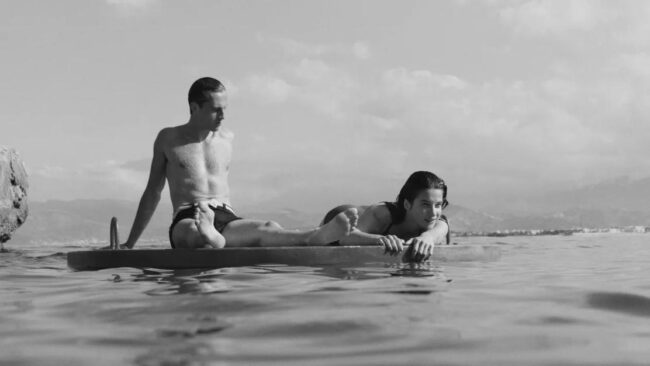
Benjamin Voisin (Meursault) and Rebecca Marder (Marie Cardona), in The Stranger. Film still: Gaumont
As if all this wasn’t enough, the director feels obliged to update his material. This isn’t new. An Algerian writer had the ingenious idea of retelling the story from the perspective of the Arab victim. (Kamel Daoud’s Meursault won the 2015 Prix Goncourt.) Ozon appropriates this by way of several add-ons: the plight of the Arab prostitute, a sign in a movie theater saying that natives aren’t allowed, the victim’s mother at his grave, a close-up of his name on the tombstone (dutifully translated into French). Some may leave the film feeling virtuous. This wasn’t my reaction. But give the film this: It makes us want to go back to the novel, and to wonder about its title. Who is the real stranger?
Production: FOZ/France 2 Cinéma/Gaumont/Lions Production/Service et Scope Pictures
Distribution: Gaumont
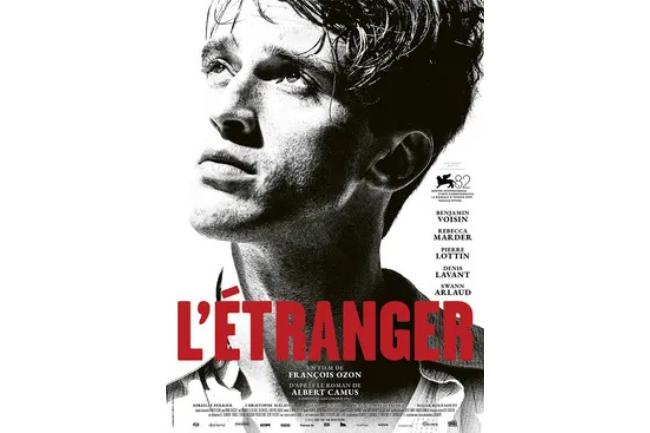
Lead photo credit : The Stranger 2025, film poster
More in Albert Camus, François Ozon, French film
Related Articles



REPLY