George Gershwin’s ‘An American in Paris’
- SUBSCRIBE
- ALREADY SUBSCRIBED?
BECOME A BONJOUR PARIS MEMBER
Gain full access to our collection of over 5,000 articles and bring the City of Light into your life. Just 80 USD per year.
Find out why you should become a member here.
Sign in
Fill in your credentials below.
The Jazz-Age composer George Gershwin personified “An American in Paris” during the spring of 1928. His short sojourn to Paris produced an ever-so recognizable orchestral arrangement, a fusion of American jazz and blues, which eventually led to a 1951 movie starring Gene Kelly and Leslie Caron. Written and first performed in 1928, An American in Paris was described by Gershwin as “a rhapsodic ballet.” It evokes the sights and energy of the French capital, embodying the vibrant cultural freedom of Paris in the 1920s.
Twelve-year-old George Gershwin had never touched the keys of a piano, until an upright was purchased for his big brother Ira. At 14, George was enrolled in formal piano lessons, and at the tender age of 15, he dropped out of school to be what was called a “song plugger” (in the pre-electronic days), promoting the sale of sheet music by playing the piano through the open windows of Tin Pan Alley.
George and Ira soon made it on to Broadway and in 1919 George had his memorable hit Swanee, popularized by Al Jolson, which sold a million copies of sheet music. In high demand, George worked non-stop, composing scores for musical reviews. With Paul Whiteman’s orchestra in 1924, Gershwin premiered Rhapsody in Blue. It became a defining classic of the American Jazz age, responsible for bringing jazz to the concert hall. Yet George still thought he needed musical respectability.
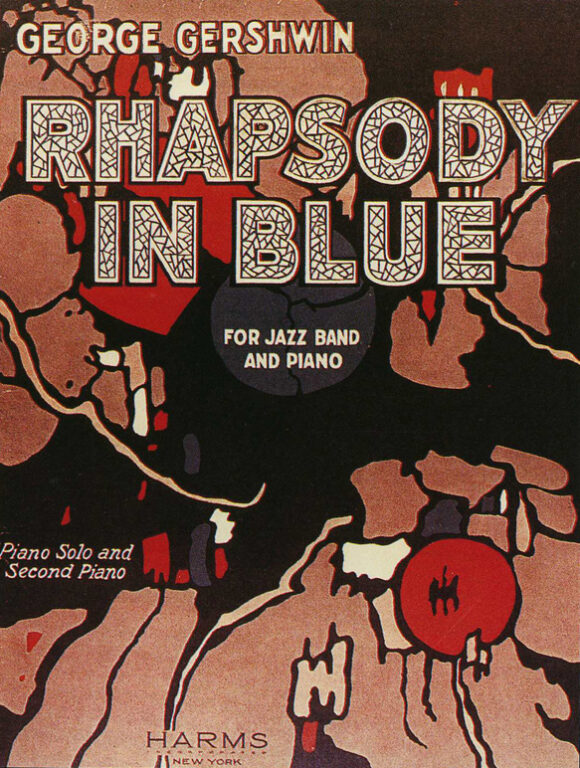
Cover of the original sheet music of Rhapsody in Blue. Public domain
Rhapsody in Blue was a massive commercial and cultural sensation in the United States following its landmark release. Victor Records sold hundreds of thousands of copies of the recording, cementing George Gershwin as a household name. Rhapsody in Blue made its first major British splash in June 1925 at London’s Savoy Hotel, followed by a notable performance at the Royal Albert Hall on April 11, 1926. During his heyday George Gershwin made annual trips to his music publisher Chappell & Co in London, however, he only visited Paris in 1926 and 1928.
In 1926, when Gershwin first ventured to Paris, he was known mostly, according to the Paris press, by France’s musical avant–garde. In these pre-radio days, Gershwin was just a novel export from America. He traveled to Paris with the hopes of studying with the famed French music teacher Nadia Boulanger, and composer Maurice Ravel. Both refused to teach him, afraid that classical instruction would ruin his natural jazz style. Ravel knew talent when he heard it, and gently rejected Gershwin’s request for lessons, telling him, “Why be a second-rate Ravel when you can be a first-rate Gershwin?”
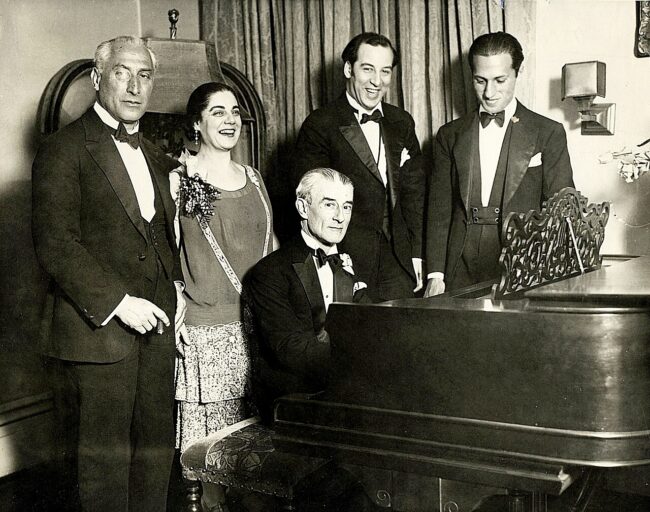
Birthday party honoring Maurice Ravel in New York City, March 8, 1928. From left: Oskar Fried; Éva Gauthier; Ravel at piano; Manoah Leide-Tedesco; and George Gershwin. Public domain
In ’26, Gershwin was the guest of Robert and Mabel Schirmer at 11 avenue Victor Hugo in the 16th arrondissement. The Schirmers were prominent New York socialites and Robert was the offspring of a venerable music publishing family. Gershwin was devoted to Mabel – with her as his guide he took in the sights and sounds of Paris. Upon his return to his apartment on Manhattan’s 103rd Street, he sent his hosts a thank you card penned with a melodic fragment marked, “Very Parisienne.”
Two years later, Gershwin began what was dubbed a “tone poem” based on those very few, very Parisienne bars. The sight of the Hudson River glimpsed from his window provided some of the necessary stimulus. He understood homesickness and the blues, and the yearning for home.
George Gershwin found inspiration when he spent a few short weeks in Paris during a broader three-month European trip, which began in March 1928. He arrived on an ocean liner called The Majestic and coincidentally stayed at the Hotel Majestic, at 19 rue Klébér. By now, the regulars in the Paris clubs were familiar with Rhapsody in Blue. Whenever he was in London or Paris, the alarm would go up, “George Gershwin’s in town” and people would clamor to meet him.
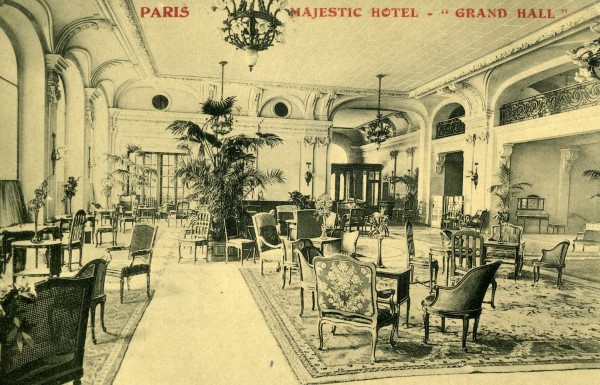
Vintage postcard of the Hotel Majestic, early 20th century
Witty, unconventionally handsome, and charming, Gershwin never felt out of place, confident of his talent, even in the highest society. Le Gaulois announced on April 12, 1928, that Gershwin was in town, hoping to connect with modern French musicians and French musicians and to learn from them. He met up with composers such as Darius Milhaud, Francis Poulenc, and once again, Ravel. However, the French maestros were just as eager to learn from Gershwin as he was with them. Some were too dazzled by Gershwin’s style and technique to even attempt to teach him fugues and counterpoint. When Gershwin approached the less-than-impressed Stravinsky, the influential Russian apocryphally asked how much Gershwin made per annum. Stravinsky then quipped that maybe their roles should be reversed, and he should study under Gershwin.
Gershwin visited Paris during Années Folles, the crazy 1920s that the so-called Lost Generation of literary American expats like Hemingway and Fitzgerald made famous. Prohibition had a vice-like grip on post-war America, and many American writers and artists found a better life in Europe. Besides being cheaper and more relaxed, there were always friends to lend a hand. However, Gershwin’s social circle centered on the music world rather than that of his “lost” literary expatriates. While in Paris absorbing the Parisian zeitgeist, he hobnobbed with a more eclectic crowd – Prokofiev, Maurice Chevalier, the gossip columnist Elsa Maxwell, and Cole Porter. His encounters with Porter culminated with Gershwin sitting at the piano for the May 10, 1928 opening of Porter’s Revue at the Café des Ambassadeurs.
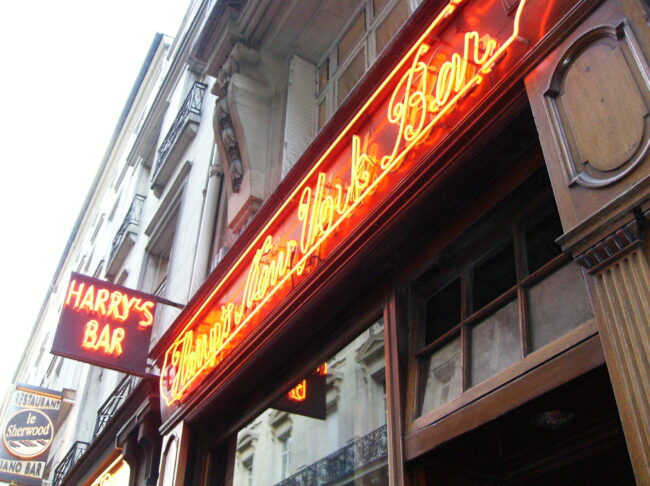
Harry’s New York Bar. Photo credit: Drhaggis / Wikimedia commons
A Paris story needs some romance and it is rumored that the 29-year-old Gershwin often had the elegant Countess Nadége de Ganay on his arm for a few short weeks.
Another unsubstantiated rumor is that Gershwin partially composed an American in Paris at the piano in Harry’s New York Bar. Apparently, Harry’s customers did not like it, and prayed that Harry would soon engage the services of a piano tuner! This snippet, however, was not covered in the press, not even by gossip columnists!
Gershwin explained his true motives in the respected journal Musical America, “My purpose here is to portray the impressions of an American visitor in Paris as he strolls about the city, listens to the various street noises, and absorbs the French atmosphere.”
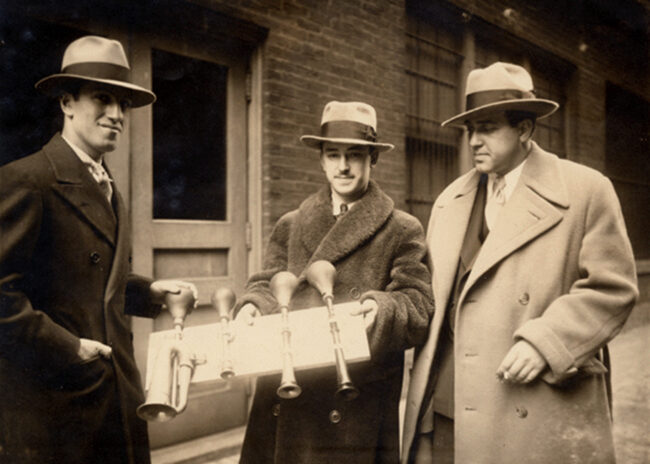
Composer George Gershwin, percussionist James Rosenberg and tenor Richard Crooks with the taxi horns. Photo credit: Ira and Leonore Gershwin Trusts
Part of Gershwin’s Paris memories were the sound of the taxi horns. Although they seem New Yorkaise to my ears, they made a big impression on Gershwin who went on a hunt for them while he was in town. Meeting up again with his buddies the Schirmers, Gershwin and the bilingual Mabel, went shopping along the Avenue de la Grande Armée, then the locus for auto parts shops, where the exacting Gershwin shopped for horns of exactly the right tone. He brought about 20 of them back to his hotel suite, and piled them on top of his Steinway grand.
A reporter covering the French beat for the Chicago Tribune said that, “on a table covered with volumes of theory and harmony, counterpoint and composition,” he saw at least a dozen various kinds of taxi horns. “Oh” Gershwin said, “you’re looking at these horns. Well in the opening section of An American in Paris I would like to get the traffic sound of the Place de la Concorde during the rush hour.” He played the piece for his visitors and got them to quack! quack! on the horns at precisely the right time. They found that Gershwin “captured the atmosphere, the feeling, the movement, the rhythm so perfectly.”
The program notes written by the esteemed music critic Deems Taylor for the premiere of George Gershwin’s An American in Paris at Carnegie Hall, on December 13, 1928, explain more fully what Gershwin tried to express in his music. Paraphrasing Deems Taylor’s words, Gershwin wants us to imagine an American visiting Paris, swinging down the Champs Elysées on a sunny spring morning. At full speed ahead, he conveys an impression of Gallic freedom and gaiety. He notes with pleasure the sounds of the city. Violins, horns and xylophones, imitate the traffic – he’s amused by the sound of the taxicabs. He walks past the open door of a café, where the trombones play a melody representing homesickness, and our flâneur gets the blues. The foreigner sinks lower, but is rescued by a stanza “reminiscent of the Charleston,” says Deems Taylor, announced by a pair of upbeat, jumpy, trumpets. Perhaps he meets a compatriot. As various motifs are recapped, the American obviously decides to enjoy Paris with its inherent noisy, honking boulevards, and the music of the can-can. The orchestra’s riotous finale proves our protagonist decides to make a night of it.
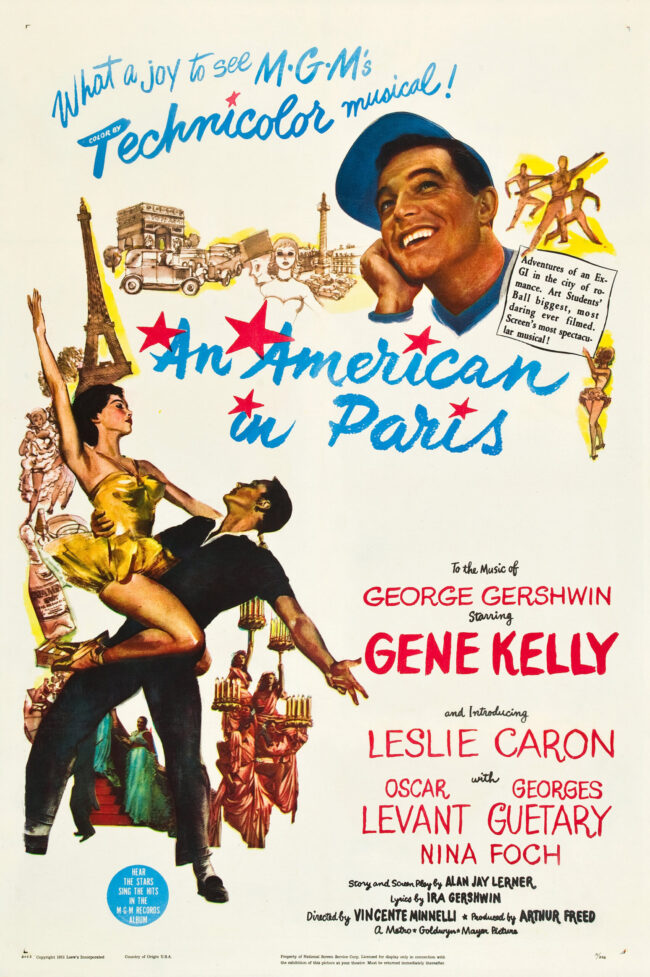
“An American in Paris” movie poster, 1951. Public domain
The Hollywood movie, An American in Paris, covered all the bases described above. Gene Kelly, portraying an American visitor in Paris, strolls about the city, listening to the various street noises, and absorbing the French atmosphere, except this time the American falls in love with a French girl played by Leslie Caron. The film directed by Vincent Minelli (Mr. Judy Garland) won the best picture Oscar of 1951. Every note and melody originated from George Gershwin and his lyricist brother Ira. The film featured a 17-minute ballet sequence, with sets and costumes referencing French painters including Raoul Dufy, Renoir, Maurice Utrillo, Henri Rousseau, and Toulouse Lautrec.
I’m sure George Gershwin would have loved it had he seen it. Unfortunately, Gershwin unexpectedly died from a brain tumor in July of 1937. It is said that Gershwin’s early death, and the end of his potential, was the biggest tragedy in 20th-century music.
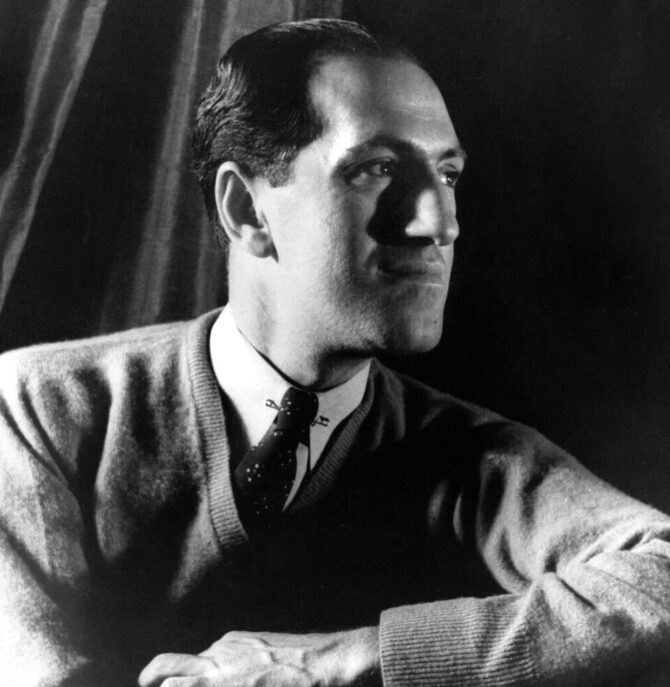
Lead photo credit : Gershwin in 1937. Photo credit: Carl Van Vechten - Library of Congress- public domain.
Related Articles