
Passage du Caire: Paris’s Oldest Covered Passageway

- SUBSCRIBE
- ALREADY SUBSCRIBED?
BECOME A BONJOUR PARIS MEMBER
Gain full access to our collection of over 5,000 articles and bring the City of Light into your life. Just 80 USD per year.
Find out why you should become a member here.
Sign in
Fill in your credentials below.
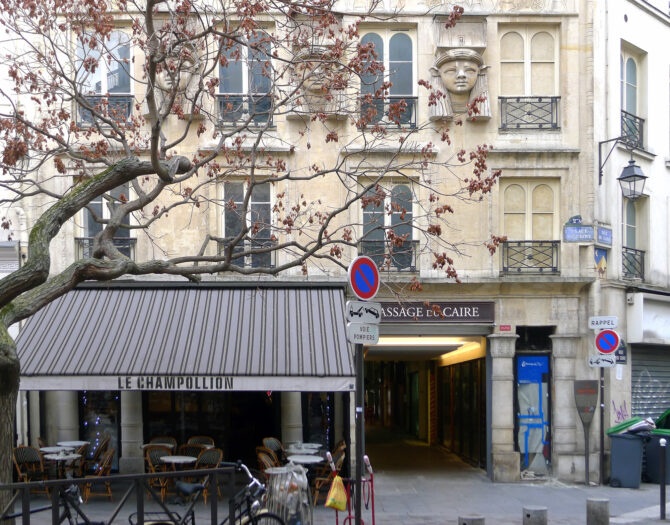
Opened in 1798, the Passage du Caire has witnessed the rich history of Paris’s 2nd arrondissement, one of the oldest neighborhoods in the city. Besides being the first of the city’s many covered passages, the Passage du Caire is unique in that it’s an industrial and residential hub, rather than a more touristy spot.
Covered passages are sprinkled throughout the city, with a large collection centralized in the 1st, 2nd, 9th and 10th arrondissements. The Passage du Caire, which is the oldest, longest, and narrowest passageway in Paris, boasts various wings and entrances which lead to what feel like different worlds — from the quiet Rue du Caire to the bustling Rue Saint-Denis. While it’s not as charming as the Passage du Grand Cerf or Galerie Vivienne, for example, the Passage du Caire is often calm and empty, providing a welcome escape from the more popular passageways dotted with coffee shops, boutiques, and tourists.
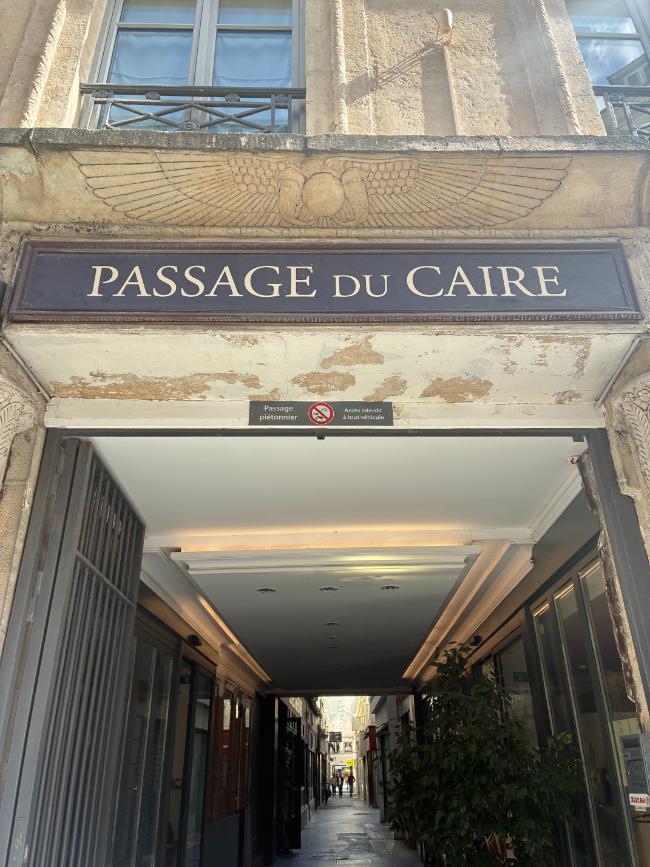
Passage du Caire. Photo: Jill Amari
The lack of restaurants and stores is a main factor which contributes to the peace and quiet of the Passage du Caire. In addition, some people live or have office spaces in the passage, so it has more of a residential feel. In the classic Parisian style, apartments and lofts are located on the first and second floors, with shops and offices on ground level and caves underground.
The influence of Egypt on the 2nd arrondissement can’t be ignored. Much of the names are a nod to Napoleon’s expedition in Egypt; he entered Cairo in 1798, and “Egyptomania” then spread throughout France. In the 2nd, beyond the spots named for Cairo, you’ll find streets like the Rue d’Alexandrie (Alexandria), Rue du Nil (Nile), and Rue Damiette (Damietta).
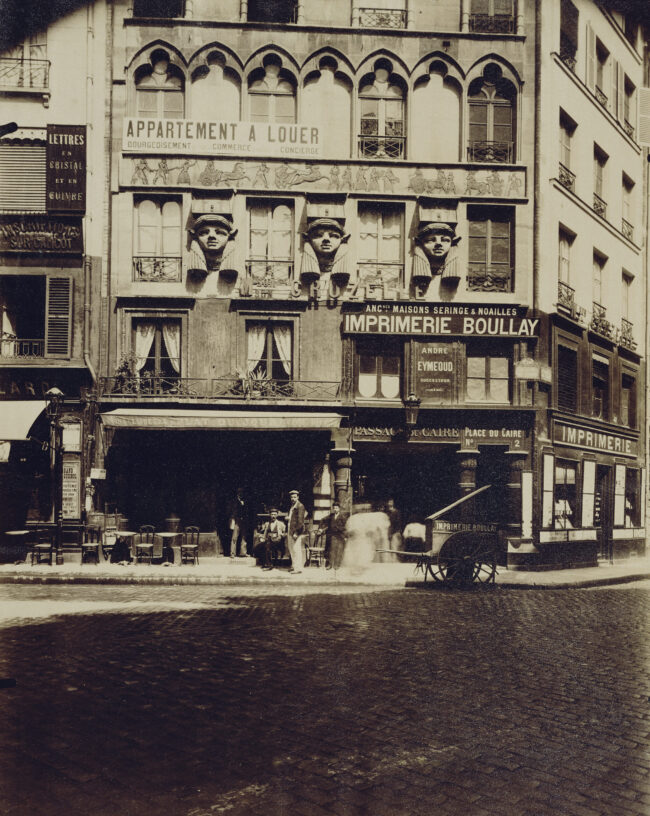
Eugène Atget, House on the Place du Caire. Getty Museum, Public Domain
Over the centuries, the industrial focus of the Passage du Caire — and the Sentier neighborhood where it was built — has changed considerably. This area was developed during the Middle Ages, around the ramparts of Charles V’s wall (built between 1356 and 1383). Up until the mid-17th century, Sentier was known for its gardens and convents. After the wall was demolished, a new neighborhood was formed, leading to the Sentier we know today. Its history spans the printing and lithography industries, followed by the textile industry in the 1900s. While the textile industry has largely moved out of the 2nd arrondissement, its influence still dominates the Passage du Caire: showrooms feature mannequins in their windows, displaying the latest designs, and tailoring workshops dot the alleyways. It’s worth a visit to see how this passageway has remained authentic to its origins as an artisanal and industrial center.
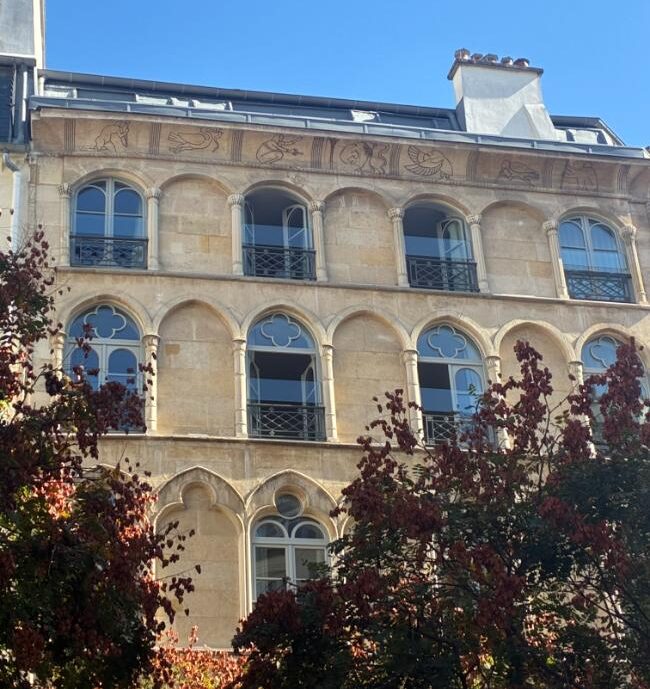
Hieroglyphs visible at the top of the building. Photo: Jill Amari
Modern additions have increased the popularity of the Passage du Caire while remaining true to its roots. For instance, the passage connects to two hotels, Hotel Edgar & Achille and Hotel du Sentier. Both hotels feature restaurants, with Edgar & Achille offering a wide selection of seafood and Sentier proposing a typical French menu. Some hotel rooms even boast views of the passage’s glass canopy, as well as the Place du Caire and surrounding area. The Hotel du Sentier also features Egyptian-style engravings on the façade of the building, including the goddess Hathor and various hieroglyphs.
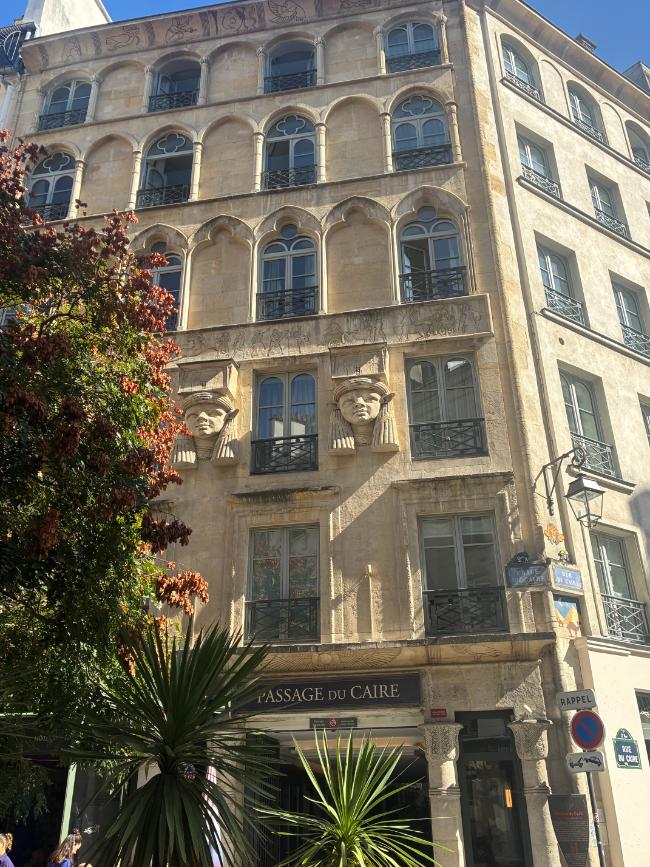
The goddess Hathor, outside the Passage du Caire. Photo: Jill Amari
The Passage du Caire not only provides a lesson in history, but it’s also located in a great neighborhood, with plenty of restaurants, shops, and sights nearby (the Louvre, Picasso museum, Pompidou Center, and Opéra are all about a 20-minute walk away). While you’re in the area, consider stopping by:
- Oasis d’Aboukir, a giant wall of green
- Street artist Combo’s mural featuring Tintin and Captain Haddock, in support of LGBTQ+ rights
- Librairie Petite Égypte, a bookstore which follows the Egyptian theme of the neighborhood
- Rue du Nil, where you can find organic foods and produce, as well as the Michelin-starred restaurant Frenchie
- Portes Saint-Denis and Saint-Martin
- Other nearby covered passageways, such as the Passage du Grand-Cerf, Passage du Ponceau, Passage de Choiseul, Passage Jouffroy, Passage des Panoramas, and Galerie Vivienne
If you’re looking to escape the hustle and bustle of Paris life while remaining centrally located, the Passage du Caire and Sentier neighborhood are the perfect place to unwind and stroll around.
Additional reading:
https://www.lhistoire.fr/visite-historique-du-sentier-%C3%A0-paris
https://lesdecouvertesdefab.com/2019/06/21/paris-insolite-visiter-les-passages-couverts/
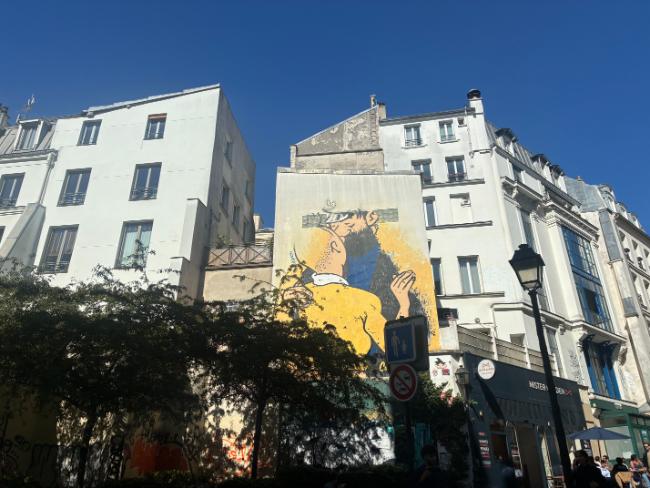
Tintin street art. Photo: Jill Amari
Lead photo credit : Entrance to the Passage du Caire. Photo: Mbzt / Wikimedia commons
More in ancient Egypt, covered passages, Napoleon, Paris passages, Sentier
Related Articles


By Jill Amari